
Note: This website was automatically translated, so some terms or nuances may not be completely accurate.
 dentsu × Riot Games Conference 2023 Report [1/2]
Why is Generation Z so passionate about esports?

Fujimoto Yasushi
Riot Games LLC

Baro Hyun
LunaTone Inc.
Esports is currently experiencing a global surge in popularity. Market size and audience numbers are steadily increasing, and this momentum is particularly pronounced in Japan. In June 2023, the world championship for "VALORANT," a flagship esports title, was held in Japan for the first time and was a huge success.
At the heart of this fervor is Generation Z.
This article provides a thorough explanation, covering the current state of esports in Japan, why Generation Z is so passionate about esports, and how companies can leverage marketing targeting this generation. Insights are shared by Yasushi Fujimoto, President/CEO of Riot Games Japan, a leading esports company, and Baro Hyun, CEO of LunaTone Inc., which handles numerous digital content-related businesses including games and esports.
※This article is edited and compiled based on a session held at the dentsu×Riot Games conference on June 8.
About Riot Games...
Founded in the U.S. in 2006, Riot Games aims to develop, publish, and provide player support for games that are the most player-focused in the world. It develops and operates games that represent esports, including "League of Legends," the most played PC game globally, and the competitive title "VALORANT." It also hosts global tournaments, serving as a major driving force behind the explosive growth of esports.
The Globally Expanding Esports Market
Hyun Baro: Let me briefly explain how much esports has expanded, based on the current situation.
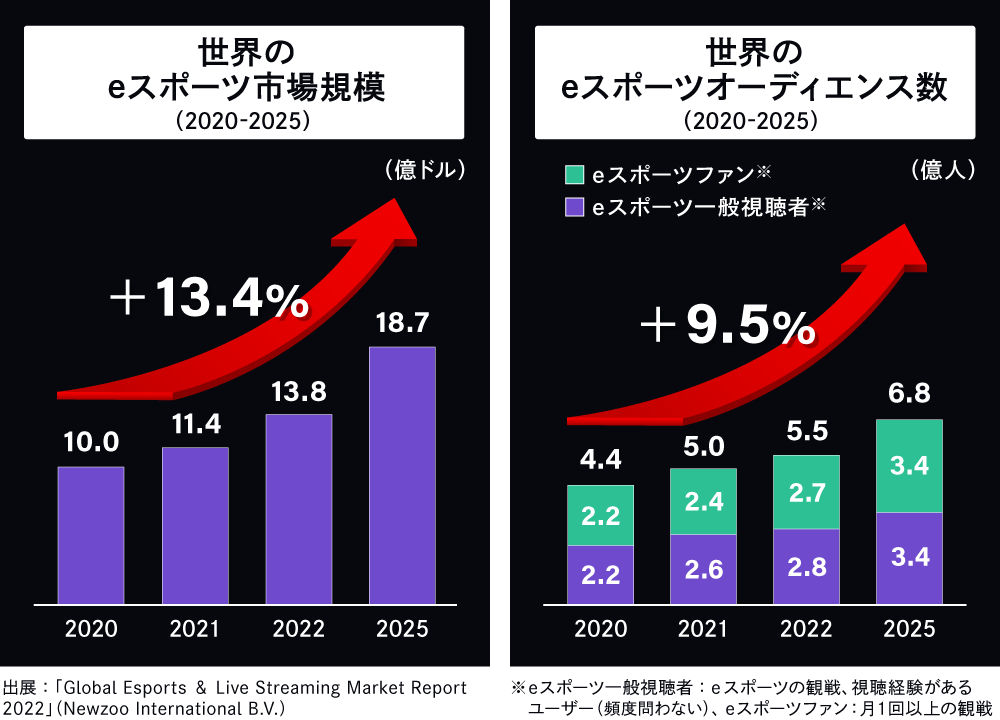
The global esports market reached $1.38 billion in 2022. It was $1.14 billion in 2021, growing at an average rate of 13.4% over the past five years. It is projected to expand further to a $1.87 billion market by 2025. The audience size is also growing significantly, surpassing 400 million in 2020. It is expected to grow to nearly 700 million by 2025.
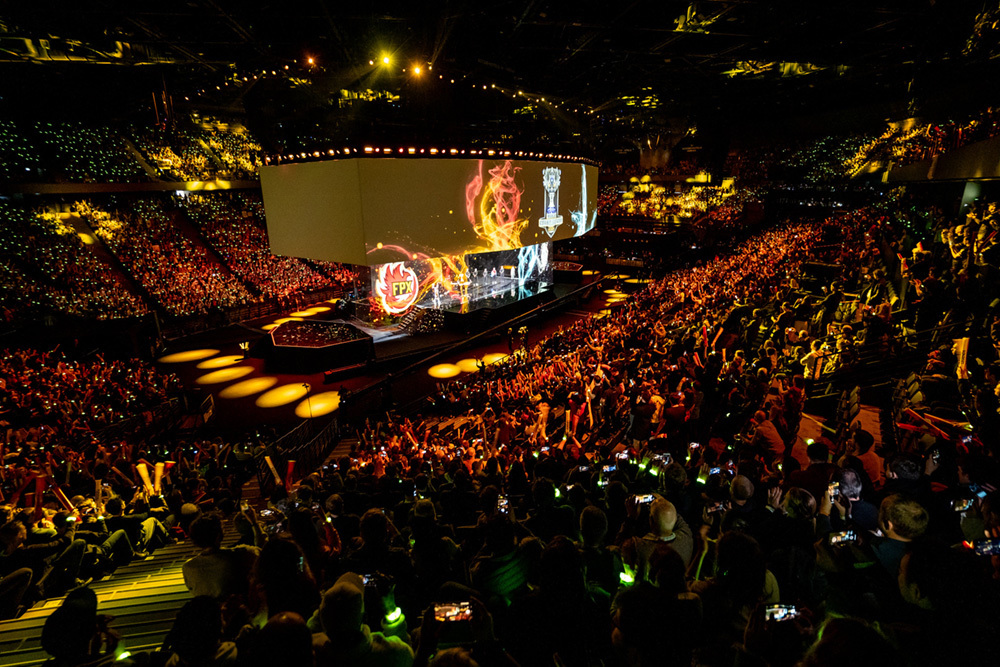
Fujimoto: At the 2021 League of Legends World Championship hosted by Riot Games, the peak concurrent viewership worldwide reached 73.9 million. Since this is based on individual displays, the total number of viewers, including those at public viewings, is estimated to have exceeded 100 million.
Major companies like Louis Vuitton, Mastercard, and Red Bull also sponsored and supported this tournament. Sponsorship isn't just about logo exposure. For example, Louis Vuitton created a custom monogrammed case for the championship trophy and incorporated monogram designs into character skins within the game. They're taking sponsorship a step further, leveraging the unique characteristics of esports to deepen engagement with fans.
Japan moves toward "Esports 2.0." A turning point toward entertainment
Fujimoto: What about the situation in Japan?
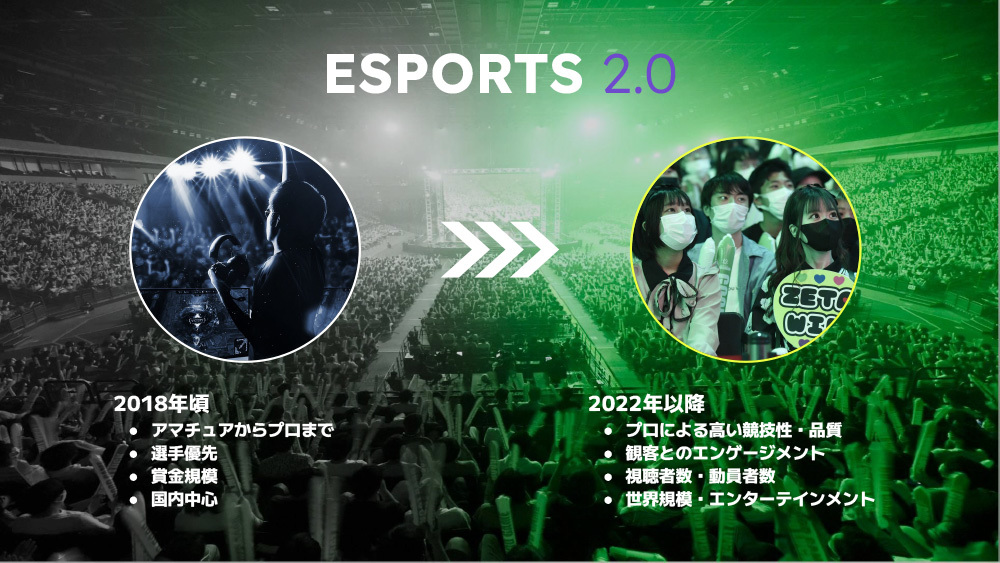
Esports in Japan is currently undergoing a period of evolution, marking the beginning of what we can call "Esports 2.0."
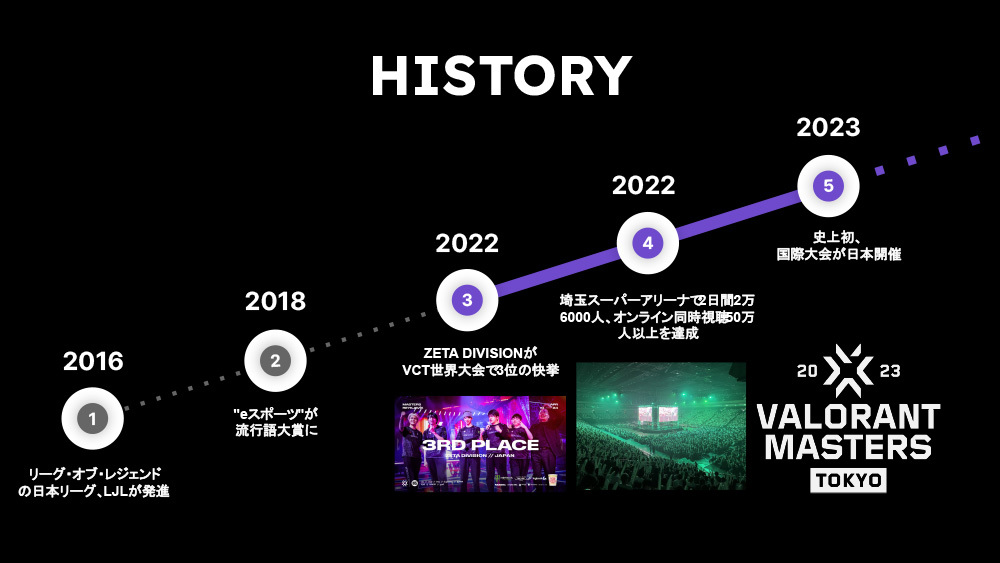
Fujimoto: Globally, esports started gaining attention in the 1990s, but Japan lagged behind. I think it really caught attention here when it was selected for the Buzzword of the Year award in 2018. Back then, the conversation mostly revolved around topics like: Japan has pro players, huge tournaments are being held worldwide, and prize pools reaching tens of millions.
These were, you could say, the organizers' perspective. The context discussed in Japan back then had a significant gap compared to the global context, where esports was established as entertainment to delight audiences.
The turning point that changed Japanese esports came in 2022. It was when the Japanese team ZETA DIVISION achieved the remarkable feat of placing third in the world at the global championship for "VALORANT," a team-based FPS(※1) esports title representing esports. To put it in soccer terms, placing third in the world is comparable to advancing to the knockout stage of the World Cup and then winning further matches.
※1= FPS (First-Person Shooter). A genre of shooting games characterized by moving through the game world from the character's own perspective and engaging in combat using weapons or bare hands.
What happened at that time was that the excitement on social media far surpassed that in traditional media. ZETA DIVISION reached number one on Twitter's (Editor's note: the name at the time) global trends. I believe this shows that a larger audience than publicly recognized was cheering them on, getting excited about this achievement, and creating a movement powerful enough to reach number one worldwide.
Hyun Baro: The excitement in Japan was also reflected in the viewership numbers. According to our research, despite the Japanese stream starting at 5 AM, approximately 40% of the global concurrent viewers were from Japan.
Fujimoto: Responding to this excitement, we as providers considered what we could do and held the finals of the domestic "VALORANT" tournament at Saitama Super Arena. Over 26,000 attendees came over two days. I believe this attendance figure compares favorably even to music concerts and other sporting events. Even people who didn't play the title came to see the event. I believe the success of this event rewrote the history of Japan's esports market.
Furthermore, in June 2023, the VALORANT World Championship will be held in Japan for the very first time. This is truly monumental, like a seismic shift. For countless fans, this is something they've long awaited, and I believe it marks a moment where history changes. (Editor's note: The VALORANT World Championship, "VCT 2023 Masters Tokyo," recorded over 37,000 total attendees over 12 days.)
Compared to around 2018, when Japanese esports was primarily discussed from the organizers' perspective, the landscape has dramatically changed over the two years from 2022 to 2023. Players are now competing on the global stage, and esports is beginning to blossom as an entertainment form enjoyed by large audiences, just like anywhere else in the world.
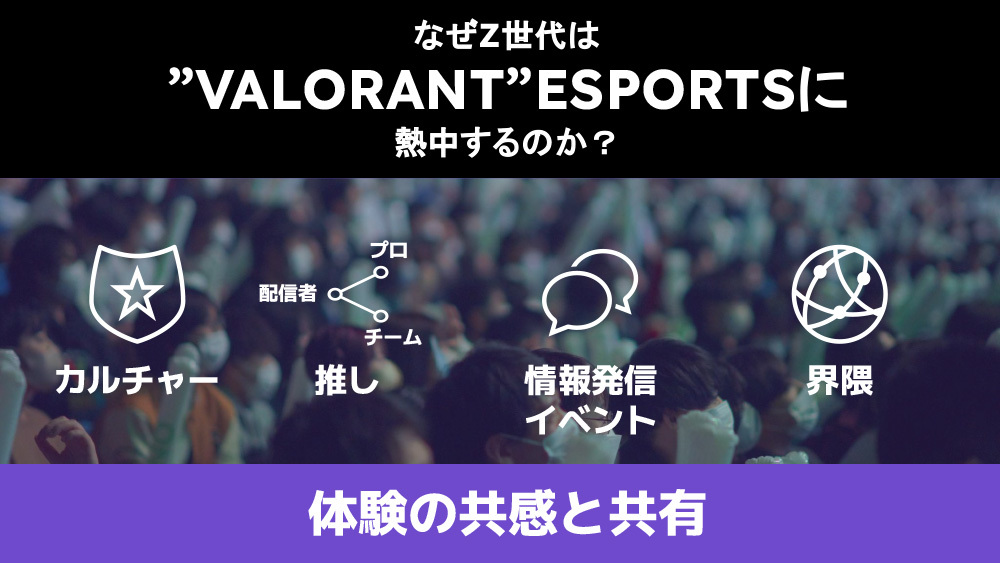
The key to Gen Z's enthusiasm lies in the "shared experience and connection" that unites the community.
Fujimoto: So, who is this audience? Over 70% are Gen Z. Why is esports so popular with Gen Z?
From the player perspective, the players themselves are predominantly Gen Z. This makes it easier for Gen Z to feel a connection and root for them. Incidentally, while most players are male, many female spectators attend events. They create fans (uchiwa) and the so-called "favorite player" culture has emerged in esports too. This is a uniquely Japanese cheering culture not seen in overseas esports.
Furthermore, considering Generation Z's characteristics, esports has a high affinity with them. One common trait of Generation Z is that they gather information primarily through social media and video-sharing services. They access information through communication channels that are highly compatible with gaming. The fact that the most-watched videos on YouTube are gaming channels also hints at this affinity.
Furthermore, it's said that the level of engagement with a subject varies dramatically depending on whether they are interested or not. The "favorite" culture mentioned earlier also demonstrates the depth of engagement they have with things they are interested in. The areas where they develop a sense of belonging, thinking "This is where I belong," are often described as "communities." This concept of "communities" is crucial: Generation Z shows profound interest in these communities, actively communicates within them, and spares no time or money investing in their "favorites" within them. Recently, the term "community consumption" (※2) has also emerged.
※2 = "Community-based consumption" refers to Gen Z's consumption behavior. Rather than following uniform trends, they prefer and find value in things that are popular within their specific community ("trending in the XX community") or strongly supported by that community.
In eSports, not only players and teams but also streamers and casters are supported as "favorites." The rise of eSports in Japan can be said to have been built by fans, players, teams, streamers, casters, and others forming a single "community." It's likely that this "community," through tournaments, achieved shared and resonant experiences—whether real or virtual—that sparked the fervor from Generation Z.
Can Companies Enter Generation Z's "Community"?
Fujimoto: In marketing terms, Gen Z is often described as a hard-to-reach, elusive generation. It's true that offering stereotypical, one-size-fits-all values won't resonate with them. What matters more is whether the company is present within their "community." If a company is perceived as being part of the community that interests them, engagement deepens as they see it as one of their own.
One example: At last year's offline Christmas event "Riot Games ONE," we collaborated with United Arrows to create original apparel products. United Arrows faced the challenge of an aging customer base and difficulty reaching Gen Z. Yet, when we sold these original apparel items, nearly all products sold out immediately. I believe this happened because the products were perceived as belonging to their own "scene," driving action.
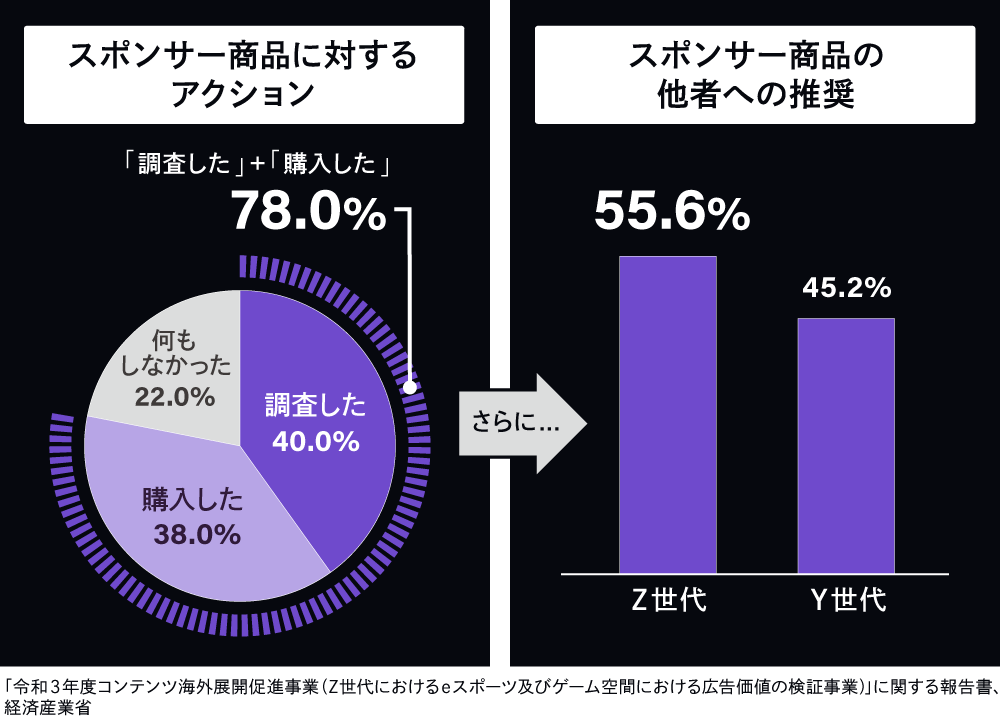
Hyun Baro: Survey data also shows this trend. Among Gen Z who watched esports, about 80% reported taking action toward sponsor products. Another interesting finding is that Gen Z is more likely than other generations to recommend sponsor products to others. This shows that when something is perceived as belonging to their favorite "scene," it leads to the action of recommending it to others.
Esports is growing as a content industry
Hyun Baro: Esports is gaining attention not only for its usefulness in corporate marketing activities but also as a standalone content industry recognized by the government.
According to a report published by the Ministry of Economy, Trade and Industry (METI) (※3), its growth potential is multifaceted. This includes core aspects like tickets and merchandise, regional revitalization through locally-hosted tournaments, player development, and the social significance of promoting Cool Japan internationally. Beyond the global market expansion mentioned earlier, significant market growth is also anticipated within Japan.
※3=Ministry of Economy, Trade and Industry report "Toward the Development of Japanese eSports: From the Perspectives of Further Market Growth and Social Significance" https://www.meti.go.jp/meti_lib/report/2019FY/030486.pdf
Furthermore, as esports increasingly becomes entertainment enjoyed by a large audience, I believe it will grow even more as various sponsoring companies become involved, just as they do globally.
Fujimoto: And above all, it's the power of the fans, especially those from Generation Z. The sense of unity and excitement in the venue the moment we announced the world championship would be held in Japan left a strong impression on me. It was a moment where I saw a kind of nationalism, where fans, streamers, casters, and everyone in the community came together to support Japanese eSports. I believe this shared experience and value will become a powerful driving force, propelling Japanese eSports to the next stage.
Click the image to watch the video.

Was this article helpful?
Share this article


Newsletter registration is here
We select and publish important news every day
For inquiries about this article
Author
Fujimoto Yasushi
Riot Games LLC
President/CEO
Baro Hyun
LunaTone Inc.
CEO