
Note: This website was automatically translated, so some terms or nuances may not be completely accurate.
 UX: The Revolution That's Right Before Our Eyes [2/7]
Consumer-Driven Revolution

Tsuyoshi Mizukawa
 Due to changes in the world's environment, consumers have become the primary source of information dissemination, forcing companies to prioritize UX (user experience).
If there has been one major environmental shift in how companies communicate with consumers, it undoubtedly began with the advent of the internet and continues today with the rise of communication tools like smartphones and tablets.
These changes provide ample reason for companies to prioritize UX.
Consumers are actively seeking ways to handle information more conveniently, comfortably, and ideally at lower cost. Faster, cheaper, and more convenient.
As a result, technological advancement has dramatically shifted consumers' mindset toward information from "passive" to "active." Many businesspeople and companies might dismiss this shift in consumer awareness as simply "the way things are."
This is a colossal mistake. It's no exaggeration to say a user-driven revolution—a UX revolution—has occurred for consumers.
User experience has always existed, but it was a result-oriented (passive) experience felt after receiving products or services from companies. The UX revolution we're talking about here, however, is user-driven, not company-driven. It encompasses a cycle where companies incorporate this user-driven experience into their products and services, then feed it back to the users.
In other words, UX is a counter-cycle revolution, not a company-driven one. Therefore, whether companies and businesspeople consciously treat UX as a counter-cycle revolution and strive to transform their own businesses, or merely make token adjustments to accommodate the newly dominant smartphones and tablets, will lead to entirely different futures.
Consider what it means for consumers to increasingly demand faster, cheaper, and more convenient experiences.
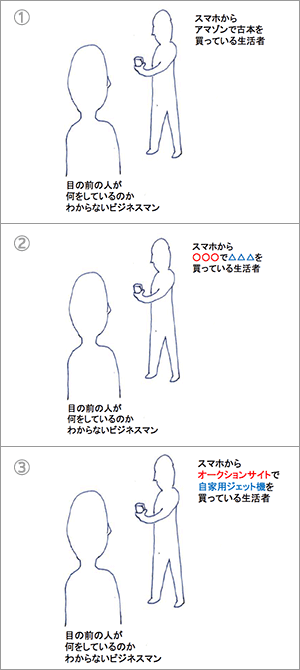
The first example that comes to mind is buying books from the online retailer Amazon. I've always loved books, and when Amazon first appeared, I actually bought more books than before. While the convenience was welcome, the expense of books was a headache. However, as you know, Amazon later started selling used books. I was honestly surprised. Traditionally, it was unthinkable for a bookstore selling new books to also sell used ones. I couldn't hide my astonishment at an interface offering both simultaneously. A landscape I'd never seen before had appeared. That's what I thought.
Amazon's business has evolved further, expanding beyond books to offer a wide range of merchandise. Above all, it continues to advance its e-book service through the Kindle device.
While this is just one example in the book industry, when such speed, low cost, and convenience become the norm in daily life, companies unable to provide that level of service risk being left behind.
Amazon has already established the aforementioned infrastructure, solidifying its position as a platform for selling not just books but virtually anything, and it continues to evolve. Companies unable to reach that level might find it wiser to consider supplying their products to Amazon rather than building their own platform. However, that platform will also host other competing companies.
As a consumer, Amazon is undeniably appealing. But for businesses, the question becomes how to navigate this space while sharing the platform with rivals.
Human consciousness adapts and changes rapidly with technological advancement, but the collective consciousness of a company, being a group of individuals, does not shift as quickly. Taking action based on that consciousness is even more challenging.
Amazon, while a corporation, could be considered a UX company that swiftly incorporates individual awareness.
From a UX perspective, awareness and action occur almost simultaneously. For companies, the critical challenge is how quickly they can provide satisfying services to consumers whose awareness shifts rapidly, and how they can continuously evolve those services. Real-time observation of consumer reactions and immediate adjustments will become essential.
Key Takeaway:
For companies to survive, they must align their products and services with this counter-cycle: the consumer-centric revolution.
Was this article helpful?
Share this article


Newsletter registration is here
We select and publish important news every day
For inquiries about this article
Back Numbers

Author