Note: This website was automatically translated, so some terms or nuances may not be completely accurate.
 HR for Growth: A Human Resources Strategy to Accelerate Business Growth [2/3]
Why a "Culture of Transformation" is Essential for Business Growth
"Companies and businesses created in the Showa era retain their past successes and still generate reasonable profits today. But they don't lead to significant growth—"
This statement was made by Toshihiro Mibe, President of Honda Motor Co., Ltd., at the International CES (Consumer Electronics Show) held in Las Vegas this January.
Today, disruptors are emerging across all industries, threatening the growth of established companies and fundamentally reshaping market structures. Companies might survive using their old methods, but they must be prepared not only for growth to stall but also for potential contraction. This seems to be the view shared by many executives, not just President Toshihiro Mibe.
※ = Disruptor
Companies that disrupt existing industry business models and markets, achieving rapid growth
Furthermore, they believe one key to achieving significant growth lies in updating the "corporate culture." At Dentsu Inc., we are also working to update our corporate culture under the slogans "Integrated Growth Partner" and "Integrity," and of course, we continue to pursue further updates.
In this article, Masashi Koyama from Dentsu Inc.'s BX Design Bureau, who leads the "HR for Growth" support program for realizing human capital management and business growth, explains what updating "corporate culture" entails for corporate transformation and how to achieve it.
<Table of Contents>
▼Why is updating corporate culture necessary for "transformation"?
▼What is a "transformation-ready corporate culture"?
▼How to update corporate culture
▼An approach supporting employees' autonomous actions
▼The key lies with the "middle management" layer
Why is updating corporate culture necessary for "transformation"?
Why is updating corporate culture necessary to drive transformation?
Consider smartphones. The phone itself is essentially a "box." Within it resides the foundational OS, and it's the various applications running on top of this OS that allow us to enjoy the convenience of smartphones.
It's well known that if the OS isn't up to date, various applications—even if they themselves are the latest versions—cannot perform optimally. In some cases, apps simply won't run on an outdated OS. That's why smartphones constantly update to the latest OS.
The "corporate culture" discussed in this article can be thought of as the "company's OS." To drive transformation within a company, updating the corporate culture is actually necessary before designing and executing growth strategies. Management guru Peter Drucker famously stated, "Culture eats strategy for breakfast" ( ). This quote perfectly illustrates that updating the corporate culture (the OS) must precede updating strategy (the applications).
What is a "transformation-ready corporate culture"?
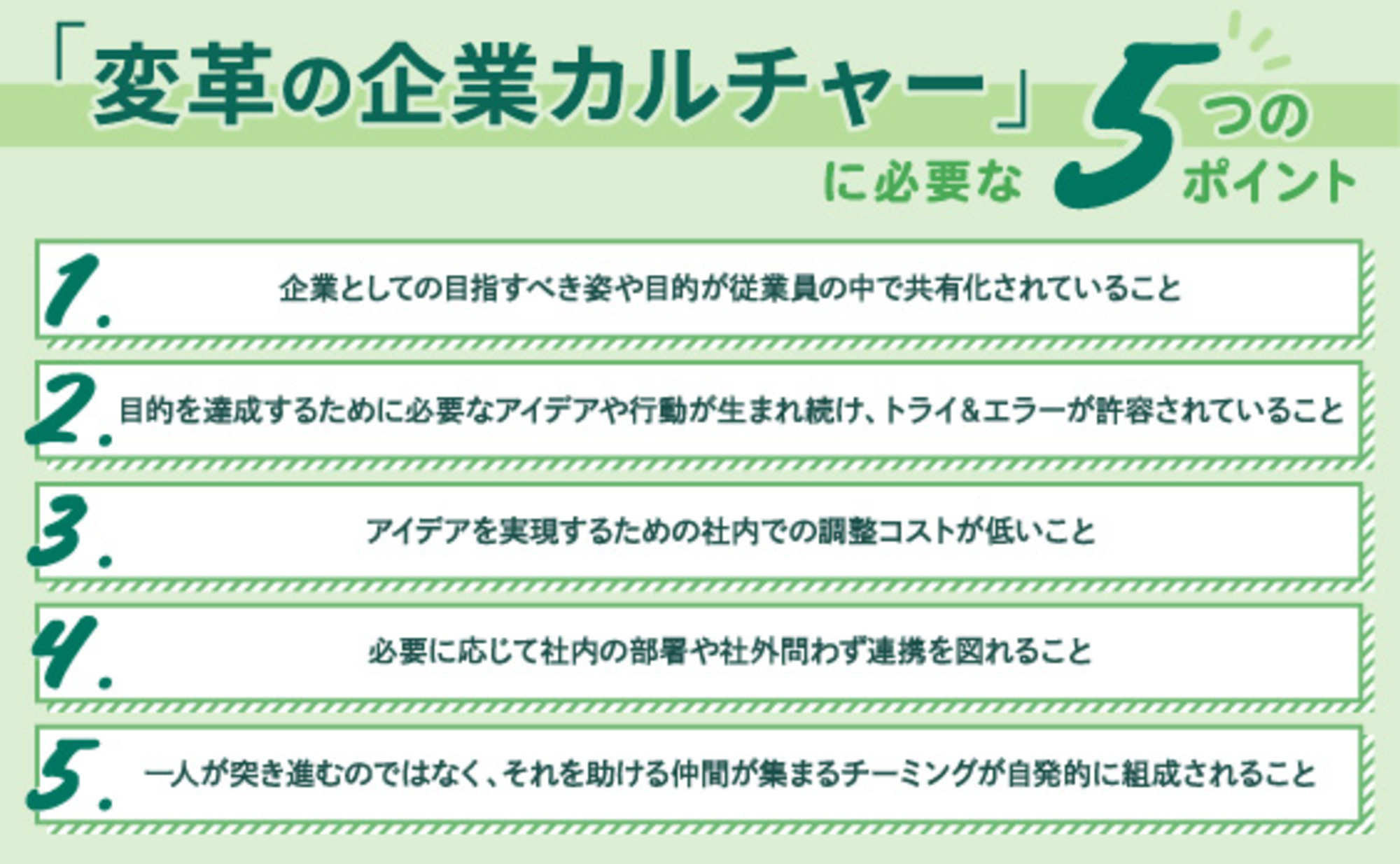
So, what exactly is a transformative corporate culture? The fundamental elements include the following five points.
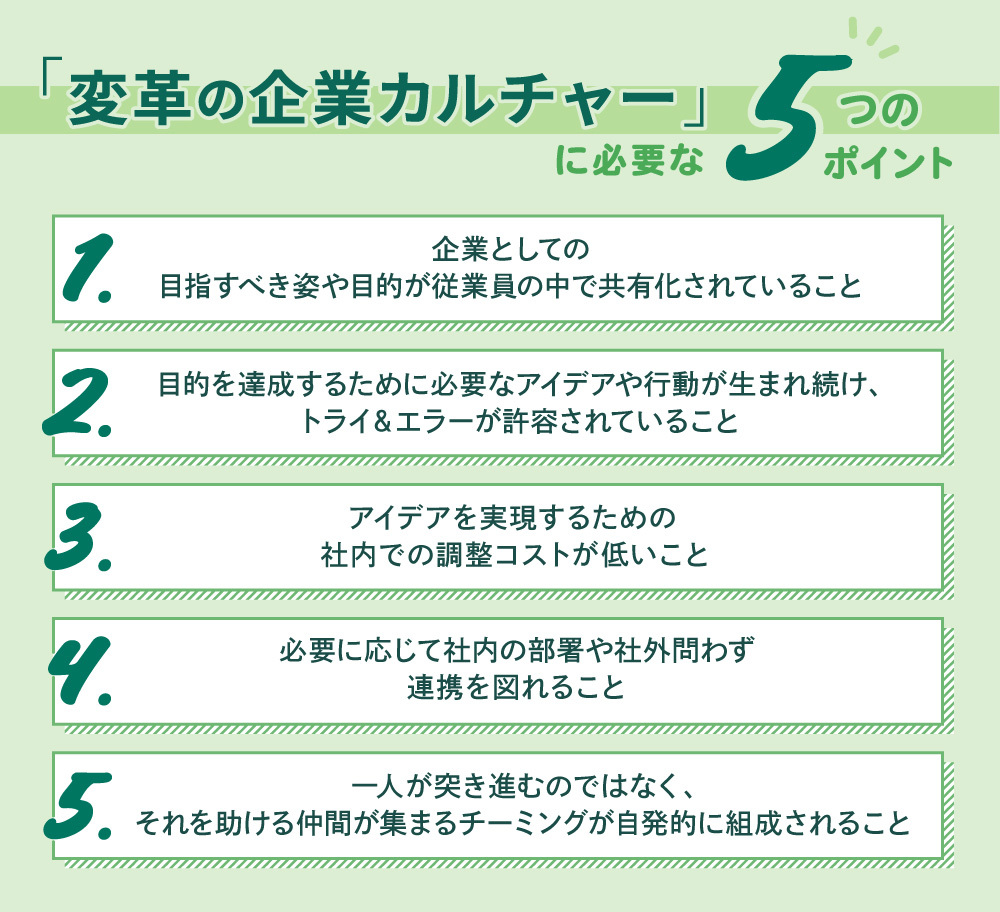
Toyota Motor Corporation's Chairman Akio Toyoda champions the purpose of "building great cars." The company has cultivated a culture where employees continuously pursue improvement toward this goal. Similarly, Netflix visualizes, articulates, and shares its corporate culture, epitomized by the phrase "freedom and responsibility." This attracts talent who resonate with it, driving growth.
Wherever there are groups, their distinct cultures exist in all aspects. However, the reality is that many companies are not actively pursuing transformation and struggle to build a "culture" that contributes to the growth the company should aim for.
To update corporate culture
Traditional Japanese companies are characterized by high homogeneity (where unspoken expectations are implicitly shared and practiced) and hierarchical structures rooted in lifetime employment systems. Such companies can become formidable organizations in collective efforts when given the right direction.
However, in today's era, it has become difficult for companies to achieve high differentiation through "business" or "technology" alone. Moreover, in an era of heightened uncertainty and emphasis on speed, large groups moving in lockstep ("right when I say right") struggle to drive growth. Instead, the source of competitiveness now increasingly depends on the creativity and execution capabilities of each individual employee. Efforts to build such organizations, centered on institutional approaches like introducing job-based employment, have begun within Japanese companies, but they have yet to take root.
Based on extensive experience shaping transformative corporate cultures, the author believes two essential conditions are required to foster such cultures:
- Employees must possess and act upon an autonomous mindset.
- The organization has systems and relationships that support this autonomy.
Regarding point ①, it concerns how employees think about the company and their surrounding environment, and act accordingly. Dentsu Inc.'s "Working Future Consortium," which we support, provides detailed insights on this perspective; interested readers are encouraged to explore it.
Of course, it is also important for companies to initiate various forms of communication to drive employees toward achieving point ①. However, this article will focus on explaining point ② in greater depth.
Approaches to Supporting Employee Autonomy
First, it is crucial to clearly define "Where is the company heading?" Without a visible destination, even if employees are autonomous, they risk moving in different directions.
In recent years, there has been a movement to clarify a company's value within society through concepts like purpose. Unfortunately, we often hear that this fails to permeate the workforce. Despite various internal communication efforts to promote awareness, the phenomenon of "awareness exists, but action doesn't follow" occurs. To actually drive action, the key lies in how effectively we can ignite passion within employees.
Employees are focused on their immediate tasks. Meanwhile, purpose and vision can feel like distant concepts. To bridge this gap and embed purpose and vision deeply enough to drive action, companies must rigorously implement approaches that close this "gap."
This involves "translating" the company's stated purpose into what it means within daily actions, prompting each employee to consider how it applies personally, and creating spaces for employees to discuss it together. Combining various methods in a comprehensive way is how we ignite passion within employees.
However, simply igniting the flame won't sustain it; it will eventually fade. Therefore, it's crucial to design actions that amplify this ignited flame. This goes beyond the communication level of "purpose awareness and understanding." It requires delving into HR and organizational domains: "How do we design and evaluate opportunities for action?" and "How do we build the relationship between the company and employees to grow this flame?"
Concretely, this includes visualizing employees who possess autonomous awareness and initiative aligned with the company's direction, establishing HR systems like evaluations and transfers based on this, and creating platforms such as recognition programs or new business proposal programs that transcend current operations.

The key lies with the "middle management" layer
To effectively implement these systems and platforms, the presence of middle management is crucial, and the "relationship" between them and regular employees (non-management) becomes vital.
Most middle managers are burdened with the "immediate tasks" necessary for the company or business to grow. Consequently, they demand that their subordinates fully execute these immediate tasks. If this focus becomes disconnected from a long-term perspective, such as the company's purpose, even if subordinates possess autonomous motivation, they are not allowed to act based on that perspective, leading to "resignation."
Therefore, it becomes crucial for middle management to consider how to enhance each individual's autonomous capabilities, how to link that to business growth, or how to connect it to their own mission. We need to think about how to design and shape the relationship between middle management, the company itself, and the employees.
This time, we discussed what a transformative corporate culture is and what is important for updating such a culture.
Since numerous companies are already working on updating their corporate cultures for transformation, future installments will introduce case studies through interviews and other formats.

Was this article helpful?
Share this article


Newsletter registration is here
We select and publish important news every day
For inquiries about this article

Author

Masafumi Koyama
Dentsu Inc.
Business Transformation Division 2
Head of Growth HR