
Note: This website was automatically translated, so some terms or nuances may not be completely accurate.
 Not just advertising! Dentsu Inc. professionals who run alongside companies and businesses [1/4]
The "Sparring Partner" for Entrepreneurs Revitalizing Japan's SMEs
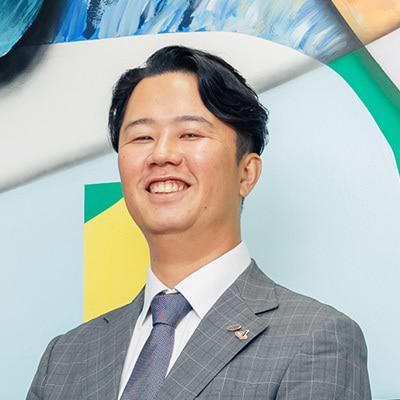
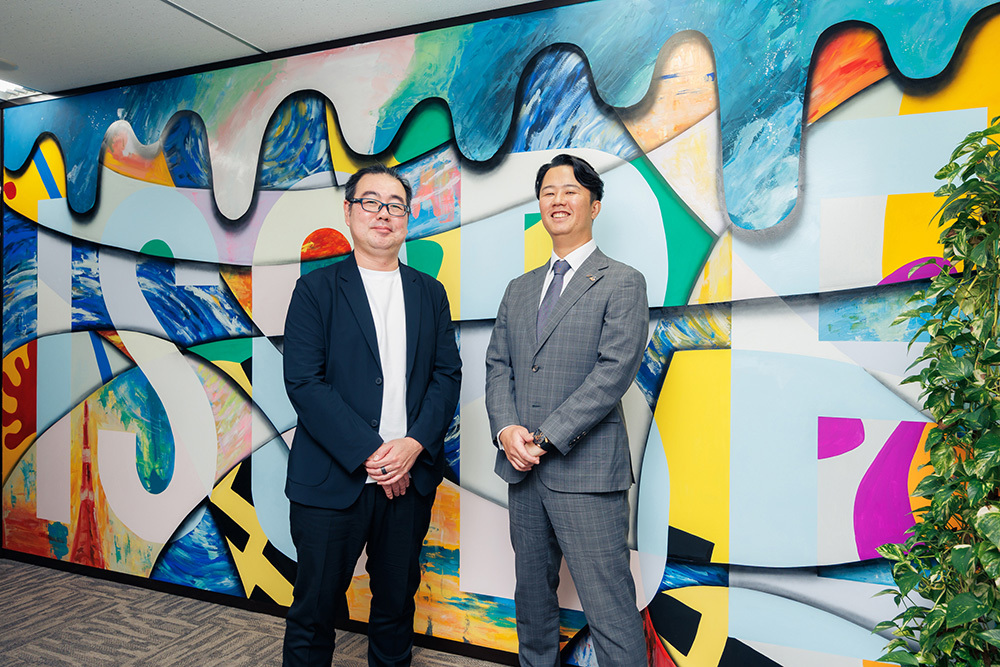
Takehide Isobe
Isobe Painting Co., Ltd.

Makoto Nakamura
Dentsu Inc.
The job of a business owner involves making decisions about organizational management and bearing responsibility. Since this significantly impacts a company's performance and growth, the quality of the owner's judgment is crucial.
Launched in February 2025, 'Dentsu Eight Eyes' is a flat-rate consultation service where specialists from various Dentsu Inc. domains act as sounding boards for mid-sized and small business owners, offering insights and perspectives on management challenges.
Related News:
Flat-Rate Management Consultation Service "Dentsu Inc. Eight Eyes" Launches for Mid-Sized and Small Businesses
The service is well-received because it allows business owners to leverage Dentsu Inc.'s diverse expertise and networks according to their specific challenges, enabling more effective decision-making.
The foundation for Dentsu Inc. Eight Eyes stems from an initiative led by Makoto Nakamura of Marketing Division 6, who continuously supported a junior colleague from his university days who was tackling the challenge of revitalizing his family business. We asked both men to reflect on that time.
<Table of Contents>
▼A Challenge from Rock Bottom: Inheriting a Family Business with ¥5 Billion in Debt at Age 27
▼The Second Chapter of New Isobe Painting: What Role Did Mr. Nakamura Play?
▼Behind the Scenes of Building an Organization for the "Expansion Phase"
Challenge from Rock Bottom: Inheriting a Family Business with 5 Billion Yen in Debt at Age 27
──Please tell us about how you two met.
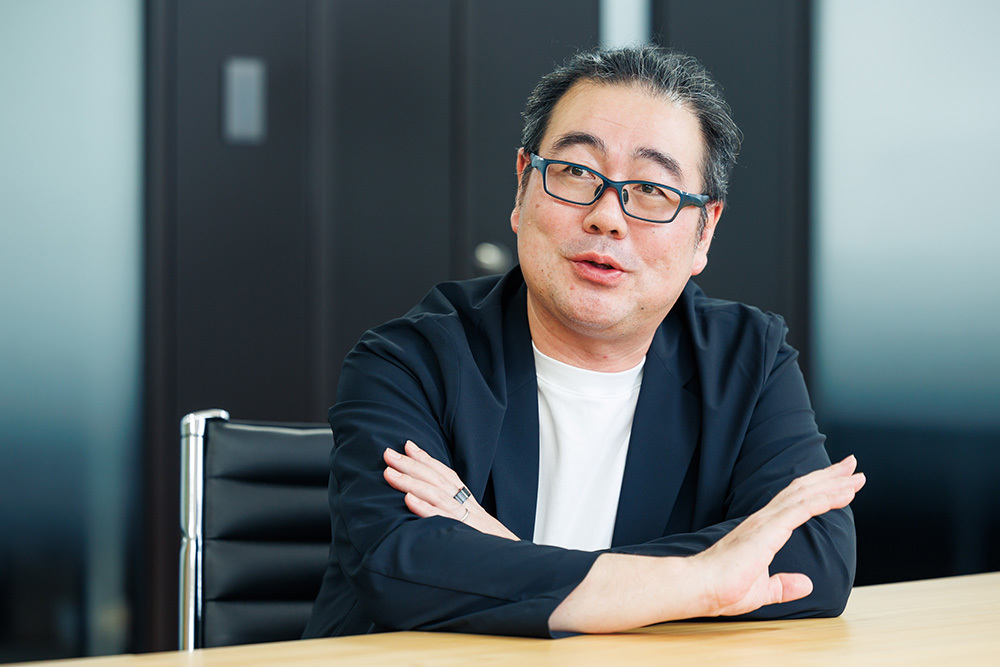
Nakamura: We met during our student days at Ritsumeikan University, where we each started and ran venture companies. It was the early 2000s, when student entrepreneurship was still rare, but we hit it off immediately. We were comrades who debated business passionately and played hard together—and became close friends. After graduating, I sold my business and joined Dentsu Inc. President Isobe focused on expanding the company he founded during university, which handled website production and e-commerce consulting.
Then one day, Mr. Isobe's family business faced a crisis. I was shocked when he told me he would "take over the family business."
Isobe: To take over the family business burdened with 5 billion yen in debt, I had to move from Osaka to Tokyo. You and several other friends threw me a farewell party. Since there was a possibility I might declare personal bankruptcy and return to Osaka, everyone had prepared jobs for me so I wouldn't struggle to make ends meet. I clearly remember how happy and reassured that made me feel.
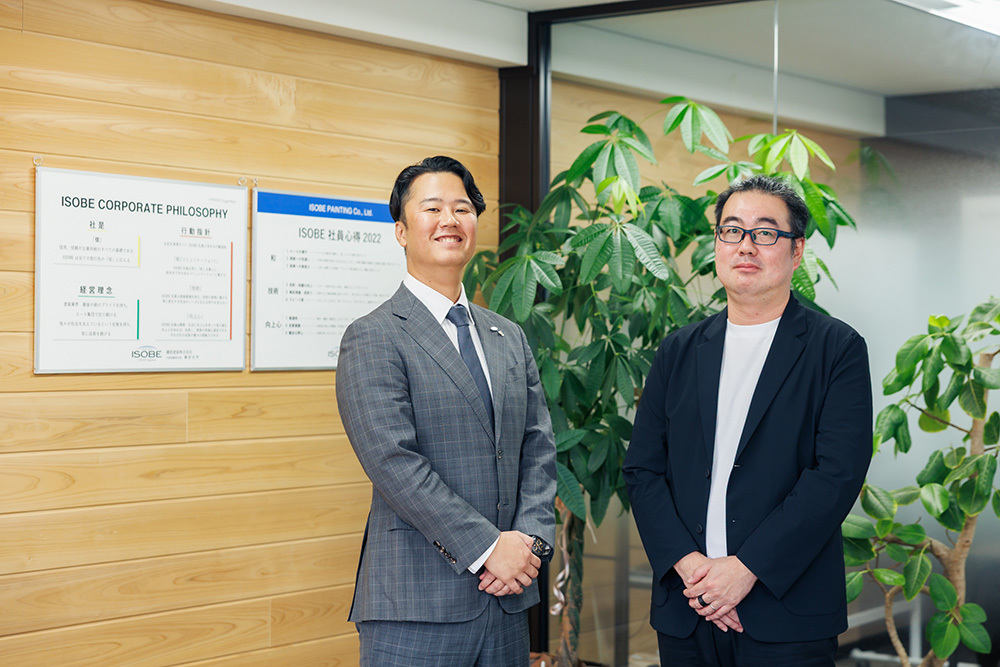
After I became president of Isobe Painting, Mr. Nakamura has been by my side throughout our recovery, growth, and into our current expansion phase.
Nakamura: Initially, I offered advice purely as a friend. But starting in 2015, I formally began working with Dentsu Inc., and this year marks our tenth year together. We've implemented various strategies aligned with the company's growth phases.
──What led to the company accumulating debts of 5 billion yen?
Isobe: Isobe Painting was founded in 1907 (Meiji 40) and is a long-established company approaching its 120th anniversary. Since its founding, we've undertaken painting projects for iconic Japanese structures like Tokyo Tower, the Nijūbashi Bridge at the Imperial Palace, and the Kanmon Bridge.
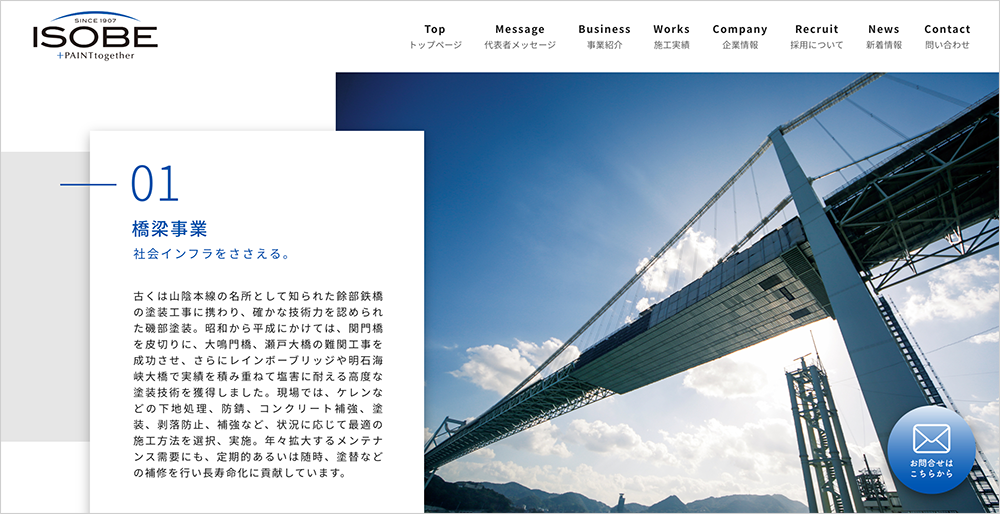
Parallel to its painting business, the company developed a paint sales division. Just before I became president, while the painting business generated 6 billion yen in sales, the paint sales division was growing into a business reaching 10 billion yen in sales.
However, in 2009, the year after Isobe Painting celebrated its 100th anniversary, a 5 billion yen bad debt emerged in that paint sales business, effectively bankrupting the company. My uncle, who was president, resigned to take responsibility. Since my father was also part of the former management team, I, then 27 years old, took over as president to rebuild the company.
Nakamura: When you went to Tokyo and actually looked into the situation, the company was in far worse shape than you had imagined, right?
Isobe: Yes. Bank transactions were suspended, sales plummeted, material procurement stopped, and subcontractors and craftsmen refused to take on work, saying, "Isobe Painting seems to be in trouble." Our credit rating dropped, leading major clients to halt transactions. Employees, pessimistic about the future, began leaving in droves.
Nakamura: After President Isobe went to Tokyo, we stayed in touch at least once a month. Back then, he was facing such a mountain of problems he didn't even have time to worry.
Isobe: Amid the crisis, when the company's situation was changing rapidly, speed in taking action was crucial. Whenever I was stuck, I'd immediately contact Mr. Nakamura and ask him to help me bounce ideas off him. Talking with Mr. Nakamura allowed me to objectively organize my thoughts, next steps, and direction.
──After becoming president, what specific steps did you take to revitalize the company?
Isobe: My first task was to spend day and night poring over three years' worth of construction data to identify organizational issues. What stood out was that, within the industry's outdated structures, the capabilities of talented young employees weren't being utilized. I centered the organizational restructuring around several promising individuals who had stayed with the company. Some of those members are now part of the current leadership.
There was also room for improvement in our profitability. We had numerous orders secured based on prioritizing relationships over profitability. While sales appeared to be rising, expenses were also extremely high, resulting in no profit. To break away from the excessive sales-first mentality that had permeated the company, we changed to an order management system where detailed project checks were required before approval.
While implementing these changes, I ate meals almost daily with the employees who stayed on, constantly gathering input about the industry and the company.
Nakamura: We started from a desperate situation, but President Isobe repeatedly stated, "I want to make this the best company in the world." I imagine he faced tough decisions, felt anxious, and even scared at times, but that strong conviction drove the reconstruction.
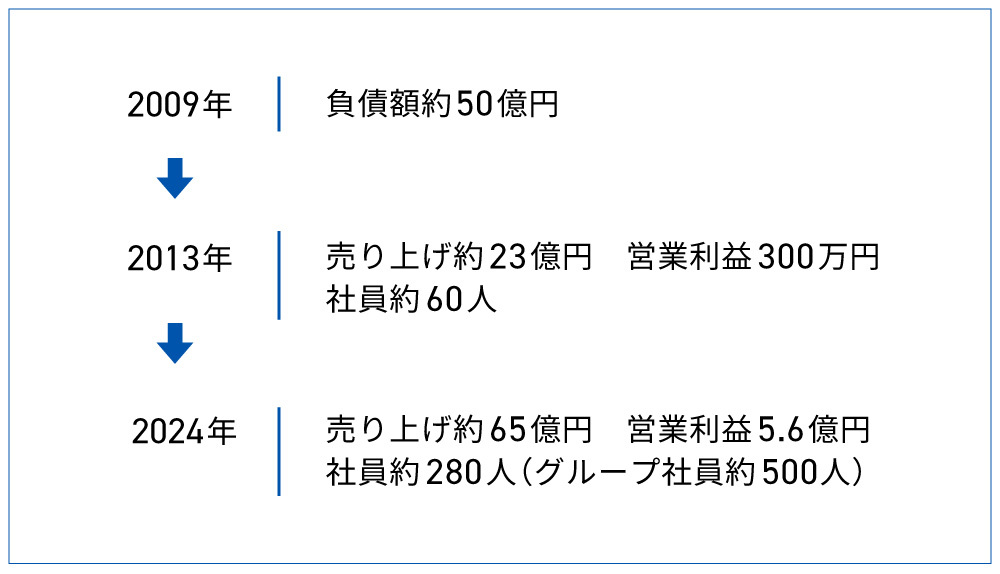
Isobe: Several crises followed, but our steady reforms paid off. The company gradually regained trust, and in 2012, we resumed business with major clients. By 2013, sales stood at ¥2.3 billion—half our historical peak—but we had established a healthy operating structure generating solid profits.
Finally, in 2014, transactions with financial institutions resumed, completing the revival. As performance recovered, internal motivation rose, and Isobe Painting became more "muscular" and in better shape than before.
The Second Chapter of New Isobe Painting. What role did Mr. Nakamura play?
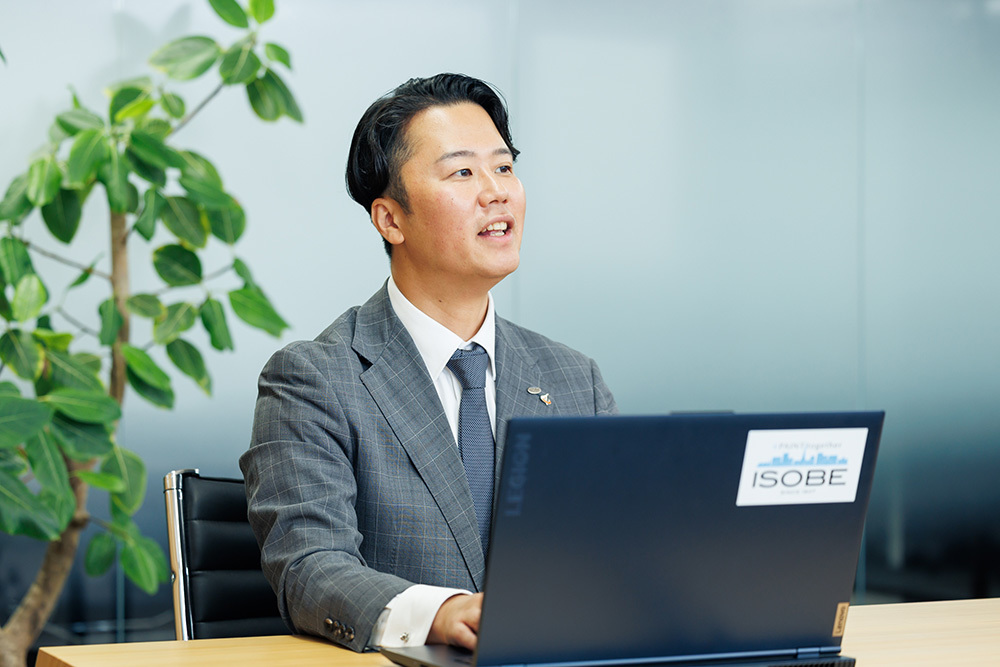
──After the company's revival, Isobe Painting has steadily improved its performance. What specific measures were implemented internally?
Isobe: By 2013, when the path to recovery was clear, I felt a surge within me: "This isn't the end." I resolved to double our sales, which were around 2 billion yen at the time. To achieve that, we needed to align the mindset of our employees.
Up to this point, Mr. Nakamura had been advising me as a university friend, but I sought further collaboration and decided to commission 'Dentsu Inc.'s' Mr. Nakamura for the job.
Nakamura: President Isobe expressed a desire to create a new image for Isobe Painting that wasn't bound by industry conventions or the past, even though the painting industry didn't exactly have the best reputation. My proposal at that time was to refresh the CI (Corporate Identity) and VI (Visual Identity).
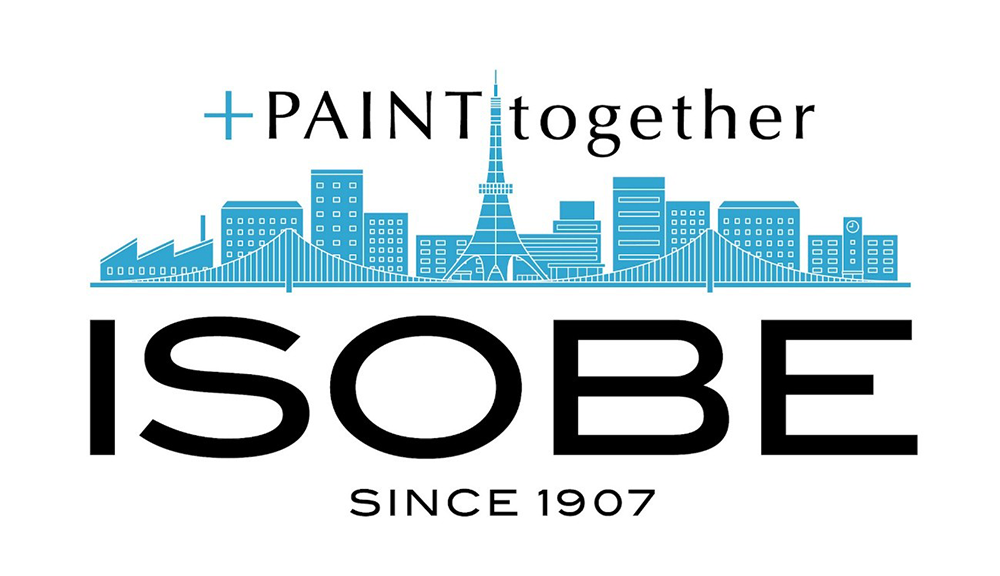
Isobe: To effectively communicate "the completion of our revitalization" both internally and externally, I felt we needed to start by changing our corporate image. Mr. Nakamura's proposal was very welcome. We created about five logo designs through discussions with Mr. Nakamura and the designers. Ultimately, we decided on the current two logos through an internal vote. Next, we asked Mr. Nakamura to be the instructor for a training session during our company trip.
Nakamura: "When they suddenly asked, 'Could you do some training for our employees?', I panicked (laughs)." So, I considered what theme would be appropriate for "employees of a company that has completed its regeneration and entered a growth phase." As a result, we decided to conduct training focused on encouraging employees to "make the management plan their own."
Even if employees intellectually understand the company's future and vision, they often struggle to translate that into their daily work. In the training, we held workshops where participants imagined: "If the company achieves its goals in five years, how would I want my family, clients, and colleagues to perceive me?"
Isobe: Mr. Nakamura highly values the "field-oriented" sensibility cultivated during his corporate career. He designed the training to help employees realistically connect their "responsibilities as company employees" with their "personal happiness" when considering their careers at Isobe Painting. Such concepts often don't resonate well when communicated internally, so his approach was greatly appreciated.
Nakamura: Before the training, employees referred to Isobe Painting simply as "Isobe." What struck me was how, around the time the training ended, they increasingly started saying "our company" or "my company." This is proof that a sense of ownership has begun to take root.
Isobe: Employee ownership is the very source of the company's profits, so this is truly gratifying. Though I doubt they'd use that phrasing (i.e., "our company") when talking to me, the president (laughs).
Nakamura: The next thing President Isobe consulted me about was reforming the personnel system. Having seen the employees' faces through the training made it easier to get started.
Isobe: Mr. Nakamura, having handled numerous companies at Dentsu Inc., you've encountered diverse HR policies and systems, right? You leveraged that experience, using various case studies to help us discuss Isobe Painting's HR philosophy together.
Nakamura: What I learned from talking with various executives is that there are many different cases—companies that strategically develop talent, companies that implement personnel systems based on individual relationships—not necessarily good or bad, just different. We started by presenting these examples and exploring the best personnel philosophy for Isobe Painting.
Isobe: Yes. Ultimately, the most noticeable result of our HR system reform was improved employee retention. We moved away from outdated training methods and created OJT tools to ensure consistent, effective on-the-job development. These tools include detailed charts specifying what skills must be mastered by when, enabling employees to become fully competent within three years. This eliminates reliance on individual mentors and elevates the overall skill level and growth of our workforce.
As a result, employees can now envision their future path, feel tangible growth, and are less likely to leave the company easily.
Before the HR system reform, both recruitment and employee retention were struggling. However, by building a system that enables steady employee growth, the turnover rate stabilized at just 1%.
Nakamura: Later, in 2017, to commemorate Isobe Painting's 110th anniversary, we produced an anniversary publication. Then, in 2018, President Isobe suddenly approached me again: "I want to formalize Isobe Painting's corporate principles, management philosophy, and action guidelines. We'll present them at employee training. Nakamura, would you write them for us?"
By that time, through training and HR system reforms, I had gained more opportunities to speak with employees and noticed a shared underlying sentiment in their words. I formulated the "Corporate Creed, Management Philosophy, and Code of Conduct" by articulating both this sentiment and President Isobe's vision. It was announced internally and externally in 2018.
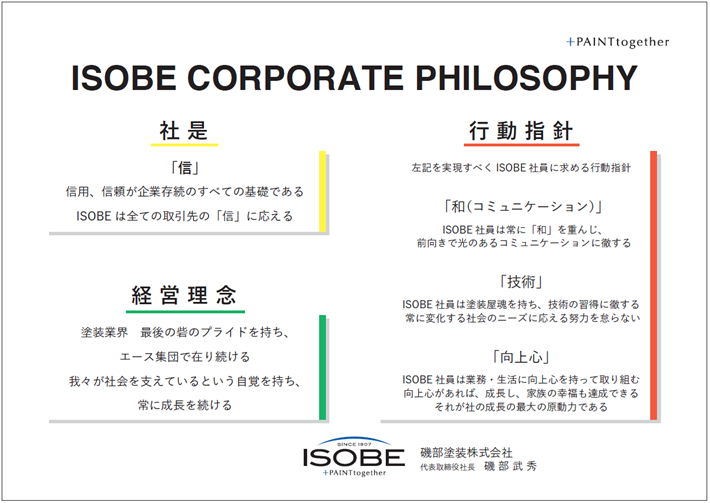
Isobe: When the company is small, it's relatively easy for everyone to face the same direction. But as the number of employees grows, ideas and approaches become more diverse. That's why we linked Isobe Painting's Action Guidelines to our evaluation system, creating a mechanism where employees who practice these guidelines get promoted. This ensures each employee incorporates the company's values into their daily work, naturally aligning everyone's direction.
Incidentally, a female employee who joined us this spring told me, "I decided to join Isobe Painting because I thought the company motto, management philosophy, and code of conduct were really cool."
Nakamura: Wow, that's wonderful to hear!
Behind the Scenes of Building an Organization for the "Expansion Phase"
──What areas is Isobe Painting currently focusing on strengthening?
Isobe: Securing sufficient personnel and developing executives. We believe these two elements are essential conditions for succeeding in the industry going forward.
One crucial role for painting companies is infrastructure maintenance. Currently, in Japan, structures like bridges and other transportation infrastructure are aging, driving up maintenance demand. At the same time, the construction industry has seen a sharp decline in players, making it increasingly difficult to secure construction work itself. This makes securing personnel at bases nationwide critical.
Furthermore, Isobe Painting saw its sales reach 5.4 billion yen and its employee count grow to 264 by 2023. As we expand our workforce, developing "executives who can manage operations on-site while understanding the broader business context" becomes crucial. Recruiting individuals suited for these executive roles is also a key challenge. After consulting with Mr. Nakamura, we decided to have him join Dentsu Inc.'s recruitment branding team starting in 2024.
Nakamura: Dentsu Inc.'s team members don't just talk to President Isobe; they also speak with frontline employees to develop the recruitment concept.
Isobe: Exactly! They listen to our raw, honest feedback with incredible care! Honestly, I thought you were the only one doing such detailed interviews (laughs). Seeing your steady, down-to-earth approach has really changed my perception of Dentsu Inc.
Nakamura: As marketing specialists, Dentsu Inc.'s job is to connect the customers who buy our products with the creators' intentions. To thoroughly adopt the customer's perspective, meticulous, repeated listening is essential. Applied to recruitment, this means listening to the voices of our employees, who are key stakeholders in the business. Understanding people's emotions, essence, and feelings is our specialty (laughs).
――What kind of future vision does Isobe Painting envision?
Isobe: When our restructuring began to show promise in 2013, we had sales of about ¥2.3 billion and around 60 employees. By 2024, sales reached ¥6.5 billion, and our workforce grew to about 280 people. Through M&A, the combined sales of our six group companies are projected to hit ¥20 billion this fiscal year, with 500 employees.
Currently, to ensure consistent management across acquired companies, we've begun consulting with Dentsu Inc. on our next strategic move, with an eye toward establishing a holding company structure. As a small-to-medium enterprise, we inevitably face limitations in our thinking and can become constrained by narrow perspectives. However, Mr. Nakamura and the entire Dentsu Inc. team consistently provide insights that help us broaden our horizons.
Nakamura: Thank you for your kind words. Our collaboration with Isobe Painting was recognized, leading to the launch of a new service in 2025 called "Dentsu Eight Eyes," designed to support SME executives. Dentsu Eight Eyes provides executives with "sparring partners" from employees across specialized fields. Leveraging our unique strengths—such as the ability to articulate executives' ideas clearly and our marketing expertise—we offer perspectives distinct from typical management consultants. This should help uncover previously unseen company challenges and identify key points to accelerate growth.
Isobe: What makes me happy is that everyone at Dentsu Inc., starting with Mr. Nakamura, treats us not just as clients, but as partners and family. Because we feel that, both myself and our employees can honestly share our thoughts. And the Dentsu Inc. team consistently responds to those thoughts. I believe this creates a positive cycle.
Nakamura: I'm glad to hear you say that. Many people might assume that Dentsu Inc. only works with large corporations, but that's absolutely not the case. We want to revitalize Japan's SMEs by fully leveraging the experience and knowledge we've cultivated through communication with all kinds of business leaders, from large corporations to small and medium-sized enterprises.
Isobe: We look forward to your continued support as our trusted partner!
SME Support Program "Dentsu Inc. Eight Eyes"
Pioneering Case Study Seminar to be held on Thursday, August 7, 2025
●Date & Time: Thursday, August 7, 2025, 3:00 PM - 4:30 PM
●Speakers: Mr. Takehide Isobe (President & CEO, Isobe Painting Co., Ltd.)
Makoto Nakamura (Producer, Project Development Department, Marketing Division 6, Dentsu Inc.)
●Format: In-person attendance at venue or online attendance (via Teams; URL will be sent later)
●Venue: Dentsu Inc. Kansai Office
(Nakanoshima Festival Tower West, 3-2-4 Nakanoshima, Kita-ku, Osaka)
●Venue Capacity: Approximately 30 people (If applications exceed capacity, participants will be selected by lottery)
●Participation Fee: Free
●Application: Please apply via the URL below.
https://forms.office.com/r/tE2kyySE23
●Application Deadline: Friday, July 25, 2025, 5:00 PM
●Other: The event may be canceled if there are an extremely small number of participants.
In case of cancellation, notification will be sent by Wednesday, July 30.
●Inquiries: Dentsu Inc., Marketing Division 6: 6mk_prokai@group.dentsu.co.jp

Was this article helpful?
Share this article


Newsletter registration is here
We select and publish important news every day
For inquiries about this article
Author
Takehide Isobe
Isobe Painting Co., Ltd.
President and CEO
Makoto Nakamura
Dentsu Inc.
Marketing Division 6 Project Development Department
Producer
