Note: This website was automatically translated, so some terms or nuances may not be completely accurate.
 Blockchain × AI: Transforming Marketing [1/2]
What is the "seamless customer touchpoint" realized through Blockchain × AI?
The evolution of digital technology is profoundly changing the relationship between businesses and consumers. How do we understand the experiences created at every touchpoint, online and offline, and how do we connect them to the next experience?
The key lies in blockchain and AI.
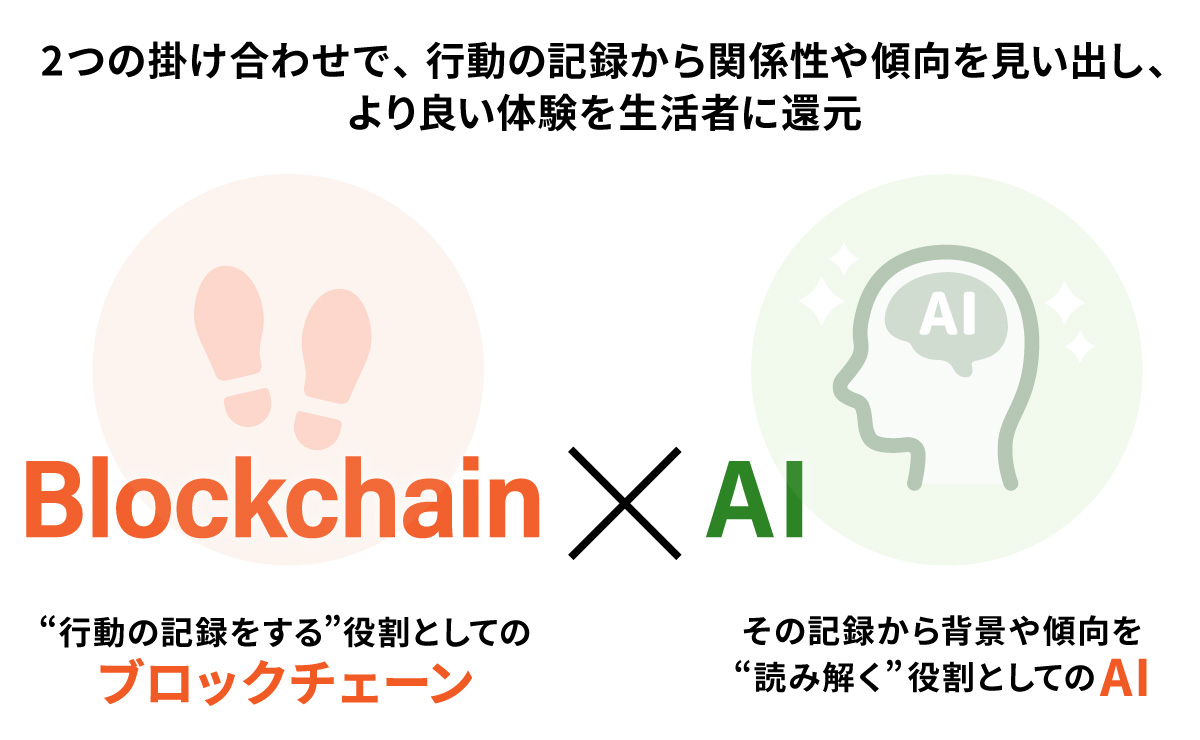
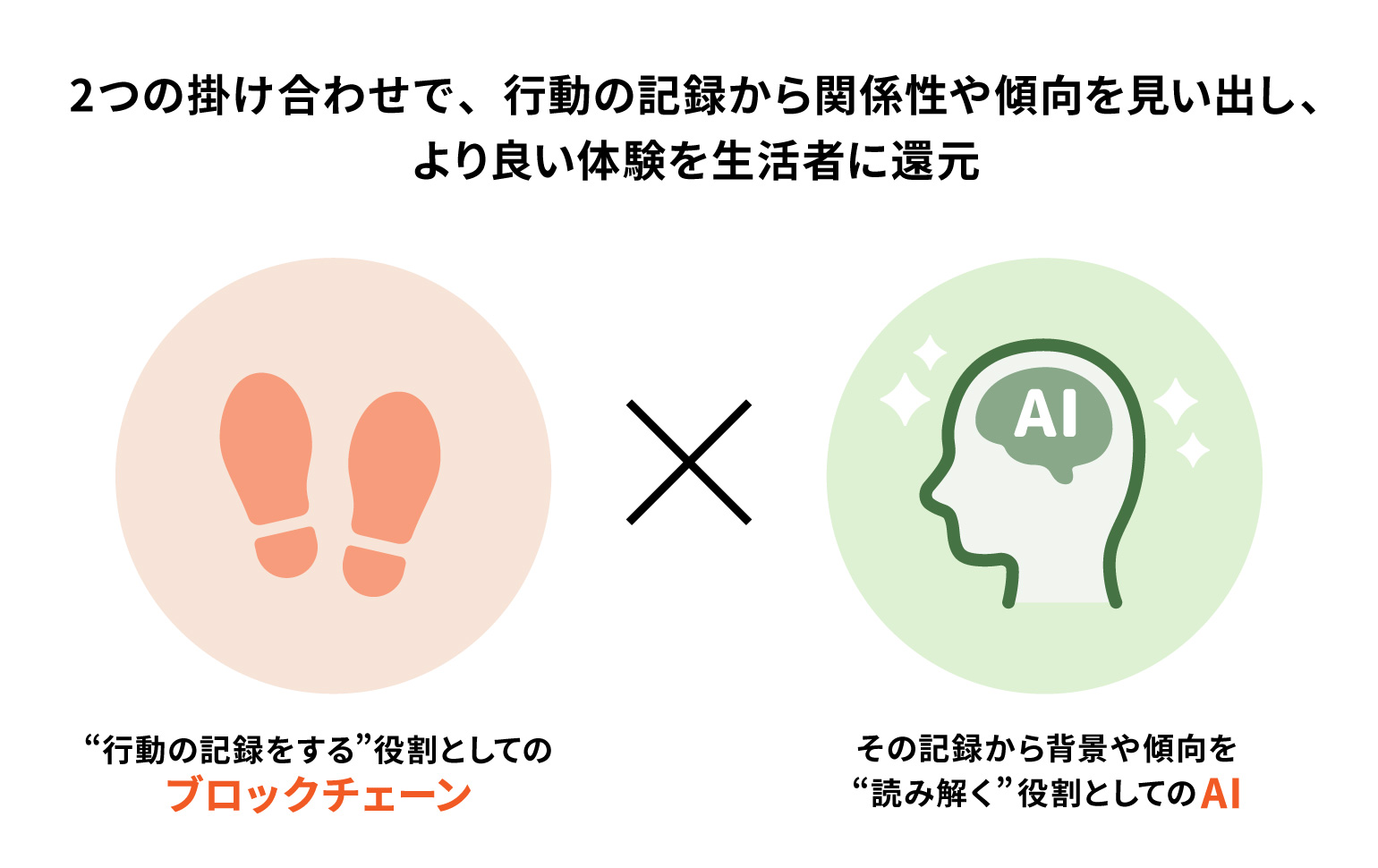
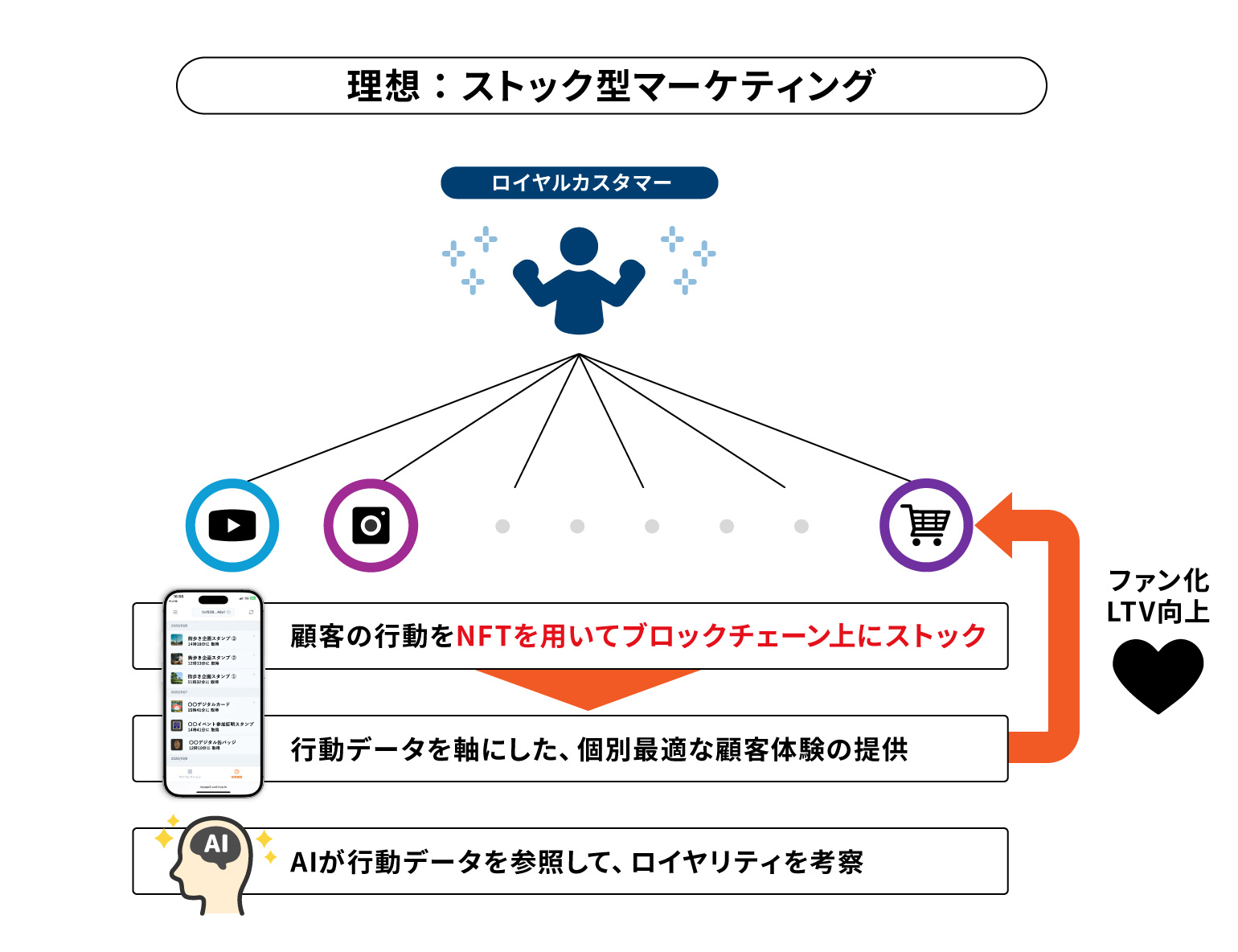
Blockchain "records" actions, while AI "interprets" those records. Combining these two technologies allows us to grasp previously scattered customer touchpoints as a "seamless flow of experiences" and connect that flow to the next, improved experience.
This article introduces how blockchain and AI are transforming customer touchpoints, based on the initiatives of SUSHI TOP MARKETING.
<Table of Contents>
▼How Diverse Customer Touchpoints Have Transformed "Understanding Consumers"
▼Blockchain Creates "Connected Customer Experiences"
▼What Does It Mean for "Behavioral Histories" to Persist Beyond Time?
▼Changes Seen in Practice: New Customer Experiences Centered Around "Railway Lines"
▼AI Enables Understanding of "Traces of Behavior"!
▼From " Recording Actions" to "Building Relationships "
Understanding Consumers Has Changed Completely Due to Diversified Customer Touchpoints
Traditionally, understanding consumers was based on demographic information like age, gender, and location. However, in recent years, the boundaries of age have become blurred, and even within the same generation, behaviors and values have diversified significantly.
For example, some people in their 60s enjoy online games, while others in their 20s avidly read print magazines. We have entered an era where the framework of "attributes" alone is insufficient to capture the true picture of consumers.
Furthermore, touchpoints between companies and consumers are expanding through SNS, e-commerce, events, and proprietary apps. From the consumer's perspective, discovering a brand on SNS, participating in an event, and purchasing products online all form a single, seamless "brand experience."
However, companies often treat these touchpoints as separate data points, making it difficult to grasp an individual's actions as a single, cohesive experience.
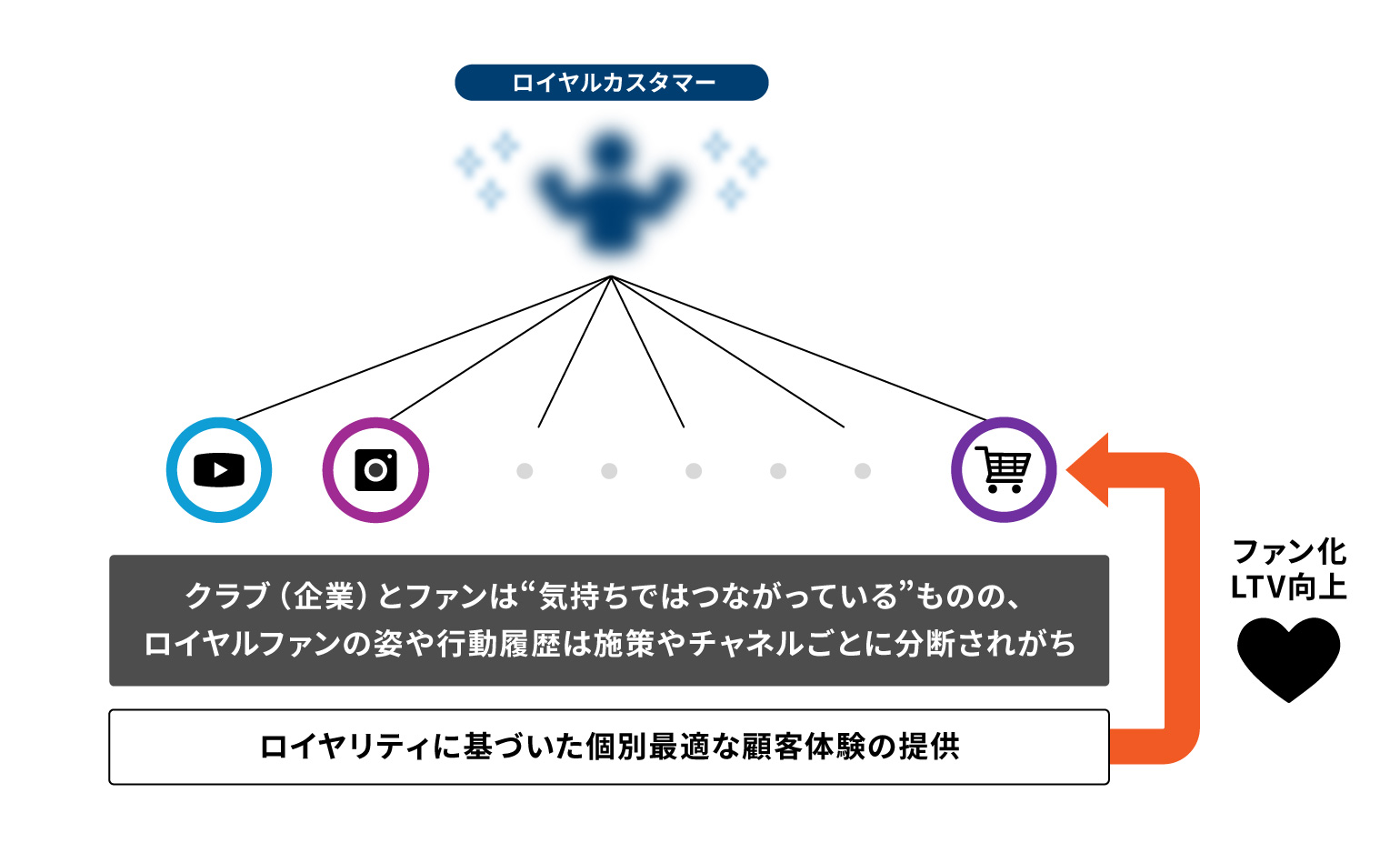
Consider, for example, a fan of a certain soccer club.
- They buy fan merchandise from the online store.
- They attend matches at the stadium on weekends.
- After the game, they stop by a partner restaurant near the stadium (like a sports bar) to relive the match with friends.
For the individual, all these activities are connected as one experience: "supporting the team."
However, from the club's (company's) perspective, the same fan is
- "EC site purchaser"
- "Match attendees"
- "partner restaurant patrons"
and treated as separate data points (individuals). Without connected behavioral data, it's difficult to accurately grasp the full picture of the relationship with fans or the "context."
As a result, while the relationship between the club (company) and fans should feel connected emotionally, the profile of loyal fans and their accumulated behavioral history often get fragmented into isolated "points" across individual initiatives and channels.
Blockchain creates a "connected customer experience"
The solution to this challenge lies in blockchain.
Many associate blockchain with cryptocurrency or finance. Yet its essence is
"a digital ledger that is difficult to tamper with and can store data over the long term."
Applying this mechanism to building relationships with consumers enables the "continuous recording of human behavioral trajectories over time."
The format used for this record is the NFT (Non-Fungible Token). An NFT is a "unique digital data asset" handled on the blockchain.
While many may typically associate NFTs with high-value digital art, we view them not as "assets" but as "evidence of actions (footprints)."
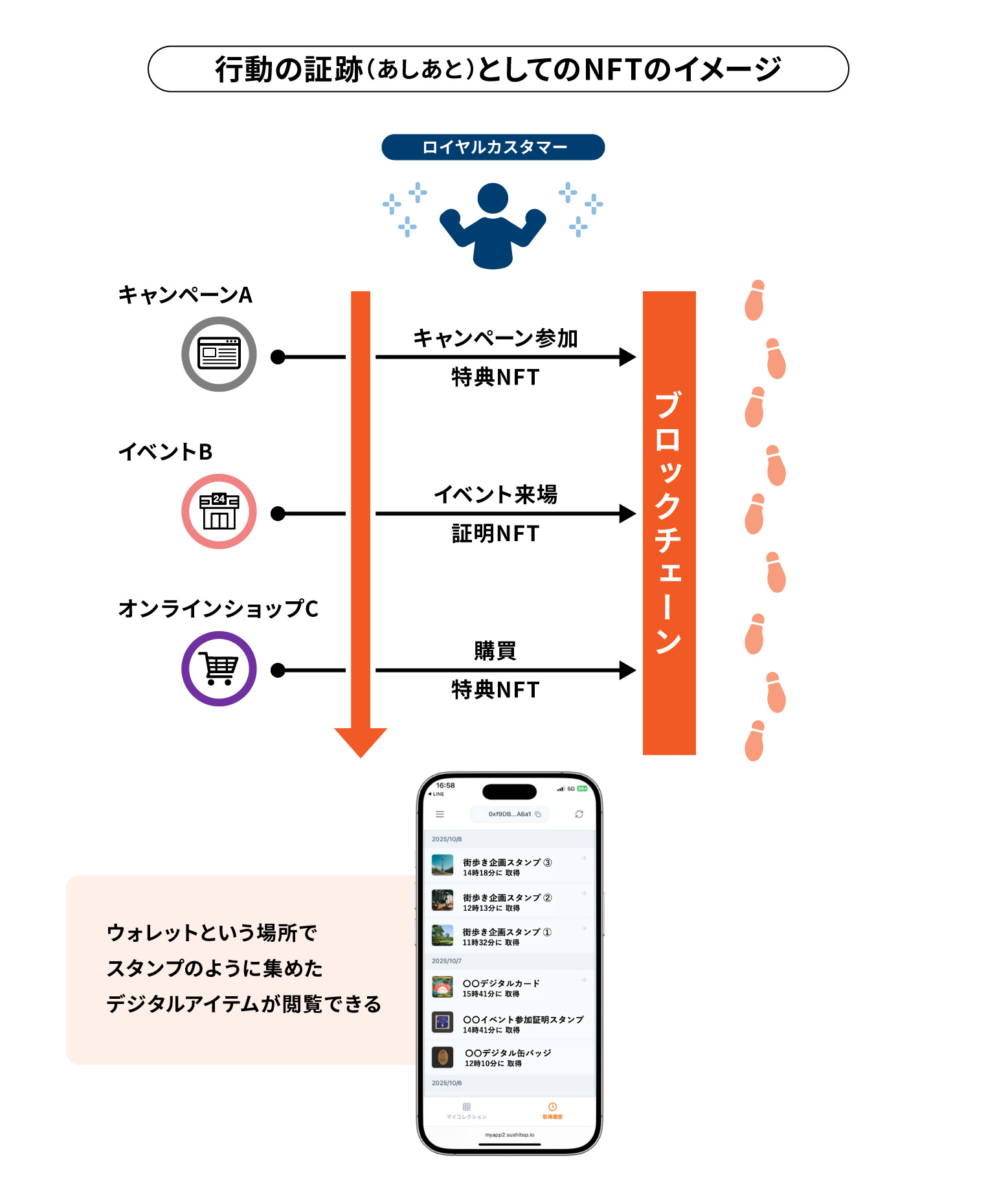
For example, if you issue an NFT for actions like visiting a store, making a purchase, attending an event, or participating in a local gathering, these records accumulate linked to a common ID called a "wallet."
A wallet is a mechanism for holding and managing NFTs on the blockchain; when you receive an NFT, its history is recorded sequentially. Additionally, the unique "address" issued to each wallet functions as a common ID that identifies that wallet.
This wallet contains no personal information. Its key feature is the ability to visualize activity history while maintaining anonymity, preventing identification of the owner.
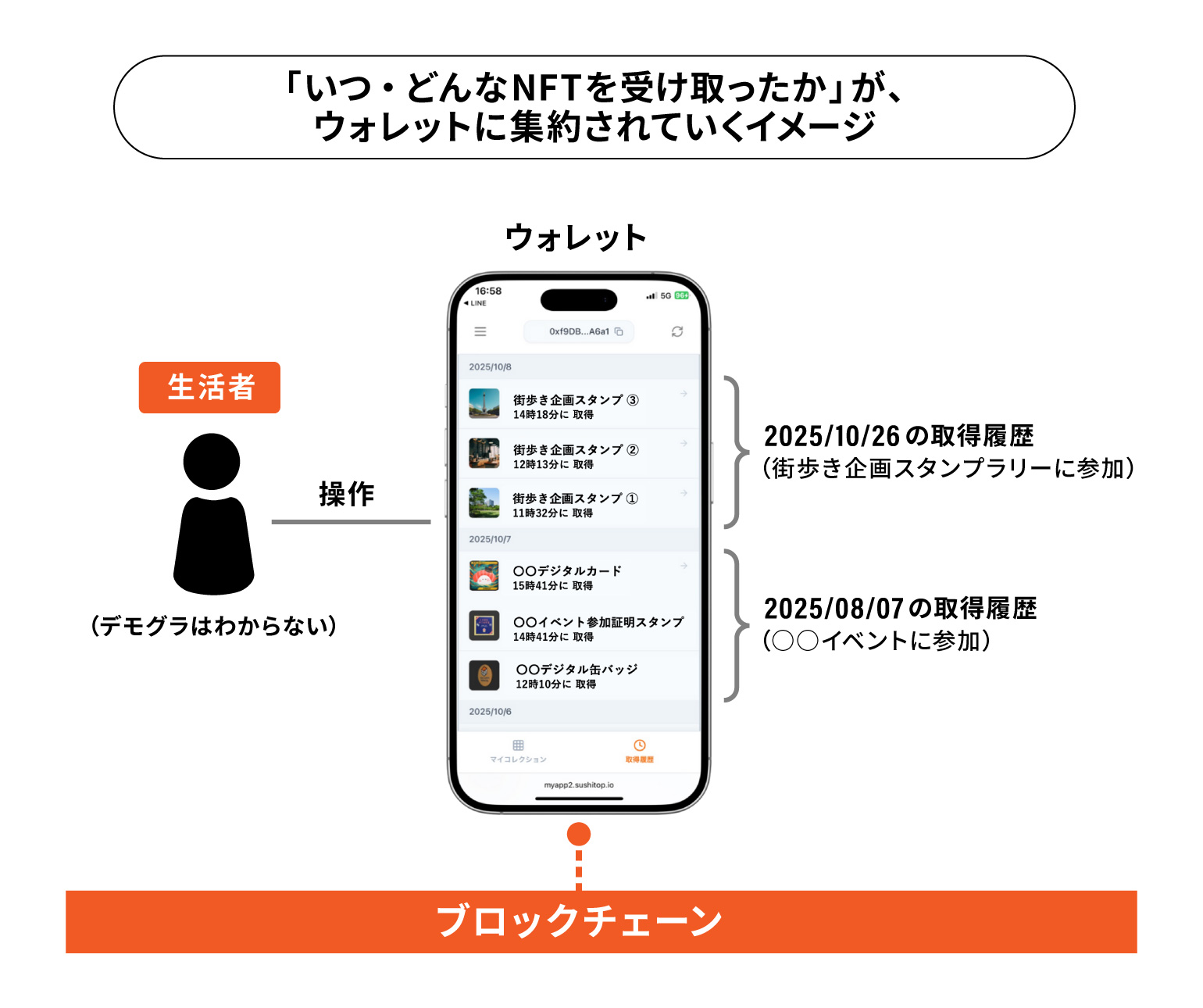
The wallet aggregates records of actions—specifically, "when and what kind of NFTs were received."
For example, a stamp NFT obtained at a station, a purchase NFT distributed at a store, or a benefit NFT received at an event would all be consolidated within a single wallet.
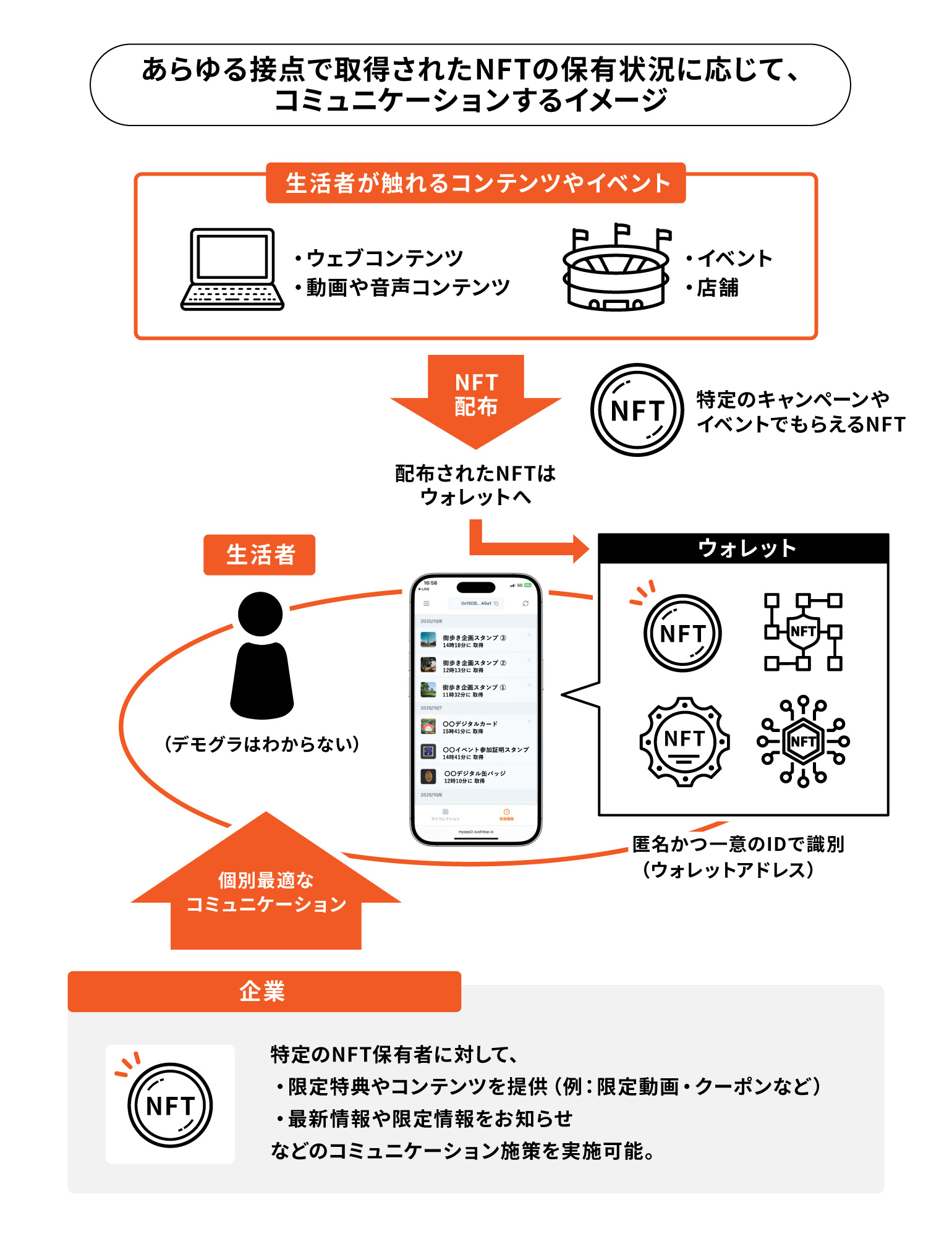
Businesses can reference the information recorded in each wallet—specifically, "which NFTs that wallet holds." This enables them to gain a cross-cutting understanding of the flow of experiences across different initiatives, such as recognizing that "a person who participated in Campaign A also attended Event B."
What does it mean for "action history" to persist over time?
A major feature of blockchain is that once data is recorded, it is difficult to tamper with and is retained long-term.
This means the data exists independently, not tied to specific corporate systems (like a dedicated app's database). Consequently, even after a campaign ends or a service changes, the "history of actions" accumulated by users remains intact and can continue to be referenced.
Unlike traditional CDPs (Customer Data Platforms), blockchain thus offers a new way to grasp the "cross-channel flow of experiences" that transcends the barriers of company-specific servers and systems.
The application of blockchain is now expanding beyond the financial sector. It is increasingly establishing its presence in non-financial fields as a "foundation for recording and nurturing relationships."
Practical Change in Action: New Customer Experiences Along the Railway Line
This concept is being brought to life through the collaboration between Tokyu Corporation and SUSHI TOP MARKETING. By leveraging blockchain and NFTs, they are creating "new value in mobility" centered around the railway line.
The goal is to move beyond one-off campaigns and events, fostering ongoing relationships through experiences like walking tours along the railway line.
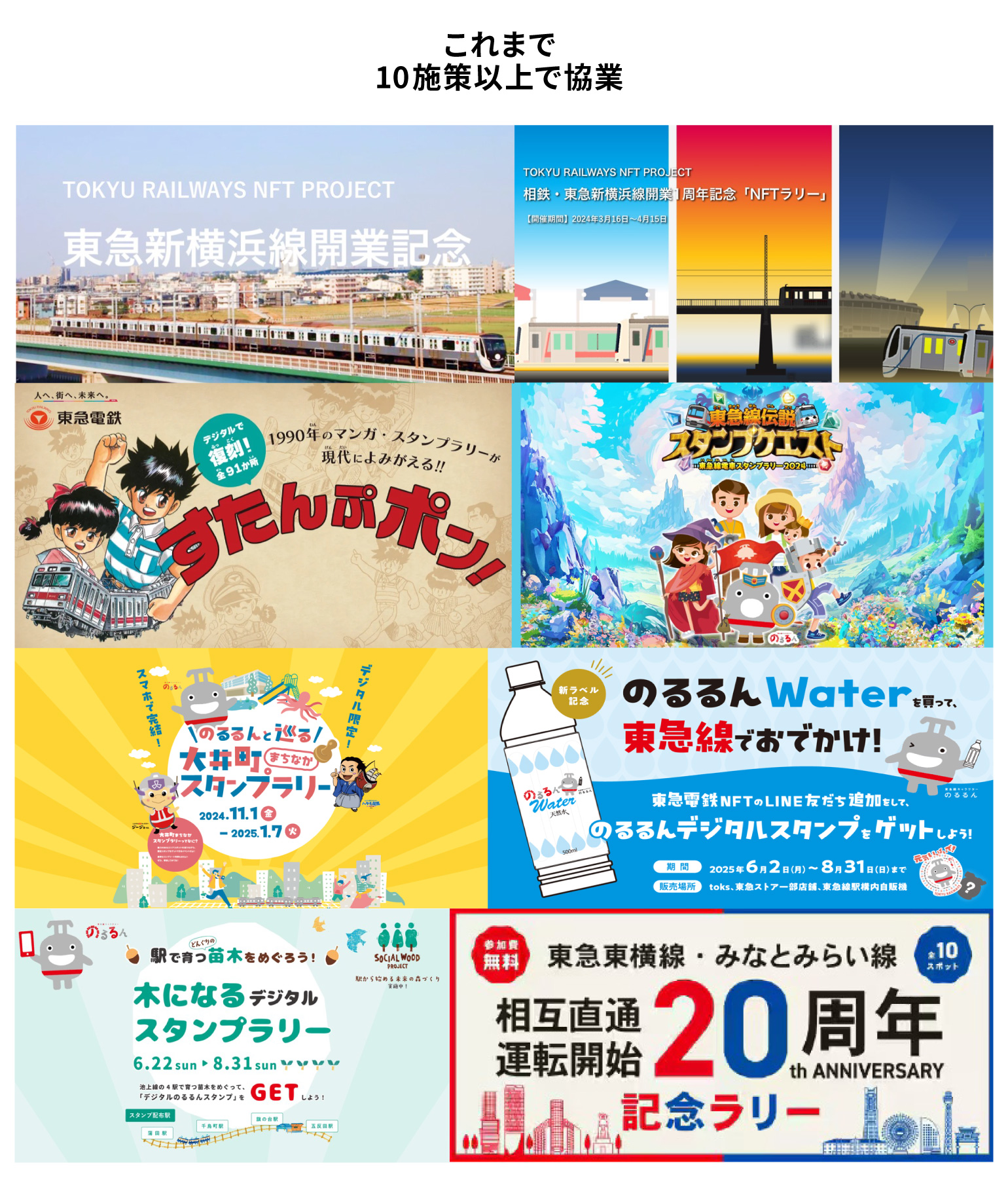
Traditional paper stamp rallies left no "history," and even digital versions faced the challenge of data fragmentation per campaign. Many initiatives introduced dedicated apps or external systems per campaign, each with its own independent database, leaving records as isolated "points." This structure made it difficult to connect consumers' experiences as a "line."
Furthermore, this data depended on the operational environment of the apps or systems introduced for each initiative, and it was not uncommon for it to fall outside management scope once the campaign ended.
NFTs (blockchain) offer an effective solution to these challenges.
NFTs can record behavioral data via a common ID (wallet address), independent of specific apps. This allows behavior histories to be centrally managed on the same blockchain without databases being fragmented across different initiatives. Consequently, it enables data linkage across connected initiatives and the visualization of relationships over time.
The "NFT Stamp Rally" is a concrete application of this mechanism.
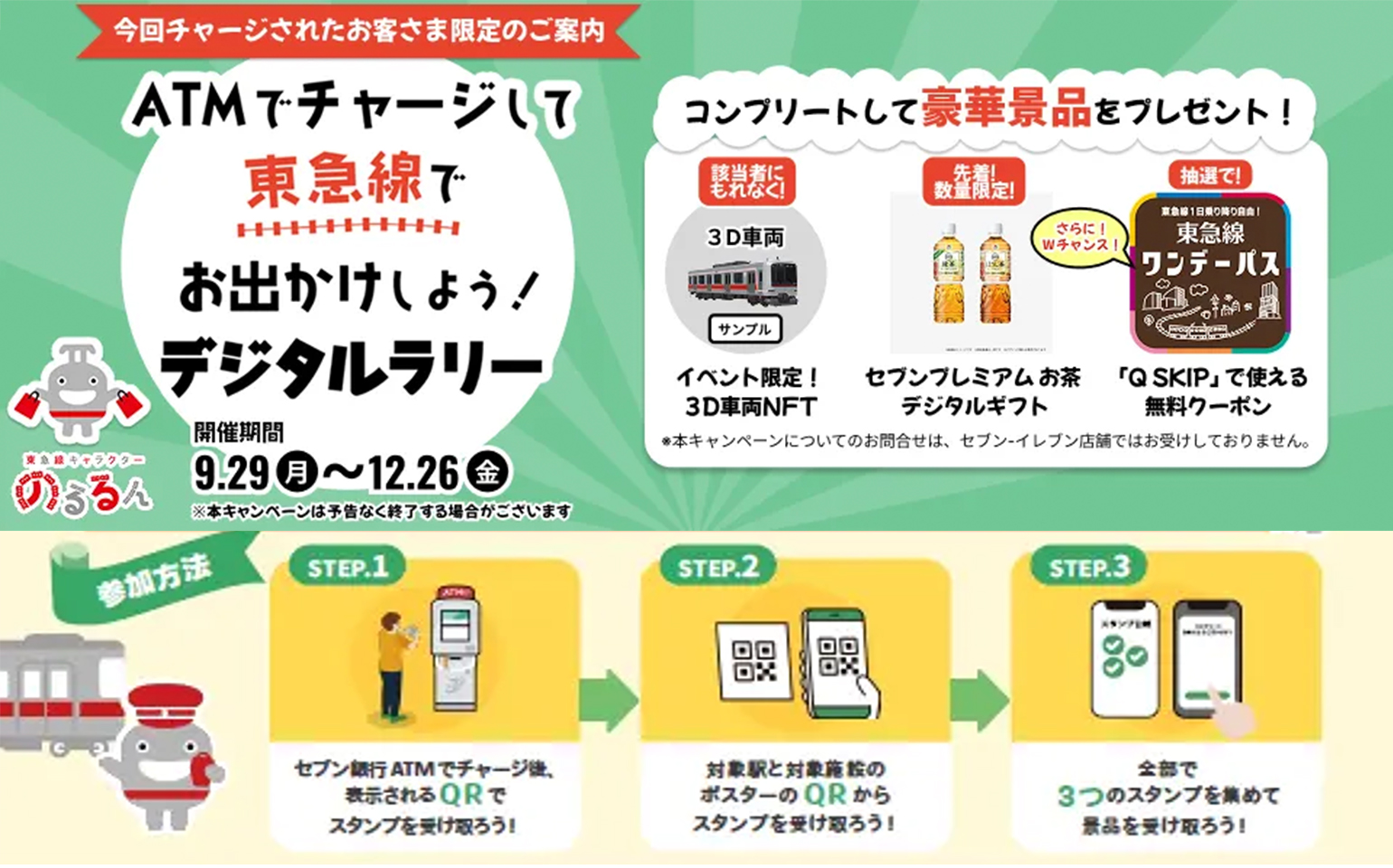
Scanning QR codes placed at stations and commercial facilities issues NFT stamps, recording behavioral history like "which stations were visited" and "the order visited" on the blockchain.
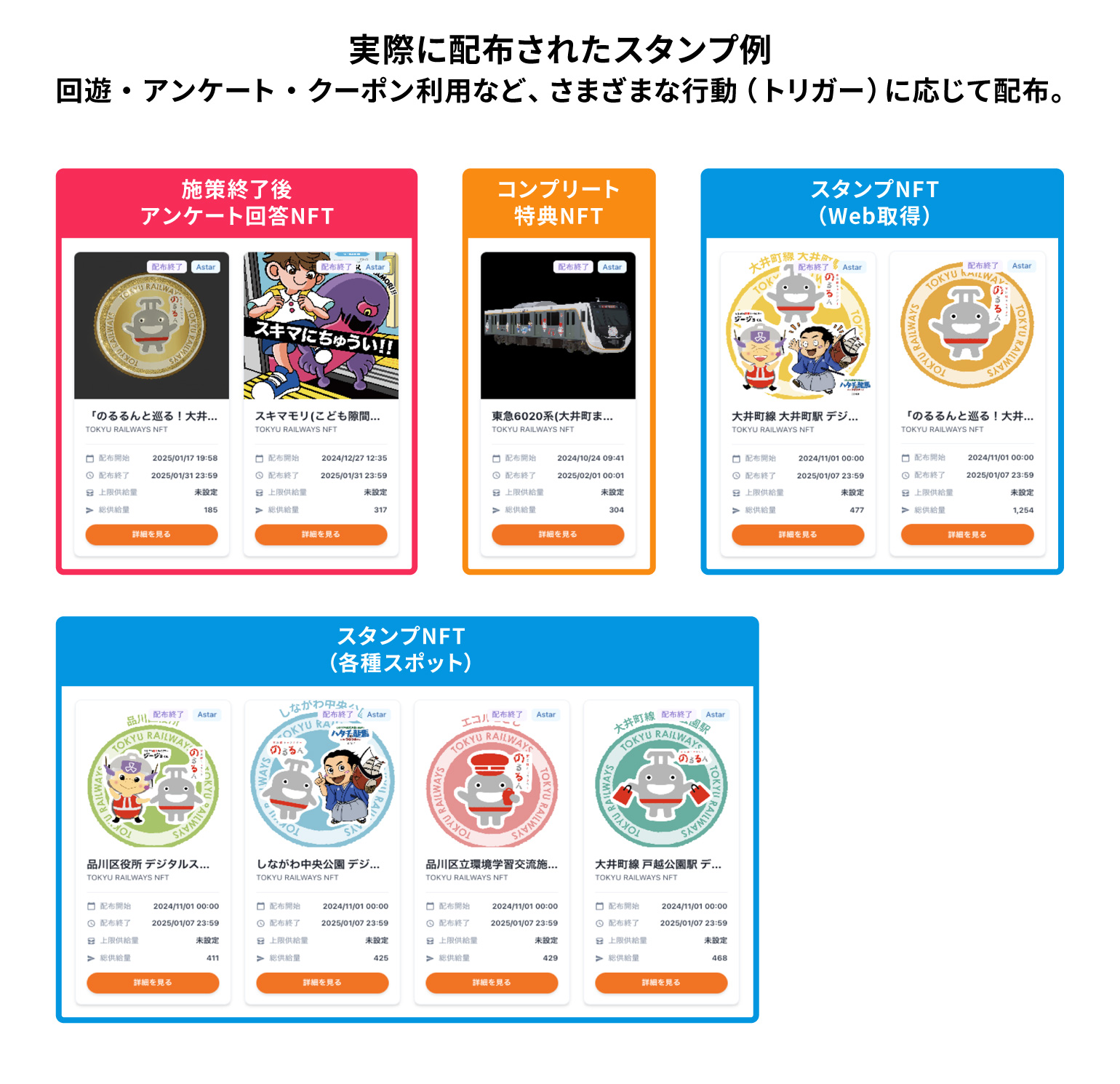
Furthermore, extending beyond the digital stamp rally, QR codes for the official Tokyu Corporation NFT LINE account—required to obtain NFTs—are printed on the labels of "Norurun Water" sold at select Tokyu Stores, toks, and vending machines within Tokyu Line stations . This connects the distinct actions of walking around (circulation) and purchasing into a single experience.
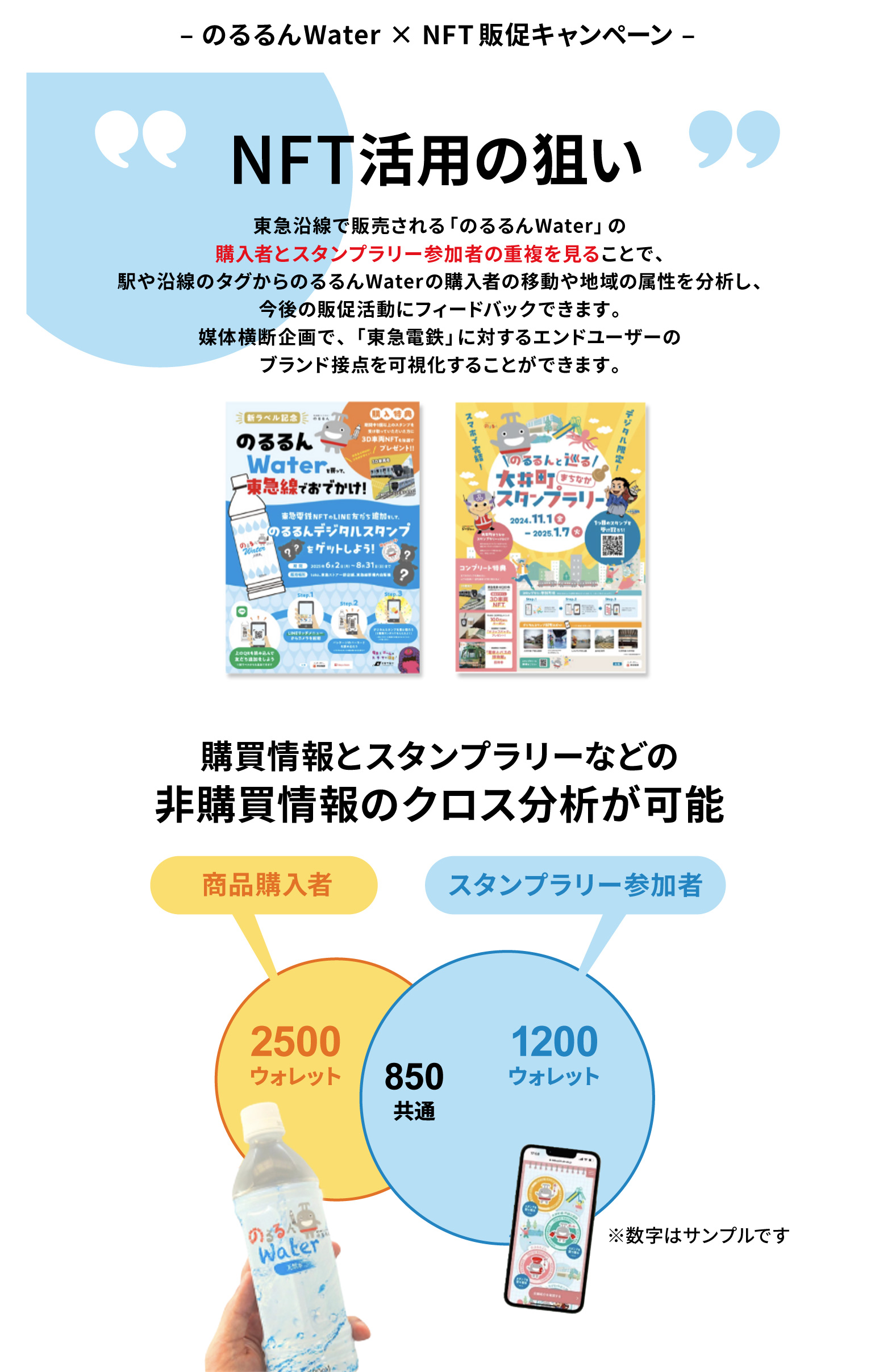
Furthermore, to expand touchpoints, a stamp rally linked with Seven Bank ATMs is also being conducted. A system allowing users to obtain NFT stamps when charging transportation e-money at ATMs has been introduced. By connecting customer touchpoints along daily routes—such as stations, streets, and ATMs—this initiative expands "relationship building centered on movement" in a more multidimensional way.
However, no matter how beneficial it is for the company, it means nothing without a compelling reason for consumers to participate. Consumers join this system not because of the appeal of NFT technology itself, but because of the "fun of the experience" through the stamp rally and the "rewards gained by collecting (like limited goods or special experiences)."
For example, Tokyu Corporation's "NFT Gauge" allows users to "play by running" 3D vehicles issued as NFTs within a digital space. Collected 3D vehicles aren't mere collection data; they function as "digital items" that can be moved and rearranged within the digital space.
Through such experiences, the connection with railways and their surrounding areas expands from the real world into the digital realm, creating a fan experience that allows people to "continue engaging while having fun" in their daily lives.
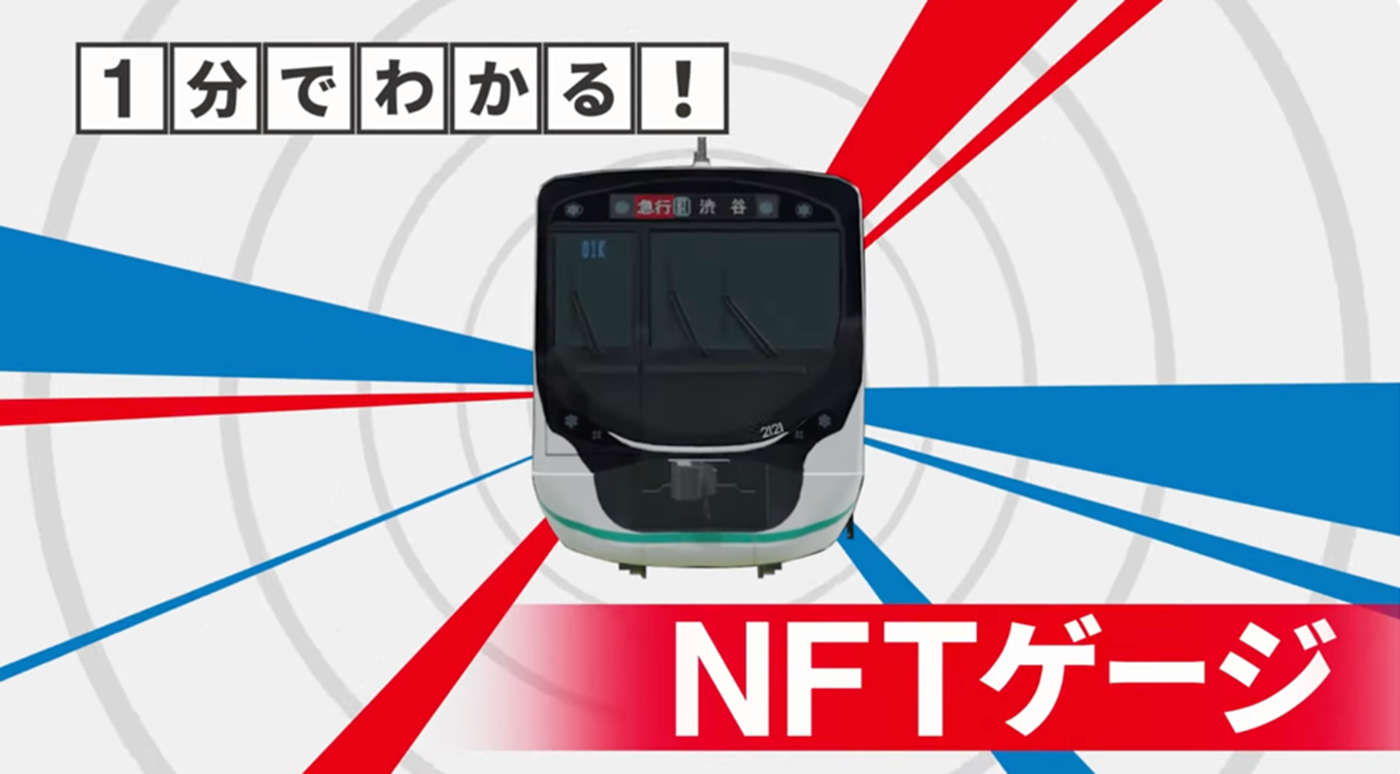
(Actual video: https://youtu.be/7nXlLO2pqOc?si=3cY1l2dyTjMUsNSD )
If we view NFTs purely as one "data format" among others, like image or video files, the value for consumers lies not in the NFT itself, but in the "next fun experience" accessible by owning the NFT (as proof of action). For companies, however, the significant value lies in recording this "proof of action" and enabling cross-campaign coordination.
By linking experience data across multiple initiatives on the blockchain, Tokyu Corporation can continuously understand its relationship with consumers and evolve it into the next communication phase.
For example, it can now track continuity metrics like "how many participants from the previous stamp rally are re-engaging this time," which informs communication strategies targeting highly loyal fan bases.
In this way, Tokyu Corporation's "relationship building with consumers" is evolving from one-off touchpoints to ongoing relationships. Blockchain is beginning to function as a new communication platform that "records experiences and nurtures relationships."
Understanding "behavioral footprints" through AI is now possible!
The key here is the modern shift mentioned at the outset: "Age and attributes alone cannot fully capture consumers." Instead of relying on attribute data, we interpret each individual's values and interests from the "footprints" of their actual actions. AI serves as the means to achieve this.
In this system, blockchain plays the role of "recording actions," while AI acts as the entity that "interprets these records and guides users toward the next experience."
Combining these two elements enables us not only to accumulate data across initiatives but also to uncover hidden relationships and trends within it, making it possible to "reward consumers with better experiences."
At SUSHI TOP MARKETING, we are advancing initiatives to visualize consumer behavior patterns and the deepening of relationships by analyzing action data recorded through NFTs using AI.
For example, at a sports club, we integrated analysis of attendance stamps and campaign participation history to visualize fan loyalty. Based on AI analysis results, we implemented a system where "truly loyal fans" have a higher probability of winning in application-based campaigns.
By rewarding experiences based on daily support and participation, they achieve fair and sustainable relationship building centered on fan connections, moving beyond simple lotteries.
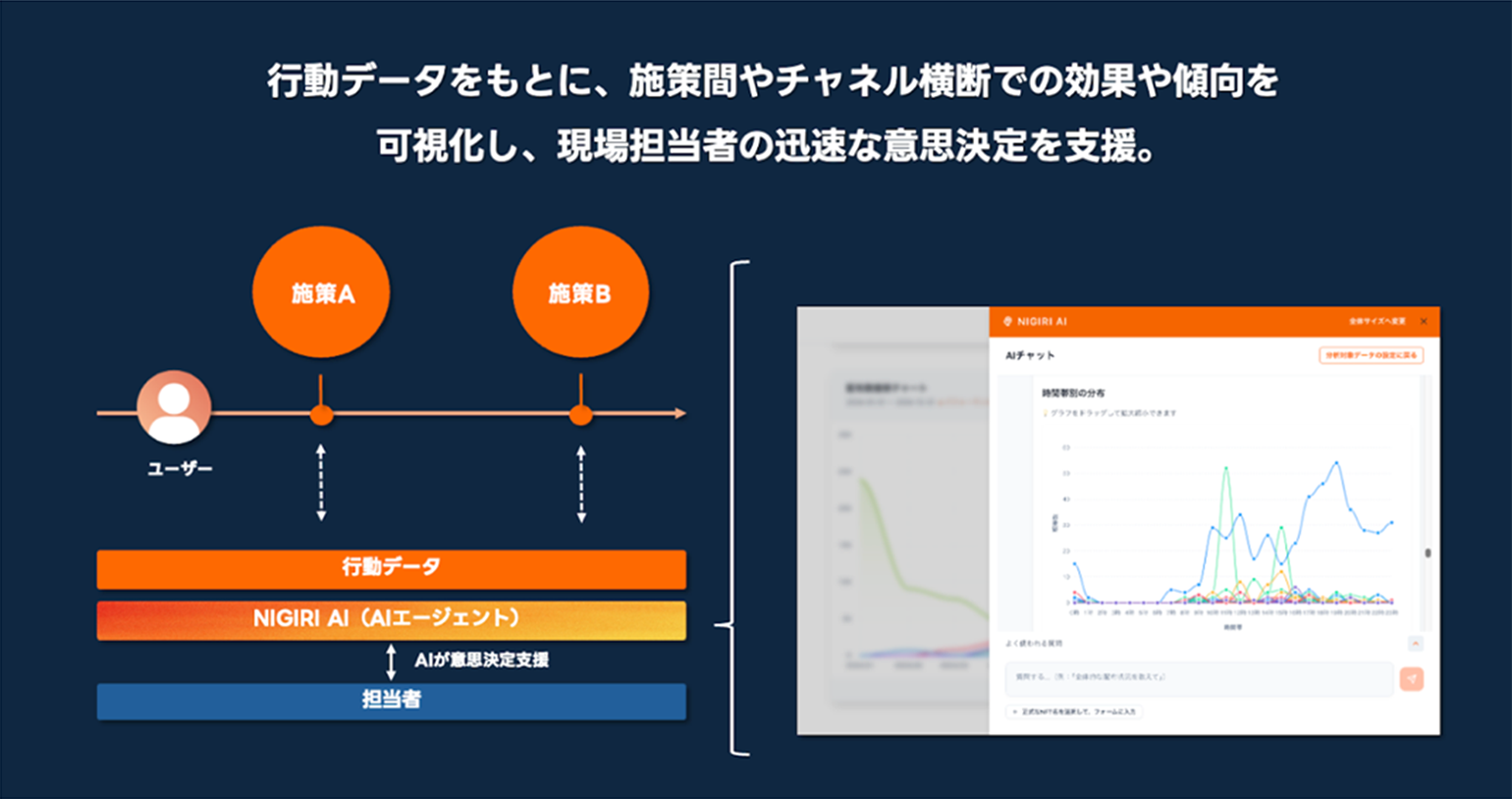
Furthermore, Dentsu Inc. and SUSHI TOP MARKETING jointly offer "Everyone's Footprints," a service enhancing customer experience value. This service uses NFTs to record and visualize consumers' actions as "footprints." AI analyzes this data, providing companies with a dashboard to understand their relationships with consumers.
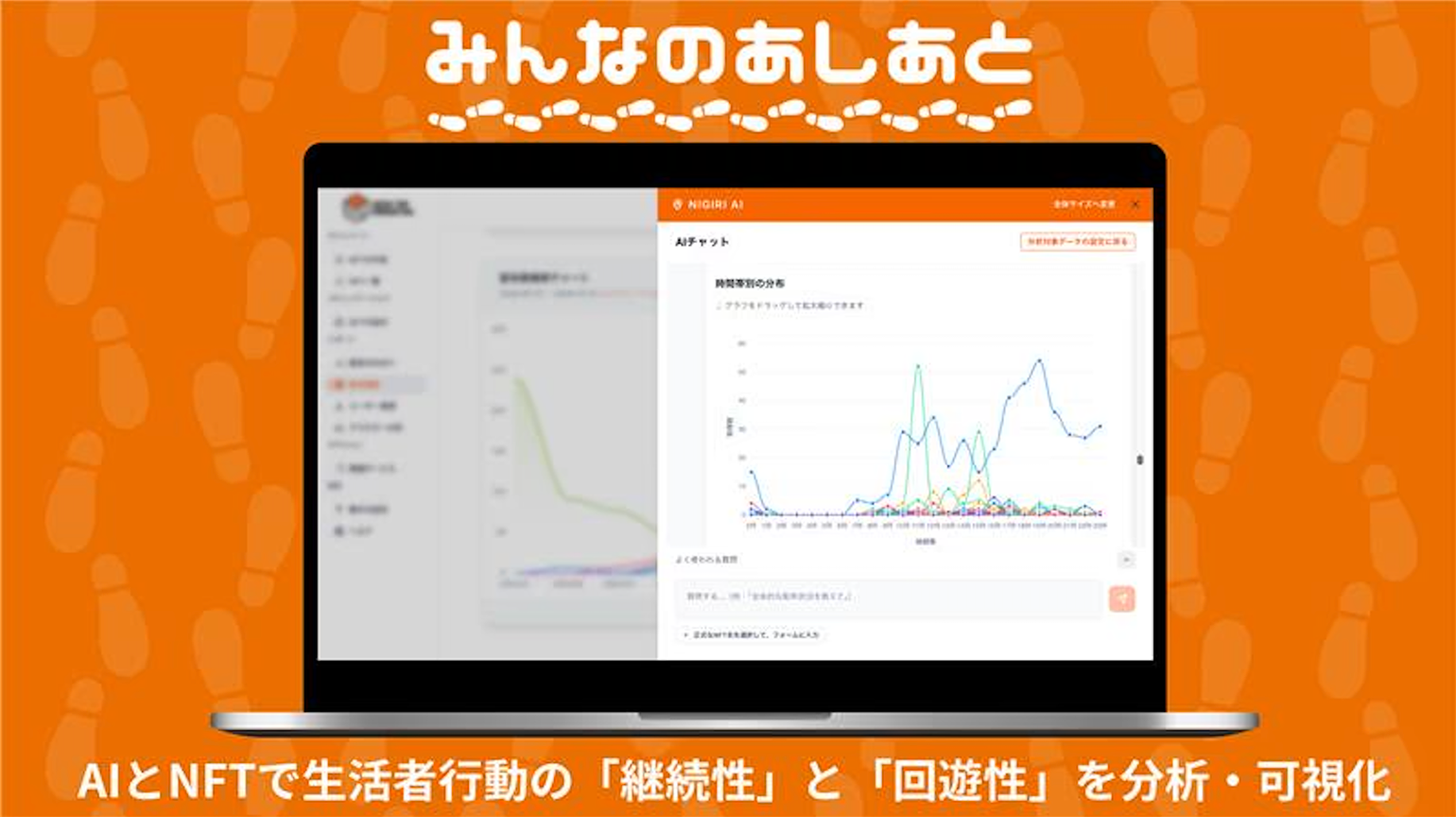
Insights derived from AI enable companies to understand previously unseen "relationship quality" and an individual's "identity"—what they value—not through attributes, but within the context of their actions. This allows for evolving experiences that closely align with each individual consumer.
From "Recording Actions" to "Building Relationships"
Blockchain plays the role of "recording actions," while AI fulfills the role of "interpreting actions."
Combining these two evolves the relationship between companies and consumers from "point-in-time interactions" to "relationships that endure over time."
When companies carefully interpret consumers' "footprints" and translate those insights into better experiences, this accumulation becomes the driving force for cultivating lasting relationships.
As technology permeates every aspect of life, what matters most is not collecting data for its own sake, but adopting a perspective that asks, "How can we use this to envision the next, better experience?"
By leveraging blockchain and AI, we connect "records of actions" to "building relationships." Through this practice, we aim to envision and create new forms of customer engagement.
Was this article helpful?
Share this article


Newsletter registration is here
We select and publish important news every day
For inquiries about this article
Author

Shoma Morishita
Dentsu Group Inc.
Dentsu Inc. Innovation Initiative
Senior Manager