Note: This website was automatically translated, so some terms or nuances may not be completely accurate.
 The Cutting Edge of "Messaging" That Supports the Power of Top Management's Words [1/4]
Why haven’t there been experts in “business language” until now?
We live in an age of information overload and rapid change. That is precisely why words that are unique to a company—words that only that company can say, words that reflect its very essence—are becoming increasingly important.
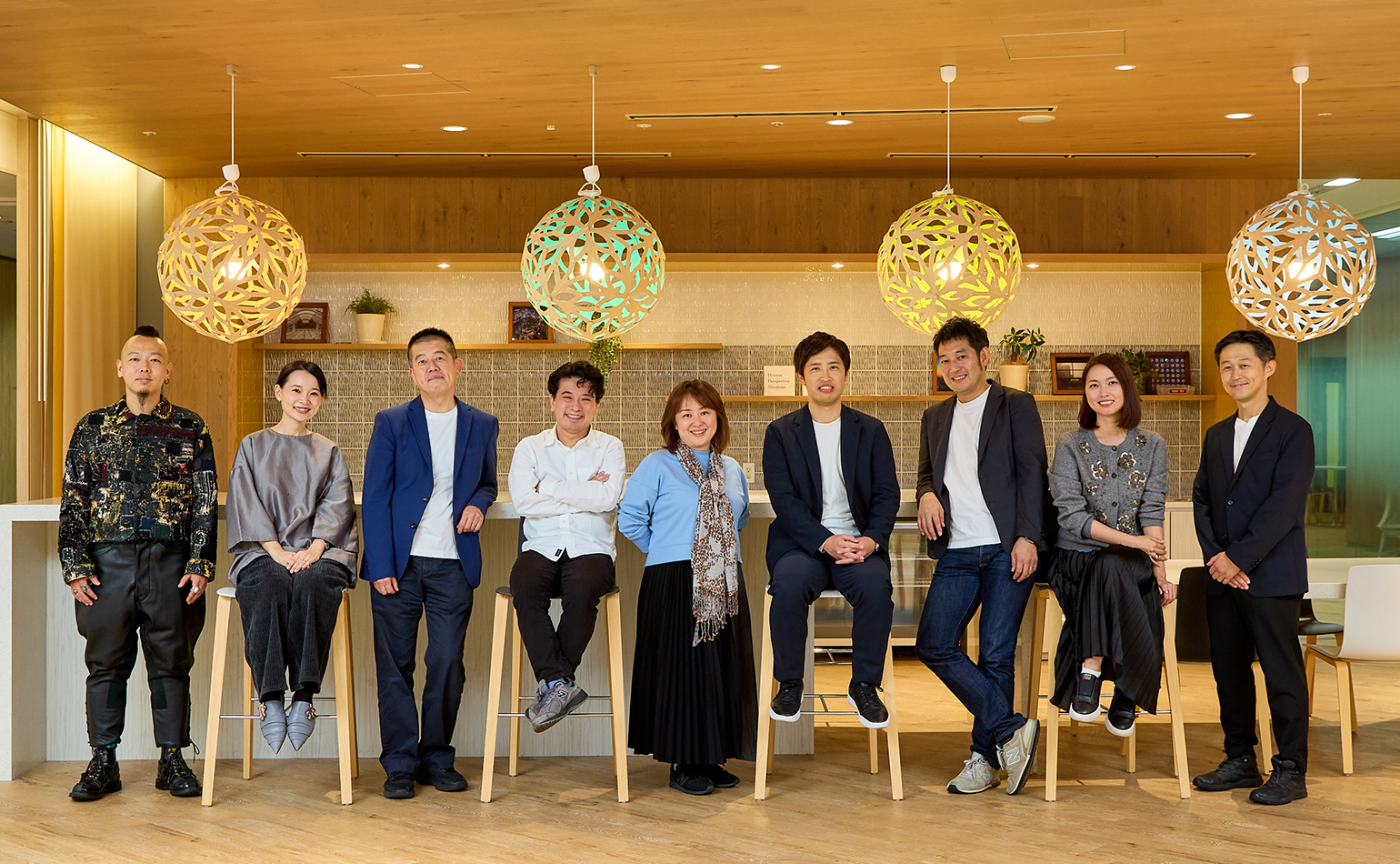
We at Dentsu Inc. Messaging Partners were established as a specialized team dedicated to corporate philosophies—such as purpose, mission, vision, and values—as well as speechwriting for top executives. In addition to copywriters, our team includes members with diverse backgrounds, such as PR planners and producers, all working under the banner of “Messaging Partners.”
In this series, we would like to carefully explain our team’s originality and expertise, as well as the future direction of “top executive messaging.”
<Table of Contents>
▼“Corporate philosophy,” “top management messages”… These terms, which are so crucial to management, have been crafted “by trial and error” each time, without a “definite method.”
▼The value latent “within a company” is difficult to discover “from within the company.” That is why “Dentsu Inc. Messaging Partners” exists.
▼“Human capital,” “social capital”… Cultivating these “invisible values” essential for a company’s sustainable growth is also the role of “management language.”
▼A level of transformation that goes beyond what typical consulting firms offer. This stems from Dentsu Inc.’s unique approach, which is dedicated to “moving people’s hearts.”
“Corporate philosophy,” “top management messages”… These words, which are so crucial to management, have been crafted “by trial and error” each time, without a “proven method.”
Nice to meet you. I’m Kei Nakayama of Dentsu Inc. Messaging Partners. I’d like to share with you the value of “top management messages”—a key element of “management language”—along with what makes Dentsu Inc. Messaging Partners unique.
“Revenue matters more than corporate philosophy,” or “Top messages are just words”—I don’t think you’ll find any executives saying such crude things these days.
In an era of increasingly rapid change, the importance of corporate philosophy—which serves as the foundation for decision-making—is growing. In an era where companies compete fiercely for top talent, the importance of top messages that boost employee engagement and bring out the best in employees is increasing. In an era where sustainability is required of management, the significance of a purpose that continues to create value over the long term is rising.
Many executives likely believe that “corporate philosophy”—including purpose, mission, vision, and values—and “top-level messages,” in other words, “the language of management,” are the driving force that keeps a company growing for decades.
However, how many executives are truly aware of the importance of the “process” required to produce these messages with high quality (where “quality” here does not refer merely to superficial polish)? And how many executives are thoroughly familiar with the “methods” for crafting these messages?
“It’s been six months since I took office as president, and I want to share a message with all employees, but I don’t know whose help to seek.” “I want to announce our major policies at the start of the fiscal year—should I have the corporate planning department come up with them?” “I’d like to incorporate employee feedback, so maybe I should gather some junior staff and hold a workshop?”
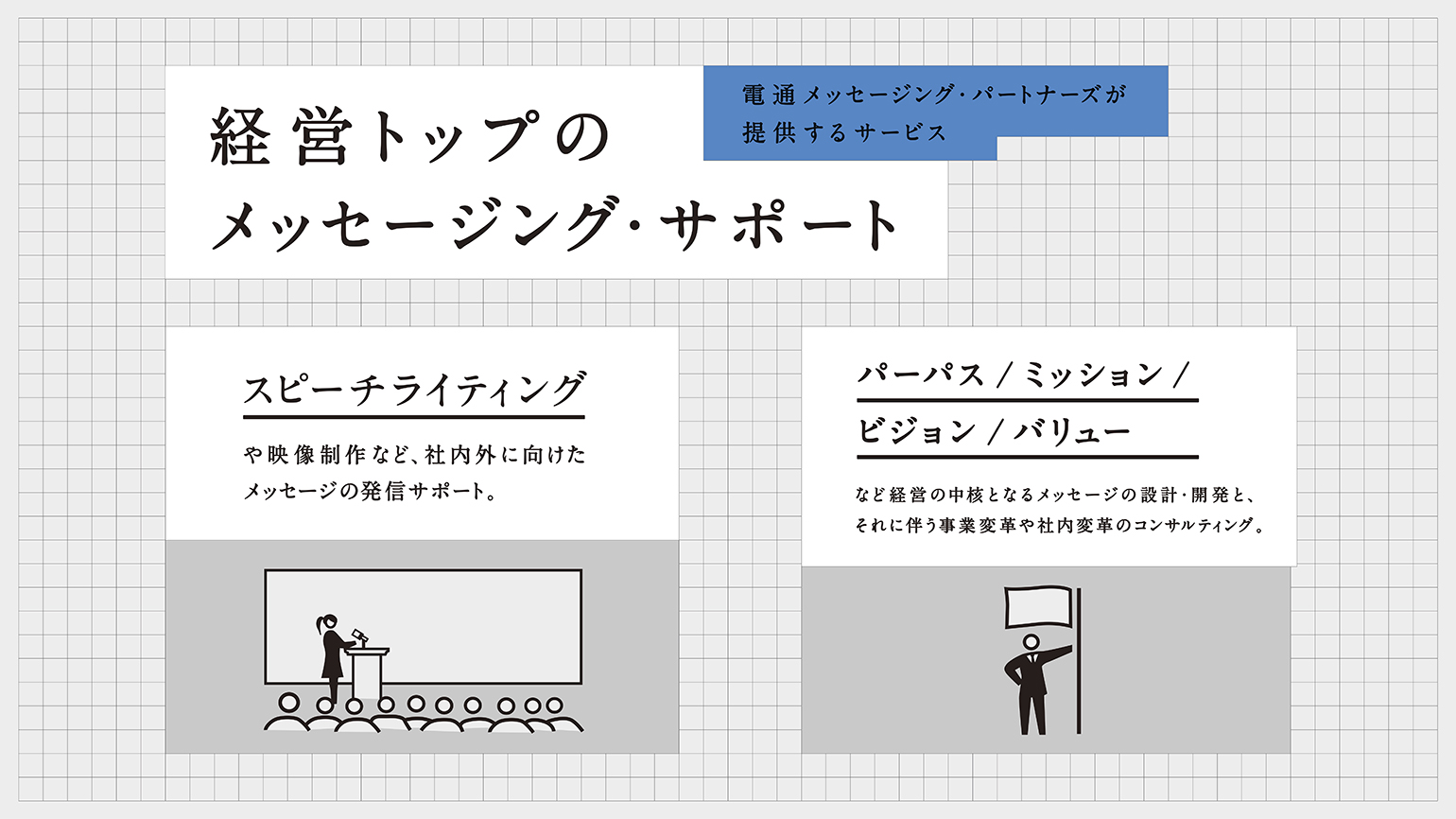
We have frequently observed situations where the development of “top messages”—a “management agenda” that is crucial for sustaining a company’s growth—is carried out in an overly haphazard manner.Based on the belief that “top messages, which are so important to a company, should be developed using appropriate processes and expertise,” we have consolidated the know-how we have provided to management teams at various companies over many years and organized “Dentsu Inc. Messaging Partners,” a team specializing in supporting the development of “top messages.”
The value latent “within a company” is difficult to discover “from within the company.” That is why “Dentsu Inc. Messaging Partners” exists.
When people hear the term “specialized organization,” some may imagine a group of outsiders imposing polished, trendy phrases on a company, saying, “Your company should put out this kind of message.” However, that is a complete misunderstanding. Words that touch on the very foundation of corporate management must be generated from within the company itself, based on its unique history, DNA, and the future possibilities specific to that company.
On the other hand, there is a structural problem: the values and treasures within a company are often difficult to identify from within. It is also a fact that extracting the unique value inherent in each individual company and elevating it into a distinct philosophy requires the perspective of external professionals and specialized know-how.
“How were you able to pinpoint the core values that define us?”
We often hear this question from the executives and management teams we’ve supported after a project concludes, but what we do is nothing extraordinary. We simply carefully excavate the unique value and future potential that each company has cultivated throughout its history from buried layers, and bring them to light in a tangible form through words. We unearth the valuable raw gems that each company already possesses from deep underground, polish them, and present them.I believe the work we do at Dentsu Inc. Messaging Partners is akin to mineral excavation or civil engineering.
Through its many years in the advertising business, Dentsu Inc. has honed the skills and know-how to uncover the value inherent in products—value that even the product developers themselves may not have realized—visualize it, present it to the world with the question, “Isn’t this what you’ve been looking for?”, and gain the empathy of society.It may be easier to understand if you think of Dentsu Inc. Messaging Partners’ work as applying those skills not to individual “products,” but to the entire “company” as it develops various businesses, engaging in activities to visualize its inherent value.
“Human capital,” “social capital”… Cultivating these “invisible values” essential for a company’s sustainable growth is also the role of “management language.”
We often hear the terms “human capital” and “social capital” these days. I believe this is because the idea that “to ensure a company’s sustainable growth, there are ‘invisible yet vital values’ beyond just money, and nurturing them is a crucial role of management” is becoming common sense in the business world.But how do we cultivate these “invisible yet vital values”? We believe the key lies in “empathy” among people, and that the source of this empathy is the “top message” communicated by senior leadership.
It is the power of the “top message” that transforms employees’ anxiety—such as “I don’t know where the company is headed”—into a single, positive hope. I believe it is also the role of the “top message” to dispel the unease of external stakeholders—such as “I’m not sure if I can trust this company”—and turn them into supporters.
While we use the term “corporation,” an excellent “corporate philosophy” and “top message” should truly embody the company’s “personality.” It is precisely because the “top message” embodies the company’s “personality” that it can strengthen “connections” with employees and build up “human capital.” It can deepen “trust” with the diverse people living in society and enrich “social capital.” That is what we believe.
A level of transformation not found in typical consulting firms. This stems from Dentsu Inc.’s unique approach, which is dedicated to “moving people’s hearts.”
We at Dentsu Inc. are no longer merely an “advertising agency.” In reality, we have expanded our scope of activities beyond simply supporting “product sales” to supporting “corporate growth” (that is, the consulting domain), and this now accounts for over 30% of our revenue.What sets Dentsu Inc. apart in this consulting domain is our unique approach: we are utterly dedicated to the questions “How can we generate empathy among people?” and “How can we move people’s hearts?” and we design real-world change with high precision.
Management, companies, organizations, and society—all activities are carried out by “people.” Unless the “human heart” is moved, nothing moves, nothing is created, and nothing changes. We at Dentsu Inc. Messaging Partners know from experience that facing this stark reality is what gives birth to “top messages” with the power to move people’s hearts.
A self-centered executive who loses sight of people’s feelings can lose society’s trust all too easily. Precisely because we live in such times, the role and significance of “top messages”—which generate empathy and inspire passionate action—will only continue to grow. And I believe there is a growing need for “empathy experts” who can fulfill that role and significance (which is why Dentsu Messaging Partners includes copywriters and PR planners with extensive experience in risk consulting).
By further refining “the language of management,” we aim to enrich the “invisible capital” that companies possess. By pouring more effort into “the language of management,” we aim to unleash the potential that lies dormant within companies and propel it toward the future.“The true potential of every single company goes far beyond what we currently see.” With this conviction, we at Dentsu Messaging Partners believe in the potential of companies and the future of this country, and today, we continue to diligently “unearth” the remarkable value that lies dormant within them.
Dentsu Inc. Messaging Partners
Email:messaging@dentsu.co.jp
Click here for the detailed eBook on “Dentsu Inc. Messaging Partners”
https://www.d-sol.jp/ebook/sustainability-corporate-branding
Was this article helpful?
Share this article


Newsletter registration is here
We select and publish important news every day
For inquiries about this article
Author
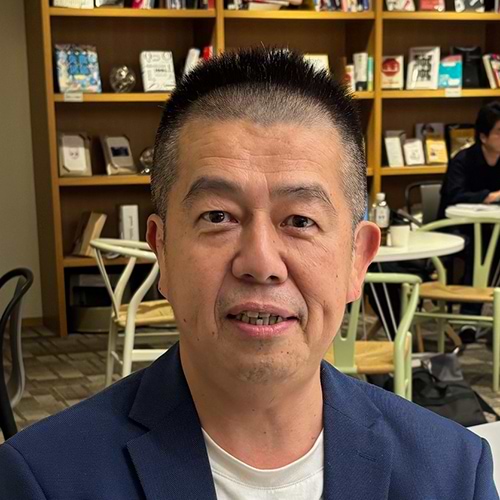
Keisuke Nakayama
Dentsu Inc.
Business Transformation Bureau 2, Growth & HR Department
BX Consultant, Copywriter