Note: This website was automatically translated, so some terms or nuances may not be completely accurate.
 The Cutting Edge of "Messaging" That Supports the Power of Top Management's Words [2/4]
The Role of a “Messaging Partner” Supporting Top Management

We live in an age of information overload and rapid change. That is precisely why words that are unique to a company—words that only that company can say, words that reflect its very essence—are becoming increasingly important.
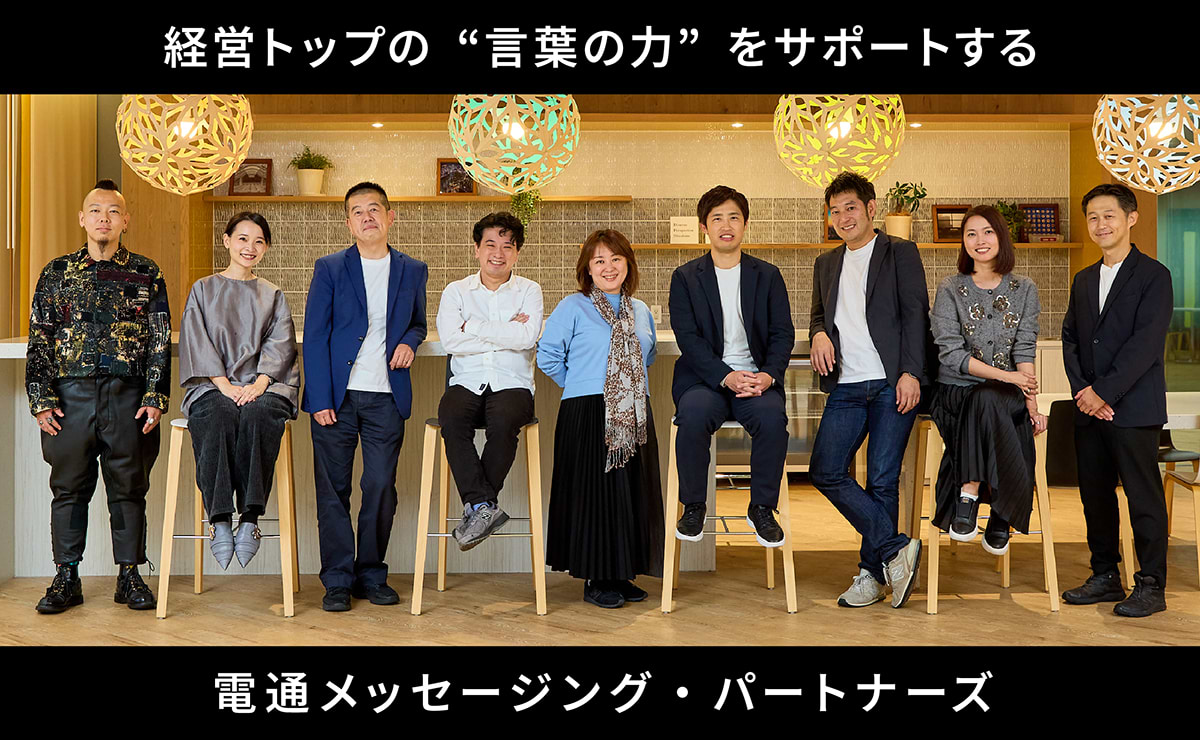
We at Dentsu Inc. Messaging Partners were established as a specialized team dedicated to crafting corporate philosophies—such as purpose, mission, vision, and values—as well as speechwriting for top executives. In addition to copywriters, our team includes members with diverse backgrounds, such as PR planners and producers, all working under the banner of “Messaging Partners.”
In this series, we would like to carefully share our team’s originality and expertise, as well as our vision for the future of “top executive messaging.”
What We Mean by “Messaging”
Hello. I’m Keisei Takahashi from Dentsu Inc. Messaging Partners. I work as a copywriter and hold the title of “Messaging Partner.” In this article, I’d like to share the vision and goals that inspired us at Dentsu Inc. Messaging Partners to launch this team.
If you look up the word “message” in a dictionary, you’ll see that its etymology lies in the verb “to send.” There is the sender and the receiver. How do we connect these two and align their respective goals? That is the very foundation of “messaging,” our area of expertise.
You might wonder how this differs from advertising copywriting. In fact, there is significant overlap. Nevertheless, we deliberately coined the term “messaging” for the following two reasons.
The first concerns the “scope” of our work. We wanted to clearly define our expertise as a team that supports the power of top executives’ words. We believed that our insights and skills could be most effectively applied in the realm of corporate messaging—more specifically, the words spoken by top executives themselves.
The second reason is to clarify the “process” of crafting words. We felt that conventional presentation formats made it difficult to convey the personal thoughts of individual executives with high purity. Consequently, we often proceed through a session-based format involving repeated dialogue.
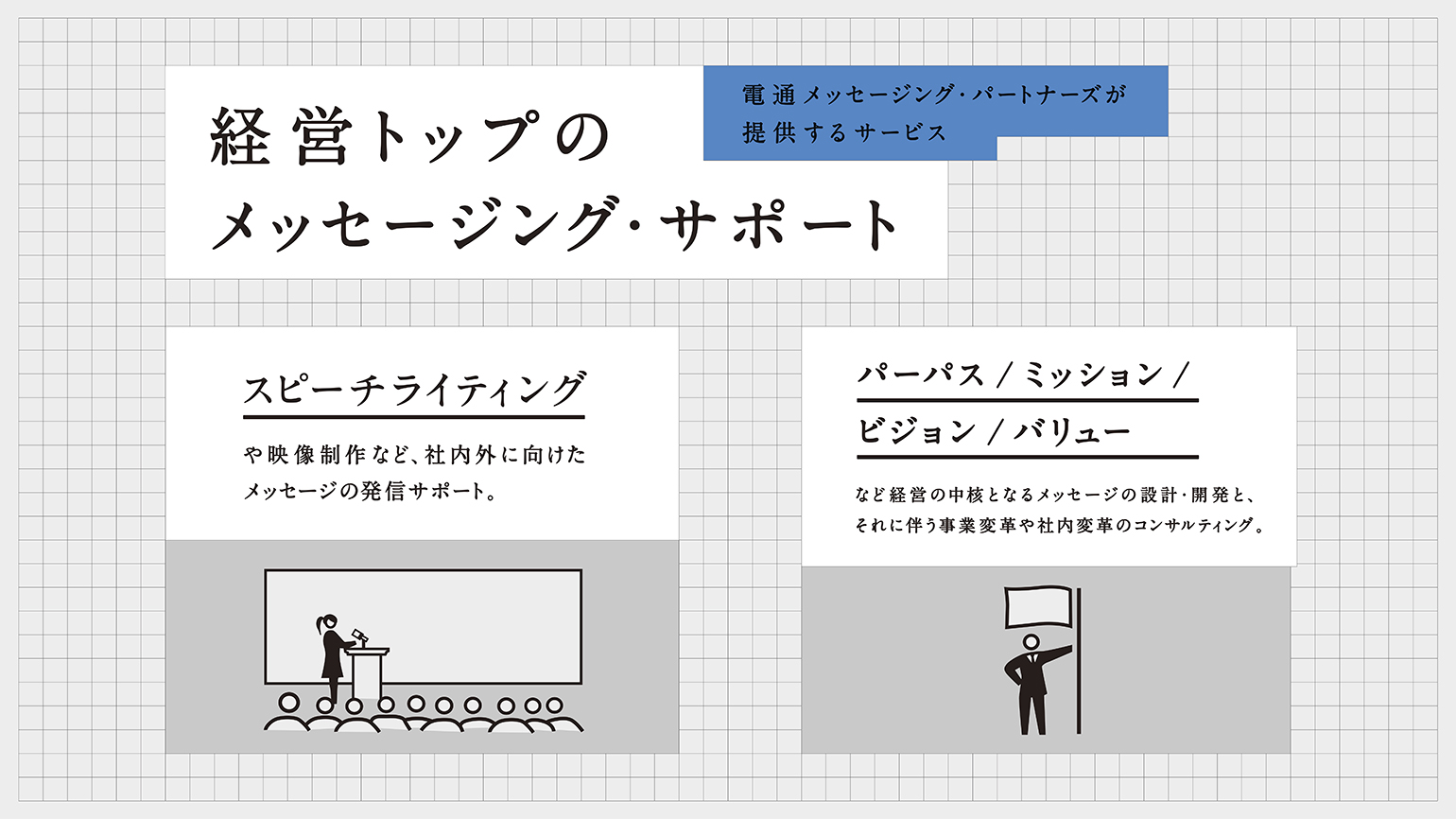
Based on this approach, we offer a service called “Messaging Support.” We are receiving an increasing number of inquiries from top executives and organizational leaders, as well as from those in corporate planning and public relations departments. We often hear from clients that while they were aware of challenges related to “messaging,” they were unsure where to turn for help.
Finding “Yes, that’s it!” through “Dialogue”
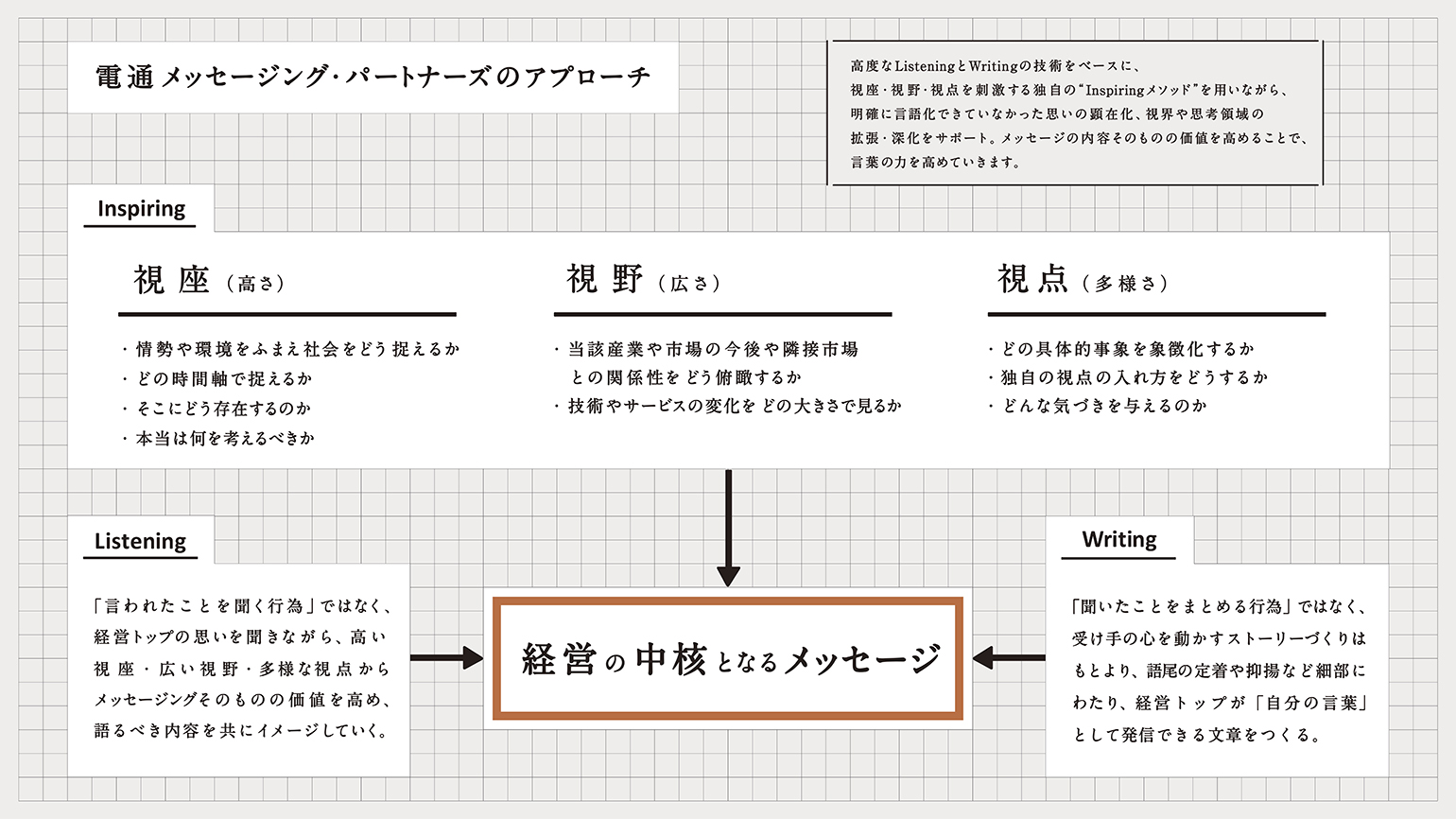
As mentioned earlier, “dialogue” is at the heart of our Messaging Support. We generally avoid preparing materials like slides or documents as much as possible, and in many cases, we begin by having the top executive themselves tell us what they want to say and convey.
Of course, sometimes clients bring a draft script from the start, but we believe that by directly receiving their raw thoughts and passion before they’re polished, we can enhance the quality and precision of the final message.
For example, we often find crucial insights in the stories they share—such as personal anecdotes, events outside of work, or themes they’ve been pondering recently—even when they preface them with, “This might stray from the main point.”
When trying to communicate broadly to “all employees” or “all stakeholders,” the subject naturally shifts to “we”—that is, the corporate voice. However, regardless of the size of the audience, the fundamental structure of “the speaker and the listener” remains unchanged. Therefore, in speechwriting, we strive to craft stories told in the first person—“I.”Of course, we must accurately organize and convey what the company needs to communicate. On top of that, to deliver the message more effectively and memorably, we infuse it with personal passion. That is the balance we strive for.
Beyond that, we also place great importance on actively posing “questions” to our audience. When people are asked a question from an unexpected angle, they may feel a moment of surprise or confusion. However, this can serve as a catalyst, helping them discover “themes they had considered but weren’t consciously aware of,” or broadening their perspective to realize, “Actually, this is what I really wanted to talk about.”
For example, during a discussion about a specific challenge, I might ask, “If we assume that challenge were suddenly resolved, how would the company change?”—a question designed to broaden their perspective.
Or a question that moves across time, such as, “If your future self from 10 years from now could give just one piece of advice to your current company, what would you say?”
The more the conversation and discussion branch out in various directions, the deeper we can delve into the message that truly needs to be conveyed. Our role isn’t merely to organize and summarize what’s been said. During the dialogue process, the moment we pinpoint the core—the very thing that must be communicated—we both feel that sense of confirmation: “Yes, that’s it!” Once we find that, the foundation of the message is established, and we can move on to refining the story.
What’s fascinating is that it’s not just us listeners who are surprised—the clients themselves often react with comments like, “I can’t believe I was thinking about this!” or “Why didn’t I realize this sooner?” I believe this kind of insight rarely emerges in settings where roles are rigidly defined, such as during a typical presentation.
After engaging in this kind of dialogue, we draft the text and message proposals, then engage in further dialogue. That is our approach to shaping the “core message of the business.”
What We Hope to Achieve Through “Messaging”
I may have gotten a bit passionate there, but you might be thinking, “Isn’t there already too much information in the world today?” However, isn’t it precisely for that reason that the importance of clearly defining and delivering the messages that truly need to be conveyed is growing?
As I mentioned at the beginning, just as the etymology of “message” comes from “to send,” I believe that if we can properly connect the sender and the receiver, the company will be able to demonstrate even greater strength, and this will also lead to unlocking the potential of every single person working there.
Some might argue that if business and management could succeed through words alone, we wouldn’t face such challenges. Yet, it is words that ultimately drive people’s intentions and actions. Why am I doing this work? How does the work right in front of us connect to the future? I believe that when both companies and individuals deeply internalize the meaning behind these questions, they can move closer to their envisioned ideals.
That is why we do not simply view the creation of words as our end goal. We aim, for example, for those words to circulate as “in-house catchphrases.” We aim for questions like, “Does that align with our mission of XX?” to naturally arise. We continue to think earnestly about how to create a common language that spans from management to the front lines, so that it can be utilized in daily work.
Above all, we find immense fulfillment in those moments during dialogue when someone says, “Yes, that’s exactly what I wanted to say.” It is also a great joy for us to witness the moment when a presentation or speech—crafted sentence by sentence through repeated dialogue—truly resonates with the audience.
Some might say it’s “just words.” But we are committed to doing our utmost to ensure those words hold meaning for the employees and executives of each company.
Dentsu Inc. Messaging Partners
Email:messaging@dentsu.co.jp
Click here for a detailed eBook on "Dentsu Inc. Messaging Partners"
https://www.d-sol.jp/ebook/sustainability-corporate-branding
Was this article helpful?
Share this article


Newsletter registration is here
We select and publish important news every day
For inquiries about this article
Back Numbers
Author

Keisei Takahashi
Dentsu Inc.
Creative Planning Division 2 / Future Creative Center
Copywriter