Note: This website was automatically translated, so some terms or nuances may not be completely accurate.
 Dentsu Inc. Business Design Square's New Secret Manual [4/7]
By diagnosing the vision, the company's future path becomes clear.
While no company exists without a vision,
every company is born to deliver value to people and enrich society.
Why do they operate their business? What do they aim for? Open any company's website, and you'll likely find their mission, vision, and values—or their management philosophy or guiding principles, as they may be called—defined in words.
Yet, we at Dentsu Inc. Business Design Square (BDS) receive inquiries about vision from diverse companies across industries. And in many cases,
"The vision isn't working."
In fact, this single statement often masks a complex layering of challenges.
For example, internal surveys often show that awareness of the vision isn't low. When asked, "Do you know your company's vision?", people can usually answer. However, there can be significant variation in its interpretation depending on position or age group. Furthermore, through ongoing dialogue, seemingly unrelated issues emerge, such as a lack of proactive ideas from the field or difficulties finding ideal candidates during recruitment.
When we say the vision isn't working, it's easy to jump to the idea that the word itself is problematic and should be changed. But in reality, the issue is deeper than that:
a vision that isn't working = "a state where the company's internal problems have surfaced."
In such cases, merely changing the vision won't solve the fundamental issues. We place the utmost importance on using the vision as a kind of "entry point" to engage deeply with the company.
The better the vision, the more it circulates within the company
So, conversely, what makes a good vision? What does it mean for a vision to function? Let's start by considering that. At BDS, we don't view a vision as merely "catchy words." While memorable phrasing or striking expressions are important, what matters more is the role that vision actually plays.
I often say, "Let's find the words that become your company's 'proper noun'." Even if they are simple or universal words, the ideal state is when they are deeply rooted within the company and its philosophy is consistently expressed in unison across every workplace. That it naturally "circulates" internally as words unique to that company. That, I believe, is the condition for a good vision.
Here, I'd like to introduce someone who puts "creating a functional vision" into practice on the front lines: Mr. Yasuhito Tanaka, CEO of Grid and CMO of Yoshinoya.
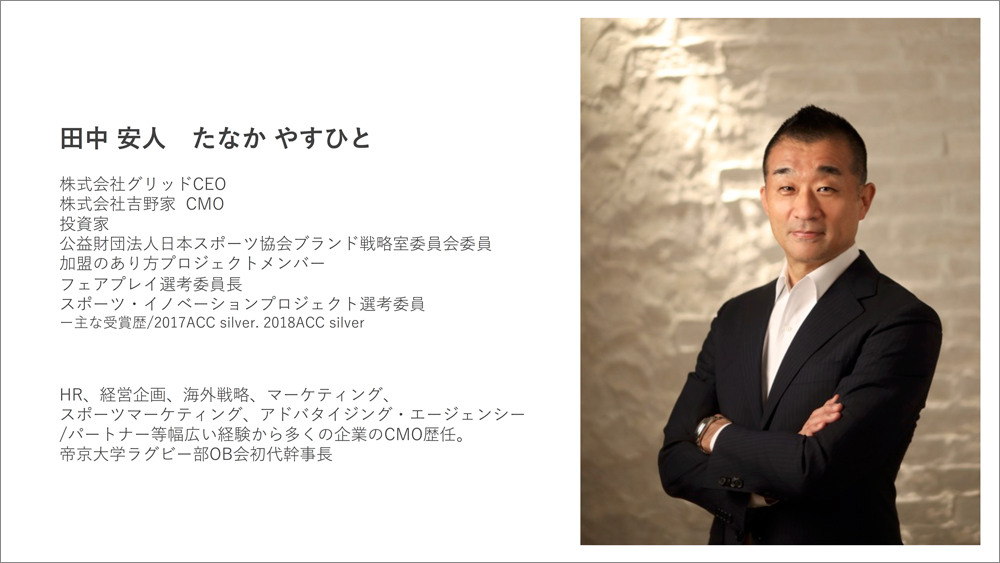
When Mr. Tanaka worked on developing a vision at Yoshinoya, the phrase "Never let everyday meals disappear" emerged during extensive discussions among the management team.
This embodies the spirit cherished by Yoshinoya since its founding—essentially the company's DNA. Even today, rushing trucks to disaster zones to provide gyudon is simply a natural act for them.
Since then, guided by the belief that a vision rooted in a company's DNA is a "functional vision," Tanaka always prioritizes uncovering that DNA when consulting on vision development for other companies.
Diagnosing a vision means visualizing a company's challenges
In September 2020, the vision diagnostic service " Visioneering Assessment " began joint provision by Dentsu Inc. and Grid, the company led by Mr. Tanaka.
Much like a structural integrity assessment in architecture, it meticulously examines the strength and structure of a vision. Its distinctive feature is not merely evaluating the wording of the vision statement, but using the vision as an entry point to visualize the complex challenges the company faces.
First, an explanation of the term "Visioneering" is necessary. It refers to the vision development service provided by BDS. A portmanteau of "Vision" and "Engineering," it is a program that comprehensively designs not only the copywriting itself, but also how to make it function within the company and how to propagate its effects into management and business operations.
The Visioneering Assessment program also leverages Visioneering insights. A team is formed with members possessing diverse expertise: copywriters, business planners, and Inner Activation Specialists specializing in internal transformation. Furthermore, by having Mr. Tanaka, who knows the frontlines of operating companies intimately as a CMO, participate, we were able to release it as a multifaceted and practical diagnostic service.
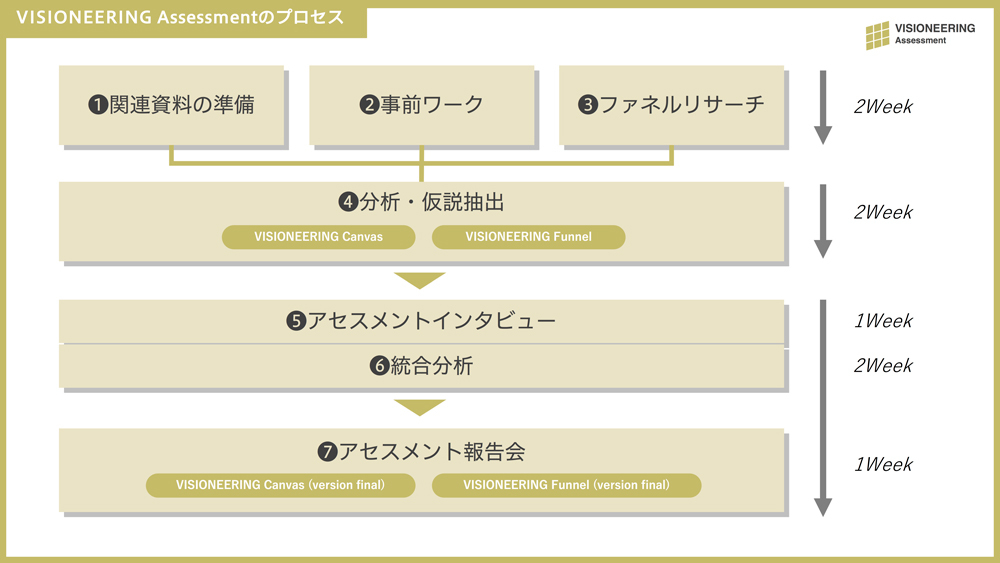
Thorough diagnosis using expert insight and data
While the actual service delivery progresses interactively through dialogue and sessions, we will introduce the two core diagnostic outputs here.
First, after gathering company information and conducting interviews, the comprehensive diagnostic result is the "Visioneering CANVAS."
This framework consists of five criteria. Starting with "Vision Strength" in the upper left, it clarifies whether there is "Consistency" along both the vertical and horizontal axes.
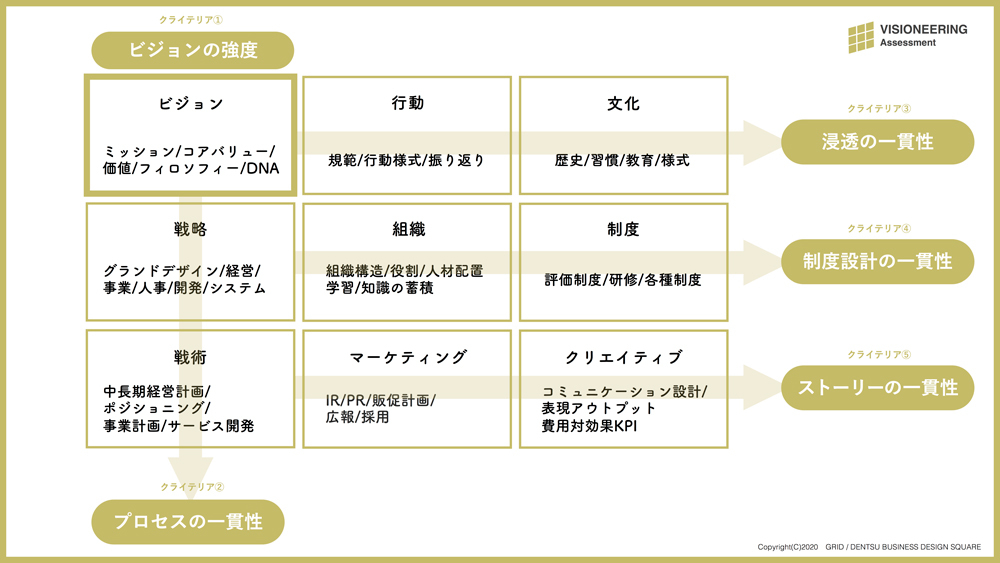
Taking the vertical axis on the left side of the diagram as an example, it examines whether the company's "Vision" is translated into management and business "Strategy." Furthermore, it assesses whether even the tactical actions on the ground contribute to achieving the vision, comparing this flow against the company's actual measures and performance.
Even if a company has a grand vision, its functionality and effectiveness vary significantly depending on whether it directly connects to the daily tasks each employee faces. Whether action guidelines for "tomorrow's step" are designed is also a crucial perspective for judging the strength of the vision.
By diagnosing each element in this manner, challenges become clear: which axis shows weak consistency, and where does this inconsistency originate? During actual service delivery, we refine the analysis through primary and secondary diagnostics, engaging in repeated discussions with company executives and stakeholders.
Of course, the goal isn't solely to find weaknesses or flaws. Where does the company's inherent potential lie? If it isn't being realized, what are the reasons? We believe that carefully unraveling these questions enhances the company's capacity for internal transformation and, ultimately, its power to drive change within society.
The second diagnostic output is the Visioneering Funnel. This tool gathers data and quantitatively assesses the functionality of the vision.
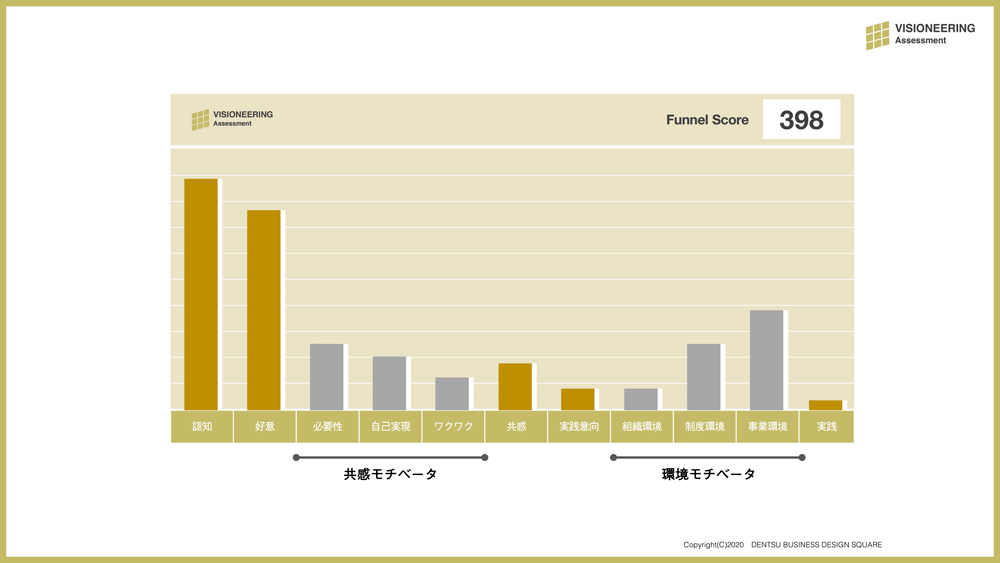
We conduct internal surveys to compile data on vision penetration, employee awareness, and behavioral characteristics. While absolute numerical values are important, this data also serves as material for identifying distinctive trends—such as differences in awareness by department, position, or age group. Conducting this survey regularly enables tracking changes over time and verifying the effectiveness of internal initiatives.
Redesigning the Future Starts with Vision Diagnosis
As mentioned at the outset, every company is born with a vision. However, it is also true that a vision consisting solely of pleasant-sounding words cannot function effectively when adapting to environmental changes in markets or industries to ensure survival.
That is precisely why we aim to help companies rediscover their inherent mission and underlying strength by diagnosing their vision, empowering them to effectively communicate this to society.
Redesigning the blueprint for the future begins with diagnosing the vision. That is precisely the spirit we have poured into our Visioneering Assessment. Where have we come from as a company, and where are we headed? We sincerely hope to explore this together with you.
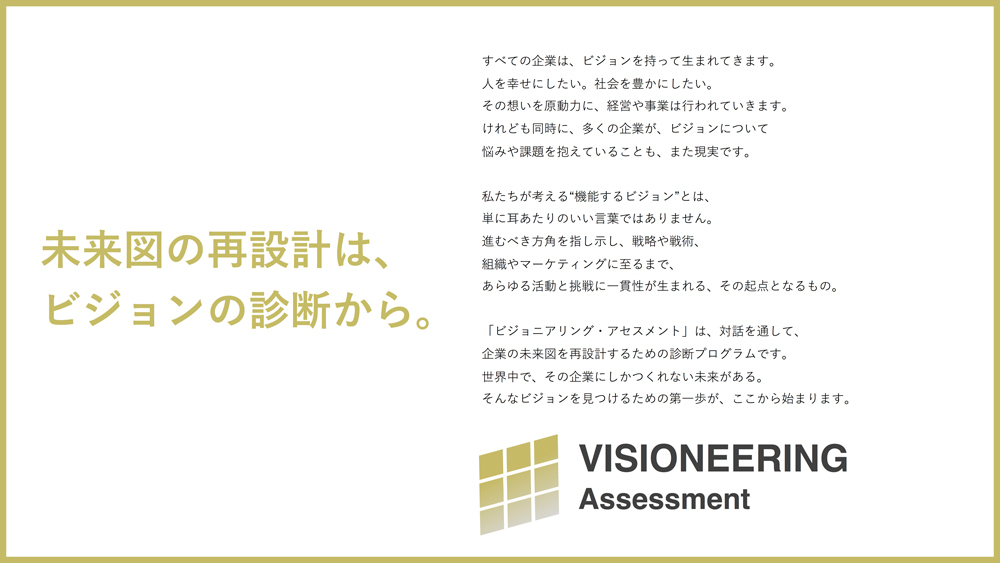
Visioneering Assessment Release:
Launching "VISIONEERING Assessment" – a diagnostic service that visualizes all challenges in corporate activities and organizational structures, paving the way for implementing a "functional corporate vision."
Was this article helpful?
Share this article


Newsletter registration is here
We select and publish important news every day
For inquiries about this article
Back Numbers
Author

Keisei Takahashi
Dentsu Inc.
Creative Planning Division 2 / Future Creative Center
Copywriter