From left: Keita Koyama of Dentsu Digital Inc., Shotaro Iizaki of Dentsu Inc., and Daisuke Akiba of TikTok for Business Japan
Since launching in Japan in 2017, the short-form video platform "TikTok" has gained popularity across a wide range of generations, particularly among younger audiences. Its movement has spread worldwide, and it has now become a source of trends and culture.
It is also gaining attention as an advertising platform for companies and brands. In June this year, TikTok released its proprietary measurement and analysis platforms and advertising solutions, including "TikTok Market Scope (TTMS)" and "Brand Consideration."
This time, Dentsu Inc. and Dentsu Digital Inc. collaborated with TikTok for Business to measure the quantitative advertising impact on "in-store purchases," utilizing TTMS data.
How do TikTok ads influence users' in-store purchases?
We spoke with Daisuke Akiba of TikTok for Business Japan, Keita Koyama of Dentsu Digital Inc., and Shotaro Izaki of Dentsu Inc.
Akiba: As the head of Marketing Science for TikTok for Business in Japan, I oversee the quantitative verification and analysis of the effects of ads placed by advertisers. This time, we collaborated with Dentsu Inc. to conduct an effectiveness verification study for ads distributed on TikTok, starting from "physical store purchases."
Koyama: I specialize in TikTok advertising within Dentsu Digital Inc.'s Platform Division, currently focusing on advancing TTMS and Brand Consideration initiatives.
Izaki: I belong to Dentsu Inc.'s Data Technology Center. My regular duties include developing ad effectiveness measurement products and conducting analysis. For this project, I collaborated with TikTok for Business on developing an ad effectiveness measurement product and conducting verification using that product.
──Before we dive into the project details, could you explain what TTMS and Brand Consideration are? They were released by TikTok for Business this year.
Akiba: TTMS is a measurement and analysis platform that enables real-time visualization of the growth of audiences with high purchase intent. It is provided to advertisers using TikTok ads.
A major feature of this platform is its ability to visualize the marketing funnel. Specifically, it shows how many audiences are at each stage of the funnel—"Awareness," "Consideration," and "Purchase"—and identifies which users are at which stage.
TTMS's major feature is its ability to visualize how many audiences are at each stage of the marketing funnel and which users are at which stage.
Akiba: Traditional marketing funnels were purely conceptual. Advertisers would set hypothetical audience profiles for each stage—Awareness, Consideration, Purchase—and deliver ads to those profiles. TTMS, however, categorizes actual users into each stage based on their TikTok behavioral data, forming real audiences. This enables the precise visualization of audience movements.
Based on the funnel visualized by TTMS, Brand Consideration is an advertising product designed to increase the "Comparison and Evaluation" segment.
Koyama: With Brand Consideration, we understand which stage the recipient belongs to and then deliver ads to expand the comparison and consideration group. This is a feature unique to TikTok Ads, made possible by the TTMS analytics environment.
──Among the diverse advertising platforms available, what are the characteristics and strengths of TikTok Ads?
Akiba: As mentioned earlier, a key feature and strength of TikTok Ads is its support for "full-funnel marketing," covering all stages of the marketing funnel. Advertisers select their objectives from three stages—Awareness, Comparison/Consideration, and Purchase—and our recommendation system delivers ads to the most suitable users.
We are particularly strong in the comparison and consideration stage, and are currently strengthening our ad delivery mechanisms to increase audiences in this stage, starting with Brand Consideration.
Even for products typically purchased in physical stores, we want to measure advertising effectiveness!
Dentsu Inc., Mr. Shotaro Iizaki
──What challenges and needs did advertisers face when undertaking this project?
Akiba: Previously, especially for products typically purchased in physical stores, it was difficult to visualize "how much the delivered ads contributed to product sales or business growth." For example, even if store sales increased after a TikTok campaign, accurately determining how much of that sales growth was directly attributable to the TikTok campaign was a significant challenge.
We frequently heard from advertisers, especially for products bought in physical stores, that they wanted to know "how the actual business moved as a result of running ads." Our challenge was that we couldn't refine specific media planning and operational improvements in a way that maximized business results to address that need.
──Against this backdrop, Dentsu, Dentsu Digital Inc., and TikTok for Business conducted joint research. What became possible through collaboration with the Dentsu Group?
Iizaki: By cross-referencing Dentsu Group's linked physical store purchase data with TikTok's advertising data within a privacy-protected analytical environment, we achieved precise quantitative effect measurement based on actual store purchases. In other words, we made it possible to visualize "how much TikTok advertising contributes to physical store purchases."
──Could you explain what kind of analysis you performed based on the physical store purchase data and what insights you gained from it?
Akiba: In short, we cross-referenced and analyzed the physical store purchase data shared by the Dentsu Group with the funnel data we obtained through TTMS analysis, all within a privacy-protected environment. Let me explain in a bit more detail.
First, we classified TikTok users into an "ad delivery group" and a "group intentionally excluded from ad delivery" based on whether they had seen the relevant ad on TikTok, and then ran an ad campaign. By ensuring no differences in audience attributes between the two groups, we aimed to isolate the pure effect of the ads. We then cross-referenced both groups with physical store purchase data to examine the difference in purchase volume between the two groups.
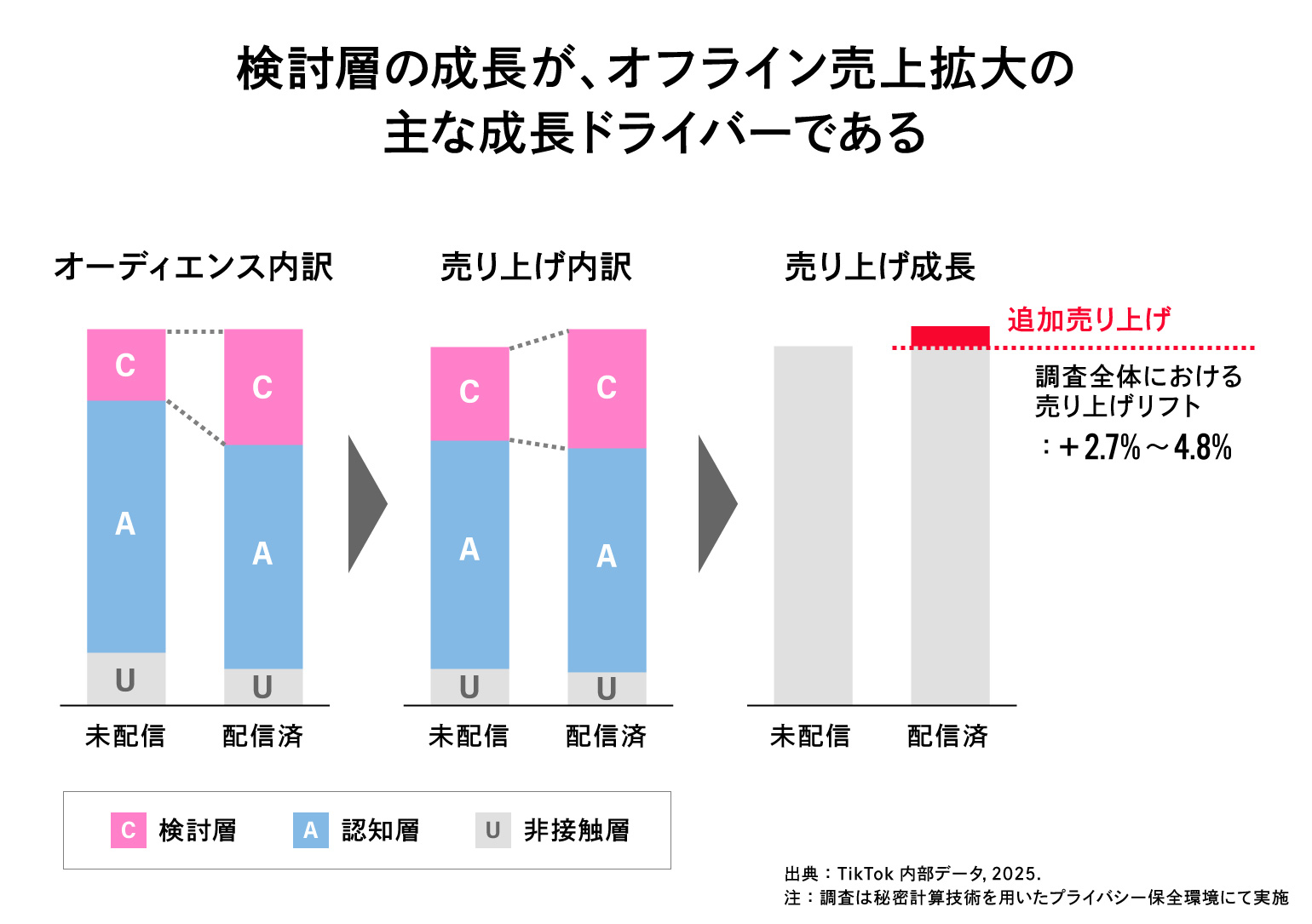
Furthermore, within TTMS, we subdivided the "ad delivery group" and the "group intentionally excluded from ads" into "Awareness Stage" and "Comparison/Consideration Stage." This means we segmented customers into three stages: "Non-exposed," "Awareness Stage," and "Comparison/Consideration Stage," examining the audience breakdown and differences in purchase volume.
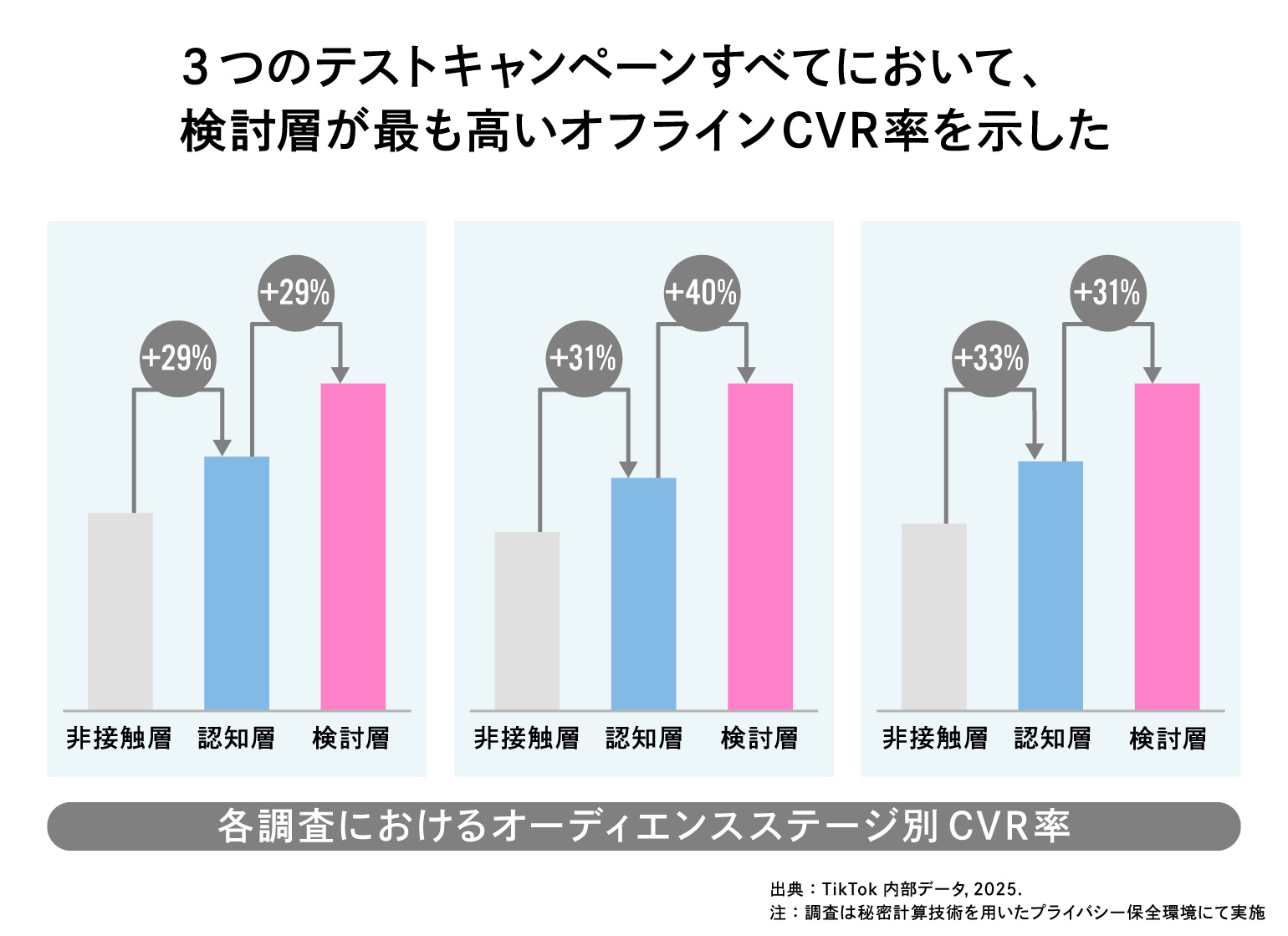
The results quantitatively proved two key points: "the comparison/consideration segment has a higher purchase rate" and "ad delivery further increased the comparison/consideration segment, boosting overall sales." We were able to demonstrate, with real data, how TikTok ads contribute to increased physical store purchases.
In all three test campaigns conducted, the "Comparison/Evaluation Stage" had the highest purchase rate (CVR).TikTok ads led to an increase in the number of potential buyers, and the growth in this high-purchase-rate segment resulted in a net increase in overall sales.
Iizaki: "We observed a trend where increasing the comparison/consideration group in TTMS leads to purchases and business growth. We believe this makes it an effective intermediate KPI for advertisers when running campaigns."
Furthermore, this analysis also revealed effective planning and creative approaches for driving in-store purchases and business growth. Advertisers greatly appreciated gaining valuable insights that can be leveraged for future planning and budget allocation.
Nurturing a Healthy Marketing Funnel with TTMS
Keita Koyama, Dentsu Digital Inc.
──The joint research by Dentsu Inc., Dentsu Digital Inc., and TikTok for Business quantitatively demonstrated how TikTok ads contribute to business growth and yielded actionable insights for the future. How do you plan to build on these findings moving forward?
Koyama: This analysis reaffirmed that "increasing the comparison/consideration stage audience" is crucial for improving in-store purchase rates. Moving forward, we want to focus on advertising strategies to grow this comparison/consideration stage audience. This includes targeting awareness-stage audiences with ads to encourage them to move down the funnel into the comparison/consideration stage.
Akiba: Furthermore, as TikTok for Business, we don't want to focus solely on increasing the comparison/consideration group; we also want to look at creating "circulation throughout the entire funnel."
I believe nurturing a healthy funnel ecosystem is vital for sustainable business growth. How can we leverage TTMS to promote circulation within the marketing funnel and drive lasting corporate growth? This is an area we intend to continue working on together with the Dentsu Group.
Izaki: This June, we launched "TikTok Shop," an e-commerce feature, along with "GMV Max," an advertising solution designed to expand GMV within TikTok Shop. Moving forward, we aim to advance analytics for TikTok Shop purchases, including analyses that combine online and offline store purchases.
Furthermore, we will focus on developing products that maximize the value of TikTok advertising by conducting multifaceted verification using various data sources in collaboration with the Dentsu Group.
──How would you like advertisers to utilize TikTok advertising?
Izaki: As discussed today, TikTok is an advertising platform supporting full-funnel marketing. We hope advertisers will utilize the insights gained, our advertising solutions like Brand Consideration, and our analytics products to implement full-funnel PDCA cycles in ad delivery and leverage this for their marketing.
Quantitative measurement of advertising effectiveness on physical store purchases is particularly effective for products like daily consumer goods, where in-store sales and purchases are primary. We believe this will be especially valuable for those in such industries.
Koyama: First, I want you to recognize the value in two key points: the visualization of audiences across the marketing funnel and the clear proof that TikTok ads drive physical store sales.
Also, as Mr. Iizaki mentioned earlier, commerce platforms like TikTok Shop are growing. We encourage you to verify each step of the process from ad delivery to purchase, make continuous improvements, and ultimately drive more effective marketing activities.
Akiba: As I mentioned earlier, fostering a healthy entire funnel is essential for sustainable business growth. We also want advertisers to focus on "how to use TTMS to healthily develop their own marketing funnel."
We also aim to undertake initiatives that help solve advertisers' challenges, leveraging the power of the Dentsu Group's collaborative purchasing data and diverse solutions.
Engaged in marketing science operations on advertising platforms such as Meta, Amazon, and Pinterest. Assumed current position in June 2025.
Keita Koyama
Dentsu Digital Inc.
TikTok Group
After working in advertising sales at newspapers and major web media outlets, joined Dentsu Digital Inc. Served as a social platform manager, working on data clean rooms, API integration, and mass media partnerships.
Responsible for client-facing advertising effectiveness measurement and analysis, primarily within the data clean room.
Simultaneously leads domestic and global data product development and collaborations with businesses holding purchasing data, consistently engaged in data technology-related work.