Note: This website was automatically translated, so some terms or nuances may not be completely accurate.
 DENTSU DESIRE DESIGN's Approach to Marketing Reconstruction Based on "Theory of Desire" [27/40]
Differences in career advancement awareness and actions are affecting happiness levels!?
Dentsu Inc. Desire Design (DDD) is an organization that develops various solutions and disseminates information based on the relationship between consumption and desire.
Starting with the 21st installment, we analyze DDD's "Heart-Moving Consumption Survey," sharing insights and findings derived from the survey results.
This time, we focus on consumers' "career advancement awareness." Based on the results of the 10th survey conducted in May 2025, Ayaka Yoneya of DDD explores the relationship between "attitudes and actions toward career advancement" and "happiness and social values" among those primarily in their 30s and 40s.
<Table of Contents>
▼"Job Changes" Emerge as a Major Topic! An Era of Considering "Work Styles" Throughout One's Life
▼Over 70% of those in their 30s and 40s feel the need to obtain qualifications or improve their skills
▼One group stands out as feeling least "happy" and least hopeful about their own lives and society
▼Is the group that sees qualification acquisition and skill enhancement as "necessary and actionable" made up of people who "do their best and leave the rest to fate"?
▼Reducing the "Discrepancy" Between Self-Perception and Action Leads to Increased Happiness and Hope
"Job-hopping" is a major topic! An era of considering "how to work" throughout one's life
Japan's population continues to decline, and the resulting labor shortage, particularly due to the shrinking working-age population, is a major challenge. Consequently, the job market remains a seller's market, favoring job seekers. Furthermore, with career changes becoming such a major topic that even fashion magazines cover it, the barriers for working adults to "change jobs" seem to be lowering.
Furthermore, over 30% of companies are raising the retirement age from 60 (Source: Money no Tatsujin Senior ), and terms like "reskilling" are increasingly heard. We are now entering an era where we must consider how we work and live throughout our entire lives. In this article , we hypothesize that in such a society , the desire for career advancement may influence life satisfaction and broader societal awareness and values. We will explore this by analyzing the "Heart-Moving Consumption Survey."
Over 70% of those in their 30s and 40s feel the need to obtain qualifications or improve their skills
First, let's examine the survey results regarding attitudes and actions toward "acquiring qualifications or improving skills for side jobs, changing jobs, or finding employment."
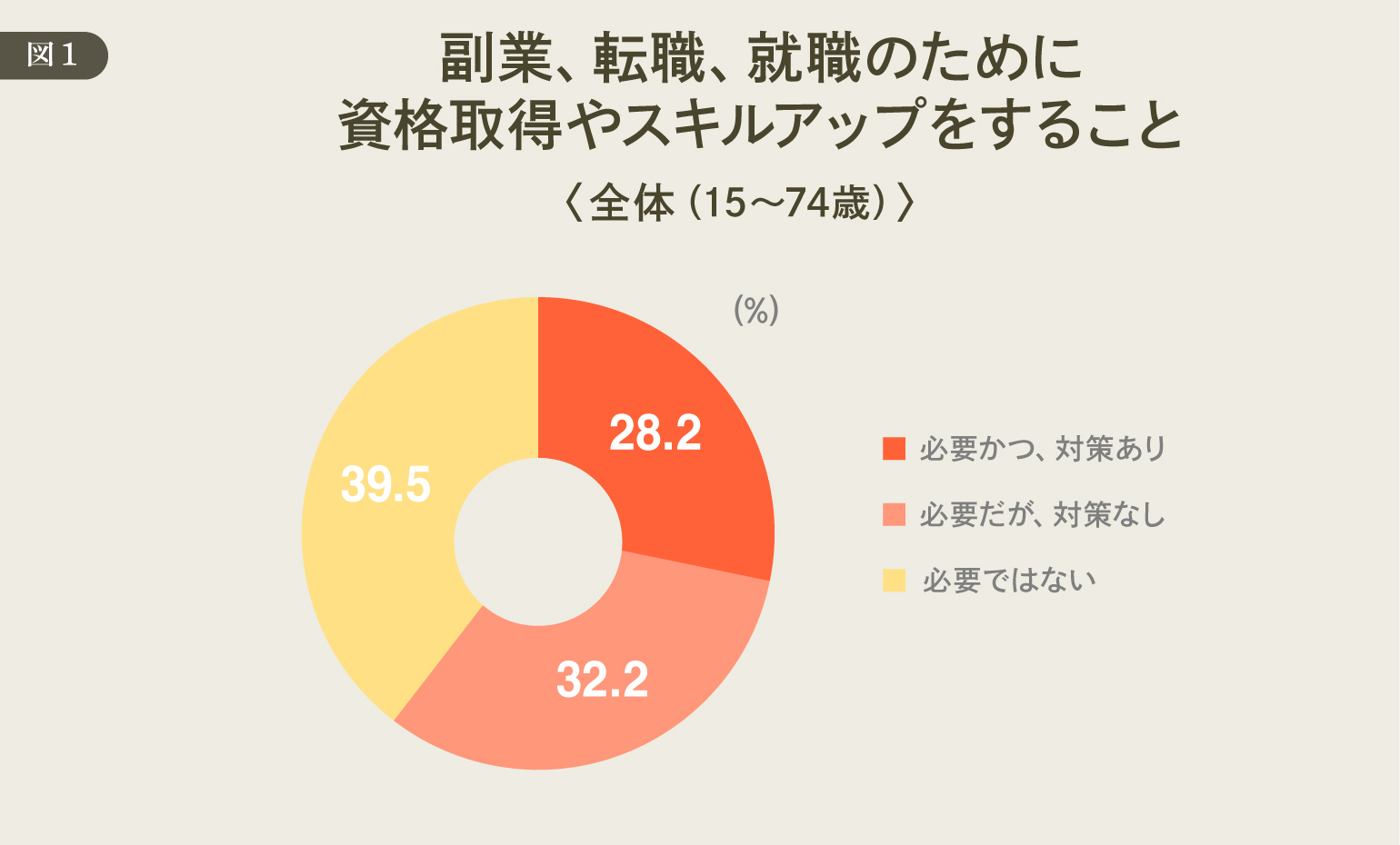
Results for the entire population (ages 15-74): * 28.2% feel the need and are taking some form of action (hereafter "Need and Action")32.2% felt the need but had not taken any action ("Need felt, but no action taken"), and 39.5% did not feel the need ("No need felt"). This shows that approximately 60% of the total population "feels the need" for some form of career advancement.
Moving forward, we will focus our analysis on those in their 30s and 40s, who are likely to have a higher level of interest in their own career choices. Figure 2 summarizes the responses regarding "qualification acquisition and skill enhancement" after refocusing the target group exclusively on those in their 30s and 40s.
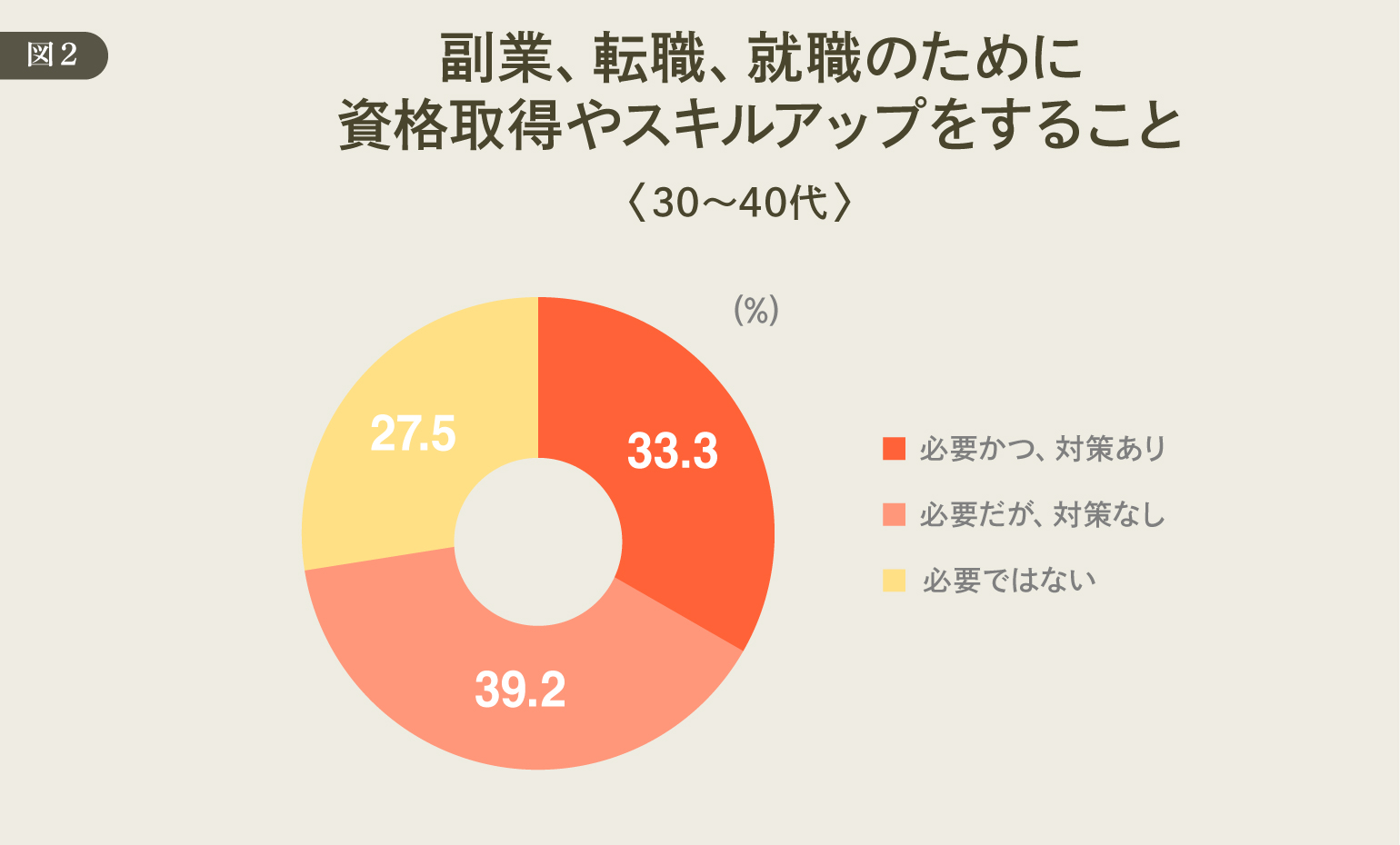
The results show that the "necessary and taking action" group is 33.3% (5.1% higher than the overall average), the "necessary but not taking action" group is 39.2% (7.0% higher than the overall average), and the "not necessary" group is 27.5% (12% lower than the overall average).
The proportion of those who "feel some necessity" for career advancement was 72.5%, about 10 points higher than the overall average. Conversely, the proportion of those who "do not feel necessity" dropped by over 10 points. Even considering that the teens and 70s age groups include people not working, it is evident that those in their 30s and 40s show a significantly higher level of interest in career choices compared to the overall average.
One group stands out as feeling least "happy" and having the least "hope" for their own lives and society
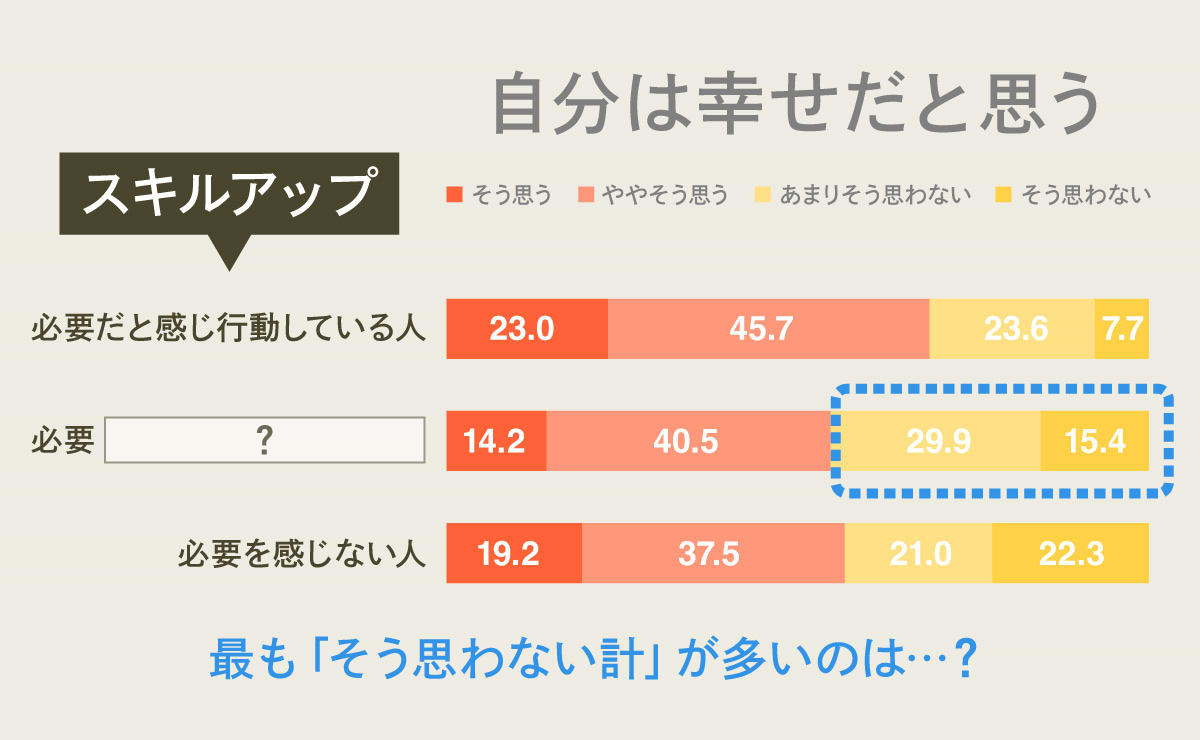
Next, we examine differences in attitudes and values—such as happiness levels and satisfaction with society—among those in their 30s and 40s, broken down by the three response groups mentioned above. Figure 3 summarizes the results for the question "Do you think you are happy?" categorized by these three groups.
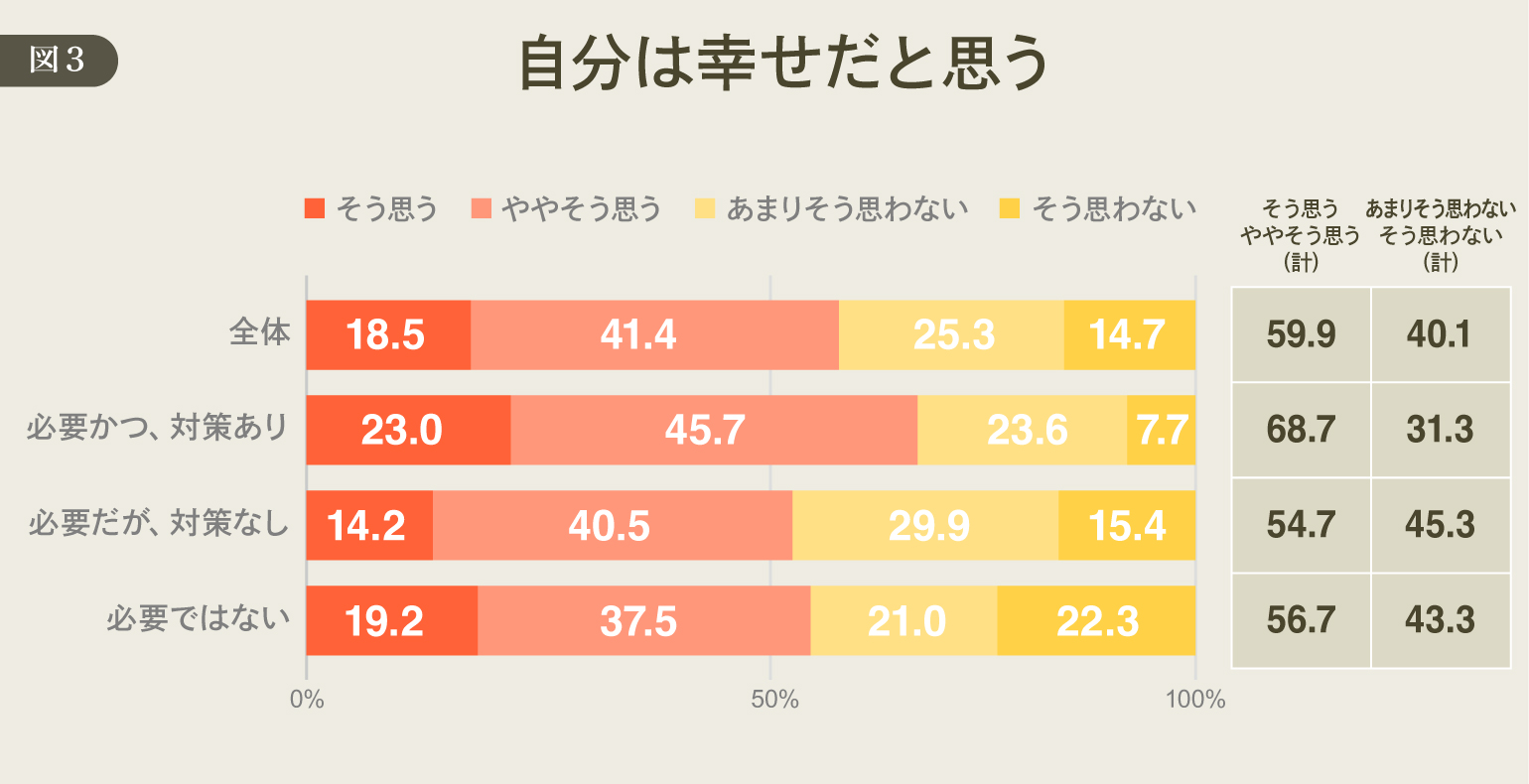
Among those who feel "qualification acquisition and skill enhancement are necessary and actionable," 68.7% responded "agree" or "somewhat agree." This is the highest proportion and 8.8 percentage points higher than the overall average for those in their 30s and 40s (59.9%). The next highest was the "not necessary" group at 56.7%, while the "necessary but no action" group had the lowest at 54.7%.
Next, we asked about "hope for one's own life" and "hope for society" compared to one year ago (Figures 4 and 5).
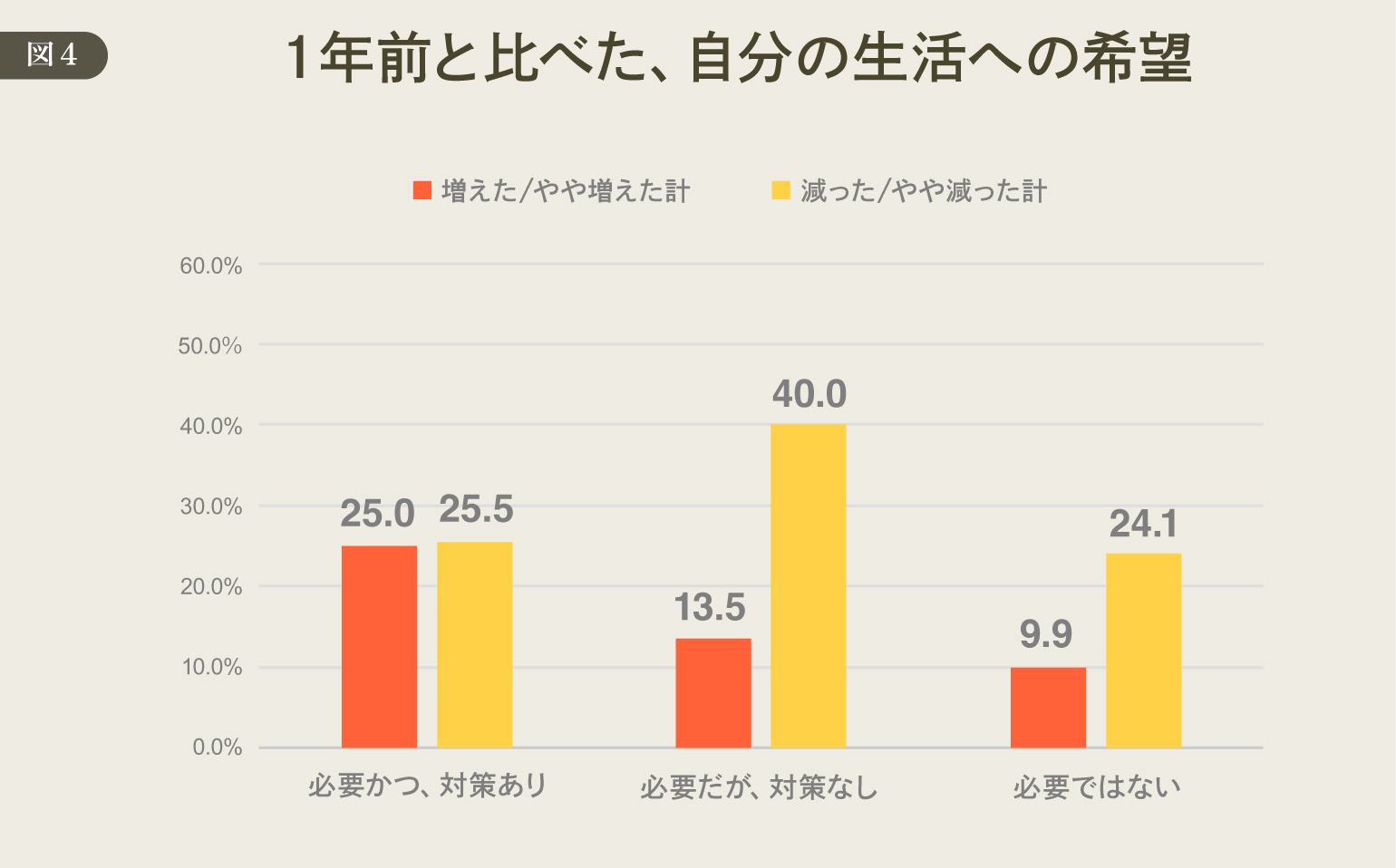
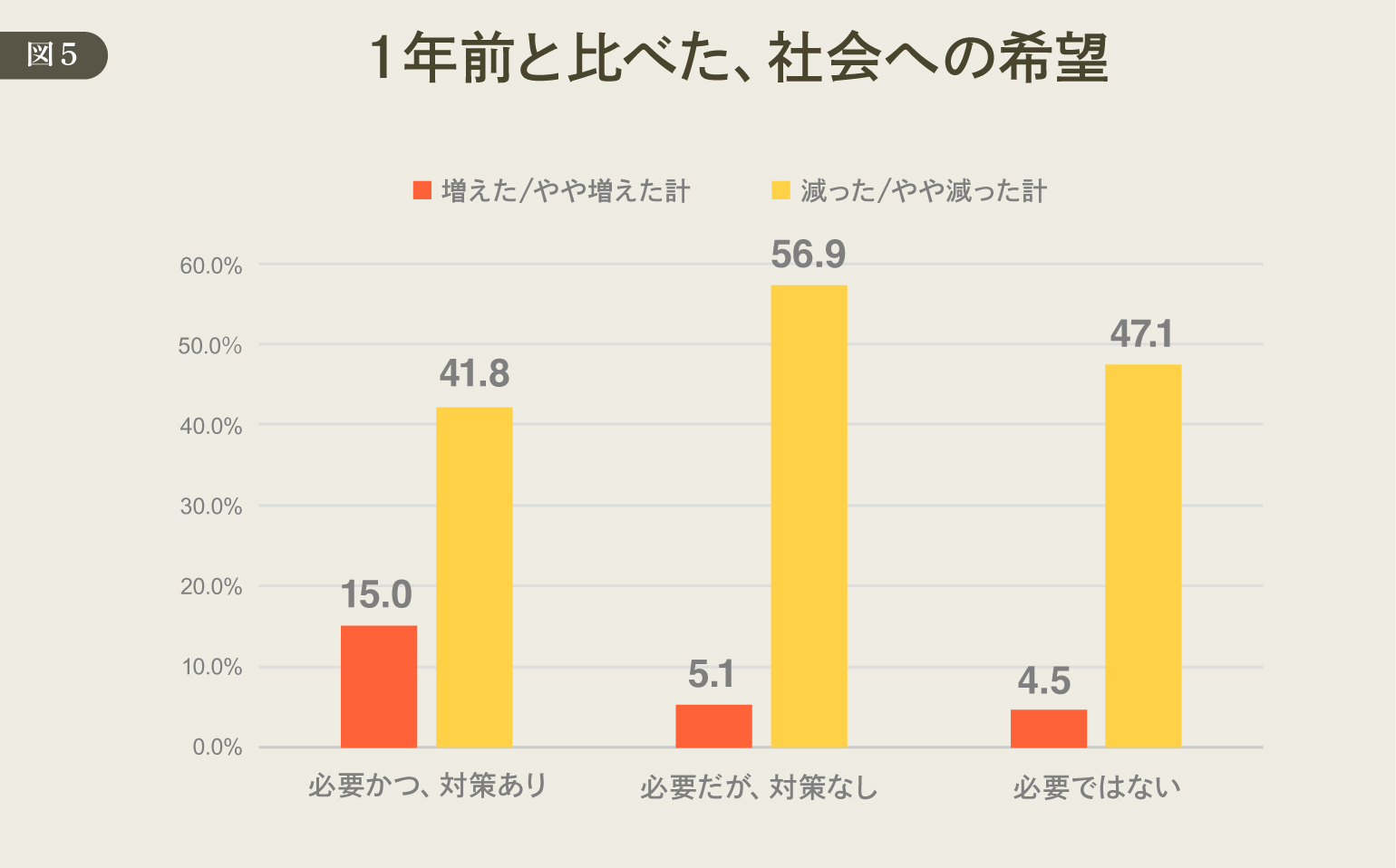
For both hope for their own lives and hope for society, the percentage of respondents who answered "increased" or "slightly increased" compared to a year ago was highest among the "necessary and taking action" group. Next was the "necessary but not taking action" group, followed by the "not necessary" group.
Interestingly, the combined percentage of those who reported their hope had "slightly decreased" or "decreased" for both their personal lives and society was higher among the "Needful but No Action Taken" group than among the "Not Needful" group.
We can infer that a complex interplay of various factors causes this decline in hope for one's own life. However, one possible factor is that some people, while feeling that acquiring qualifications or improving skills is necessary, are not taking action. This gap between awareness and action may lead to stress and anxiety, causing their hope for their own life to decrease compared to a year ago. Furthermore, they may be projecting this personal anxiety and frustration onto society.
Those who see qualification acquisition and skill enhancement as "necessary and actionable" – are they the ones who "do their best and leave the rest to fate"?
Next, we'll examine other survey results comparing attitudes and values to a year ago.
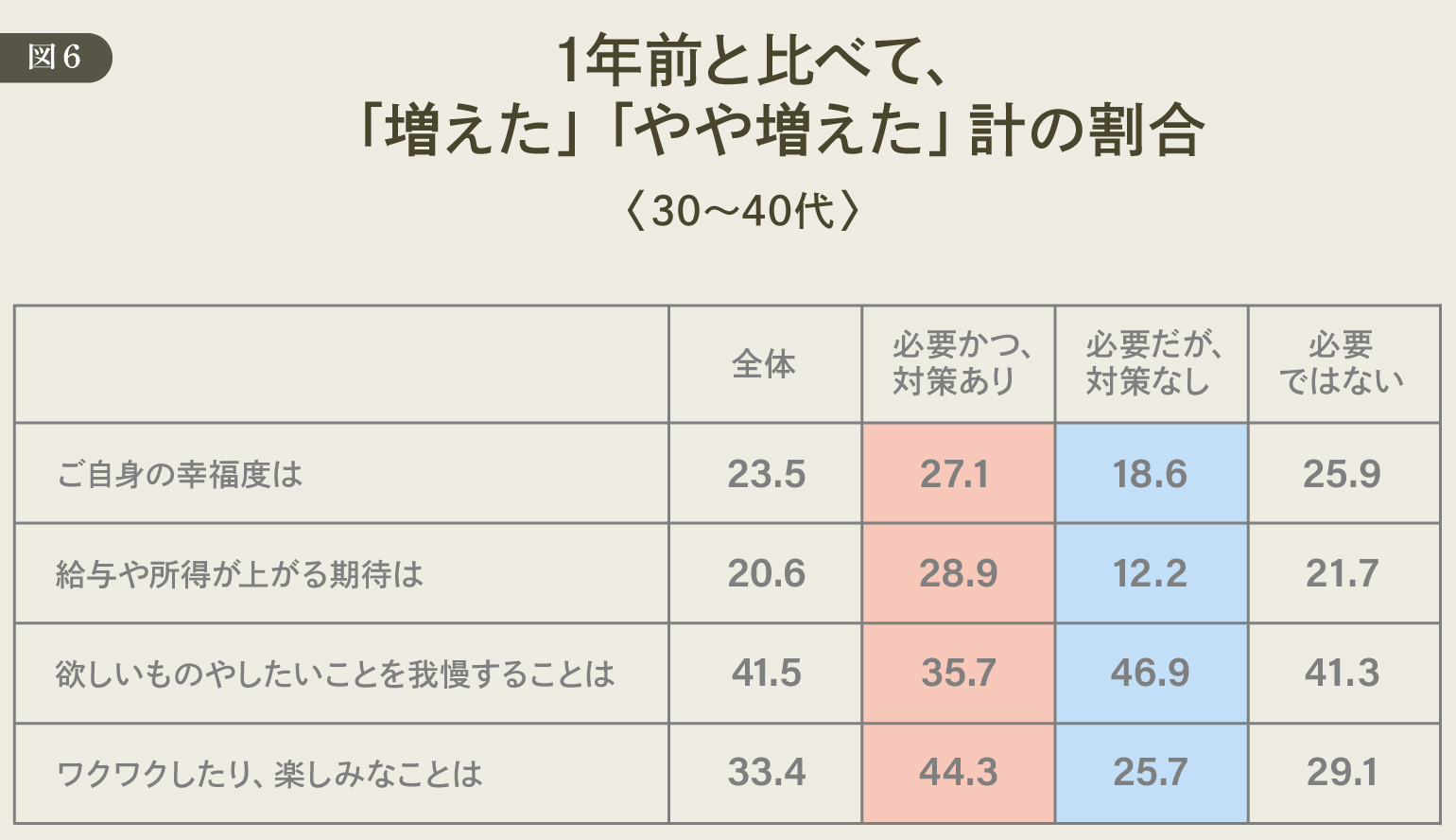
A notable point is that the group who answered "necessary but no action taken" regarding qualification acquisition or skill enhancement showed the lowest increase rate in happiness and desire/positive feelings ("increased" or "slightly increased") compared to last year. Conversely, the "necessary and action taken" group showed the largest increase rate across all items.As seen in responses to "Things that excite or delight me," this group also scored over 10 points higher than the other two groups in certain categories.
Considering the above, it becomes clear that one's approach to their career influences their happiness and their hopes for life/society compared to last year. Specifically, it was revealed that the group that "felt it least" across all items was the group that felt qualifications and skill development were [necessary but no action taken].
Beyond changes in awareness since last year, we also asked about their current personal feelings and awareness of society.
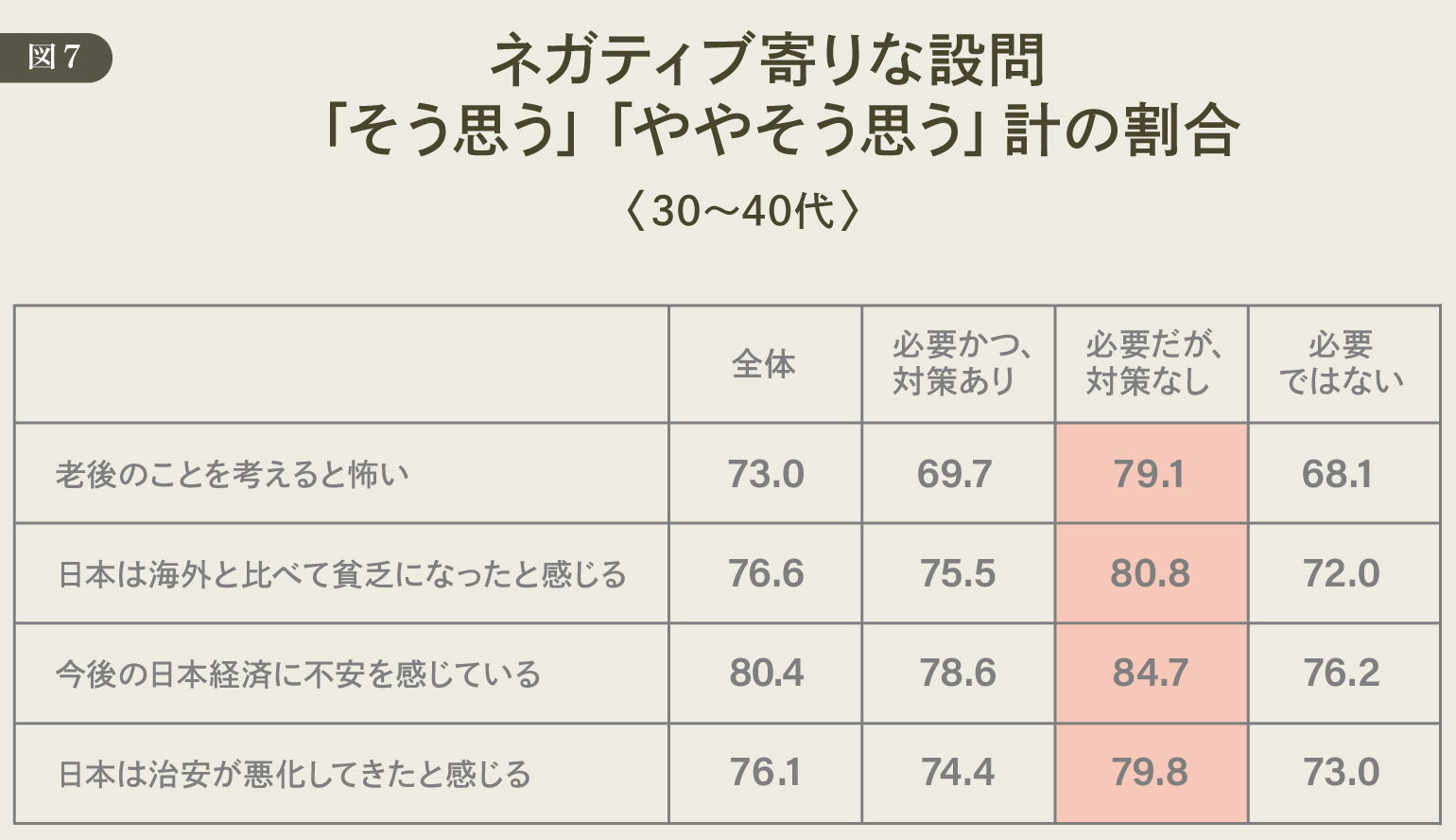
The group expressing the highest levels of "anxiety/concern" about social safety, poverty, and their own retirement was the group that felt qualification acquisition and skill development were "necessary but no action taken."
Next, let's look at the results for more positive-leaning questions.
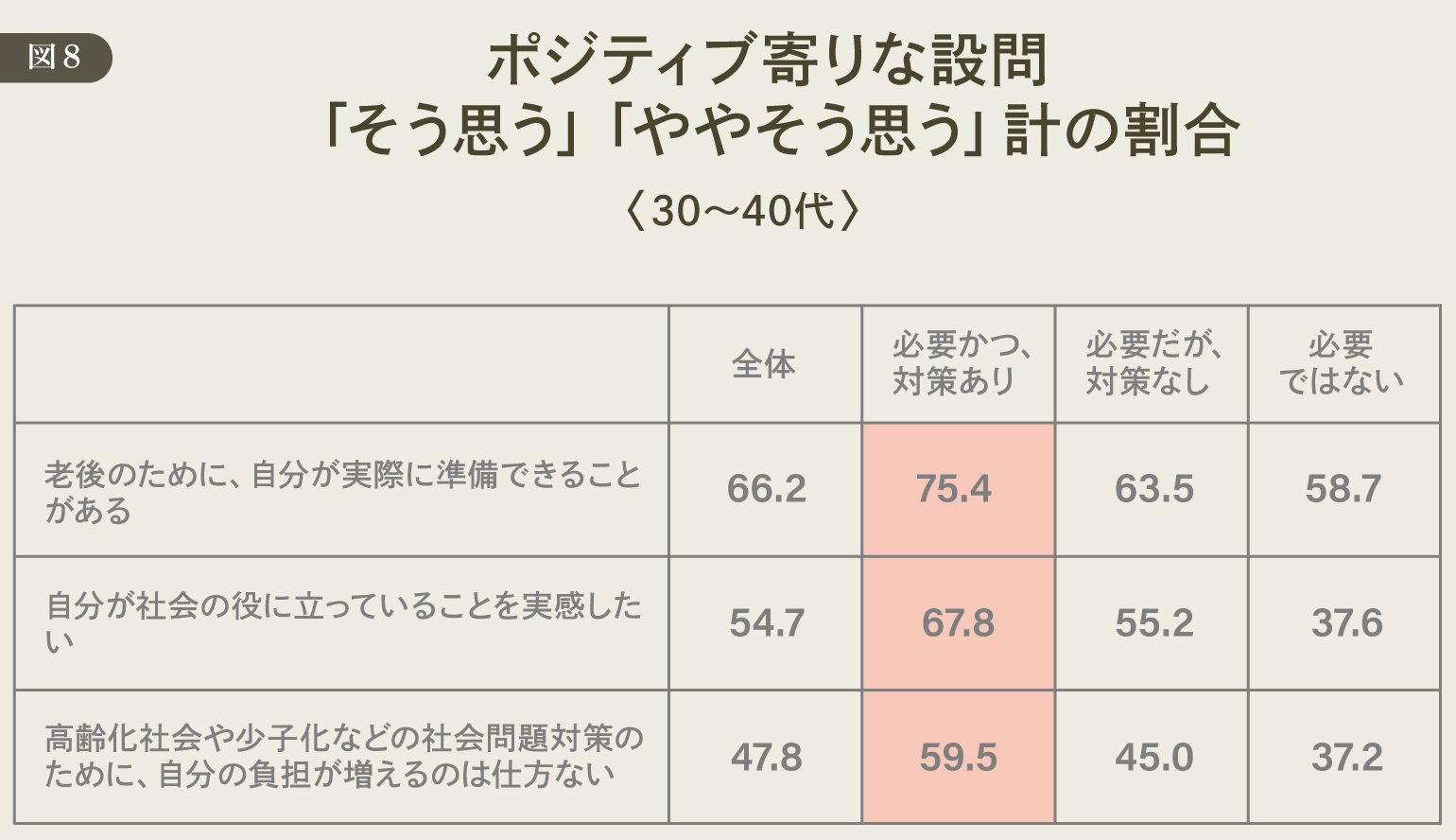
Among the "necessary and action taken" group, the results revealed a sense of positioning themselves as "members of society." This was evident in responses such as accepting increased personal burden for social problem solutions and believing they can prepare for the future (retirement).
Additionally, we observed interesting results on questions that differed slightly in perspective from respondents' own awareness and actions, which we will also introduce.
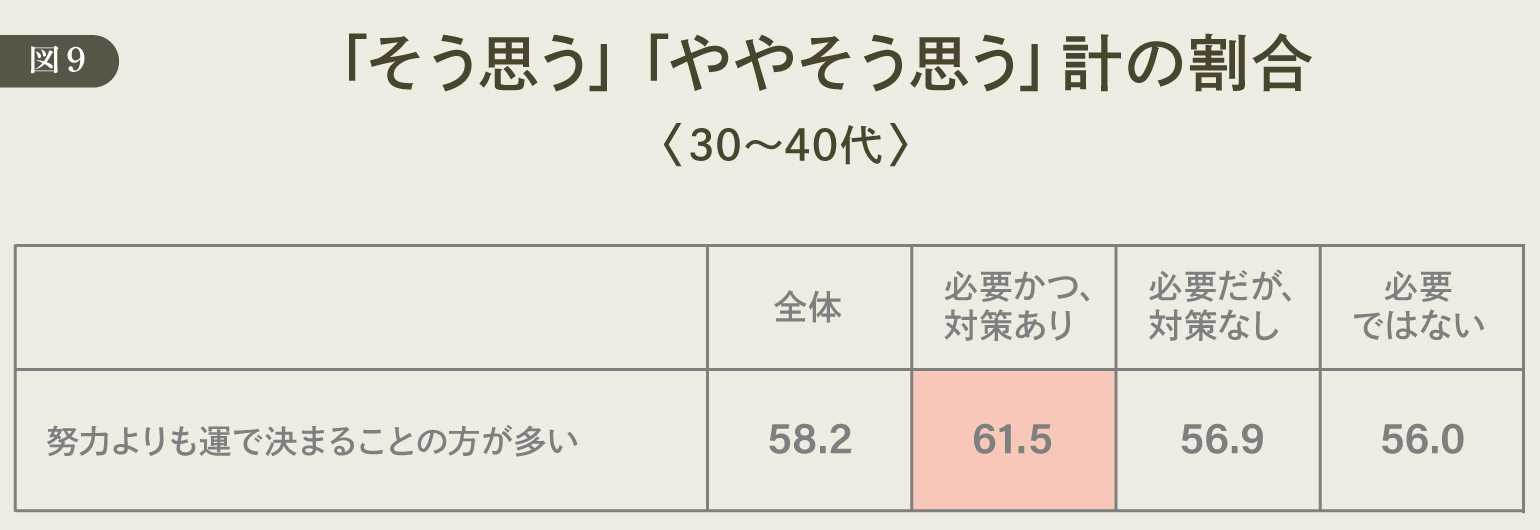
The "necessary and actionable" group showed the highest proportion believing "life is determined more by luck than effort." While the other two groups showed nearly identical figures, this group alone was about 6 percentage points higher. This indicates a higher proportion of people in this group believe life is heavily influenced by luck.
Conversely, these are also the people who "feel the need to acquire qualifications or improve skills and are taking measures = they properly prepare for things they can control." Examining this result, it suggests that the "necessary and actionable" group embodies the mindset of "do your best and leave the rest to fate."
Reducing the gap between self-perception and action leads to increased happiness and hope
This study examined how attitudes toward career advancement influence individual happiness and societal values, segmenting people in their 30s and 40s into three groups based on their attitudes toward career advancement and then measuring their happiness and societal values.
Overall, the segment perceiving career advancement qualifications and skill development as "necessary and actionable" showed the most positive outlook on their own role in society and their happiness levels.
Conversely, the "necessary but no action" segment showed the lowest levels of happiness and hope for society, with the highest proportion expressing anxiety. The "not necessary" segment tended to fall in the middle across both positive and negative dimensions compared to the other two segments.
Analyzing this situation, the "necessary but no action" group appears to be the only segment experiencing a disconnect between their awareness and their actual behavior. The other two groups show no such disconnect between awareness (whether skill enhancement is necessary) and action (taking action if necessary / not needing action if not necessary).
In other words, the gap between believing that obtaining qualifications or improving skills is necessary and not actually taking action to address it may be causing stress, potentially impacting happiness, satisfaction with society, and feelings of anxiety.
Conversely, minimizing this gap between awareness and action could lead to increased happiness and satisfaction. If you feel career advancement is necessary in your life, taking that first step toward action should help you confront your own situation. This could ultimately become a force for transforming your life's happiness and, by extension, society itself into something more hopeful and positive.
At DDD, we will continue to explore consumer insights from various perspectives through our "Heart-Moving Consumption Survey."
[Survey Overview]
10th "Heart-Moving Consumption Survey"
・Target Area: Nationwide, Japan
・Respondent Criteria: Men and women aged 15–74
・Sample Size: Total 3,000 samples (allocated according to population ratio across 7 age groups: 15-19, 20s-60s, 70-74, and 2 gender categories)
・Survey Method: Internet survey
・Survey Period: Tuesday, May 13, 2025 – Friday, May 16, 2025
・Survey Sponsor: Dentsu Inc. DENTSU DESIRE DESIGN
・Survey Agency: Dentsu Macromill Insight, Inc.
Was this article helpful?
Share this article


Newsletter registration is here
We select and publish important news every day
For inquiries about this article
Back Numbers

Author

Ayaka Yoneya
Dentsu Inc.
Marketing Division 2