Note: This website was automatically translated, so some terms or nuances may not be completely accurate.
 DENTSU DESIRE DESIGN's Approach to Marketing Reconstruction Based on "Theory of Desire" [28/40]
Is it true that "Gen Z hates drinking parties"? The existence of "consideration" that divides generations
Dentsu Inc. Desire Design (DDD) is an organization that develops solutions and disseminates information based on the relationship between consumption and desire.
Starting this time, we will analyze the 11th "Heart-Moving Consumption Survey" conducted by DDD in November 2025. We will share insights and findings derived from the survey results.
In this article, DDD member Rei Taira, a Gen Z representative, focuses on Gen Z's "attitude toward drinking parties" based on the latest 11th survey results, uncovering their true feelings about drinking parties and the generational gap surrounding them.
▼Are Young People Really Avoiding Drinking Parties?
▼Resistance to "banquets and drinking parties" among 25-29 year-olds is actually "almost unchanged from the overall population"
▼What do employed individuals who enjoy alcohol really think about banquets and drinking parties?
▼The majority of people in their 20s don't mind banquets and drinking parties
▼Those in their 20s who don't mind banquets/drinking parties strongly desire "connection and growth"
▼Young people "want to go to drinking parties but can't bring themselves to do it" precisely because they are overly considerate
▼What separated generations may not be a divide, but mutual "reluctance"
Are young people really avoiding drinking parties?
As 2025 draws to a close, many are likely busy with year-end work and parties. In recent years, this season brings heartfelt complaints from older generations in mass media and social media: "Young people aren't coming to our year-end parties," or "I invited them but they turned me down..."
It's not just year-end parties; in recent years, we've increasingly heard statements like "Young people don't come to drinking gatherings" or "Young folks don't drink alcohol." Supporting this, new terms like "sober curious*" and "moderate drinking" are gaining social attention. Against a backdrop of changing work styles, diversifying values, and shifts in daily rhythms following the pandemic, it's said that the drinking party culture itself is reaching a turning point.
※Sobercurious: A lifestyle choice where one "can drink alcohol but chooses not to," combining "Sober" and "Curious."
On the other hand, browsing social media, posts showing young people dining with friends after work or gathering with peers on weekends are a common sight.
Moreover, among my own circle, regardless of industry or occupation,
"I miss having drinking parties—there are none anymore,"
"I thought working adults went out drinking more often"
"I'd love to go out for 'overtime meals' with my seniors..."
These are common sentiments I hear from young employees.
So, are Gen Zers really avoiding drinking parties?
And where does this perceived "generation gap in attitudes toward drinking parties" come from?
To carefully understand generational attitudes surrounding drinking parties, we'll analyze the following two questions, presented as part of our survey items, from both perspectives: "Attitudes toward alcohol" and "Attitudes toward drinking environments."
[Survey Questions]
・Do you enjoy drinking alcohol?
・Do you find attending banquets or drinking parties burdensome?
Resistance to "banquets and drinking parties" among 25-29 year olds is actually "almost the same as the overall population"
First, we compared the attitudes of those aged 25 to 29 (an age group accumulating real-world drinking party experience as working adults) with the overall population.
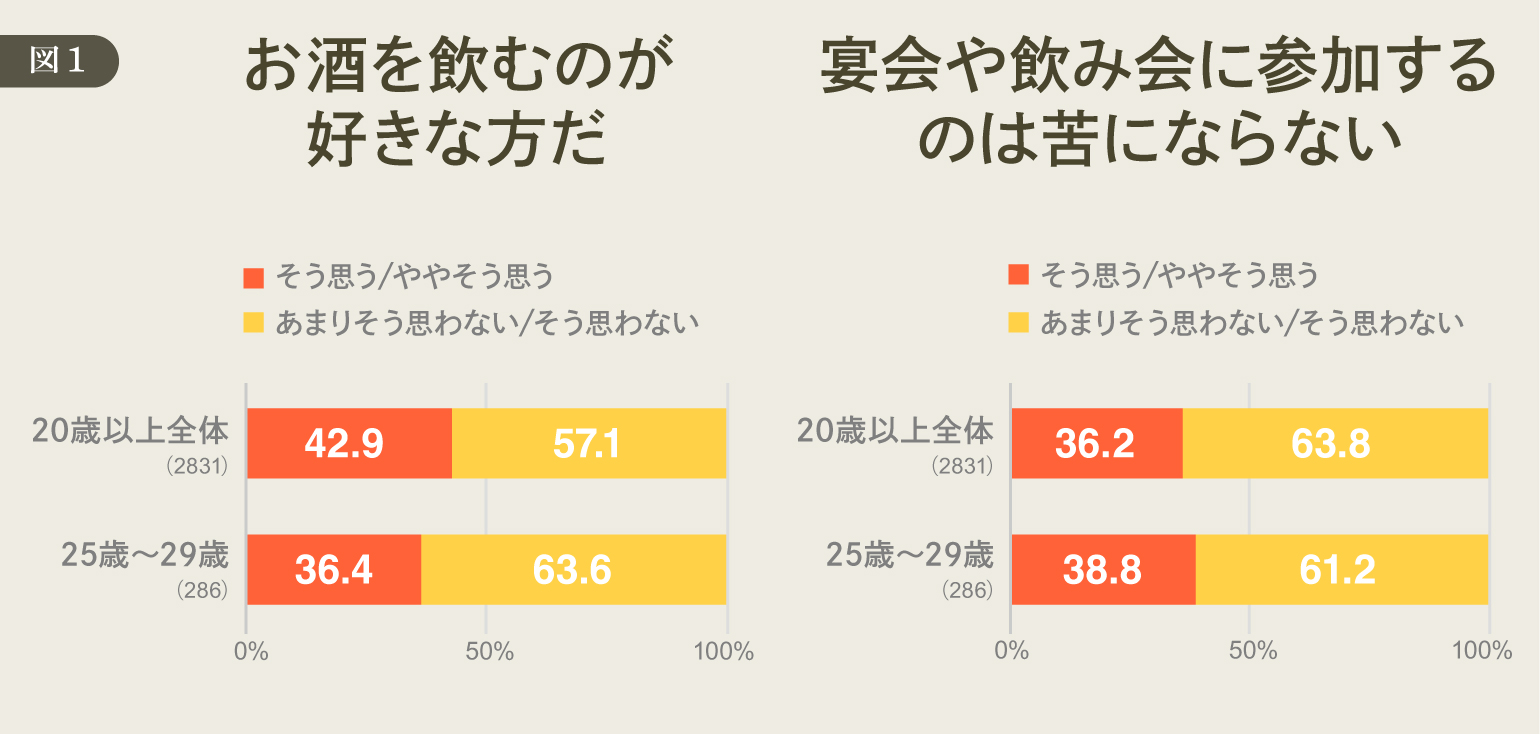
Among those aged 20 and over, 42.9% responded that they "like drinking alcohol" (combining "agree" and "somewhat agree"). Among those aged 25 to 29, this figure was 36.4%, 6.5 percentage points lower than the overall 20+ age group. This aligns with the broader societal trends of sobriety and responsible drinking.
Conversely, 36.2% of all respondents aged 20 and over stated they "don't mind attending banquets or drinking parties" ("Agree" and "Somewhat agree" combined), while 38.8% of those aged 25-29 felt this way, showing a higher proportion than the overall 20+ age group.
This result differs from the common perception that "young people dislike drinking parties." At least based on the data, it suggests that "while they may be cautious about alcohol itself, they likely do not dislike the social setting of drinking parties."
What do employed individuals who enjoy alcohol really think about banquets and drinking parties?
We delved further by narrowing the focus to "employed individuals who enjoy alcohol*" and examined how many within this group feel attending banquets or drinking parties is not a burden. Since attitudes toward drinking parties are easily influenced by workplace relationships and work styles, this article first analyzes the group most likely to attend work-related drinking parties.
*For this article, "employed individuals" refers to civil servants, executives/managers, company employees, self-employed individuals, freelancers, and part-time/temporary workers (excluding students).
Among those who enjoy alcohol, 60% do not find banquets or drinking parties burdensome.
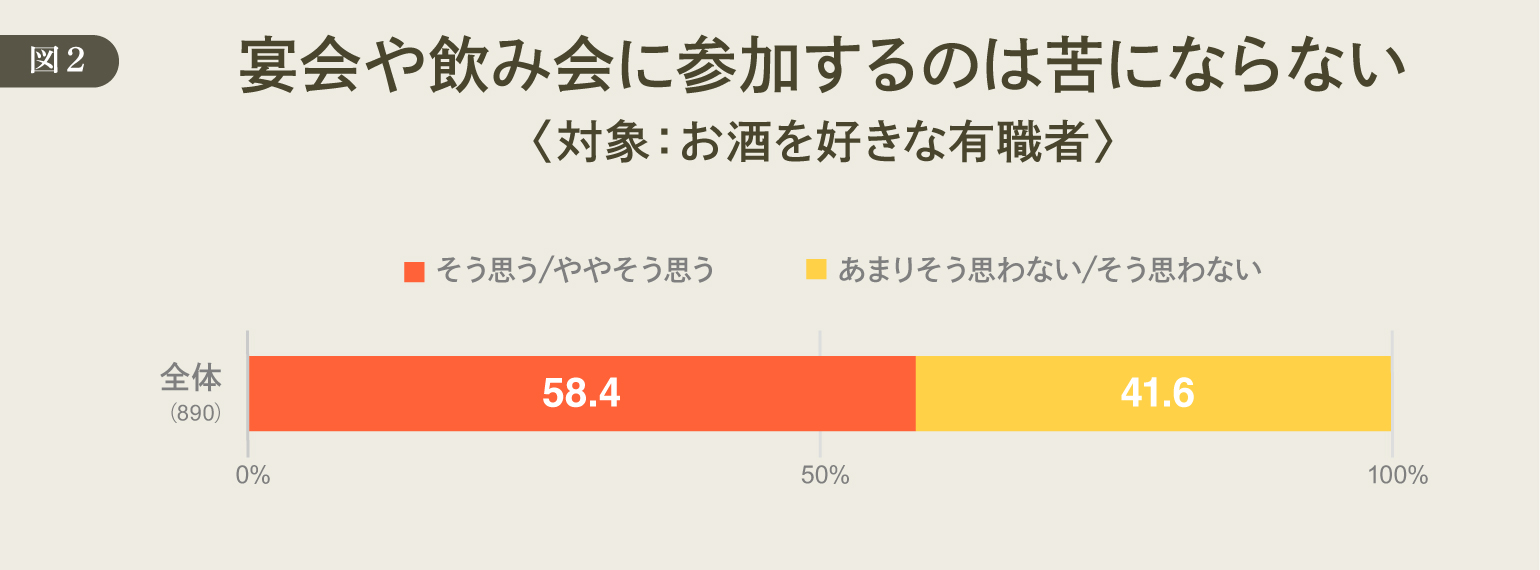
Among 890 employed individuals who stated they "like alcohol," 58.4% reported that "attending banquets or drinking parties is not a burden," while 41.6% found them "burdensome."
This means that about 60% of people who enjoy drinking alcohol view banquets and drinking parties positively.
The majority of those in their 20s also find banquets and drinking parties not a burden.
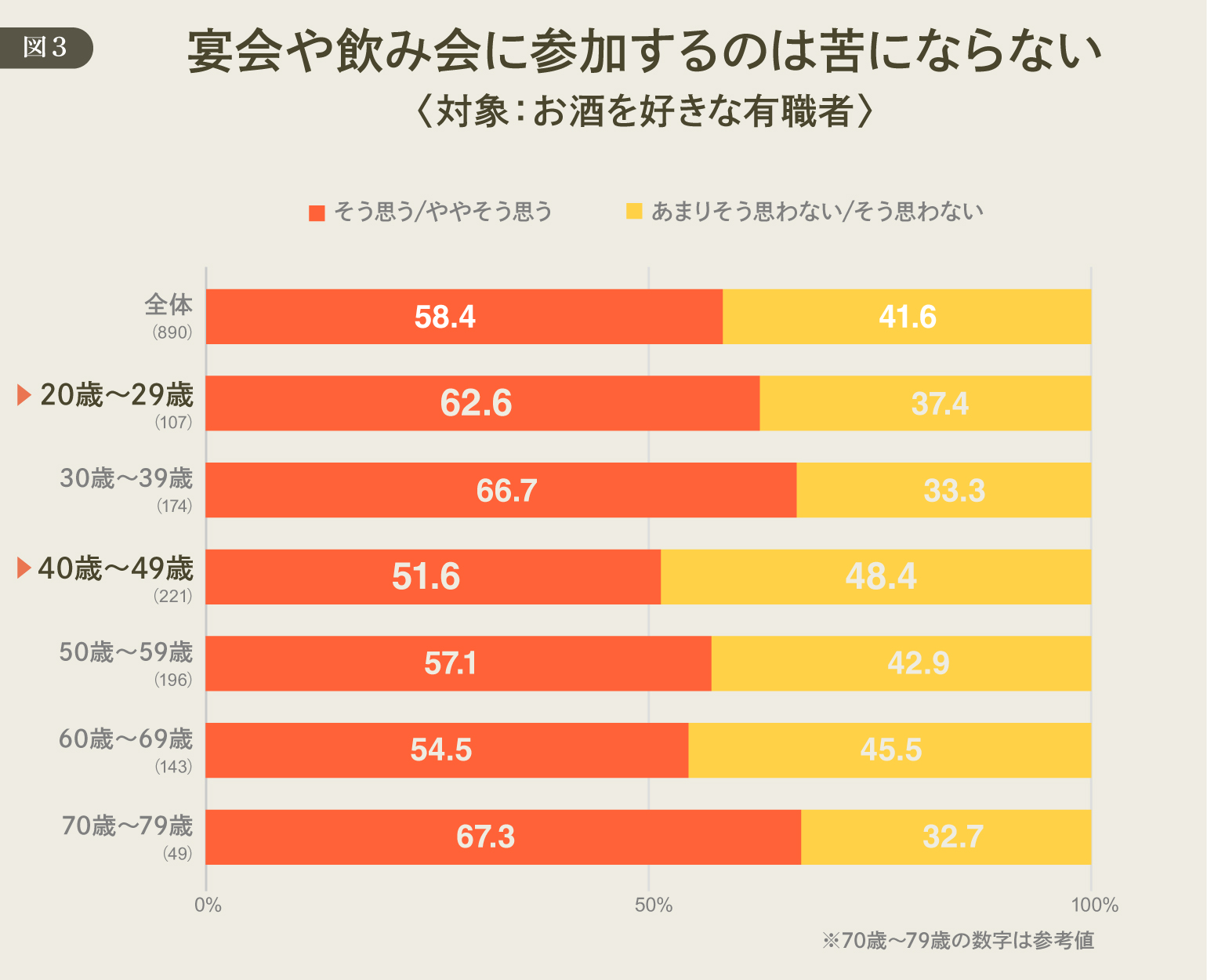
Furthermore, examining the ratios by age group revealed an interesting trend.
Among employed individuals in their 20s who enjoy drinking, over 60% responded that "attending banquets or drinking parties is not a burden." In contrast, among employed individuals in their 40s who enjoy drinking, 51.6% said it was "not a burden" and 48.4% said it was "a burden," resulting in nearly equal proportions.
In other words, the proportion of those in their 20s who answered "I don't mind attending banquets or drinking parties" is actually higher than among those in their 40s to 60s, who tend to hold the image that "young people avoid drinking parties." Focusing specifically on those who enjoy alcohol, this point also reveals a reality that differs from the common perception that "young people dislike drinking parties."
It should be noted that around 60% of those aged 25-29 do not like alcohol. Therefore, it is natural that a certain number of young people overall choose not to attend banquets or drinking parties. This time, by focusing specifically on the group that enjoys alcohol, we aim to gain a clearer understanding of their attitudes toward "banquets and drinking parties" themselves.
Among those in their 20s who don't mind banquets and drinking parties, the desire to "connect with others" and "grow" is strong
When we cross-reference the aforementioned group of 20-somethings who enjoy alcohol and don't mind banquets/drinking parties (hereafter the "Banquet/Drinking Party Positive Group") with questions about their values, several common characteristics emerge. Due to the limited sample size of the survey, we will now look at absolute numbers (sample size) rather than percentages.
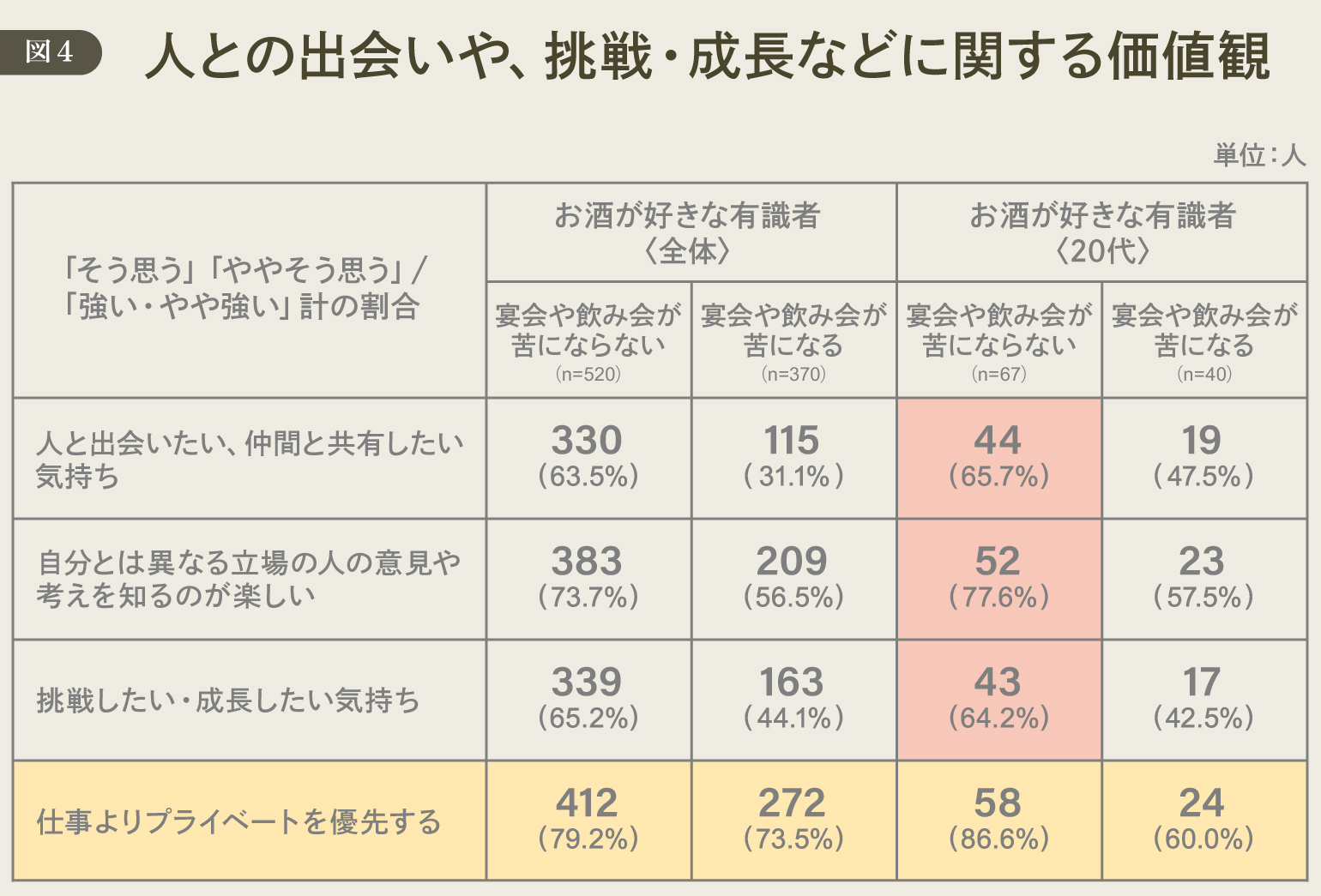
First, on the item "Desire to meet people and share experiences with peers," the banquet/drinking party positive group in their 20s showed significantly higher scores than the group of the same age who enjoy alcohol but dislike banquets/drinking parties (hereafter referred to as the "banquet/drinking party negative group"). This indicates an attitude of wanting to encounter new people and ideas on a daily basis.
Furthermore, scores for the "enjoy learning opinions and ideas from people with different perspectives" and "desire to challenge oneself/grow" items were consistently higher among the positive group. This suggests they view drinking gatherings not merely as occasions for drinking, but as opportunities to expand their connections and experiences with people and society.
Taking all this into account, it can be inferred that the positive group toward banquets and drinking parties in their 20s are not simply positive about drinking parties, but rather a group with a proactive motivation to update themselves through new values and interactions with people.
What's even more interesting is the relationship with the item "Prioritize private life over work."
Although the sample size is limited, among the banquet/drinking party positive group in their 20s, approximately 90% responded "agree/somewhat agree" to this item, significantly higher than the 60% seen in the banquet/drinking party negative group of the same age.
While the common perception is that "young people who value their private time avoid work-related drinking parties," these results show the opposite trend.
This shift may stem from a change in young people's mindset, where they want to proactively choose how to spend their limited time. Rather than attending out of a sense of work-related obligation, they view such gatherings as a meaningful opportunity for personal growth and building connections – one option among their private time choices. This value system may be at play.
In other words, for the positive-minded 20-somethings, drinking parties are not seen as unavoidable events requiring sacrifice of personal time, but rather positioned as a proactive choice to broaden their horizons and relationships.
Looking at this so far, while it seems true that more people in their 20s overall are not fond of alcohol, it's also clear that a significant number still find value in drinking parties. So why does the perception that "young people these days don't come to drinking parties" get emphasized more?
The key lies in the following characteristic:
Because they are "highly considerate," young people find themselves in a situation where they "want to go to drinking parties but can't bring themselves to do it."
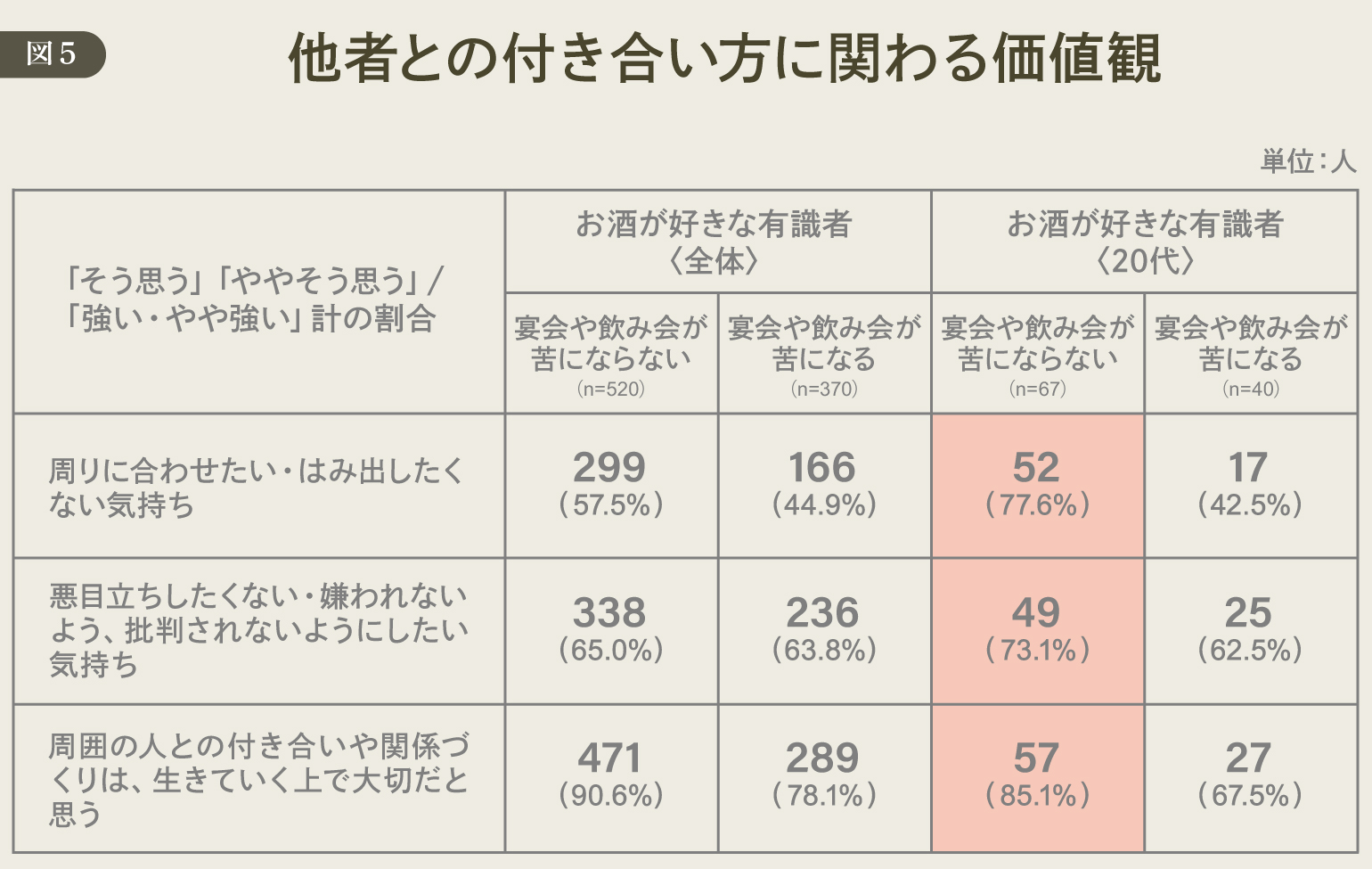
What's noteworthy here is that while the positive group toward banquets and drinking parties in their 20s strongly desires "meeting people and sharing experiences (connecting) with friends," they also scored highly on items indicating "caution in interpersonal relationships," such as "wanting to fit in with others/not wanting to stand out" and "not wanting to draw unwanted attention." Specifically, the percentage for "wanting to fit in with others/not wanting to stand out" was nearly double that of the negative group in the same age bracket.
Furthermore, over 80% agreed that "interacting with and building relationships with others is important," revealing a strong desire to carefully nurture interpersonal connections.
The positive group of 20-somethings attending banquets and drinking parties have a strong desire to connect with people and to learn. On the other hand, they also express concerns such as:
• "What if inviting them causes trouble?"
• "What if they think I'm trying too hard?"
• "Wouldn't it be presumptuous to invite my seniors?"
may cause them to hesitate when it comes to taking the initiative to invite others or organize events.
What appears superficially as passive behavior among young people is likely rooted in a structure where "consideration for others" drives caution, rather than genuine disinterest.
This duality of "wanting to connect but being unable to act" likely contributes to the impression that "young people don't attend drinking parties," potentially creating generational misunderstandings.
■ If you're interested in "intergenerational disconnect," please also see the article below
"Young People Who Want to Engage More but Can't Take the First Step: The Current State of Misaligned Workplace Communication" (Dentsu-ho)
What separated the generations may not be a divide, but mutual "reserve"
A major finding revealed by this data is that while the proportion of young people who don't drink alcohol itself is increasing, among those who do enjoy drinking, a significant number do not harbor strong resistance to drinking parties per se. Instead, they view them positively as opportunities for human connection and personal growth. The image of young people treating drinking parties not as an "obligation" but as a "place they want to choose for themselves" offers an important perspective that differs from conventional assumptions.
However, this positive attitude is matched by a strong sense of "consideration for others," which can make them cautious about taking the initiative themselves. This analysis highlights this duality among young people.
Given this dynamic, those organizing gatherings might not need to overthink things. Rather than preparing for a special event, try casually suggesting, "Hey, if you're up for it..." as if it were an everyday conversation. That level of "casualness" might gently ease young people's caution and create a natural opening for interaction.
And once again, the season is approaching—Christmas, New Year's, and other times when opportunities to gather with people increase. Why not relax a little, invite someone, or accept an invitation?
We hope this survey article encourages those small steps and becomes a catalyst for sharing pleasant moments together.
At DDD, we will continue to explore consumer insights from various perspectives through our "Heart-Moving Consumption Survey."
<Overview of the 11th "Heart-Moving Consumption Survey">
・Target Area: Nationwide, Japan
・Respondent Criteria: Ages 15–74
・Sample Size: Total 3,000 samples (allocated according to population ratios for ages 15–19, 20s–60s, and 70–74)
・Survey Method: Online survey
・Survey Period: November 7 (Fri) to November 12 (Wed), 2025
・Survey Sponsor: Dentsu Inc. DENTSU DESIRE DESIGN
・Survey Agency: Dentsu Macromill Insight, Inc.
Was this article helpful?
Share this article


Newsletter registration is here
We select and publish important news every day
For inquiries about this article
Back Numbers
Author

Rei Tai
Dentsu Inc.
Future Scenario Consulting Department, Marketing Division 4
Associate Planner