Note: This website was automatically translated, so some terms or nuances may not be completely accurate.
 DENTSU DESIRE DESIGN's Approach to Marketing Reconstruction Based on "Theory of Desire" [29/40]
The "Health Dilemma" of Longevity Nation Japan
Dentsu Inc. Desire Design (DDD) is an organization that develops solutions and disseminates information based on the relationship between consumption and desire.
This time, Nobuyasu Kaida of DDD examines the "Health Dilemma" faced by Japanese people, considering the perspective of consumers' desires and results from the 10th "Heart-Moving Consumption Survey" conducted in May 2025, among other findings.
The Pride of "Longevity" and "Health Without Feeling It"
Japan ranks among the world's most long-lived nations. Data showing average life expectancy for both men and women in their 80s is widely known through various media. However, "living long" and "living healthily" are not necessarily equal. In other words, despite being a long-lived nation, a significant portion of the population lacks the tangible sense of "I am healthy." This "disconnect in perceived health" has emerged as a shadow issue within our longevity society.
This article aims to reveal the "distortions in health promotion that Japan, as a 'long-lived nation,' has fallen into" and explore "approaches from a corporate perspective" to help the many people living in Japan achieve truly healthy lifestyles.
<Table of Contents>
▼"Perceived Health" - Current Status and Implications Seen in Sleep
▼ The Challenge in Japanese Health Literacy Lies in "Judgment and Utilization" of Information
▼Between "Crisis" and "Opportunity" — Rising Medical Costs and the Expanding Healthcare Market
▼"Desire," Not Fear, Holds the Key to Human Health Behavior
▼For Longevity Nation Japan to Regain "Health" Once More
"Perceived Health" — Current Status and Meaning as Seen Through Sleep
Many Japanese people face challenges regarding "sleep and rest," the foundation of health.
According to the Ministry of Health, Labour and Welfare's " Sleep Guide for Health Promotion (2023 Edition) ", it is recommended that adults " aim for at least 6 hours of sleep, recognizing that appropriate sleep duration varies by individual, and strive to secure the necessary amount of sleep." The guide also states that "not only sleep duration (quantity) but also the feeling of rest after sleep (whether one feels rested upon waking) = quality is important."
But what is the actual situation? As of 2019, the percentage of people aged 20 and over who slept less than 6 hours per day averaged 37.5% for men and 40.6% for women ( Ministry of Health, Labour and Welfare ). An OECD (Organisation for Economic Co-operation and Development) survey also showed that among its 30 member countries, Japanese people have the shortest sleep duration.
What about "quality"? According to the Ministry of Health, Labour and Welfare's "2023 National Health and Nutrition Survey," only 74.9% of people reported feeling well-rested from sleep within a month. This figure has been declining since 2009 ( Obesity Prevention Association ). In other words, more people are struggling to secure sufficient "quantity (time)" and are also failing to achieve "quality (sense of restful sleep)."
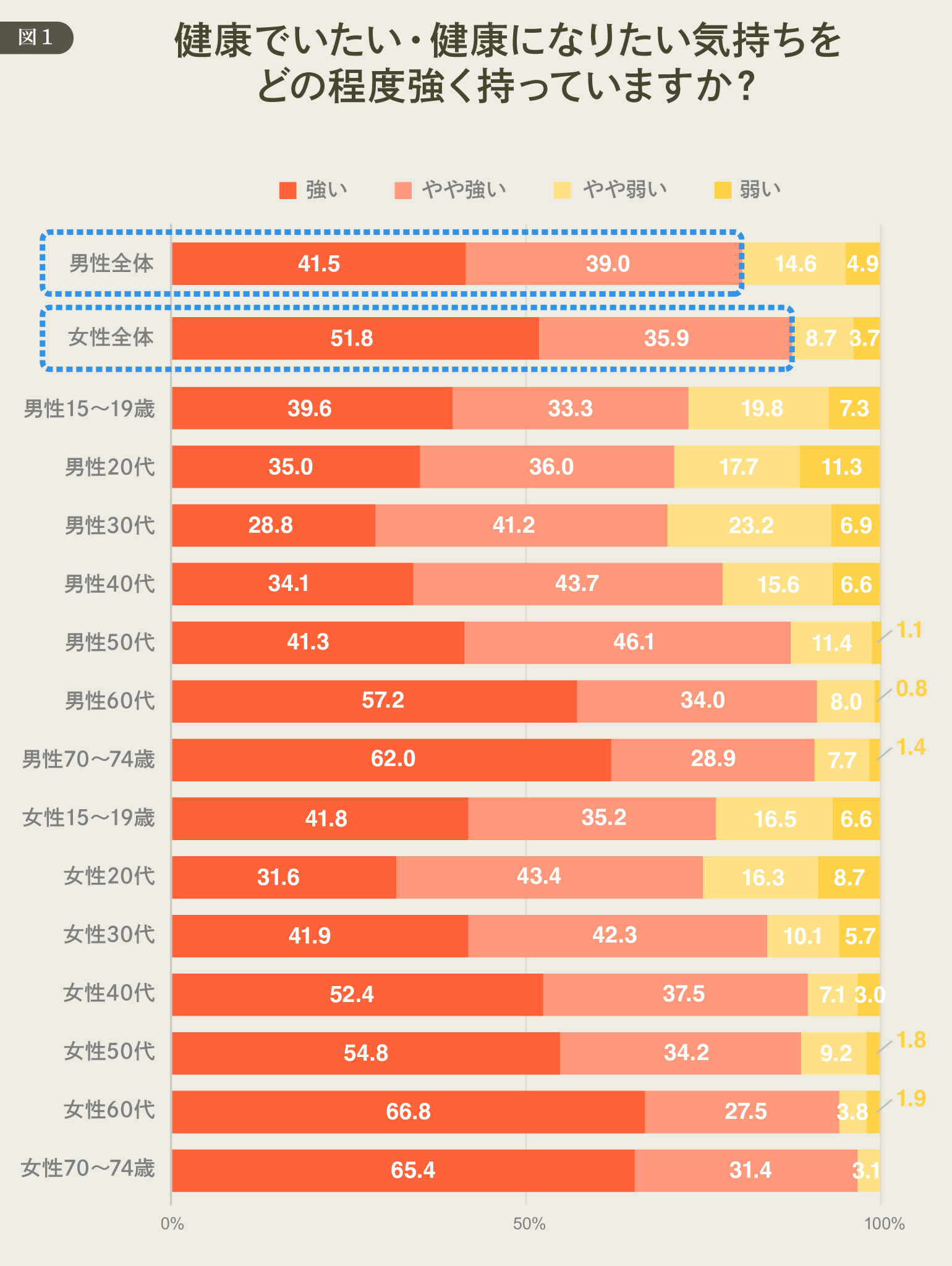
Dentsu Inc.'s "Heart-Moving Consumption Survey" also asked about several health-related items, including "desire to be healthy," "thoughts and actions for maintaining health," and "measures and consumption for staying healthy." Among these, when asked "How strongly do you feel the desire to be healthy?", positive responses of "strong" or "somewhat strong" exceeded 80% overall for both men and women.While many people desire a future where they "want to live a healthy life" or "want to become healthy," what lies behind this "gap between ideal and reality"?
The challenge in Japanese health literacy lies in the "judgment and utilization" of information
Ensuring health requires "appropriate information" and "rational action." Let's first examine "information."
A vast amount of health information circulates in society. Obtaining better, more suitable information for oneself is crucial. However, not all the diverse health information available is accurate. Collecting correct information, understanding it, and translating it into appropriate actions – the presence or absence of so-called "health literacy" significantly influences a person's health.
Although slightly dated, a 2015 study evaluated Japanese-language comprehensive health literacy using a European scale and reported that Japan's scores were lower than those of European countries ( BioMed Central ). Furthermore, a nationwide domestic survey conducted in 2020 clearly identified challenges in health literacy.Disparities by region and age were also confirmed ( BioMed Central ). Scores were particularly low among the elderly and rural residents, with "digital divide" and "social isolation" thought to be underlying factors.
Since health literacy scales differ by country, it would be inaccurate to simply assert that "Japanese health literacy is low."
Moreover, given Japan's high literacy and general literacy rates compared to other countries, the problem with health literacy in Japan may not lie in the "understanding" of health information, but rather in significant challenges at the stage of "judgment and utilization." This interpretation likely reflects the reality more accurately.
While access to information may be possible, the ability to reach "conviction, appropriate judgment, and rational action" is weak—this could be described as the structural barrier hindering health-related actions in Japan.
Between Crisis and Opportunity: Soaring Medical Costs and the Expanding Healthcare Market
Let us now take a broader view of "Japan's Health." Japan faces an unprecedented super-aged society, with social security costs already reaching 140 trillion yen. Much of this is spent on "treatment." Against this backdrop, the major challenge is how to shift toward a society centered on "prevention."
In recent years, the government has clearly articulated a shift "from treatment to prevention." Led by the Ministry of Economy, Trade and Industry (METI) and the Ministry of Health, Labour and Welfare (MHLW), it is promoting healthcare policies focused on health promotion and disease prevention. The concept is for companies to take the lead in supporting a society where every individual can maintain their health. According to METI estimates, Japan's healthcare market is projected to reach approximately 77 trillion yen by 2050 , nearly double its current size.
Conversely, numerous cases exist where products and services lacking scientific evidence have circulated in the market, leading to health hazards and public distrust. It appears consumers' focus is shifting from "price" and "convenience" toward "reliability" and "safety." For healthcare companies, the presence or absence of evidence now determines trust and brand value.
Japan's healthcare sector is now at a critical turning point.
What companies should focus on here is the growth potential within the healthcare market targeting prevention and health promotion (consumer health support, wellness products/services, health tech, etc.). The healthcare market is already in an expansion phase, encompassing wearable devices, sleep improvement apps, online health checkups, and preventive nutritional foods.
The question now is whether companies can provide added value beyond simply "selling health products." For example,
- "Information-driven" healthcare services that empower individuals to build their health
- "Step-by-step UX design" that visualizes individual health status and presents small improvement steps
- Subscription services combining reliable information provision and ongoing support
- Differentiation strategies like providing "preventive health experiences" through integration with existing markets (food, appliances, wearables, IT) are effective.
Such differentiation strategies are effective. If companies can carefully design the "desire trigger" that makes consumers think "I want to invest in prevention," it will lead to a powerful competitive advantage.
Desire, not fear, is the key to driving people's health behaviors
We have now organized insights on "perceived health," "Japanese health literacy," and "future policy and market outlook." This section explores "creating hooks to guide consumers toward health."
To achieve and maintain solid health through a high sense of health, access to accurate health information is essential, but equally crucial is designing ways for people to "judge, utilize, and act upon" that information appropriately.
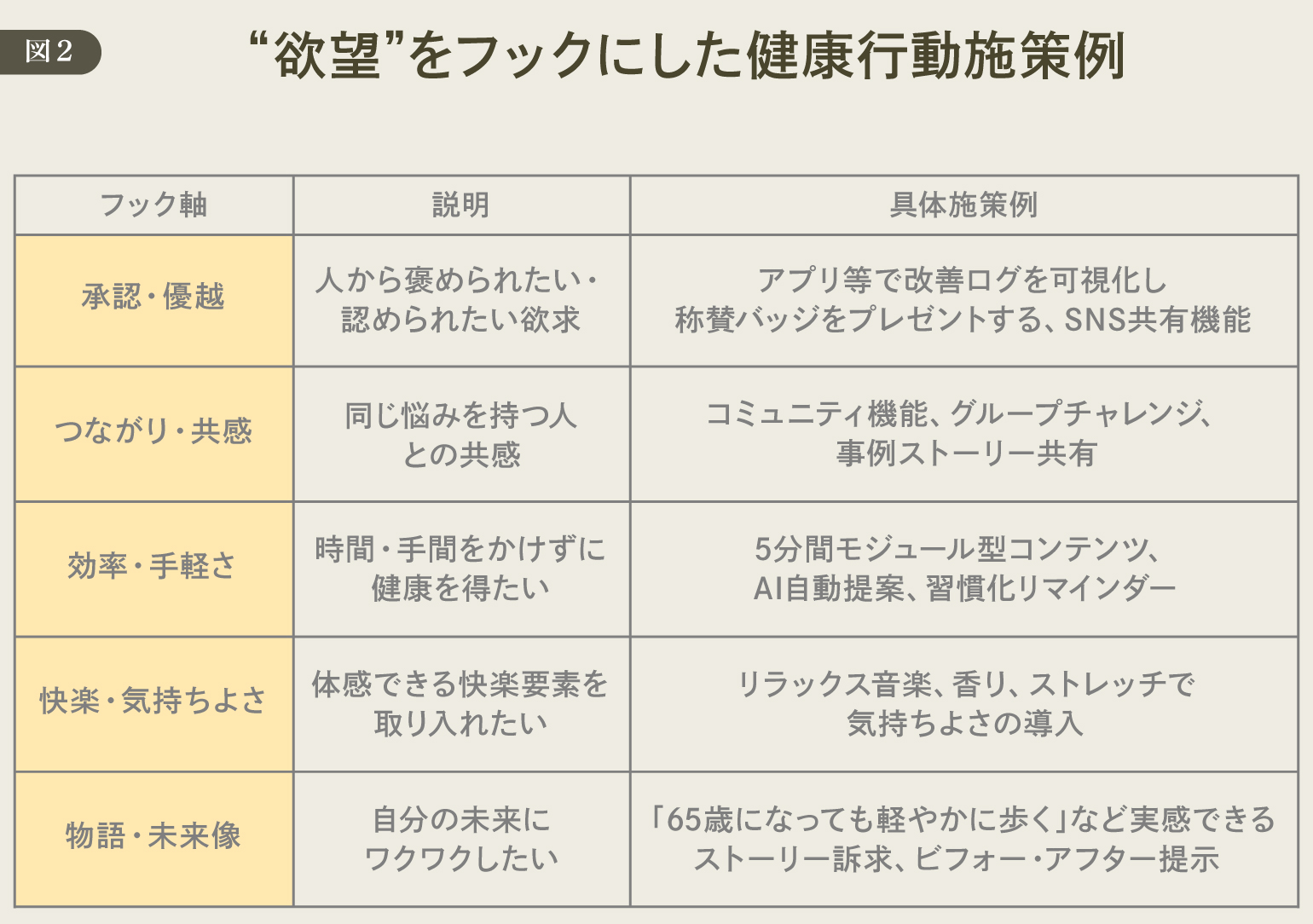
However, many health awareness initiatives tend to rely on fear-based appeals, such as "Don't get sick" or "Reduce your risks." While this approach may resonate with the "highly health-conscious," it often fails to effectively reach the "low health-conscious." Instead, we can hypothesize that motivating people with positive future visions — such as "I want my future self to be more active" or "I want to achieve a healthy body I can be confident in"—is more likely to prompt action.
For example, initiatives that hook into desires like those in the table below have a higher potential to prompt consumer action in new ways.
For Japan, the nation of longevity, to reclaim its health once more
"Long-Lived Nation Japan." The phrase resonates with pride, yet carries a certain poignancy. While we have succeeded in "living longer" ahead of the world, we still lack a sufficient sense of "living healthily." Sleep deprivation, challenges in health literacy, and systems and structures overly focused on treatment – all reflect the "health dilemma" where knowledge and information fail to translate into action.
The key to overcoming this dilemma lies not in fear or obligation, but in "designing desire." Rather than starting with "I don't want to get sick," we must create blueprints for action rooted in positive desires: "I want to walk more lightly," "I want to spend more time with the people I love." This is what moves people's hearts and becomes the driving force for sustained action.
Health is not something earned through effort alone; it is cultivated naturally within daily life. For Japan, the nation of longevity, the next goal should be health driven by desire, not fear. Designing this vision across society will pave the way toward becoming a truly "health-conscious nation with tangible results."
Was this article helpful?
Share this article


Newsletter registration is here
We select and publish important news every day
For inquiries about this article
Back Numbers
Author
Nobutaka Kaida
Dentsu Inc.
Future Business Creation Research Institute
Strategist