Note: This website was automatically translated, so some terms or nuances may not be completely accurate.
 Fact-Based "Attractiveness Branding Model Ver.3" [1/3]
What are the facts about companies that consumers find attractive, as revealed by new metrics?
The Appeal Brand Survey is conducted to analyze what corporate activities and facts consumers find appealing and how these messages are conveyed. This survey has been conducted since 2016, designed based on the "Appeal Branding Model" developed by the Corporate Communications Strategy Institute (within PR Consulting Dentsu Inc.).
A major topic in the "10th Charm Brand Survey" conducted in 2025 was the first revision in seven years, now called the "Charm Branding Model Ver.3." Building on the concepts of the previous model, it reconfigured indicators to align with changing times, evolving into a new framework.
This series introduces findings from the survey regarding this new model.
<Table of Contents>
▼ A PR-Oriented Branding Model Focused on Corporate Facts
▼ Structurally Organizing Corporate Appeal and Visualizing "Communication Power"
▼Decomposing "Corporate Appeal" into 3 Elements and 24 Areas
▼What Attractiveness Do Consumers Seek in Companies?
▼Primary Information Channels for "Appeal": "Real-Life Experiences," "Advertising," and "Programs/Articles"
A PR-Driven Branding Model Focused on Corporate Facts
Several models exist for evaluating corporate brand metrics. However, most measure "how a company is perceived." While effective for identifying "which direction to strengthen" through assessing image levels or competitor comparisons,
For example, they help design communications backward from "image recall," such as "producing a commercial to reinforce this image." Furthermore, if the desired image is clear, there is room to refine the methods of expression—choosing tools like advertising or publicity, or crafting the company's future vision.
Conversely, the field of Public Relations (PR) requires a slightly different approach. In PR, the "actual corporate activities (facts) that serve as evidence (supporting the image)" are paramount. Therefore, a more fact-based attractiveness metric is essential.
Based on this concept, the Corporate Communications Strategy Institute developed the "Attractiveness Branding Model" in 2016. It was revised in 2025 as the "Attractiveness Branding Model Ver.3." This marks the second revision since 2018.Seven years after the previous revision, and following the COVID-19 pandemic which significantly altered the global landscape, we undertook a revision of the traditional attractiveness metrics. This revision reflects the changing socio-economic environment surrounding companies, including addressing social issues, global responsiveness, and multi-stakeholder engagement.
We also recognized that the activities (facts) consumers (including customers, individual investors, job seekers, and other stakeholders) find attractive in companies change year by year. Therefore, we determined that adding items such as diversity, global initiatives, and technological innovation was necessary. We added new appeal domains and items and restructured the model. In revising the model, we consciously adopted a "stakeholder-centric approach."
Structurally organizing corporate appeal and visualizing "communicative power"
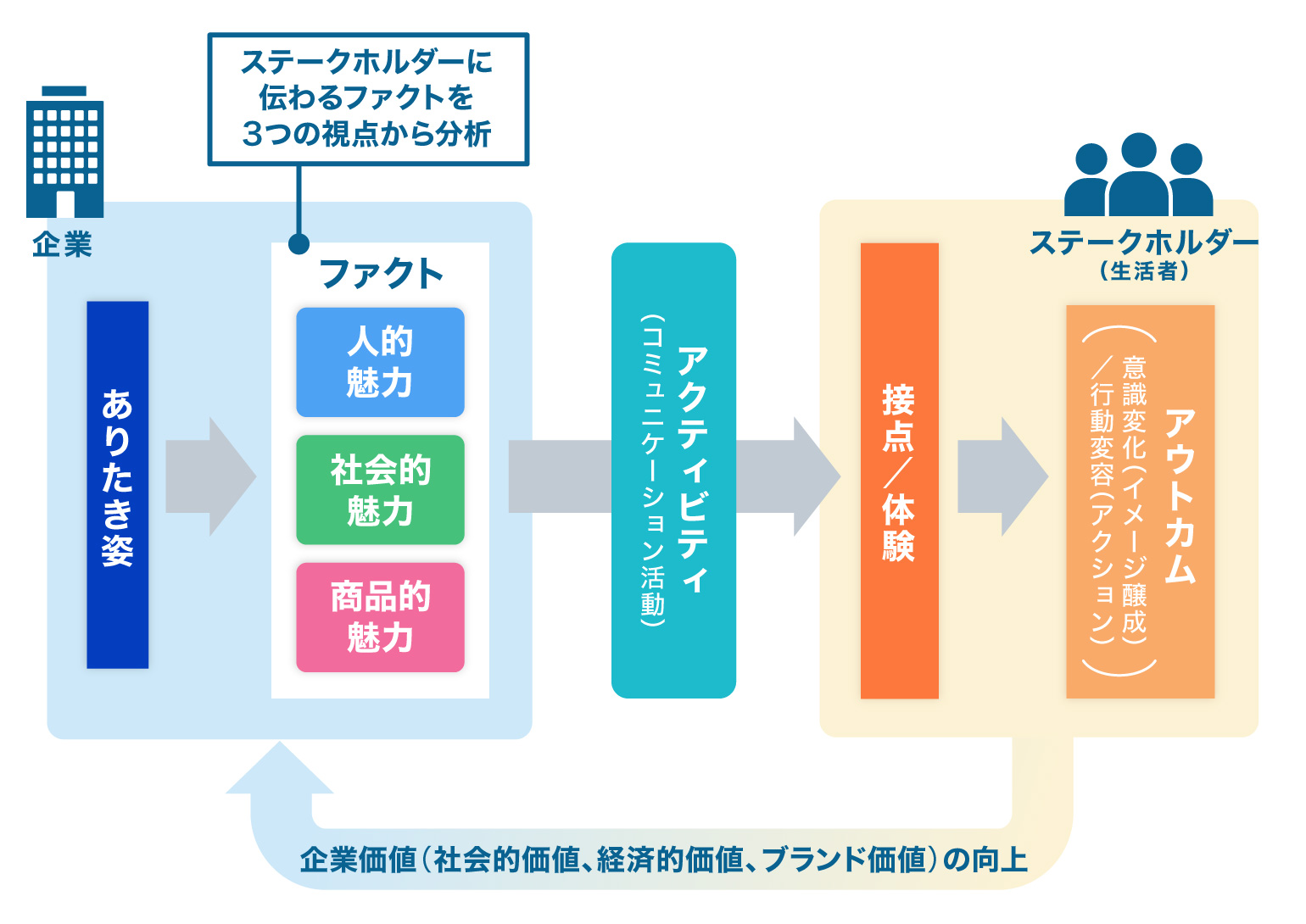
The new model organizes and structures the elements perceived as "appeal" within the company's activities (facts) that serve as the basis for communicating information toward the company's desired future state.
It clarifies:
How does that appeal influence outcomes like changes in awareness or behavior?
And how do these results ripple out to the entire corporate brand?"
The purpose of this model is to systematically visualize these aspects.
Decomposing "Corporate Appeal" into 3 Elements and 24 Domains
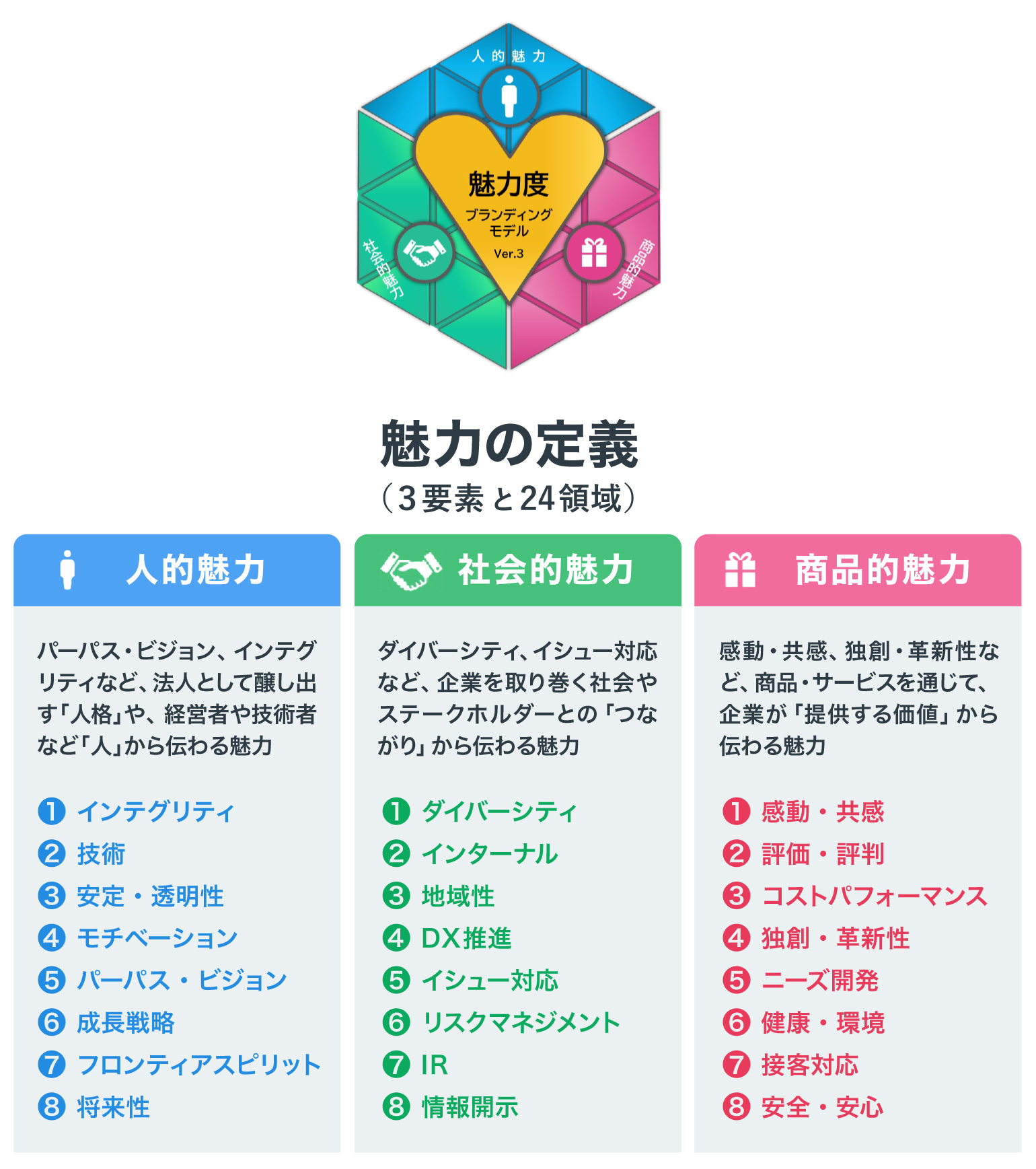
This model classifies corporate activities (facts) that are likely to be perceived as "appealing" into the following three elements:
・Human Appeal
(The "personality" cultivated as a legal entity, such as purpose/vision and integrity, and the appeal conveyed by "people" like executives and engineers)
・Social Appeal
(Attractiveness conveyed through "connections" with the surrounding society and stakeholders, such as diversity and issue response)
・Product Appeal
(The appeal conveyed through the "value provided" by the company via its products and services, such as inspiration/empathy and originality/innovation)
Each charm element is subdivided into 8 domains, totaling 24 domains.
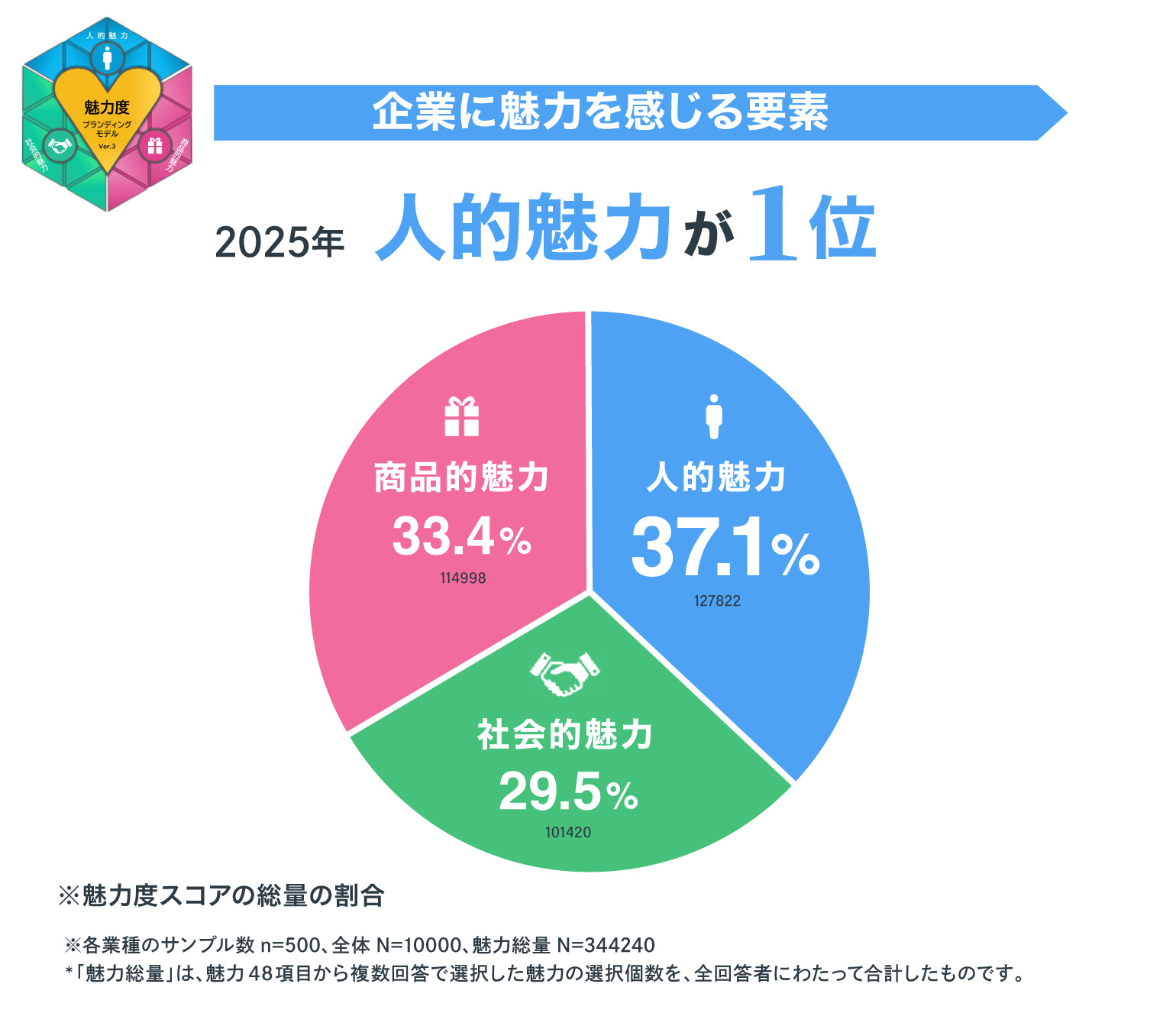
Based on this model, we conducted the "Attractiveness Brand Survey" targeting 10,000 consumers nationwide, examining the appeal of 200 companies across 20 industries. The results revealed that among the three elements of corporate "appeal" – "Human Appeal," "Social Appeal," and "Product Appeal" – "Human Appeal" was perceived most frequently, at 37.1%.
This was followed by "Product Appeal" at 33.4% and "Social Appeal" at 29.5%. (In the actual survey, two survey items were set for each appeal domain; the percentages represent the share of the total 48 survey items, with the total sum set at 100).
What appeal do consumers seek in companies?
When asked "What elements make a company attractive to you?" for each company, the following three points were strongly identified as key sources of "appeal":
1. "Issue Response" (Addressing essential societal challenges)
2. "Stability and Transparency" (Sense of security and trust in management)
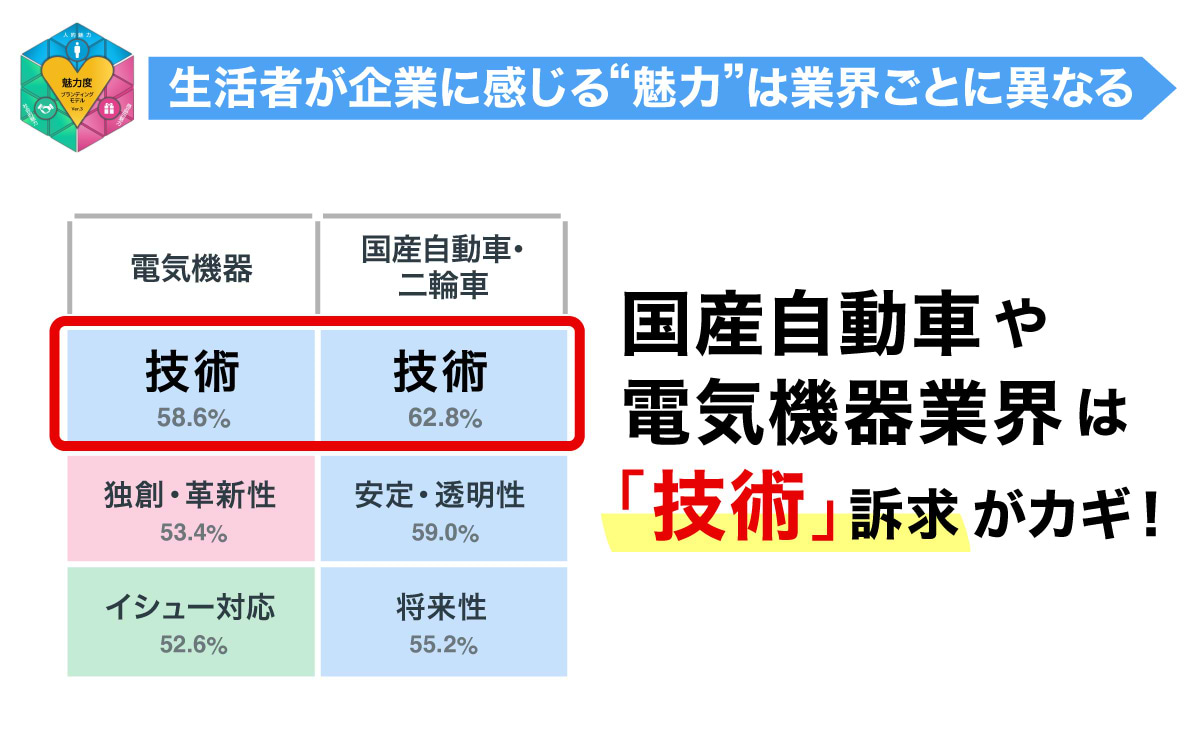
3. "Technology" (High technical capabilities and know-how)
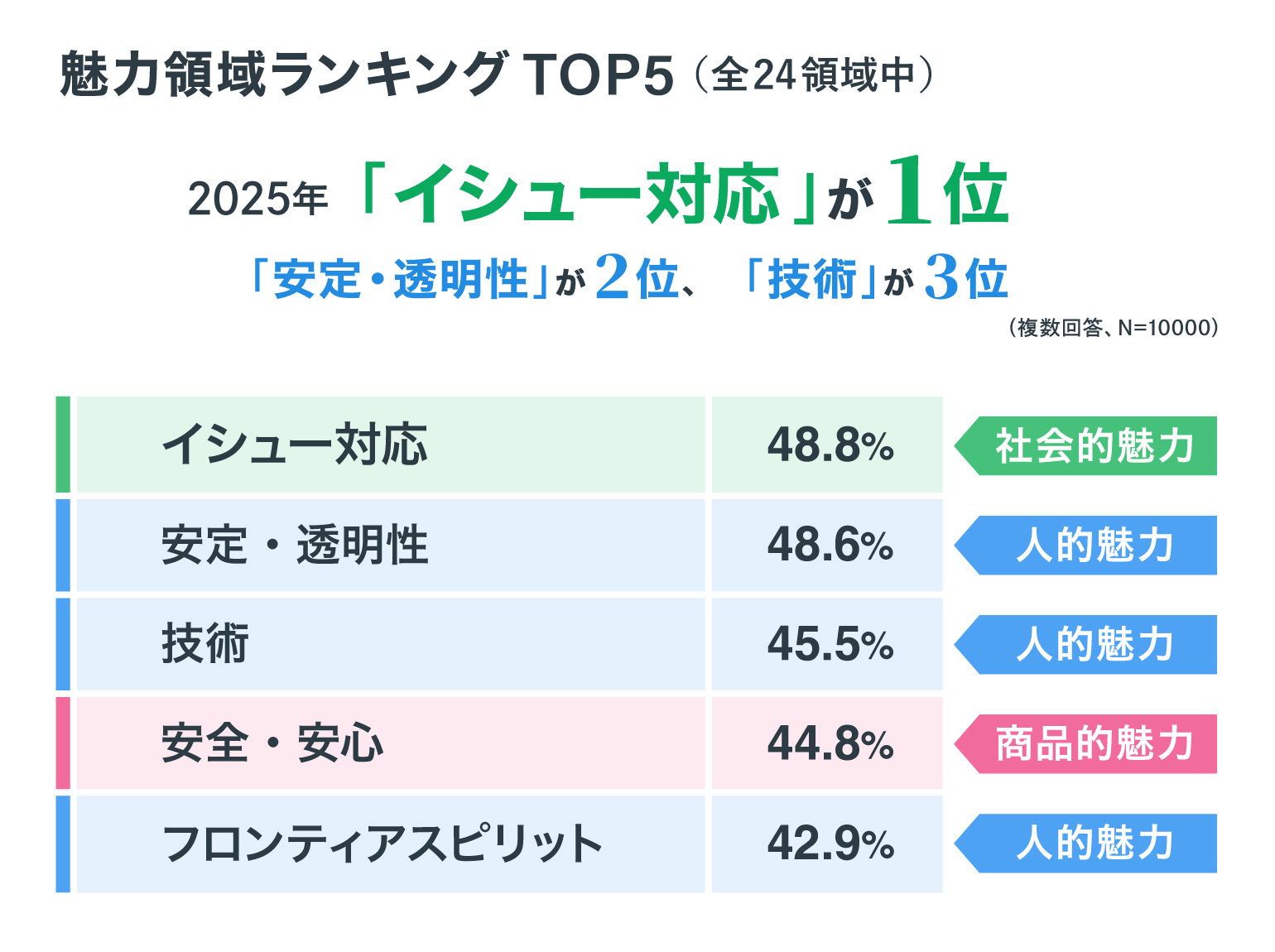
Furthermore, three of the top five selected areas relate to "human appeal."
These results suggest that these elements are considered important for consumers in building trust based on "people" or "organizations" and forming empathy.
Examining the appeal items derived from further subdividing the appeal domains revealed the following:
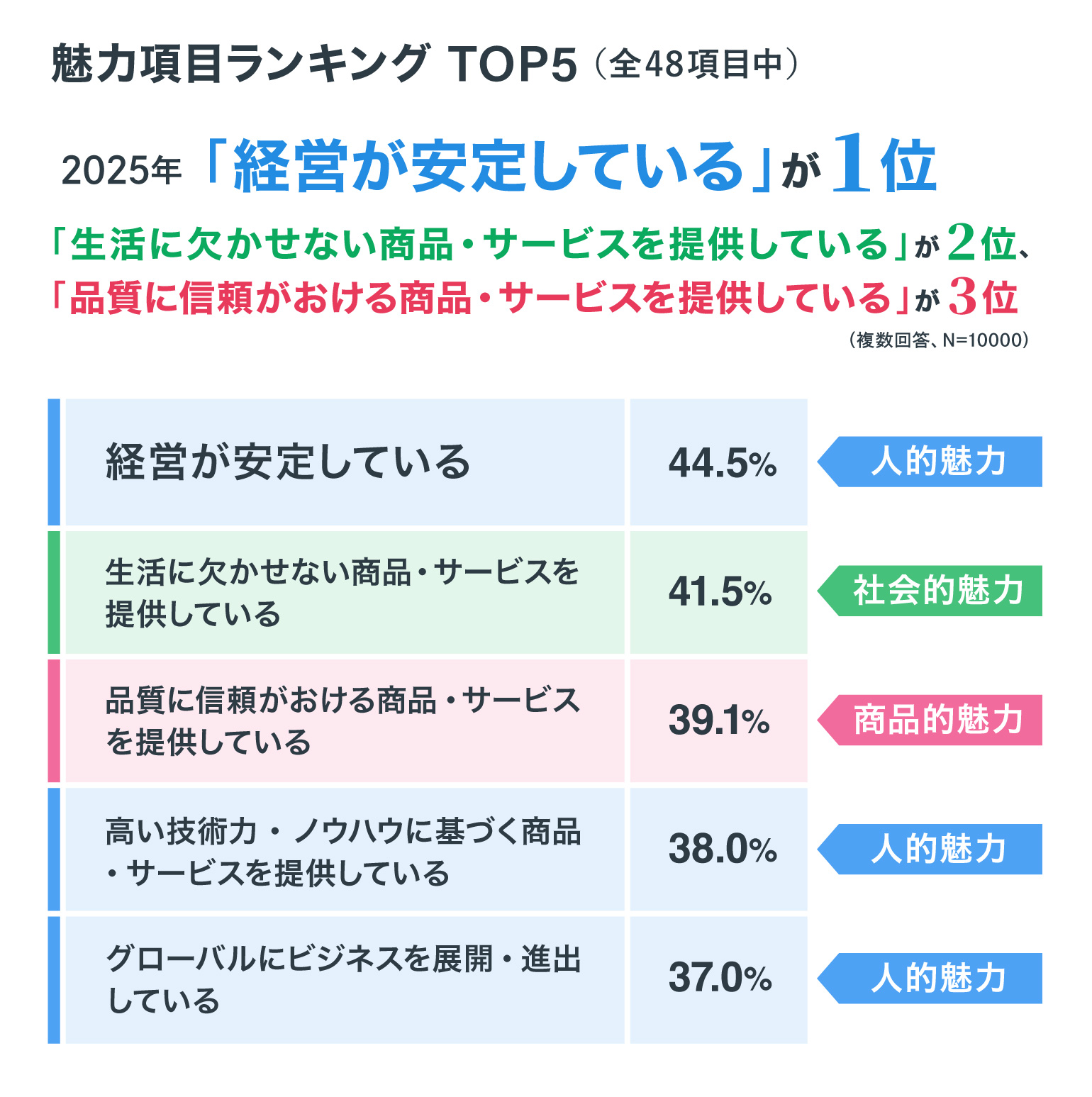
In the top 5 selection rates for appeal items: 1st place was "Stable and Transparent Management" (Human Appeal) under the "Stability and Transparency" domain; 2nd place was "Providing Essential Goods/Services" (Social Appeal) under the "Issue Response" domain; 3rd place was "Providing Reliable Quality Goods/Services" (Product Appeal) under the "Safety and Security" domain;Fourth place was "Providing products/services based on high technical capabilities and know-how" from the "Technology" domain (Human Appeal). Fifth place was "Operating globally" from the "Frontier Spirit" domain (Human Appeal).
These all center on elements demonstrating a company's "fundamental reliability" and "social significance." This suggests that the appeal consumers seek is grounded most fundamentally in "trust, security, and contribution to daily life," rather than flashy corporate buzz. "Challenge" and "individuality" are "developmental appeal elements" that are evaluated only after trust and security are established.
Primary information channels for "appeal": "Real-life experiences," "Advertising," "TV programs/Articles"
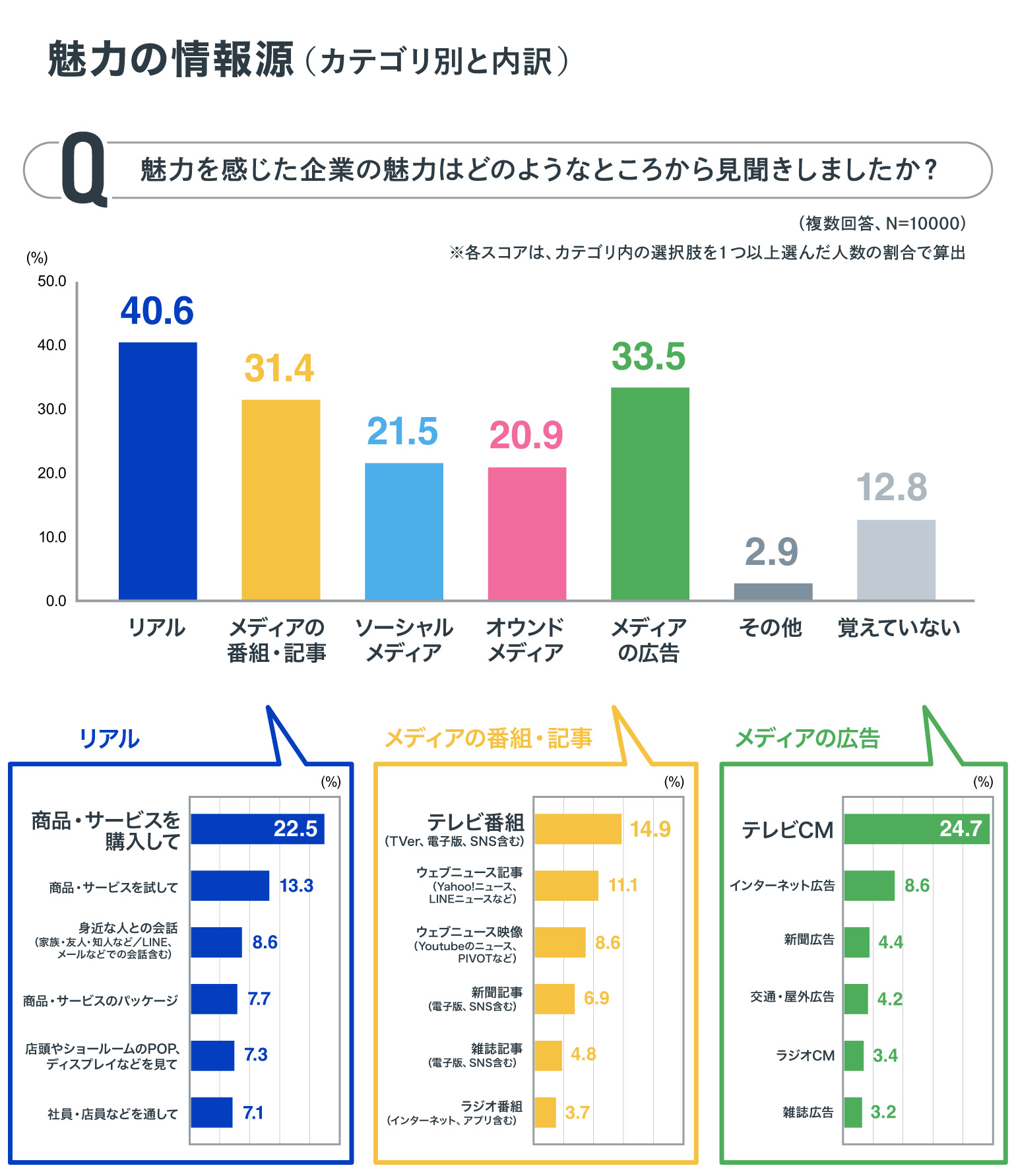
The information channels that triggered consumers' attraction were ranked as follows:
1. Real-world experience (purchase/use, trial, etc.)
2. Advertising (especially visual appeals like TV commercials)
3. Programs/Articles (exposure through news or features)
While information pathways for appeal can be broadly divided into experiencing it through purchase or perceiving it through information, overall, "real-world" experiences (purchasing or trying), "media advertising" (like TV commercials), and "media programs/articles" (TV shows or news articles) rank highly.
Of course, these information pathways are known to vary between B2C and B2B companies.
The Corporate Public Relations Strategy Institute interprets these trends in appeal as the "advantage of human appeal."
As mentioned earlier, "Trust, Security, and Contributing to Daily Life" are considered the most crucial foundation for building corporate appeal. However, these are fundamentally the basic requirements a company must possess.Once this foundation is met, it is the attitude of "challenge" and the expression of "individuality" demonstrated by the company that function as "developmental appeal elements" creating differentiation from competitors. Furthermore, we believe that such "challenge" and "individuality" are precisely the appeal conveyed by the corporate personality itself, and even more so by the "people" – such as executives and engineers – leading to the "advantage of human appeal."
Next time, we will introduce "Approaching with Appropriate 'Attractiveness' for Each Industry" based on survey data.
[Survey Overview]
Survey Name: Appeal Brand Survey
Survey Period: June 20, 2025 - July 8, 2025
Survey Method: Online survey
Survey Area: Nationwide
Survey Population/Sample: 10,000 respondents aged 20–69 nationwide (men and women equally distributed across segments below)
(Breakdown) 20s: 2,000 ss / 30s: 2,000 ss / 40s: 2,000 ss / 50s: 2,000 ss / 60s: 2,000 ss /
*To extract the above sample, a screening survey was conducted targeting general men and women aged 20-69 (high school students and above, regardless of marital status or occupation). In addition to age criteria, respondents were allocated to 20 industries (companies) they found appealing, with 500 respondents per industry.
Survey Release: https://www.dentsuprc.co.jp/releasestopics/news_releases/20251020.html
Was this article helpful?
Share this article


Newsletter registration is here
We select and publish important news every day
For inquiries about this article
Author

Shohei Suetsugu
PR Consulting Dentsu Inc.
Corporate Public Relations Strategy Research Institute
Deputy Director