Note: This website was automatically translated, so some terms or nuances may not be completely accurate.
 DENTSU DESIRE DESIGN's Approach to Marketing Reconstruction Based on "Theory of Desire" [33/40]
“Full Circle: A Return to Analog”? — Unexpected Common Ground Between Young People and Seniors —
Dentsu Inc. Desire Design (DDD) is an organization that develops various solutions and disseminates information based on the relationship between consumption and desire.
In this article, we analyze DDD’s “Emotional Consumption Survey” ( see survey overview here ) and share the insights and findings derived from the results. Based on the findings of the 11th survey conducted in November 2025, Takashi Chiba of DDD examines the results under the theme of “Digital and Analog.”
Many People Feel the "Charm of Analog That Digital Lacks"
Our lives are now inseparable from smartphones and various digital services. More and more of our activities—from gathering information and shopping to interacting with others—are taking place entirely on screens. In this environment, what kind of feelings do people have toward “analog and handmade items”?
When asked, “Do you feel that analog and handmade items have a charm that digital items lack?” 73.9% of respondents answered “Yes” (25.6%) or “Somewhat yes” (48.3%). On the other hand, only 5.9% answered “No.” At the very least, it seems certain that a positive perception of analog items is widely held.
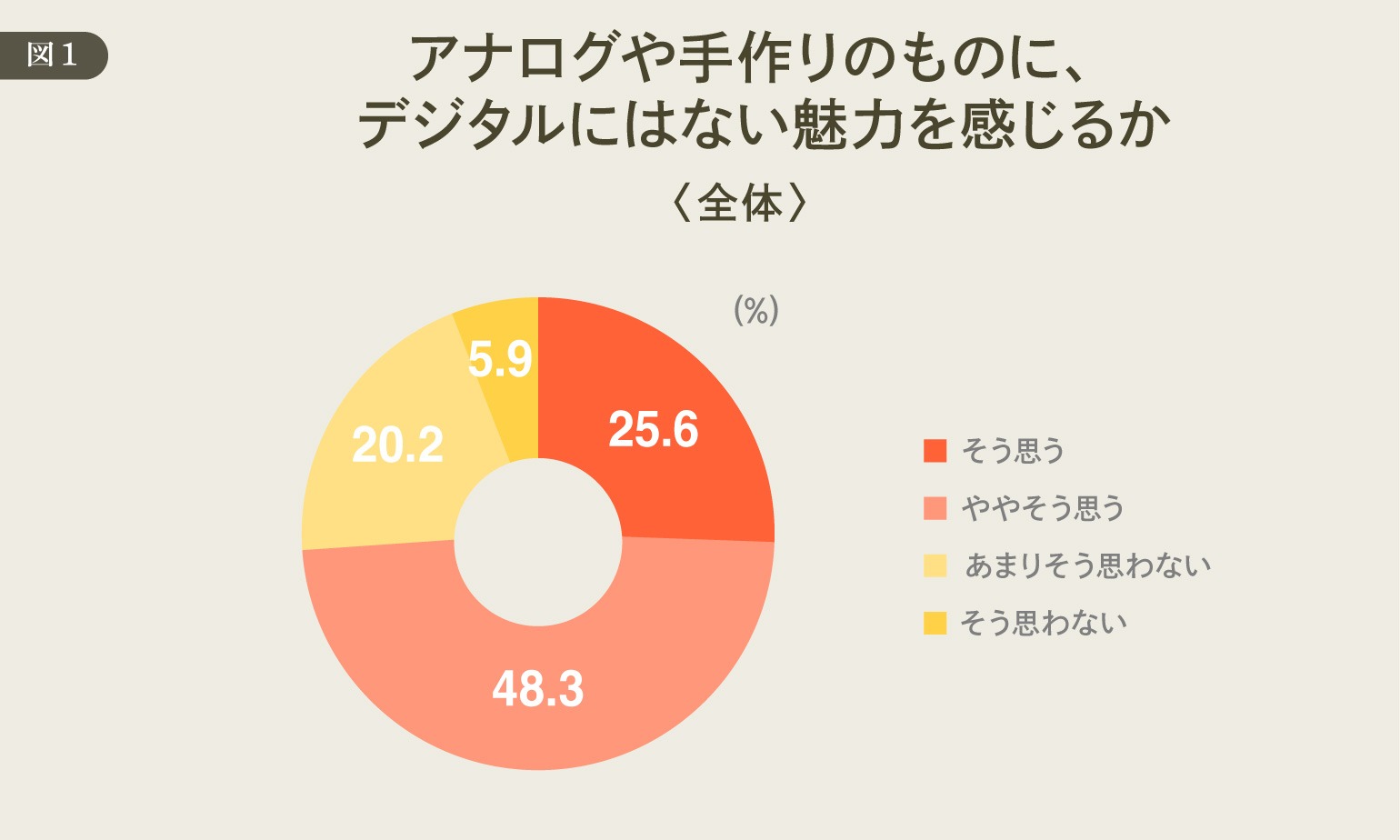
However, it might be premature to simply conclude that “a return to analog is underway.” Looking at the breakdown, the “strongly agree” responses do not stand out significantly; rather, “somewhat agree” is the most common response. The impression is one of gentle, widespread support rather than fervent enthusiasm. It seems closer to a sense of these items being naturally integrated into daily life than a strong, anti-digital stance.
Common Ground Between Young People and Seniors: Insights from a Generational Comparison
When viewed by generation, an interesting trend emerges. Among young people aged 15–19, the combined percentage of those who “agree” and “somewhat agree” reaches approximately 80% for both men and women. Even among the generation known as “digital natives,” the proportion affirming the appeal of analog remains high.
On the other hand, a similarly high proportion of positive responses is found among those in their 60s. This figure does not decrease significantly even among those in their 70s. A pattern emerges in which the groups at the “extremes” of the generational spectrum share a consistently high level of appreciation for analog.
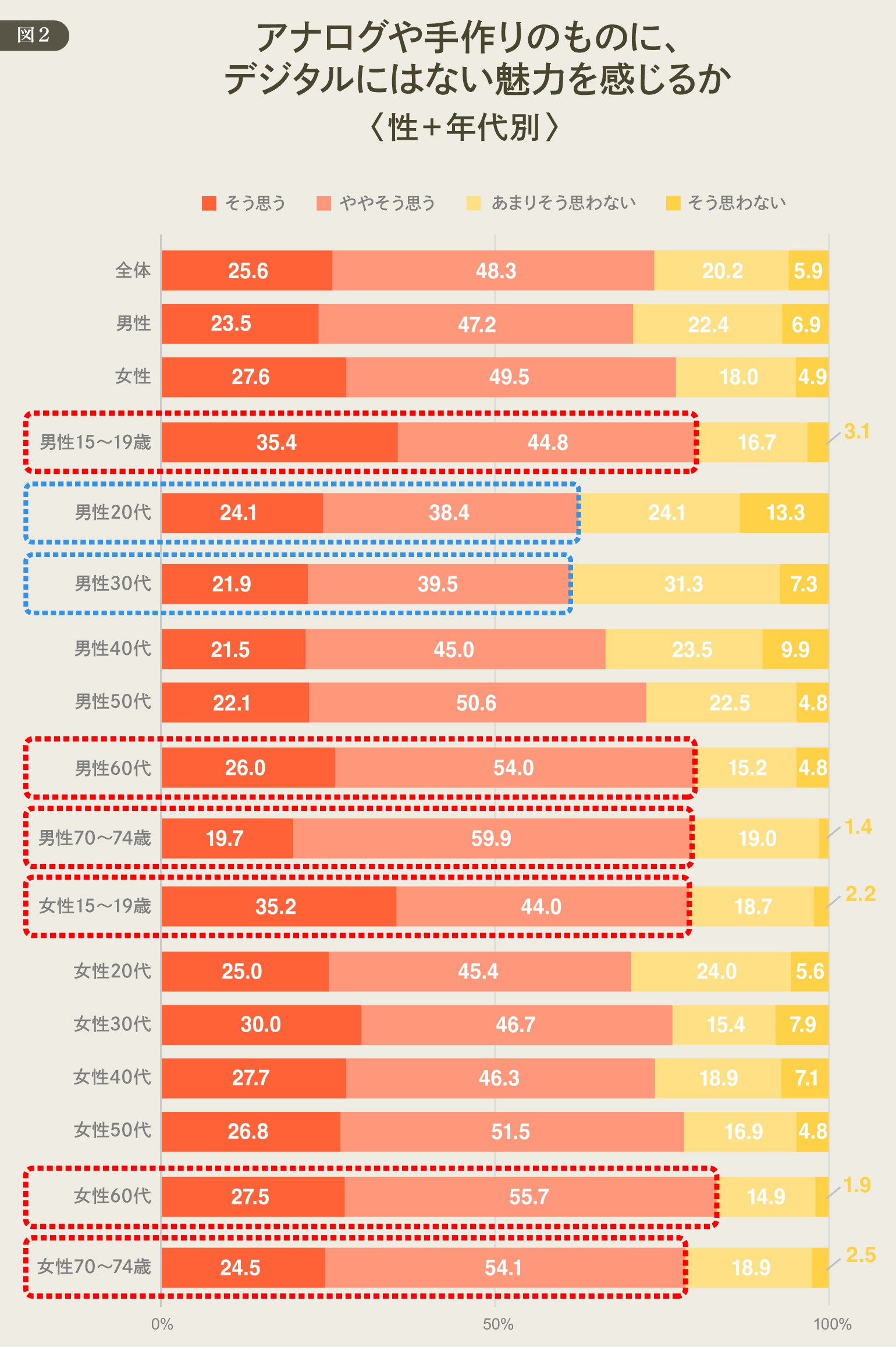
In contrast, men in their 20s and 30s present a starkly different picture. In this demographic, the combined percentage of those who “agree” and “somewhat agree” is 62.4% for those in their 20s and 61.4% for those in their 30s—slightly lower than other generations and showing a significant gap compared to women of the same age. However, this does not necessarily mean they are negative toward analog technology. Since 60% still express a positive view, this difference should be interpreted as a relative one.
Furthermore, it is worth noting the difference between “strongly agree” and “somewhat agree.” While the proportion of “strongly agree” is relatively high among younger generations, “somewhat agree” is more prevalent among those in their 60s and older. Even within the category of agreement, there appears to be a difference in the level of enthusiasm. While these results alone do not reveal the motivations or background, the distribution of the numbers clearly reflects generational differences in perception.
Analog and Digital Are Not a “Binary Opposition”
What we can infer from these results is not a simple dichotomy where “analog is perceived as being in opposition to digital.” Rather, it gives the impression that digital has become the foundation of daily life, with analog existing alongside it.
While positive responses are in the majority, negative responses are not extremely rare, nor is there overwhelming enthusiasm. This balance suggests that consumers may not view digital and analog as a “binary opposition,” but rather accept them according to their respective characteristics. Furthermore, the results in Figure 2 indicate that the appeal of analog is not limited to a specific generation.
Taking this analysis a step further, it is possible that precisely because the use of digital technology is permeating every aspect of daily life, the unique characteristics of analog are once again catching people’s attention.
In recent years, numerous terms ending in “-pa” (such as “time performance” and “space performance”) have emerged. It is likely that changes in our living environment—where convenience and efficiency have become the norm—have, as a result, made people more conscious of different textures and ways of using time. In other words, as digital technology has spread, the value of analog has become relatively more visible. This relationship can be interpreted in this way.
Has it “come full circle,” or has it simply “never disappeared”?
Looking at this situation, some might feel that we’ve “come full circle” and are witnessing a “return to analog.” But is that really the case? The phrases “coming full circle” and “return” evoke the image of trends cycling through phases. However, judging by these results, it would be inappropriate to conclude that analog simply vanished and then came back. Rather, we can view it as something that has maintained a certain level of support even as digitalization has advanced.
Now that digital has become the standard infrastructure, analog may no longer be a distinct counterpoint but rather an option that continues to exist somewhere in our daily lives. Even if it isn’t strongly emphasized, there is a sense that it is shared across generations. It is this very breadth that emerges as the landscape revealed by this data.
Rather than having come full circle, it has always been right there beside us. When viewed this way, the positioning of analog takes on a slightly different perspective. Rather than drawing a line between digital and analog, future marketing will likely require us to consider them from the perspective of coexistence and mutual prosperity.
At DDD, we will continue to explore consumer insights from various perspectives through our “Emotionally Driven Consumer Research.”
[Survey Overview]
〈Overview of the 11th "Emotionally Engaging Consumer Survey"〉
・Target Area: All of Japan
・Eligibility: Men and women aged 15–74
・Sample Size: 3,000 respondents total (allocated according to population demographics across 7 age groups—15–19, 20s–60s, and 70–74—and 2 gender groups)
・Survey Method: Online survey
・Survey Period: November 7 (Fri) – November 12 (Wed), 2025
・Survey Sponsor: Dentsu Inc., DENTSU DESIRE DESIGN
・Survey Agency: Dentsu Macromill Insight, Inc.
Was this article helpful?
Share this article


Newsletter registration is here
We select and publish important news every day
For inquiries about this article
Back Numbers
Author

Takashi Chiba
Dentsu Inc.
第4マーケティング局
Producer
Exploring Pathways from the "Quality of Society Survey" to a "Society" Where People Find Meaning in LifeCurrent State of Public Awareness and Values as Seen in the "Quality of Society Annual Survey 2021"DENTSU DESIRE DESIGN's Approach to Marketing Reconstruction Based on "Theory of Desire"The starting point is "desire"; product development that moves the heart