Note: This website was automatically translated, so some terms or nuances may not be completely accurate.
 The Case for "Technology PR": Are There "Treasure Troves" Hidden in Your Company’s Technology Department? [1/2]
40% of Engineers Say They “Don’t Collaborate with PR”: Challenges and Solutions for Technical PR
・What is Technology PR?
Corporate communication regarding a company’s “technology,” particularly external information dissemination.
Collaboration between the technical and public relations departments to effectively communicate the company’s technologies to the outside world is of great significance in corporate management.
In this series, we will examine “technology PR” while keeping both management and academic perspectives in mind.
In this first installment, Norihito Naka, Senior Researcher at PR Consulting Dentsu Inc. / Corporate PR Strategy Research Institute, will introduce key points that management and public relations departments should keep in mind regarding corporate communications, as well as approaches to addressing challenges based on the results of a “Survey on the Current State of Technology PR” that was conducted.
<Table of Contents>
▼Three Reasons to Focus on Technical PR Now
▼What Kind of Management Is Required from Executive Leadership to Resolve “Technical PR Bottlenecks”?
▼40% of Engineers Feel They “Cannot Collaborate with PR”
▼ Does PR Involvement Double “Team Strength”?
▼What Approaches Should Executives and PR Teams Take to "Clear the Bottleneck"?
3 Reasons to Focus on Technical PR Now
There are three reasons behind our focus on this topic. Note that the term “engineers” used in this article includes researchers involved in development and basic research.
- Engineer Shortage… As labor shortages accelerate, the shortage of engineers—who serve as essential workers supporting social infrastructure—is becoming increasingly severe
- The Need for Human Capital Management… When managing “engineers,” there is a growing need for human capital management that considers long-term “social value” alongside short-term “economic value.”
- Changing Relationship Between Companies and Society… The role of “technical PR” is no longer limited to communications aimed at marketing effectiveness; it now requires strategies that include strengthening organizational engagement by using communications to boost the motivation of engineers and researchers
What kind of management is required of executives to resolve the “bottleneck in technical PR”?
Traditionally, technical PR was positioned similarly to external “product PR,” with the expectation of marketing effects such as increased profitability. However, its role has now reached a stage where it directly influences “corporate value itself.”
A symbolic example of this is the Tokyo Stock Exchange’s warning to companies with a PBR (price-to-book ratio) below 1x (*). Under the title “Request Regarding Measures to Realize Management Conscious of Capital Costs and Stock Prices,” the exchange has been continuously urging certain listed companies to improve their situation since March 2023, stating that “the company’s activities are not sufficiently understood by the market, which is preventing it from receiving a fair market valuation.”
*Companies with a PBR below 1x: Companies with a price-to-book ratio of less than 1, meaning their market capitalization (market valuation) is lower than their net assets. These companies typically have low return on equity (ROE), low growth expectations, and low liquidity. Market participants have pointed out that, particularly among domestic B2B companies, the “technology” value chain (customer value → market opportunity → competitive advantage → revenue contribution) is not well understood, which may be causing their PBR to fall below 1x.
Furthermore, in addition to consistently explaining “technology” to shareholders from both the perspectives of “economic value” and “social value,” management is required to implement management practices that take into account the “motivation” and “performance” of engineers as a means of addressing “labor shortages.”
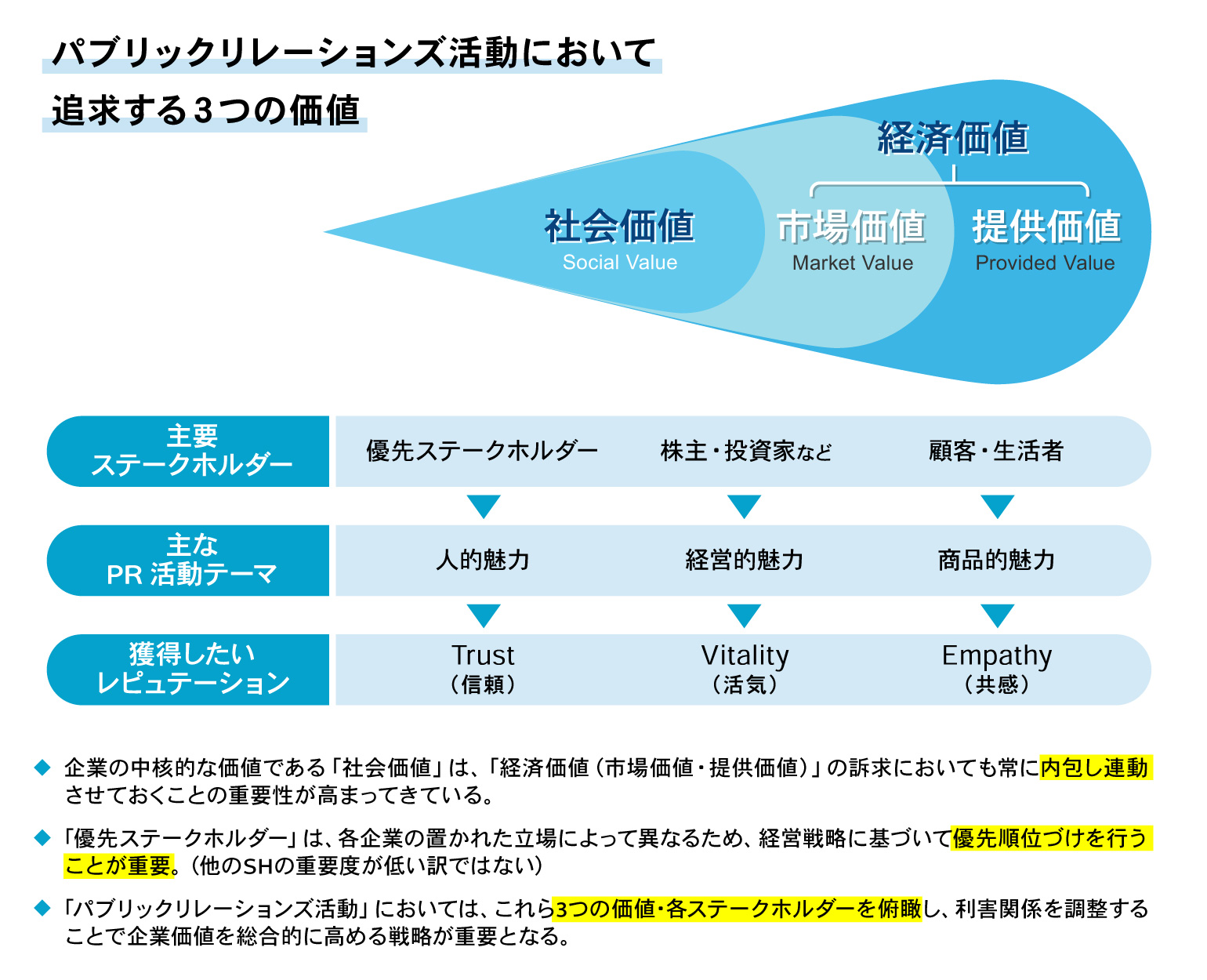
In the Corporate Public Relations Strategy Institute’s [2020] publication “New Strategic Thinking in PR Management” (Nikkei BP), an interview was conducted with Professor Kunio Ito, Director of the CFO Education and Research Center at Hitotsubashi University’s Graduate School of Business Administration. In the interview, Professor Ito noted that “it is common for business strategy and human resources strategy to fail to connect effectively,” and pointed out that “PR should demonstrate leadership through integrated thinking.”
However, in my conversations with public relations professionals, I sense that, even before the issue of PR leadership , “the internal position of public relations within the company is simply too weak.” I believe that only when management and the PR department understand this point and address it as a united front can social value and economic value be integrated, leading to corporate value.
Above all, it is crucial to first recognize the possibility that “technologies that have not yet materialized as corporate value are buried within the company.”
Furthermore, within the company’s corporate value creation cycle for “technology,” it is necessary to pinpoint where the “bottlenecks” lie and issue top-down directives to resolve them.
On that basis, it is crucial for the public relations department to recognize these bottlenecks and determine the overall direction of all communications related to “technology” through on-site interviews, redefining the company’s technology from the perspective of social issues, and constructing narratives within the context of “social value.”
40% of engineers feel they “are not collaborating with PR”
Focusing on the reality of these bottlenecks, we formulated the following hypothesis:
・Hypothesis: Engineers perceive three barriers when it comes to the PR department
- Collaboration barrier: There is a communication barrier between the PR department and the R&D or business departments where engineers are based
- Barrier of Understanding: PR does not fully understand the engineers’ technical and research initiatives
- Image barrier: Engineers perceive the PR department as “conservative,” and there are challenges with information dissemination
Based on this hypothesis, PR Consulting Dentsu Inc. conducted a “Survey on the State of Technical Public Relations” targeting 500 engineers—who belong to technical departments and serve as decision-makers in selecting external contractors. We attempted to analyze the results from the perspective of organizational behavior theory (*).
*Organizational Behavior: A field of management studies that seeks to elucidate the causal relationships behind the attitudes and behaviors of individuals and groups within an organization, including the factors that give rise to them.
PR Consulting Dentsu Inc.: Survey on the Current State of Technical PR Targeting 500 Engineers
https://www.dentsuprc.co.jp/releasestopics/news_releases/20251224.html
The survey results showed that 56.0% of respondents answered that they were “able to collaborate,” while 53.4% answered that “engineers and PR staff have mutual understanding.” In other words, over 40% answered that they were “unable to collaborate” or lacked “mutual understanding,” indicating that many engineers feel there is a lack of collaboration with PR.
Furthermore, nearly 60% of engineers described the PR department as “conservative,” indicating a perception gap between the two groups.
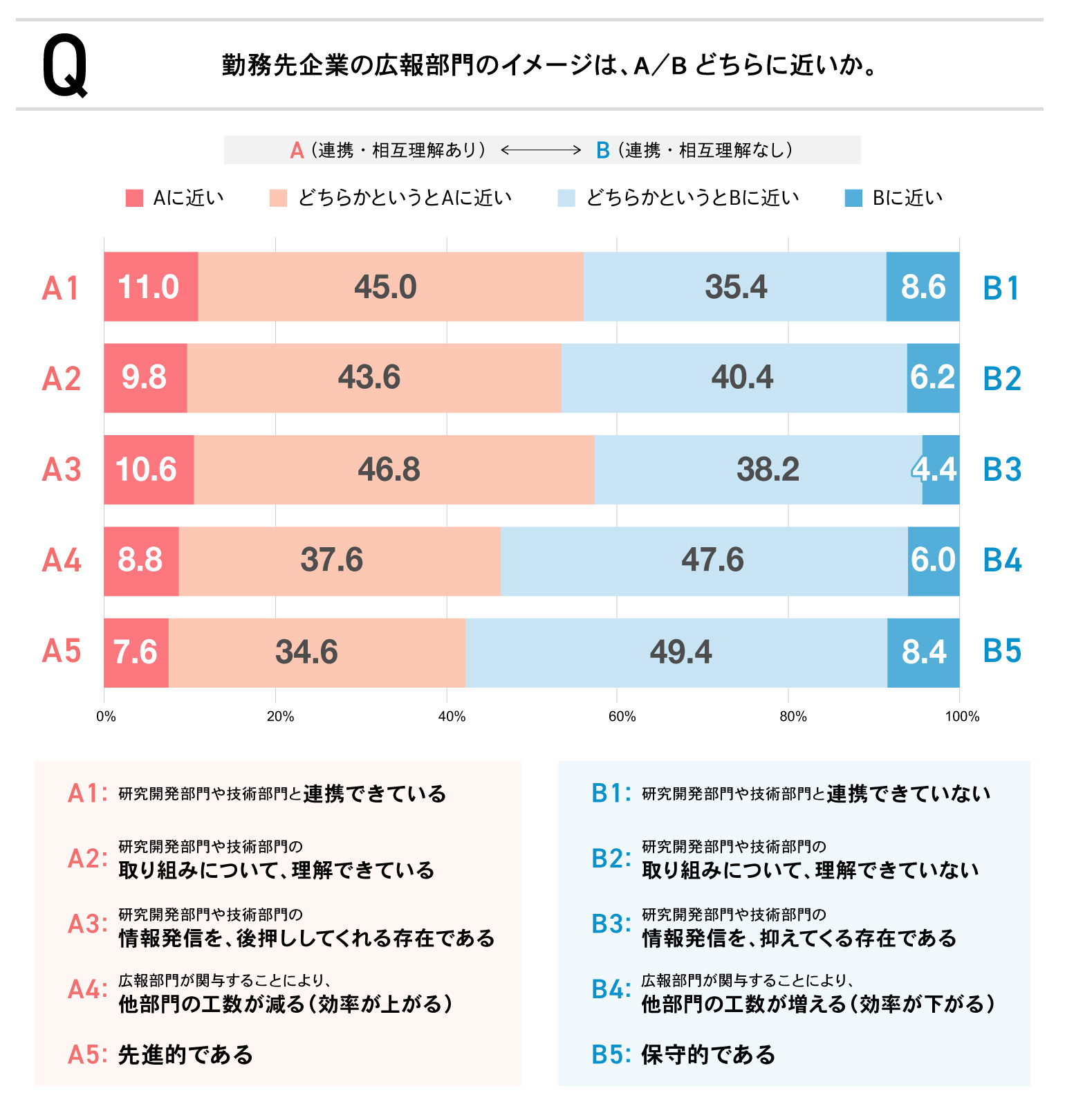
A negative perception emerges: engineers feel they have something to say but are not allowed to speak up, while the PR department is risk-averse and reluctant to communicate.
Furthermore, when looking specifically at unlisted companies, the percentage of those reporting a lack of collaboration is even higher, accounting for just under 50%.
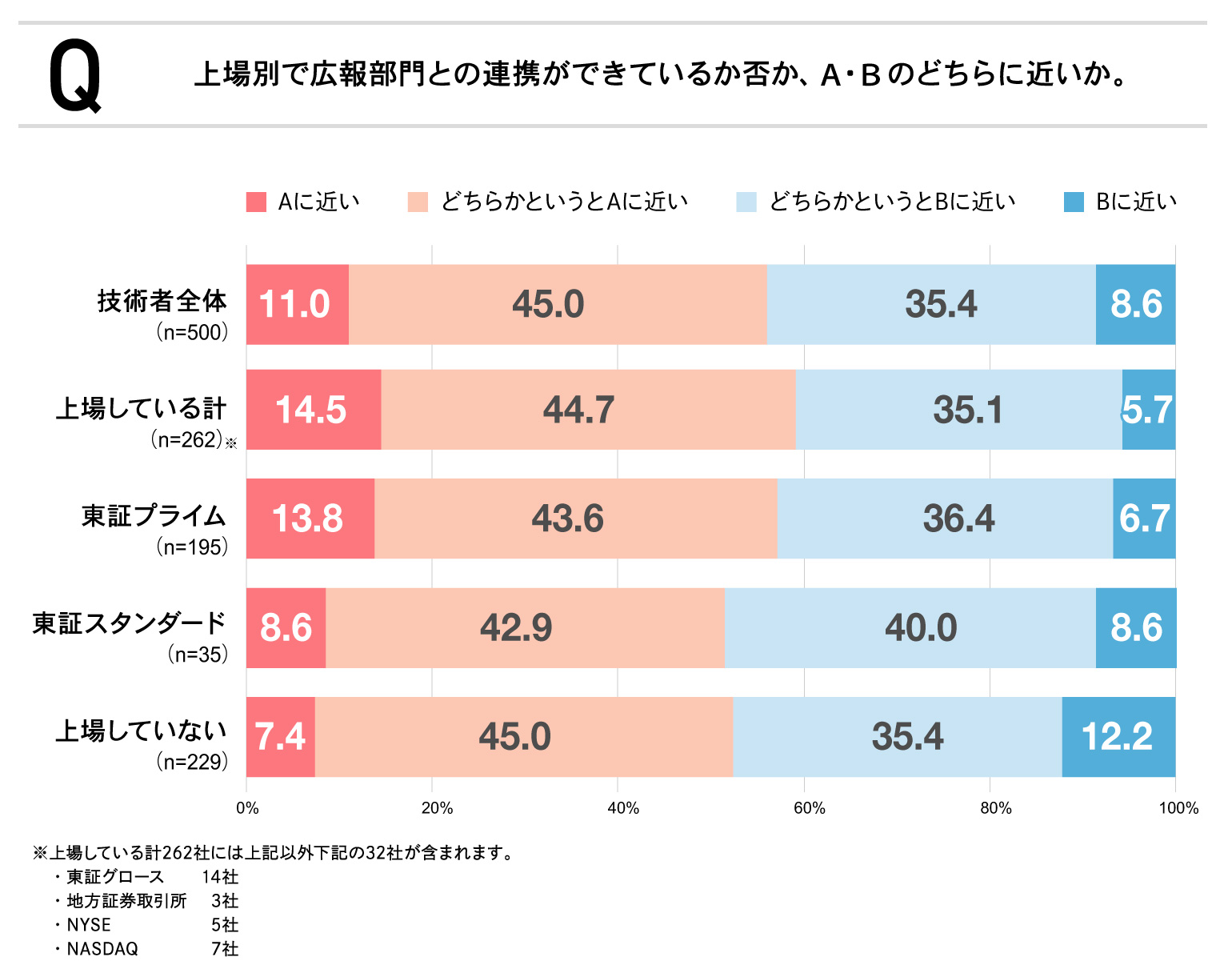
The survey results can be summarized as follows.
Summary of Engineers’ Responses to the Hypothesis
- Barriers to Collaboration: There are communication barriers between the public relations department and the R&D and business departments where engineers are based
→ About 40% stated that "collaboration is not taking place" - Barriers to Understanding: The PR department does not fully understand the engineers’ technical and research initiatives
→ Just under 50% stated that they “do not understand” - Image Barriers: Engineers perceive the PR department as “conservative,” and there are challenges with information dissemination
→ Just under 60% perceive the department as “conservative”
→ 70% responded that it is a waste not to share information despite having strong research and technical capabilities
Does PR Involvement Double “Team Strength”?
In this survey, we further analyzed how “PR involvement” affects engineers’ behavior from the perspective of organizational behavior theory.
We examined whether those who view PR as a “supporting force” have a positive impact on the proactive behavior (*) of technical and research departments, and the results are as follows.
*Proactive behavior: Refers to adaptive actions such as actively gathering information within the organization or taking the initiative to build relationships with existing members. It involves identifying issues independently and taking the initiative to drive environmental change. In analyzing these survey results, we conducted factor analysis on the "organization," "team," and "individual" factors, and focused on the "team" figures using hierarchical multiple regression analysis.
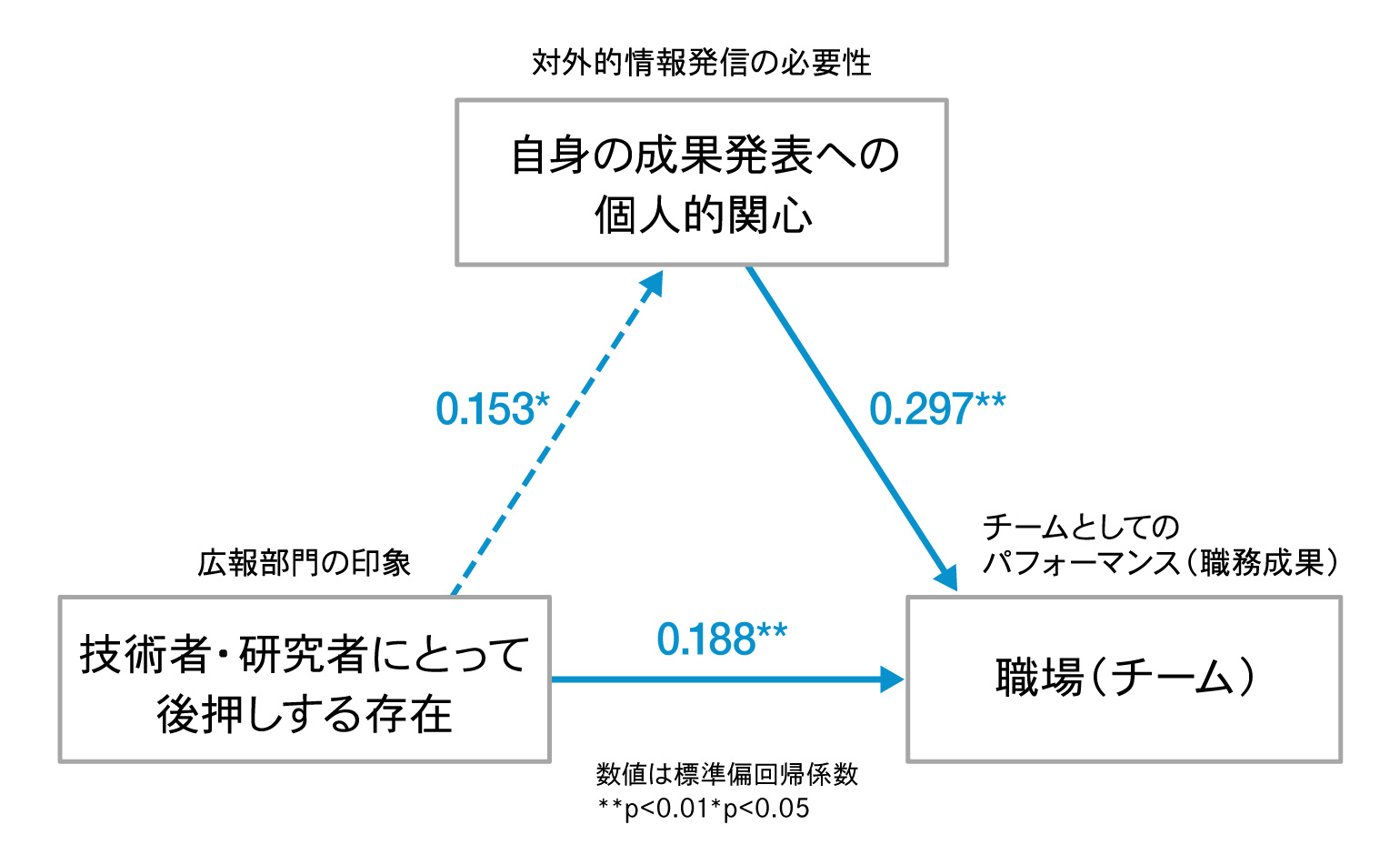
*The Sobel Test was conducted to verify mediating and moderating effects.
*For job performance (team), hierarchical multiple regression analysis was performed using the scales from the following prior study. Here, job performance is examined in relation to proactive behavior.
Griffin, M., Neal, A., and Parker, S. K. (2007) “A new model of work role performance: Positive behavior in uncertain and interdependent contexts,” Academy of Management Journal Vol. 50, No. 2, pp. 327–347.
It’s a bit complex, but in short, the findings show that if engineers and researchers are able to communicate externally, positive proactive behavior toward the team can be doubled.
In other words, these findings suggest that when public relations actively engages with engineers and researchers to translate technology into “social value” and disseminate it, this not only generates promotional benefits but also has the potential to revitalize the technical department itself—a significant advantage for the company.
It can be said that the public relations side is required to work closely with researchers and engineers on the ground, identifying the greatest common denominator between the “results the organization wants to communicate” and the results that researchers and engineers want to present to the market, while making efforts to disseminate information.
What is the approach to “clearing the bottleneck” that management and PR should adopt?
In chemical and manufacturing companies with strong technical expertise, internal communication can become rigid due to factors such as a hierarchical structure and a closed-off culture among engineers and researchers.
To overcome these challenges, a two-pronged approach is required: “top-down leadership from management” and “a flexible approach from the public relations team.”

In fact, when observing various companies, I feel that organizations with agile PR staff tend to be stronger.
At PR Consulting Dentsu Inc., we conduct workshops such as “Vision Quest” to revitalize internal collaboration among PR, executive leadership, frontline staff, and HR. I plan to introduce these initiatives as case studies in a future post.
In the next installment, I will define communication regarding “technology”—specifically external communications—as “technology PR,” and use case studies to explain how CTOs, executive officers in charge of PR, and frontline PR and marketing teams should address these challenges.
Was this article helpful?
Share this article


Newsletter registration is here
We select and publish important news every day
For inquiries about this article
Author

Atari Norihito
PR Consulting Dentsu Inc.
Deputy Director, Integrated Communications Bureau
Senior Researcher, Corporate Public Relations Strategy Research Institute