Note: This website was automatically translated, so some terms or nuances may not be completely accurate.
 Taking on the Challenge of "Intractable Diseases × Work" Through Creativity [1/2]
What is “RD Worker,” the buzzword of 2026?
Have you heard of the term “RD Worker”? RD Worker is a new concept announced in September 2025, referring to people who are working or seeking to work while living with a “rare disease.” When you hear the term “rare disease,” you may feel that it’s a world unrelated to your own. However, the topic of “rare diseases and work” is likely to become much more relevant to us all in the future.
In this series, Ikumi Sotozaki, Creative Director and Copywriter at Dentsu Inc., will introduce creative projects that have tackled the theme of “Rare Diseases and Work”—a topic that has historically been difficult to discuss openly in society.
*In this article, the term “rare and intractable diseases” is used comprehensively to include not only those defined by national systems—such as “rare and intractable diseases,” “designated rare and intractable diseases,” “rare and intractable diseases under the Act on Comprehensive Support for Persons with Disabilities,” and “rare diseases”—but also “intractable chronic diseases,” as defined by the NPO Ryoyu World.
<Table of Contents>
▼Articulating the challenges and possibilities of “Intractable Diseases × Work”—an issue long overlooked by society
▼Raising Awareness Is the First Step Toward Changing Society
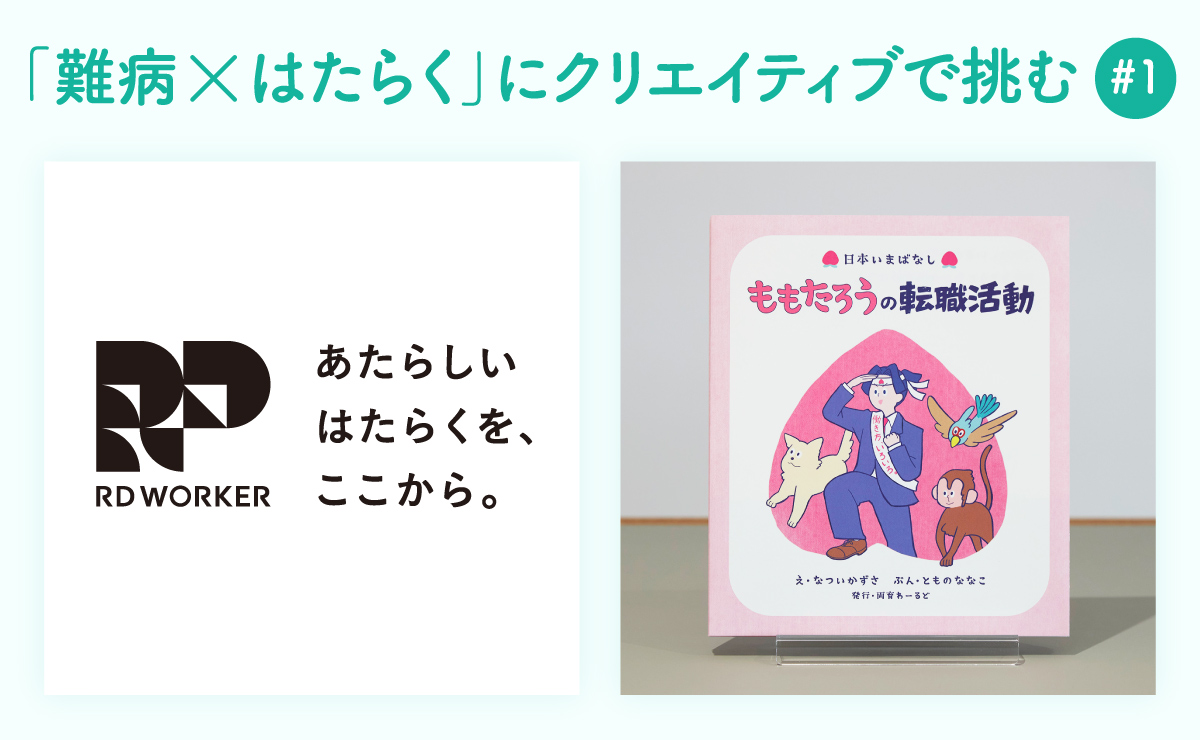
▼Vol. 1: Expressing the Potential of RD Workers Through a "Logo"
▼Vol. 2: "Momotaro" Embodies Diverse Ways of Working!
Articulating the Hidden Challenges and Possibilities of “Intractable Diseases and Work”
August 2024. I received a message from Takayuki Shigemitsu, Chairman of the NPO Ryoyu World. He asked if I could help develop a message to raise public awareness of “Intractable Diseases × Work.”My connection with Mr. Shigemitsu began 10 years ago through a Dentsu Inc.-initiated project addressing social issues under the theme “Creators × NPOs/NGOs.” We first collaborated on creating posters and workshop tools to raise awareness of various disabilities, intractable diseases, and rare diseases. Since then, we have continued to exchange information to raise broader awareness of this issue, while exploring ways to give it tangible form and share it with the world.
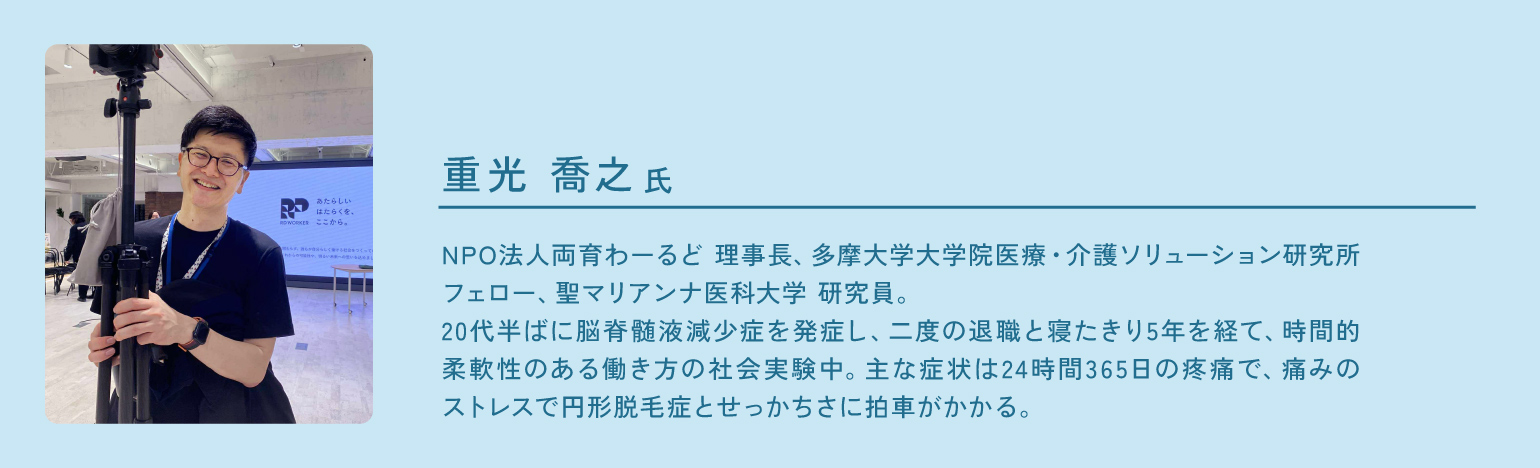
Although Ms. Shigemitsu had been actively involved in various initiatives as the chairperson of the NPO Ryoyu World since that time, she is actually a person living with a rare disease called “cerebrospinal fluid hypovolemia.”
Cerebrospinal fluid hypovolemia is an intractable disease of unknown cause for which no established treatment exists. While symptoms vary from person to person, in Ms. Shigemitsu’s case, she reportedly experiences severe, constant pain throughout her body every day—pain comparable to that of having a wisdom tooth extracted. While battling the stress caused by this pain, she has continued her efforts to support the social participation of people living with disabilities, intractable diseases, and rare diseases.
Why did Shigemitsu ask me to develop these terms? It was because she strongly believed in the power of language.“I feel that the world is changing as the existence of groups like ‘young carers’ and ‘LGBTQ+’ has become visible and recognized by many people through the creation of new terms. I want to articulate the concept of ‘Intractable Diseases × Work’ in an easy-to-understand way so that more people can learn about its challenges and possibilities.” Hearing Shigemitsu-san say this, I realized this was an issue worth tackling, and I took action as well.
“Raising awareness” is the first step toward changing society
Through this process, after repeated discussions with Ms. Shigemitsu and other people living with rare diseases, we ultimately coined the term “RD Worker.” Currently, the definition of “RD Worker” is described as follows on the Ryoyu World website and in the “White Paper on Social Participation of People with Rare Diseases 2025.”
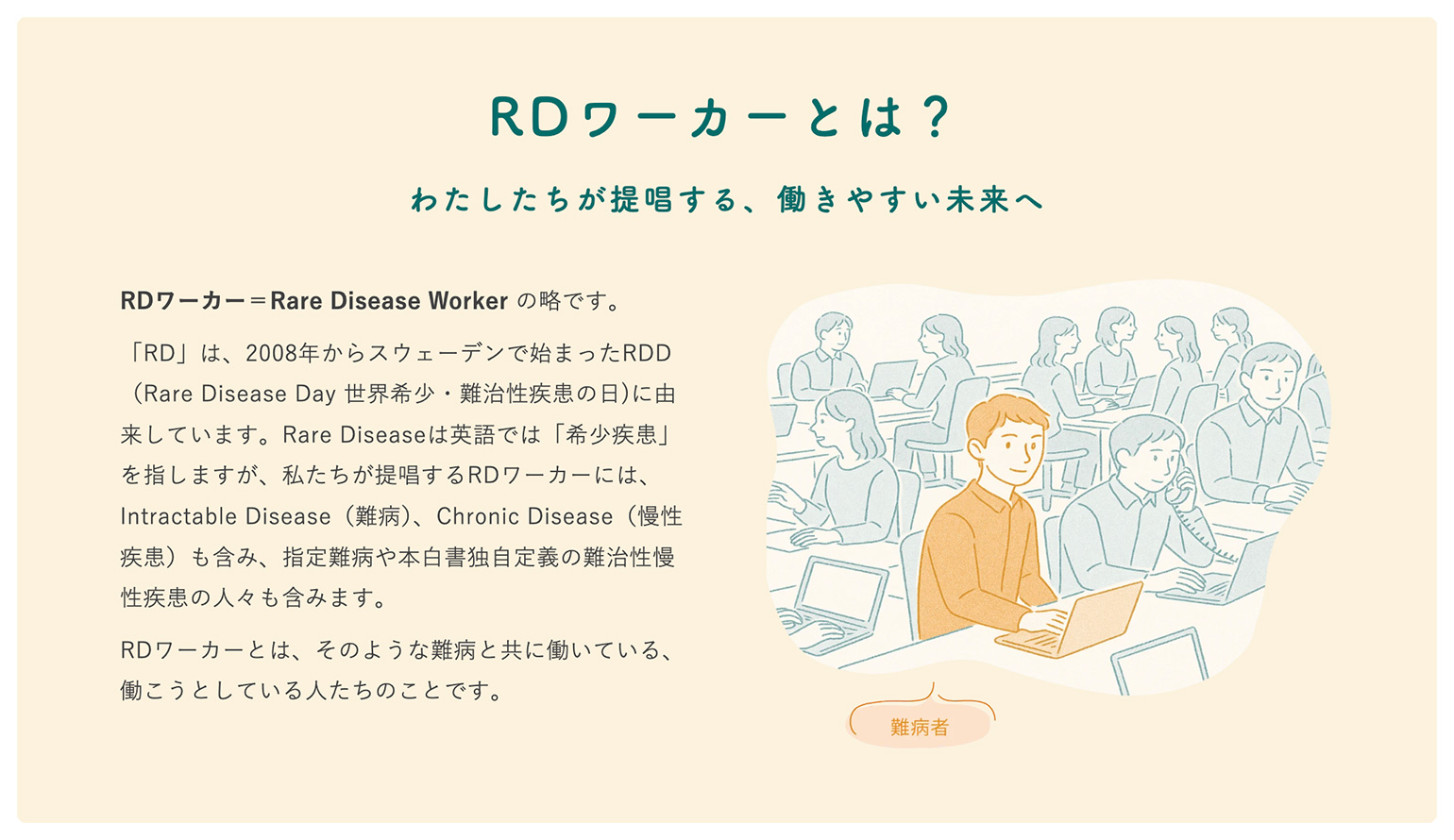
The “R” in “RD Worker” stands for “Rare,” but it also carries three additional meanings beyond the English term “Rare Disease.”
- Limited support systems
- Low public awareness
- Limited employment options
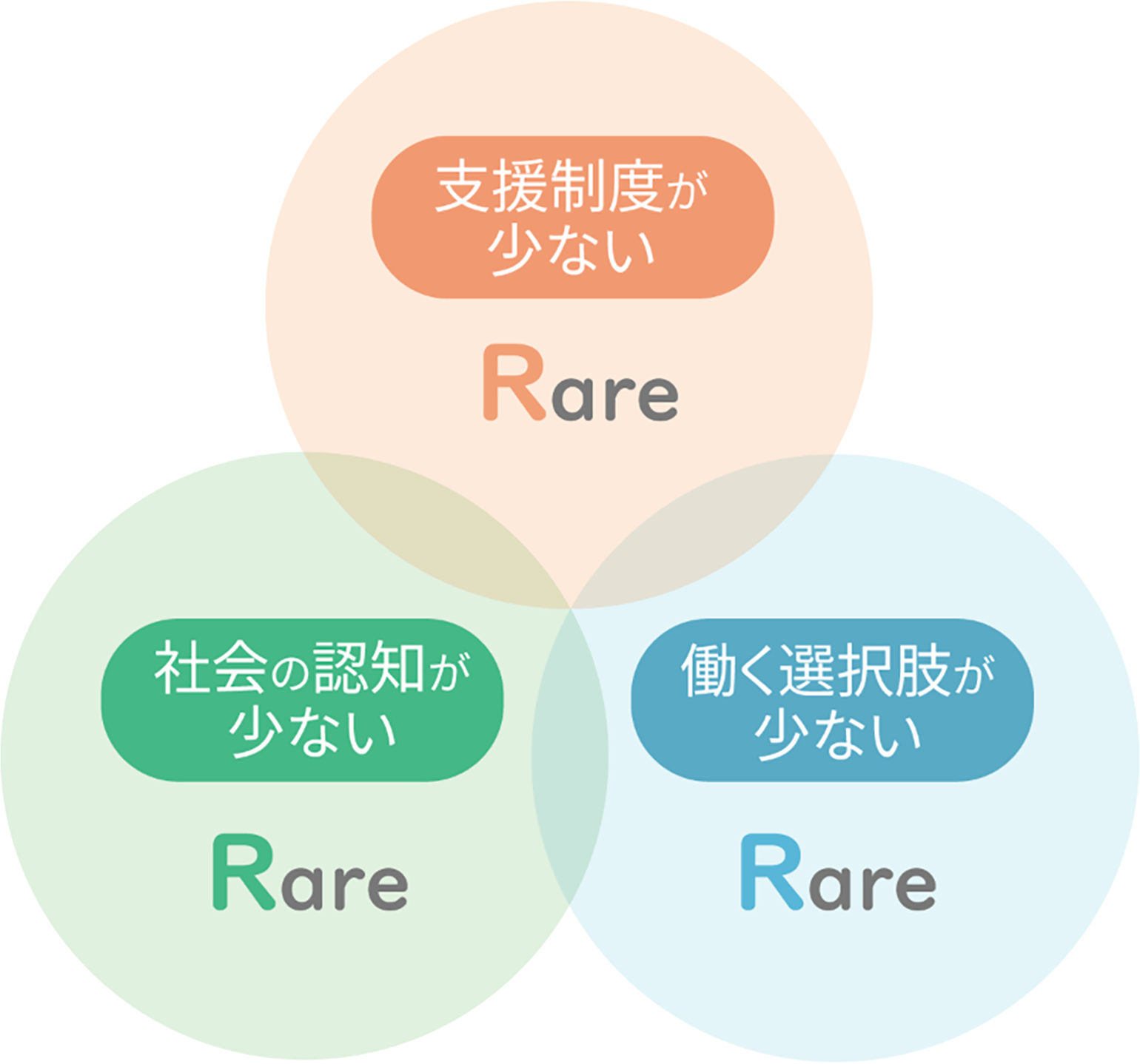
This “Rare” is a key point. The fact that many people remain in a state of “not knowing the facts” or “not trying to learn” is a major factor hindering understanding of rare diseases. As a result, because they cannot gain understanding from those around them and support systems fail to develop, there are many people who want to work but are unable to do so. The number is estimated to be over 1 million (according to the NPO Ryoyu World).Furthermore, survey results indicate that nearly half of those with rare diseases who have worked have left their jobs due to their condition (2018 White Paper on Health, Labour and Welfare).
Although we use the term “rare disease” as a general category, there are numerous types and symptoms, and many people could work if given flexible arrangements such as remote work or reduced hours. In other words, there is still a great deal of untapped potential in society.One of the most effective ways to instantly raise awareness of the potential of these 1 million people is through the power of “creativity.” Therefore, I decided to ask young creators—who are themselves full of potential—to use their flexible thinking to develop ideas that would help spread awareness and understanding of “RD Workers.” All of the works were finalized after extensive discussions with Mr. Shigemitsu and people living with intractable diseases.
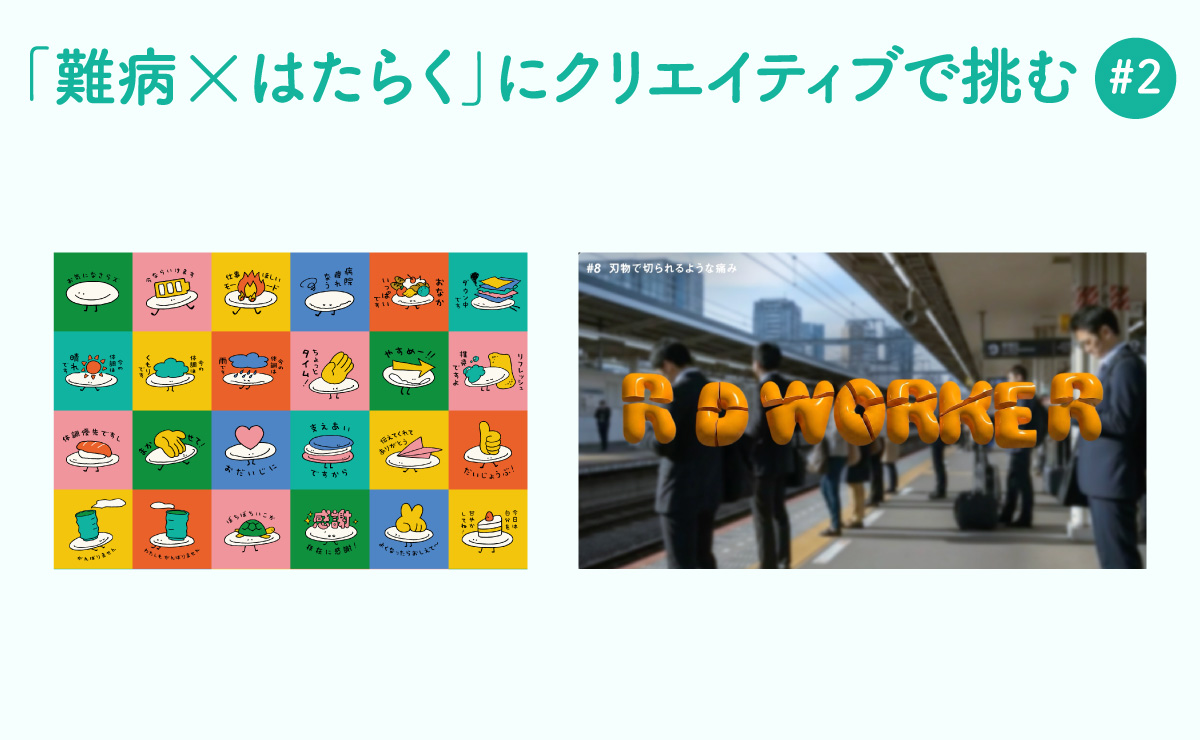
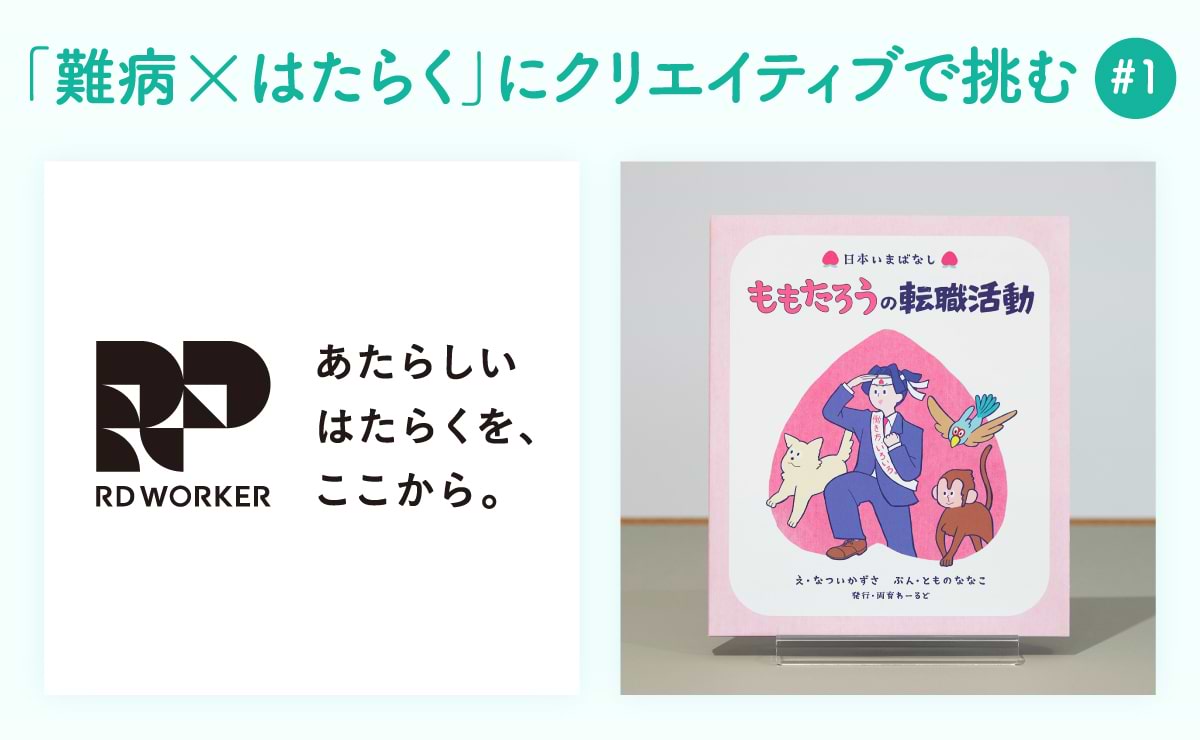
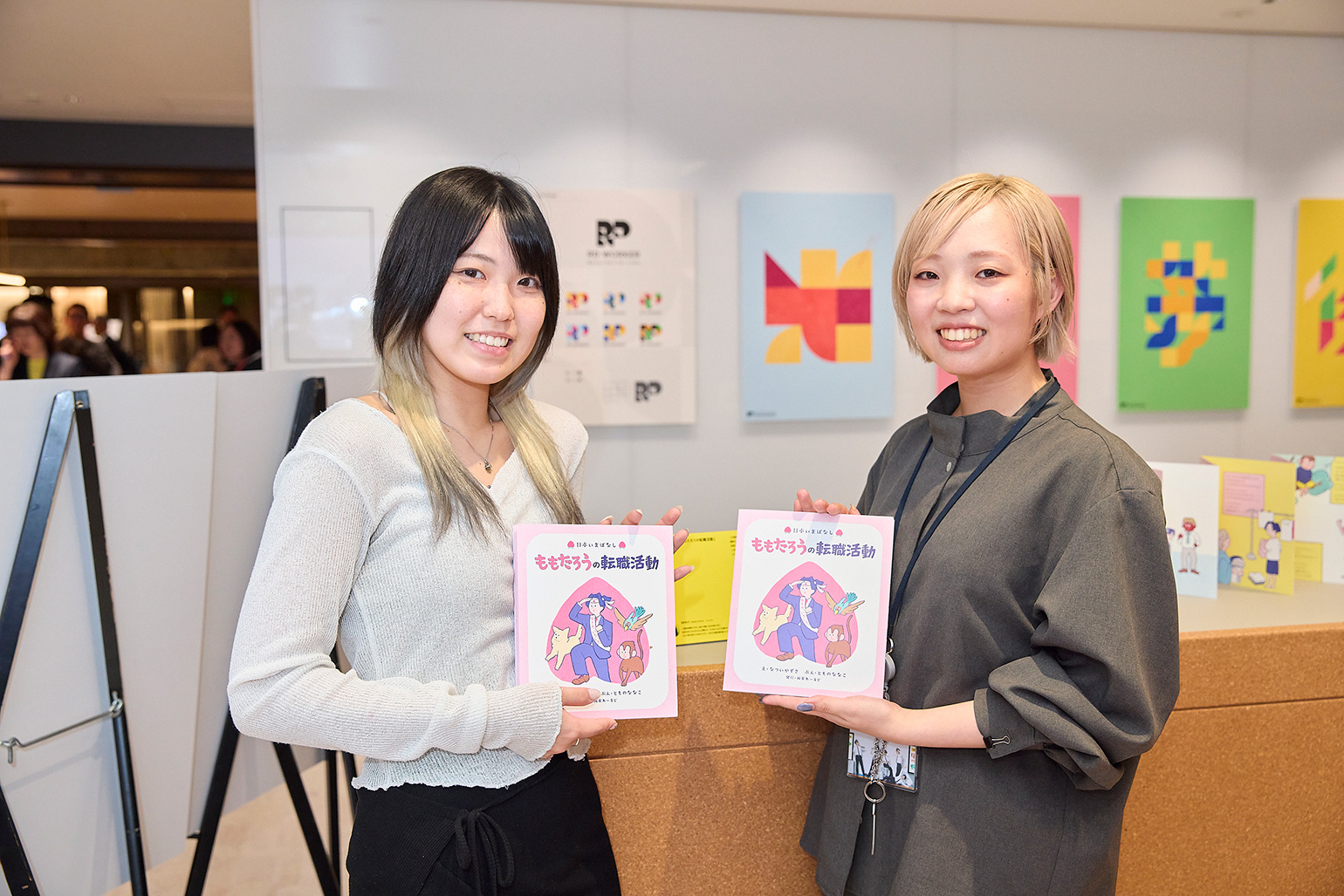
Then, on April 7, 2026, we unveiled these works at “PYNT Takebashi”—a co-creation space platform for solving social issues operated by Nikken Sekkei—in conjunction with a symposium titled “Designing the Future of ‘Intractable Diseases × Work’—Unlocking the Potential of ‘RD Workers’ Through the Power of Creativity.” Here, we present the works of the four teams of young creators who participated, along with details of their creative process. (This first part of the article features two of the teams.)
Vol. 1: Expressing the Potential of RD Workers Through “Logos”
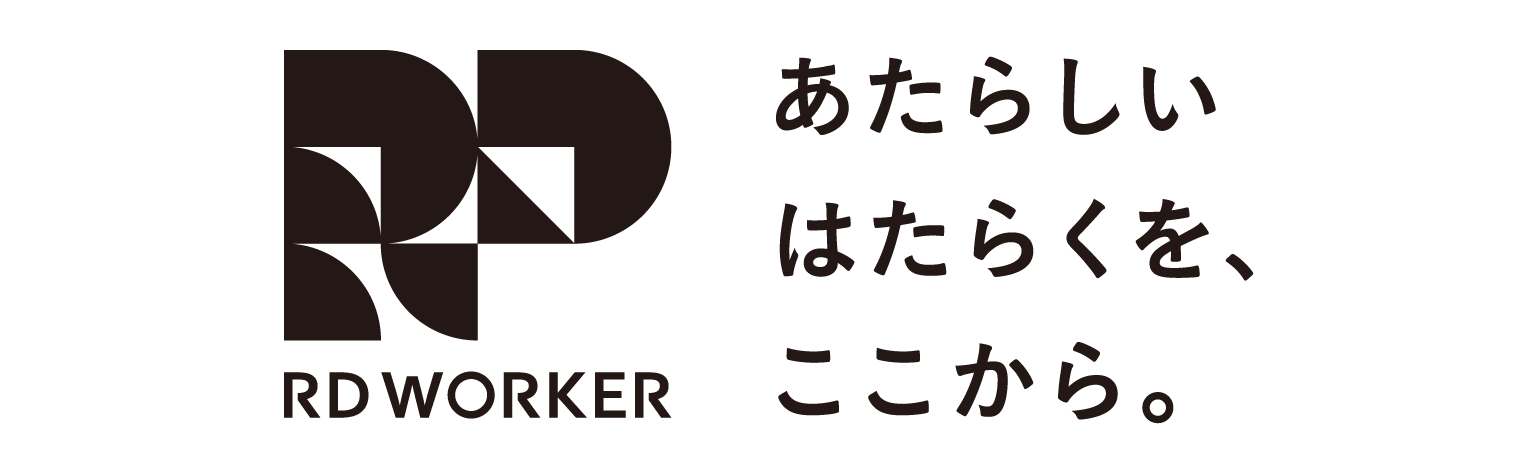
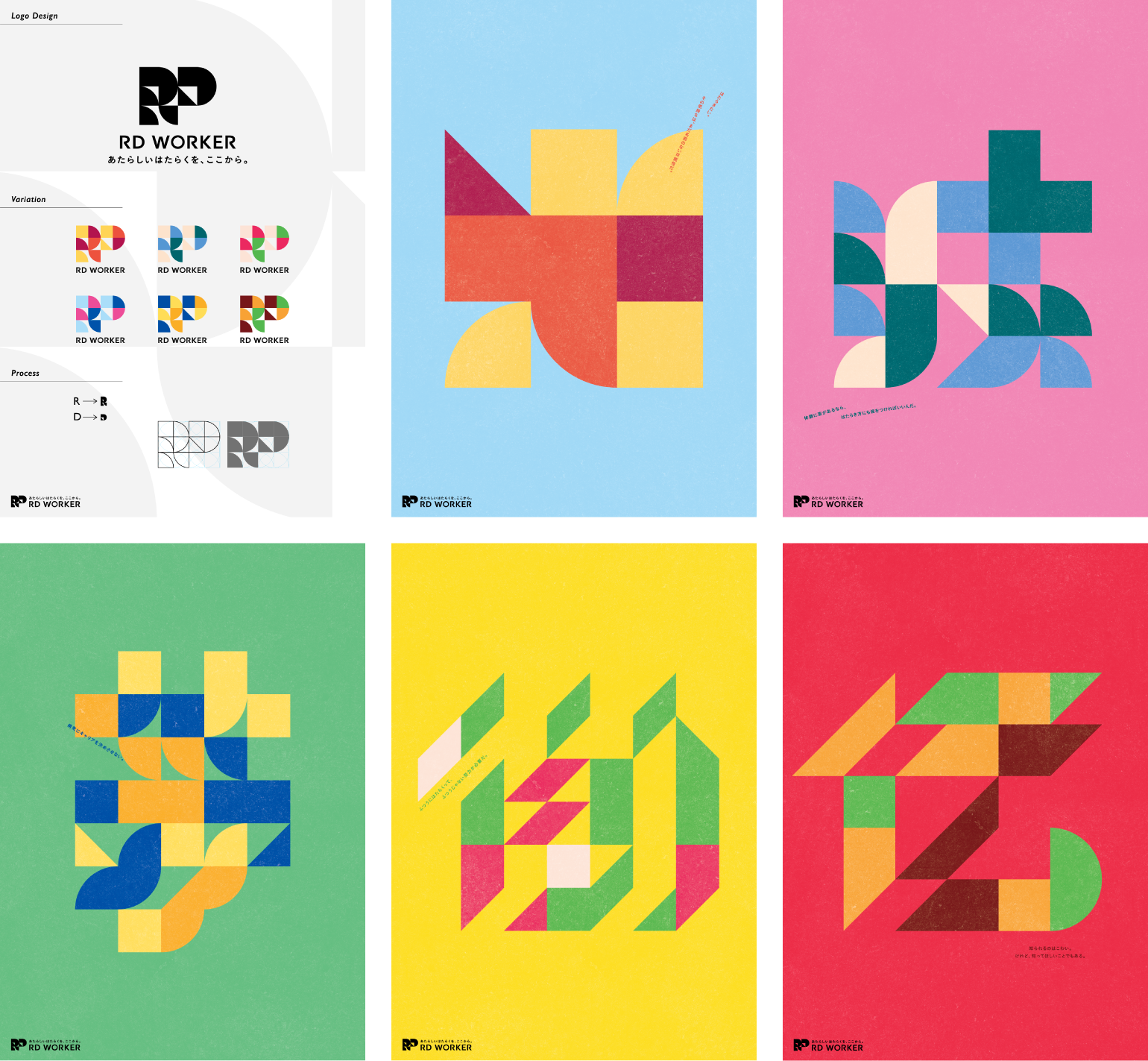
Planning and Production:

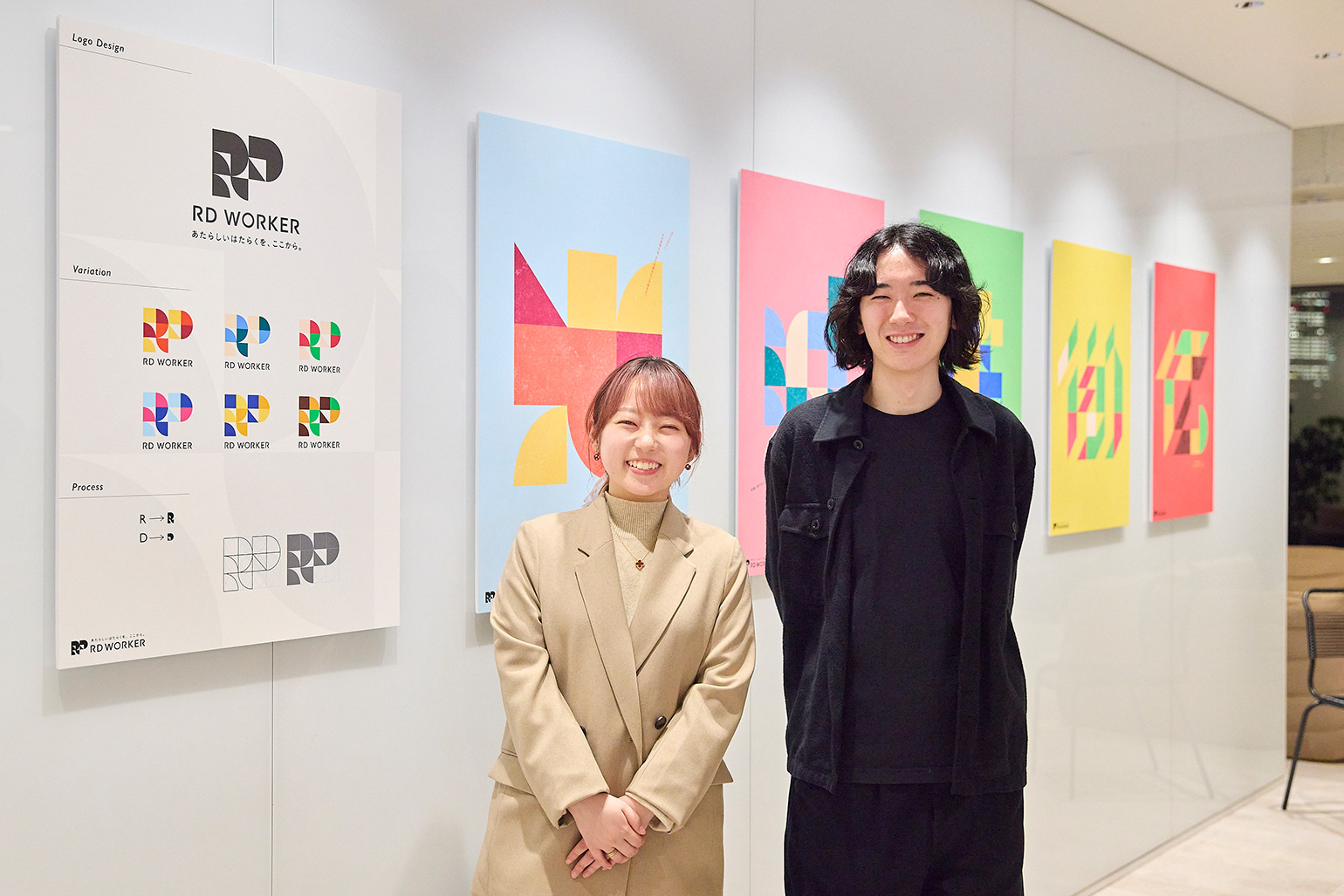
──This team transformed the new term “RD Worker” into a symbolic logo. Please tell us what you prioritized in the design.
—A design where parts can be combined like building blocks to create various forms truly embodies the very potential of RD Worker. What is the sentiment behind the tagline, “A new way of working, starting here”?
──Since it’s all in hiragana, it’s easy to read and symbolic, and the phrase “from here” really conveys a sense of future possibilities. What is the purpose or intention behind the poster visuals that utilize the logo’s adaptability?
──Please share the message you hope to convey through this work.
Vol. 2: “Momotaro” Embodies Diverse Ways of Working!
Planning and Production:

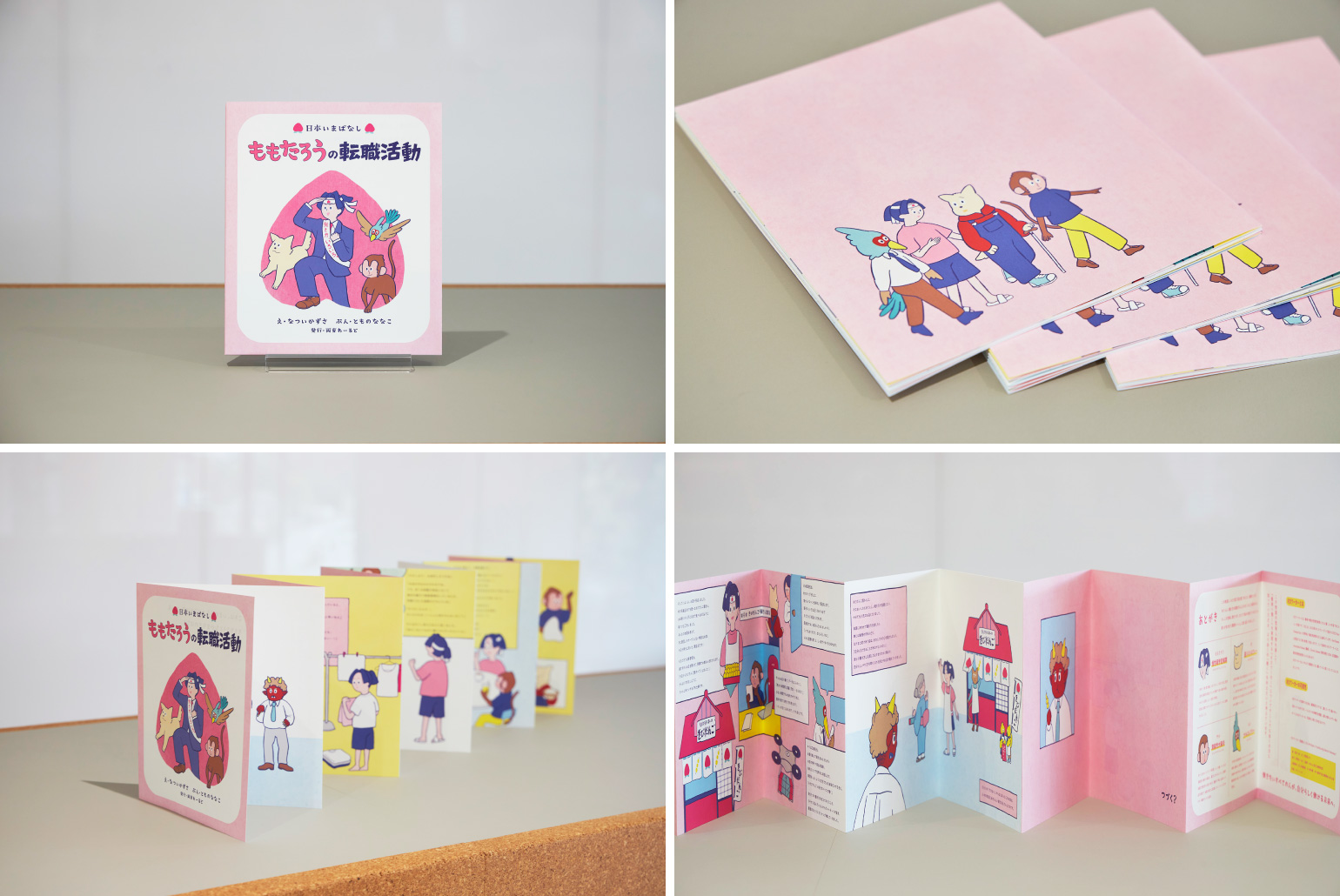
──This team utilizes the format of the well-known story “Momotaro,” reflecting the challenges faced by “RD workers” through the characters, thereby conveying the message in a way that everyone can easily relate to. How did you come up with the idea of using the “Momotaro” story as a hook?
──Using the well-known “Momotaro” as an introduction makes it much easier to engage with the theme of rare diseases. Was there anything you were careful about when designing the characters?
──It’s also a unique idea to have the demon appear as a “boss whose values haven’t been updated.”
──What message do you want to convey through this story?
*Continued in Part 2
Was this article helpful?
Share this article


Newsletter registration is here
We select and publish important news every day
For inquiries about this article
Author

Ikumi Toga
Dentsu Inc.
Second CR Planning Bureau
クリエイティブディレクター/コピーライター
GIRL meets GIRL Project Beyond Advertising: What We Can Do for GirlsMOM meets MOM ProjectMOM meets MOM projectGirl Meets Girl Project Relay ColumnLearn business development from Finland!Signs of Reiwa GirlsCreating a Sustainable Era: Insights on Collaboration—Sustainable d Actions—The "New Standard" for Sustainable FashionTaking on the Challenge of "Intractable Diseases × Work" Through Creativity