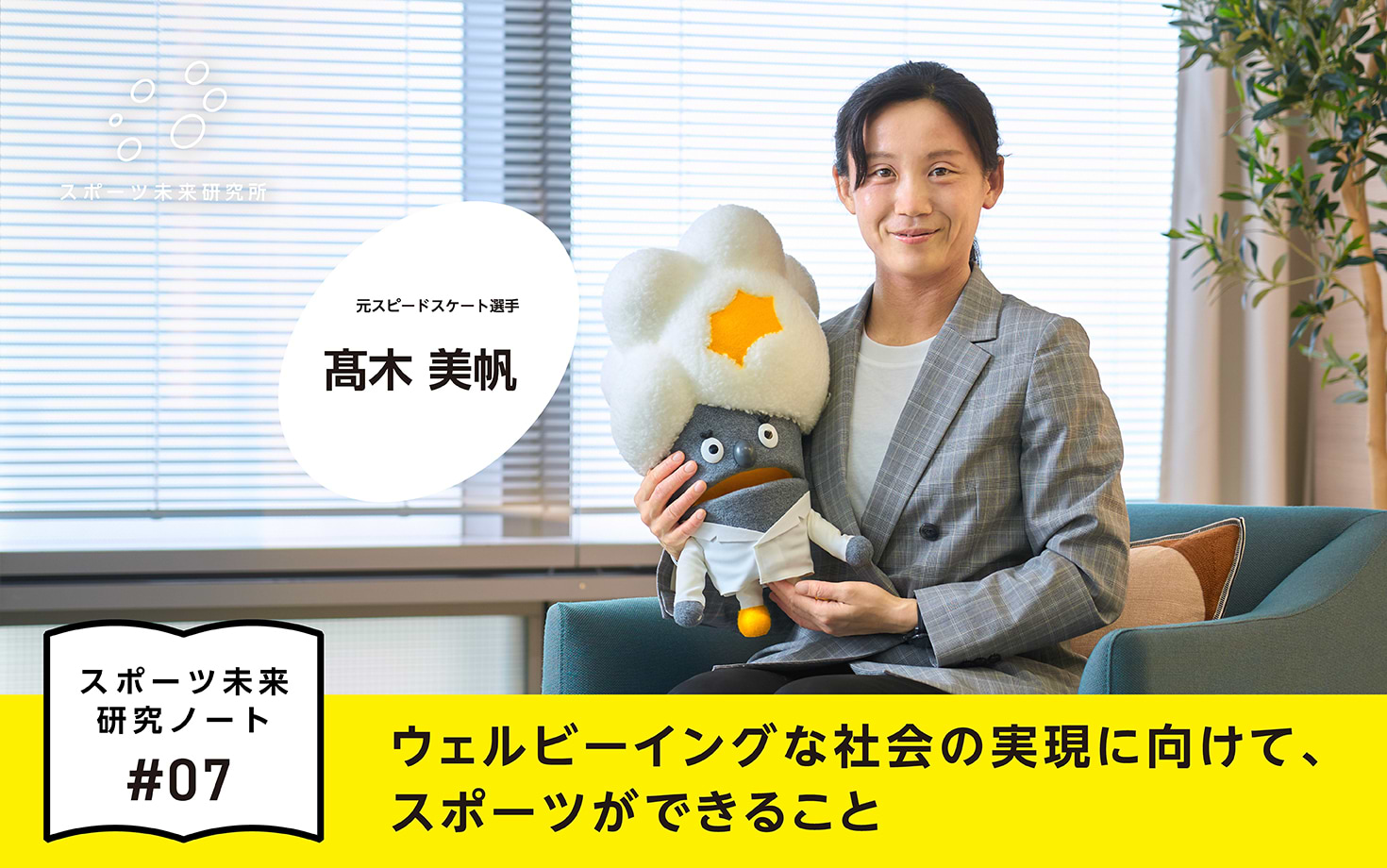
“Sports Future Research Notes” is a series that explores “the value of sports” from both qualitative and quantitative perspectives. In this sixth installment, we feature speed skater Miho Takagi, who retired from competitive competition in April 2026. Director Kuniko Ohikata and Researcher Fumikazu Katsumi of our institute spoke with her about everything from her first encounter with sports to her current interest in “the relationship between sports and the brain.”
It was fun to see how I could get faster and faster by finding new ways to improve
Katsumi: I hear you’ve played various sports since you were little. How did you first get into sports, Ms. Takagi?
Takagi: As for speed skating, I started when I was five years old, after my older brother—who is four years older than me—joined a local skating club. I took up swimming at my parents’ suggestion, and I started soccer and dance because my older siblings had already begun them. I played soccer from second grade through ninth grade, and I danced from first grade through twelfth grade.
Dai-Nichi Co., Ltd.: You stuck with all of them for quite a long time, didn’t you? Was there something about speed skating that made you think, “This is it,” leading you to focus on it? How was it different from the other sports?
Takagi: I didn’t really feel like speed skating was my absolute favorite—in fact, I actually enjoyed dancing more. However, when I thought about “How can I get a little better?” or “How can I go faster?”, speed skating was the sport where all sorts of ideas came to mind. That didn’t happen much with other sports, so I remember thinking at that point, “Maybe I’m cut out for skating.”
Katsumi: So it feels like your choices naturally narrowed down from there. Over the course of your 26-year competitive career, could you tell us about any experiences that influenced your outlook on life or your values?
Takagi: There are two major experiences that influenced my inner growth. The first was when I was in fifth grade. Under my coach at the time, I learned firsthand that “when you think for yourself and take action, the results follow.” It was exciting to see how I could get faster and faster by coming up with new techniques, and I felt a real sense of elation when I saw the results. From that point on, I started thinking even more deeply about how I could become faster. That was a major turning point for me; I believe it was the time when I established my core principles.
The other was the two years leading up to the PyeongChang Olympic season. I believe that was a period when my mindset toward competition and my perspective on competing on the world stage took a significant step forward.
Katsumi: Earlier, you mentioned that skating was where ideas about how to go even faster would come to you—so that led to the first turning point you just described, didn’t it?
Takagi: That’s right. Because I was physically large, I’d been winning consistently since the early elementary school years. So for me, achieving results wasn’t about winning—it was about how much I could shave off my time or how much I could break the meet record. In that sense, I’ve always compared myself to my previous self or to who I was the year before. Since I could feel my growth more easily by becoming faster than my previous self rather than by beating someone else, I think I naturally focused on that.
Katsumi: What kind of changes did you experience during the two years leading up to the PyeongChang season?
Takagi: My mindset toward skating—the desire to “get faster” and “improve my times”—has always remained the same, but I think my attitude toward taking on those challenges has changed. Up until then, I had a strong desire to “handle things smartly,” so I avoided showing how desperately hard I was working. But starting around the time leading up to the PyeongChang season, I became more focused on winning, and I think my approach shifted to a more gritty one where I didn’t care how I was perceived.
Even when there are no spectators in the arena, their cheers reach me
Dai-Nichi Co., Ltd.: I’d like to ask about the dynamic between the audience and the athletes. From major events like the Olympics to domestic competitions, the energy in the venue and the nature of the cheering vary depending on the event, don’t they? As an athlete, how did you perceive those differences?
Takagi: For me, whether or not there were spectators didn’t really affect my performance. At local competitions, even when there were a lot of people, it was relatively quiet because many spectators were focused on closely tracking my times and speeds rather than cheering loudly to build excitement. On the other hand, at events like the World Cup, the venue would be packed, and the atmosphere could get very lively. Having experienced both quiet and high-energy environments, I think I’ve built up the ability to approach races with a level head in either situation.
Katsumi: Don’t you feel more motivated when the cheers are louder?
Takagi: Having lived through the COVID-19 pandemic, I truly feel that even when there are no spectators at the venue, the support I receive remains just as strong. During the Beijing Olympics, I didn’t use social media for the entire duration, so I didn’t really know what was happening back in Japan. However, my family and friends shared the reactions and messages from people watching in Japan with me, and that gave me strength.
At the Tokyo Olympics before that, I was also on the other side—watching the events on TV as a spectator myself. So I think that made it easier for me to visualize that there were people cheering me on with all their heart, even if they couldn’t be at the venue. That said, it’s just plain fun when there are a lot of spectators. Also, at competitions overseas, I can hear the Japanese cheers very clearly. I feel like their support reaches me more easily than when I’m in Japan.
Katsumi: After the Milan-Cortina Olympics, there was a parade in Nihonbashi and a community gathering in your hometown. What were your feelings during those events?
Takagi: Since there weren’t parades like that for winter sports, I was deeply moved that they organized such an event for us in the first place, and I was incredibly grateful that so many people came out to join us.
In particular, I think it was wonderful that we had a place where the athletes and our supporters could express our gratitude to one another. It made me realize once again just how much support I’d received, and it gave me time to think about how I could give something back.
If sports can help prevent dementia, there’s no reason not to do them
Katsumi: You mentioned that your future plans are still undecided, but what kinds of things are you interested in? In an article in another publication, you spoke about the relationship between the brain and the body, as well as healthy life expectancy.
Takagi: Before the Beijing Olympics, I began to wonder if improving my concentration and thinking skills might lead to better athletic performance, and that sparked my interest in the “brain.” I’ve also read books about the brain, such as those on motivation, and found them fascinating.
In particular, when I learned that sports and exercise can stimulate the brain and help prevent dementia, I realized just how vast the potential of sports is. On a personal level, this was also a time when my grandmother’s dementia had progressed quite far, so I experienced firsthand the hardships of the condition. That’s why I thought that if sports can help prevent dementia, as an athlete, I simply had to give it a try.
Katsumi: At the Sports Future Research Institute, we’re also focusing on the potential of sports in prevention and health promotion.
Takagi: I’ve read in books that high-altitude training and exercises like HIIT (*) are effective for maintaining cognitive function and stimulating the brain. But those can be quite challenging for older adults to take on, right?
*HIIT: Abbreviation for “High-Intensity Interval Training,” a training method that alternates between all-out exercise and short rest periods.
Dai-Nichi Co., Ltd.: It’s also difficult to recommend high-intensity exercises like HIIT to people whose cognitive function is already declining, isn’t it? There’s also the risk of fractures and other concerns.
Katsumi: How do you think we can get people who aren’t interested in sports or health to take an interest?
Takagi: I do think it’s difficult to reach people who aren’t interested in health. I think we first need to focus on reaching people who are interested in health but haven’t yet turned their attention to sports.
Dai-Nichi Co., Ltd.: I suppose people who say they’re not interested in health are simply healthy right now and don’t feel any anxiety about it.
Takagi: I’ve had a similar experience with nutrition. When I was around 20, I was asked if I wanted to work with a nutritionist, and even though I didn’t really feel the need at the time, I decided to give it a try. But in the end, I didn’t stick with it. About two years later, because I was managing my diet on my own, my weight kept dropping, and I reached a point where I couldn’t compete at the end of the season. That was when I first realized, “I need a nutritionist,” and I took the initiative to seek nutritional guidance.
I believe there’s nothing more effective—in terms of how much you absorb and how efficient you become—than taking action because you genuinely feel it’s necessary. That’s why I’m driven to reach out to people who are interested or who feel, “This is something I need.”
“The freedom to be oneself” and “the occurrence of change” are the values of sports
Dai-Nichi Co., Ltd.: Finally, could you share your current thoughts on the future of sports and the new value of sports?
Takagi: Earlier, we discussed how to reach people who aren’t interested in sports, but I think there’s a slight difference between “sports” and “competitive sports.” However, they’re often lumped together in general discourse, and I wonder if that creates a barrier for ordinary people when it comes to exercising.
Competitive sports, in a sense, seem like they’re in a different dimension—they can look incredibly grueling, don’t they? But physical activity for health or sports for enjoyment aren’t necessarily like that. So, when we talk about “the value of sports,” I wonder which aspect we’re actually referring to.
Katsumi: We share exactly the same concern; the conversation can sometimes veer off track depending on whether we’re talking about physical activity or competitive sports. Here at the Institute for the Future of Sports, we’re currently in the process of redefining and clarifying the very definition of “sports.”
Dai-Nichi Co., Ltd.: There’s something called the “Basic Plan for Sports,” which the government formulates once every five years. It uses an indicator called the “sports participation rate,” which shows the percentage of people who engaged in exercise or sports within a certain period. Since the government aims to raise this rate as much as possible, the sports participation rate covers a wide range of physical activities—not just competitive sports, but also walking, radio calisthenics, and climbing stairs.
Takagi: With that in mind, I’ve come to think—and this might sound cliché—that sports should be free, and that “the ability to be free” is perhaps the true value of sports. The word “freedom” is, of course, difficult to define, but it doesn’t mean “you can do whatever you want”; rather, it means making your own choices. I believe it’s a freedom that includes the responsibility that comes with those choices. That’s why I also believe sports aren’t something you do because someone else forces you to.
I also believe that “bringing about change” is a core value of sports. By continuing to participate in sports, changes occur in various areas of one’s life. This includes physical changes, such as improved health, as well as changes in one’s connections with those around them. Taking all of these into account, some form of change is brought about. In that sense, I believe that “the ability to be free” and “the occurrence of change” are the core values of sports.
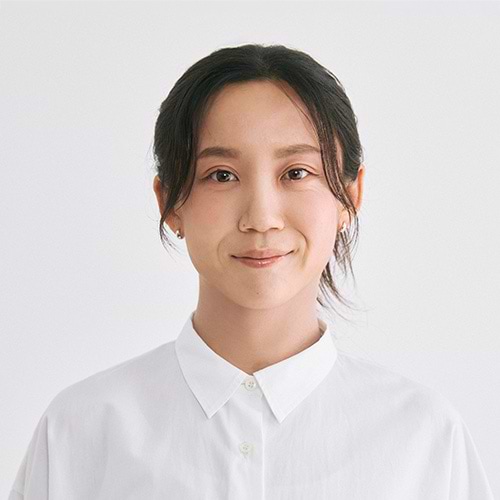
Born in Hokkaido in 1994. She began competing at age 5 and was selected for the Vancouver Olympic team at age 15. She won three medals, including a gold, at the PyeongChang Olympics, and four medals at the Beijing Olympics—the first Japanese athlete to win four medals in a single Games. She added three more medals at the 2026 Milan-Cortina Games, reaching a total of 10—the most by any woman. She competed for many years as the world record holder in the 1,500 meters and retired in April of that year.
Dai-Nichi Co., Ltd. Ohinata Kuniko
Director, Japan Paralympians Association / Fellow, Dentsu Inc.
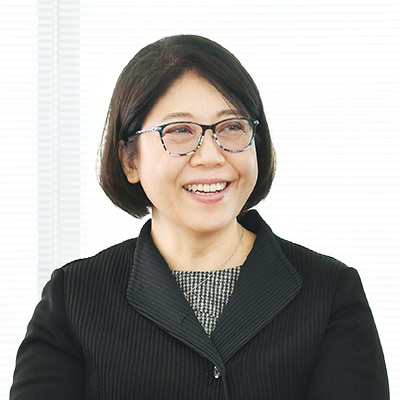
Former Japanese Paralympic Alpine Ski Team member. Began his skiing journey in his second year of high school after encountering chair skiing. Competed in five Winter Paralympic Games from Lillehammer 1994 to Vancouver 2010. Won a total of 10 Paralympic medals, including Japan's first-ever Winter Games gold medal at Nagano 1998.Served as Team Leader for the Japanese delegation at the Milano-Cortina 2026 Winter Paralympics. Joined NHK in 1996 as a director, working on educational programs and Paralympic broadcasts. Joined PR Consulting Dentsu Inc. in 2007. Became a Dentsu Group Fellow in 2022 and assumed current position in 2025. Holds numerous public positions including Director of the Japan Para Sports Association and Director of the Japan Paralympians Association.
Since 2015, he has been dedicated to the Tokyo 2020 Olympic and Paralympic Games, producing sponsor activations, the torch relay, and SPP (Spectator Performance Production). He is currently engaged in visualizing the value of sports and exploring new values, launching the Sports Future Research Institute in July 2025. He is a member of the Japan Society of Sports Industry and is currently enrolled in the Graduate School of Sport Sciences at Waseda University. Born in Okinawa, raised in Venezuela, South America.

 Visualizing the value of sports. "Sports Future Research Notes" [7/7]