Note: This website was automatically translated, so some terms or nuances may not be completely accurate.
 The Six Value Pillars of Newspaper Media—Demonstrating “ANCHOR,” Which Generates Empathy, Dialogue, and Outreach [1/2]
Understanding the Current State of Newspapers Through the “Newspaper Media Value Survey”
In recent years, newspaper advertising has faced not only changes in the media landscape—such as “shrinking reach” and “an aging readership”—but is also frequently perceived as “difficult to quantify in terms of effectiveness” compared to online media. Consequently, it can be said that there are aspects where the inherent value of newspapers is not being fully communicated...
Amid significant changes in consumers’ information-seeking behaviors driven by the diversification of media, what value and role do newspapers play? To explore this, Dentsu Inc. conducted the “Survey on the Value of Newspapers ” ( see survey overview here ) targeting 8,250 men and women aged 15 to 69 nationwide.
The survey results revealed that newspaper readers are more information-savvy than users of other media and actively share content on social media and other platforms based on the knowledge and information they gain from newspapers. In other words, this suggests that newspapers function not only as a medium for delivering information but also as a medium that encourages readers to share information and engage in communication.
In this article, based on the survey results and in light of “ANCHOR”—the six value axes for newspaper media proposed by Dentsu Inc.—we will examine the value and role that newspaper media currently fulfill, and consider the significance of these characteristics for newspaper advertising.
<Table of Contents>
▼Newspapers Serve as an “Anchor” Connecting Brands and Society Through “Meaning”
▼In the Advertising Sector, Newspaper Media Virtually Monopolize the Top Ranks of the ANCHOR Categories
▼Are Newspaper Readers Truly “Highly Information-Sensitive”? Insights Revealed
▼Are Newspaper Ads Easily Accepted by Readers as Part of the Content?
▼From Awareness to Loyalty: The Funnel-Based Effects of Newspaper Advertising
▼Newspapers: From a “Reading Medium” to a “Medium That Supports Communication”
▼Newspaper Advertising: Conveying a Sincere Corporate Stance Along with “Meaning”
Newspapers serve as an “anchor” that connects brands and society through “meaning”
“ANCHOR” is a framework proposed by Dentsu Inc. to capture the value of newspaper media.
The name is composed of the initials of the following six value axes.
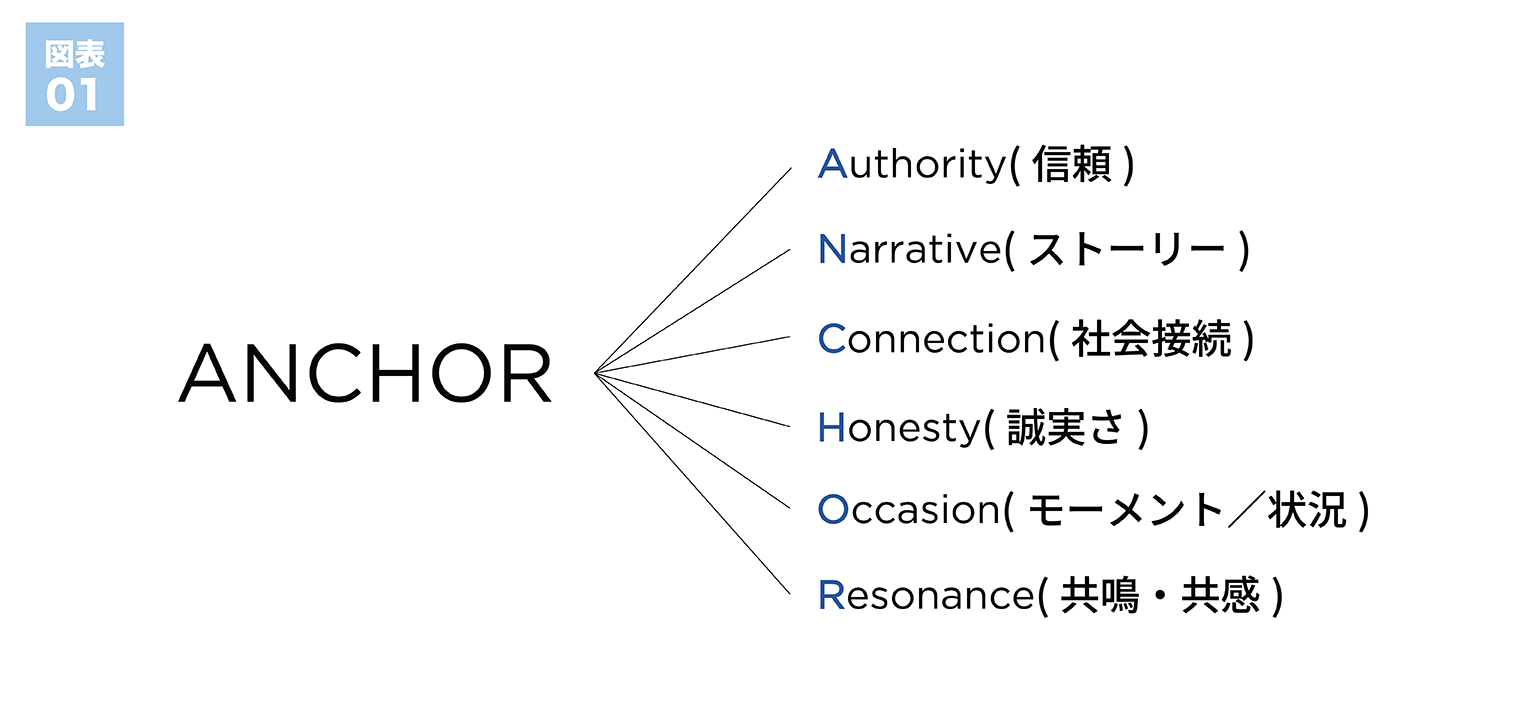
Incidentally, “ANCHOR” means “anchor” in English. We believe that, in the realm of advertising , newspaper media serve as an “anchor” that connects brands and services with consumers through “meaning” and helps them take root in society. In other words, we believe newspaper media can play a role similar to that of an “anchor” in connecting brands and consumers.
This survey was designed to examine that role of newspaper media. The results show that, across nearly all six value axes that make up ANCHOR, newspapers received higher ratings than other media. So, specifically, what kinds of values were recognized? Starting in the next chapter, we’ll take a closer look based on the survey results (*1).
*1 = This survey targeted individuals (including multiple responses) who read or watch a total of 18 media outlets—including the four major mass media (television, radio, newspapers, and magazines), as well as portal sites, news sites, video services, social media, and outdoor advertising (n=8,250).
In the advertising sector, newspaper media virtually monopolized the top ranks of the ANCHOR categories
First, it is worth noting the survey results when considering the four categories—“Newspapers (print)”, “Newspapers (digital edition, page viewer)”, “Newspaper publishers’ paid web articles”, and “Newspaper publishers’ free web articles”—as newspaper media.
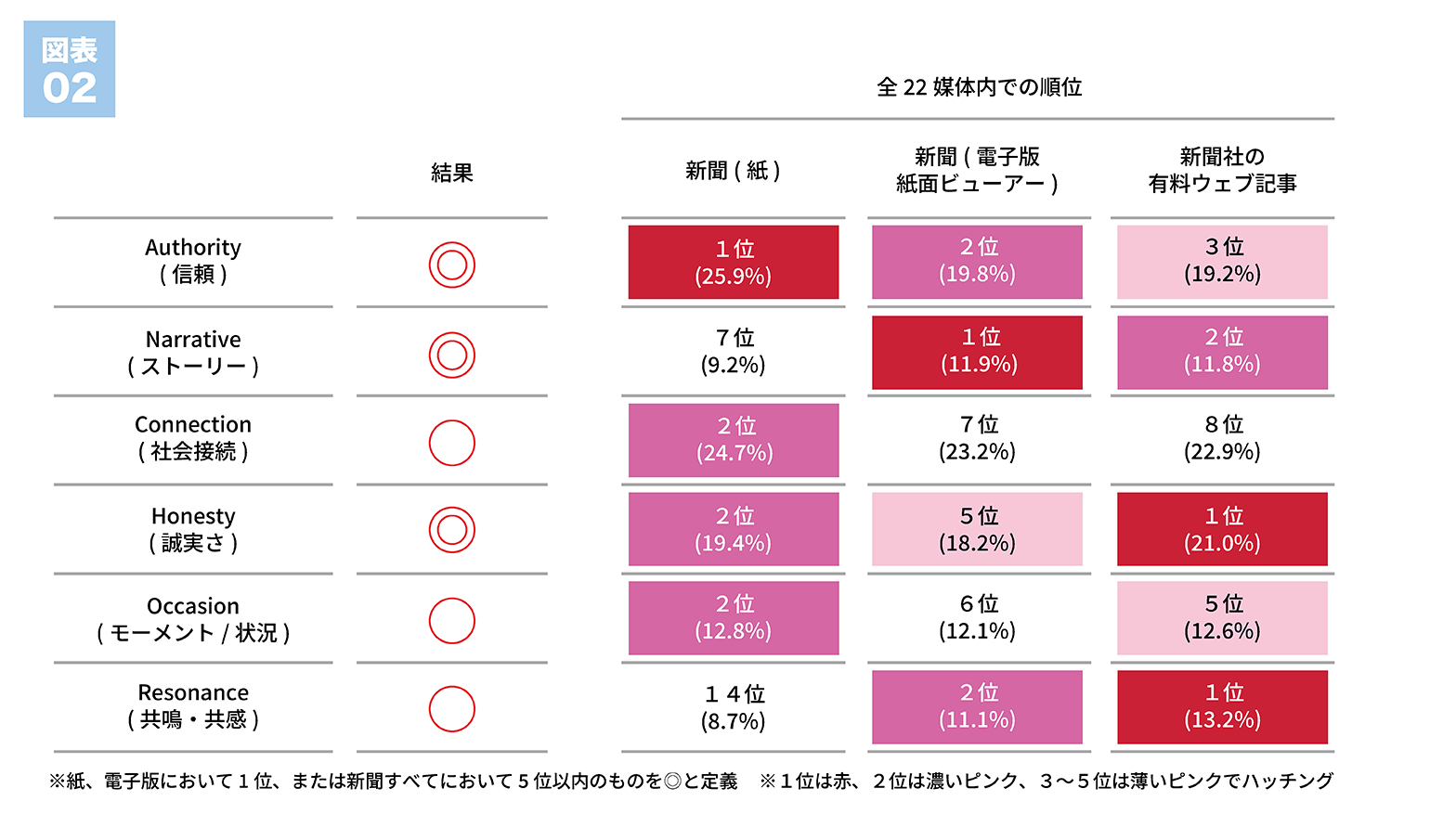
The survey asked, “What are your thoughts on the messages conveyed in advertisements in the following media?” and organized and tabulated the responses according to the six ANCHOR value axes. The results showed that advertisements published in the three media—“Newspapers (print),” “Newspapers (digital edition, page viewer),” and “Newspaper publishers’ paid web articles”—received higher ratings across the six ANCHOR value axes compared to other media.
In particular, they received high ratings for “Authority” and “Honesty.”
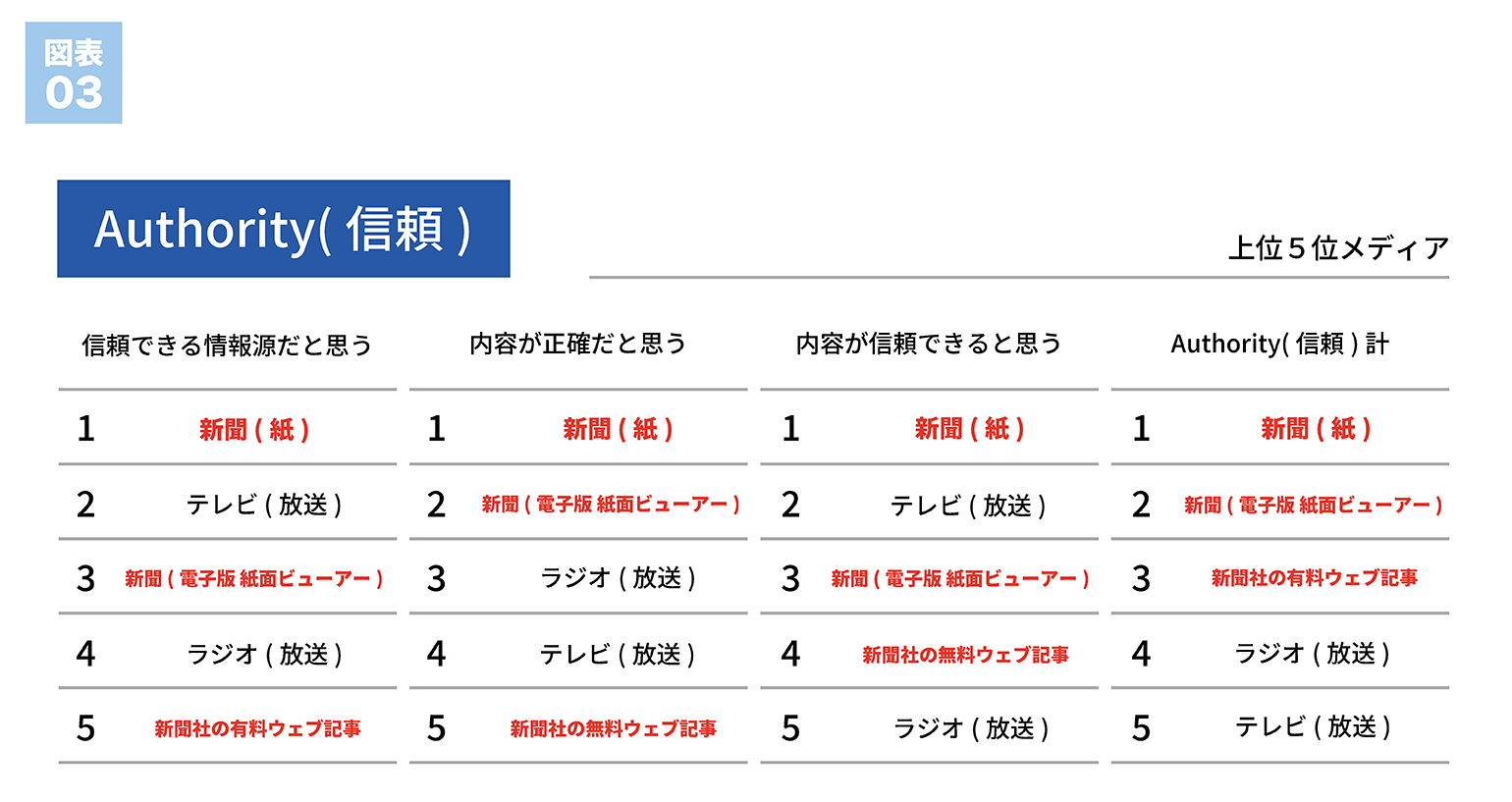
For example, among the items corresponding to “Authority (Trust),”
“I consider it a reliable source of information”
“I think the content is accurate”
“I think the content is reliable”
“Newspapers (print)” ranked first out of 18 media outlets. Furthermore, in the overall evaluation scores, “Newspapers (digital edition, print-page viewer)” ranked second and “Newspaper companies’ paid web articles” ranked third, with three newspaper-related media outlets dominating the top spots.
Also, among the items related to “Honesty,”
“No excessive exaggeration”
“Evidence is properly presented”
“Conveys the honest thoughts and true feelings of society and companies”
“It is easy to identify who is conveying the message”
"paid online articles from newspaper publishers" received the highest ratings among all 18 media outlets. Here as well, all three newspaper outlets ranked highly, a result that highlights the strength of the newspaper media sector as a whole.
Newspapers have long been described as “trustworthy media” and “sincere media,” and the results of this survey suggest that this image is not merely a perception within the industry but is also supported by the actual experiences of consumers.
Are Newspaper Readers Truly “Highly Information-Sensitive”? Insights Revealed
In addition to questions regarding ANCHOR, we also conducted a survey to gain a more detailed understanding of the behavioral patterns and values of newspaper readers. Prior to the survey, we formulated the following six hypotheses.
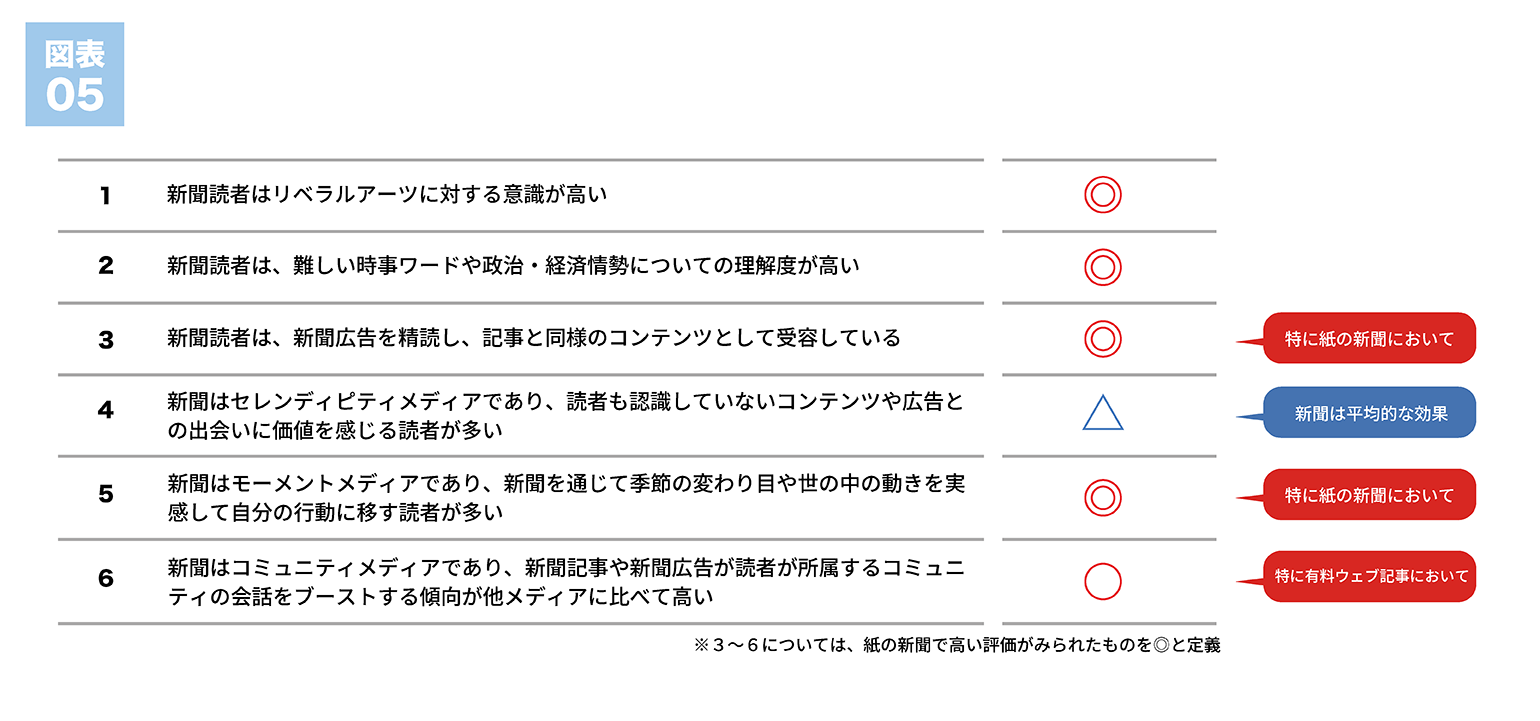
The results showed that while the fourth hypothesis—"Newspapers are a medium of serendipity"—did not receive clear support, the findings generally corroborated the validity of the other hypotheses.
First, regarding the findings that “1. Newspaper readers have a strong awareness of the liberal arts” and “2. Newspaper readers have a high level of understanding of complex current affairs terminology and political and economic conditions,” these likely align with the image many people hold of newspaper readers.
The image that “newspaper readers have a strong interest in social issues and current events” has been reaffirmed by this survey.
Are newspaper ads readily accepted by readers as part of the content?
On the other hand, from a marketing perspective, I would like to draw your attention to the following three hypotheses: “3. Newspaper readers read newspaper advertisements carefully and accept them as content on par with news articles,” “5. Newspapers are ‘moment media’ (*2),” and “6. Newspapers are community media.”
*2 = Media that allows people to tangibly experience the changing seasons and societal shifts, and has the power to prompt action based on those experiences
First, let’s examine the hypothesis “3. Newspaper readers carefully read newspaper ads and accept them as content on par with articles.”
In response to the question, “What do you think about advertisements in the following media?”, “newspapers (print)” received the highest rating among all media in the category of “I look closely at the content (read/listen).”
Generally, digital ads are often encountered with the expectation that they can be skipped or closed. In contrast, since newspaper ads are often published on the same page as articles, there is a tendency for readers to peruse the ads just as they do the articles and attempt to understand their content. In fact, scores were low for items such as “I find ads annoying” and “I find ads stressful,” indicating that newspaper ads are not perceived as a hindrance to the reader experience but are accepted as part of the content.
Furthermore, regarding “newspaper publishers’ paid web articles,” high ratings were also obtained for items such as “Ads are just as interesting as the content” and “I like ads.” This suggests that, regardless of whether the medium is print or web, there is a segment of newspaper media readers who exhibit a high level of interest in and acceptance of advertisements.
Next, let’s examine the hypothesis “5. Newspapers are ‘moment media.’”
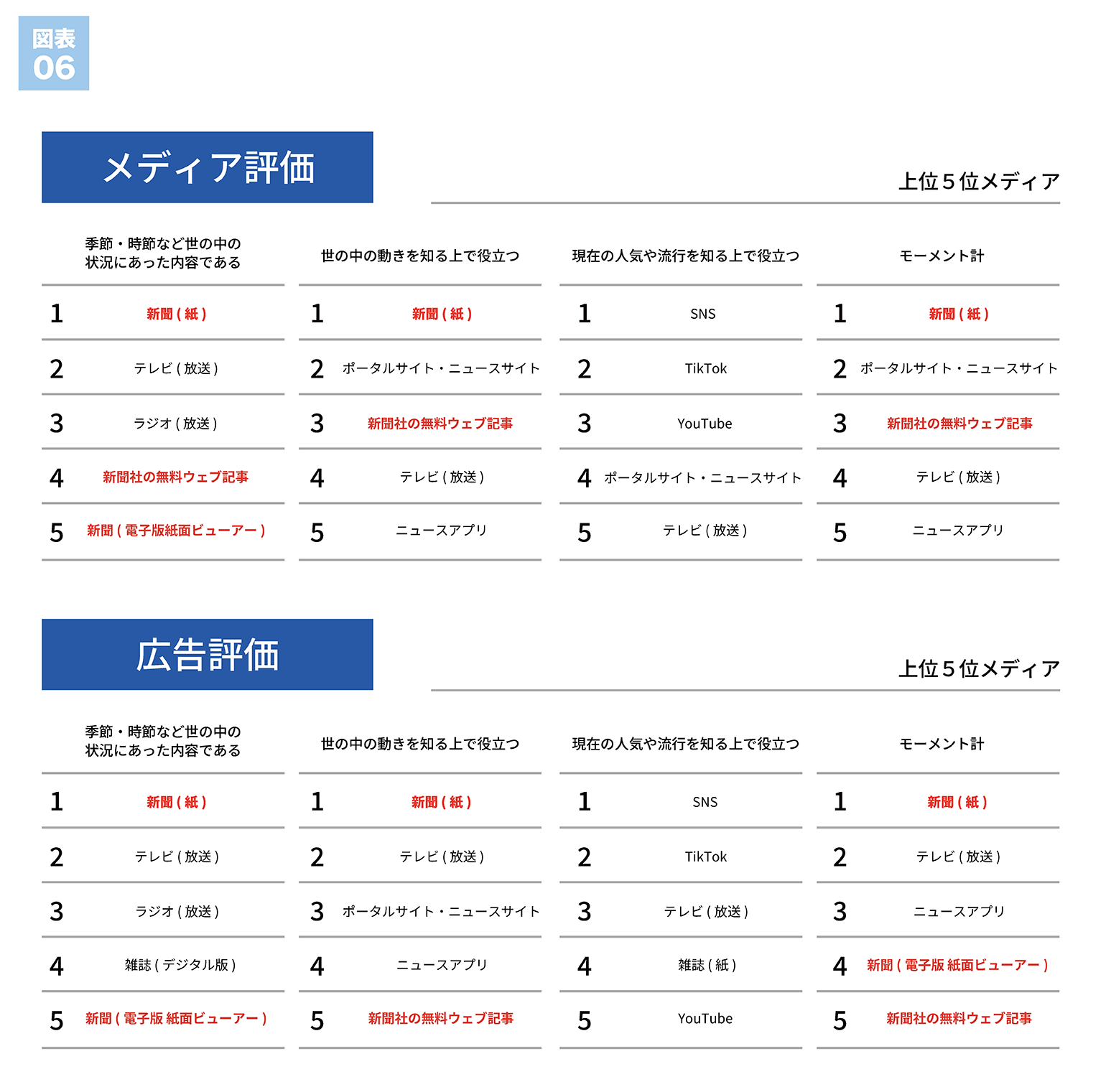
The survey results show that “newspapers (print)” received the highest ratings among all media for both “content that reflects current social conditions, such as seasons and special occasions” and “useful for understanding current events.” Interestingly, this trend was observed not only in evaluations of articles but also in evaluations of advertisements.
In other words, newspaper advertisements appear to be perceived not merely as a means of conveying information about products or services, but as content that is connected to the social context and seasonal atmosphere of the moment . From an advertiser’s perspective, running newspaper ads that address social themes—such as new life stages, disaster preparedness, environmental issues, and regional revitalization—at times when consumers are mindful of seasonal transitions or societal changes is likely to elicit deeper empathy and understanding.
Finally, let’s examine the hypothesis “6. Newspapers are community media.”
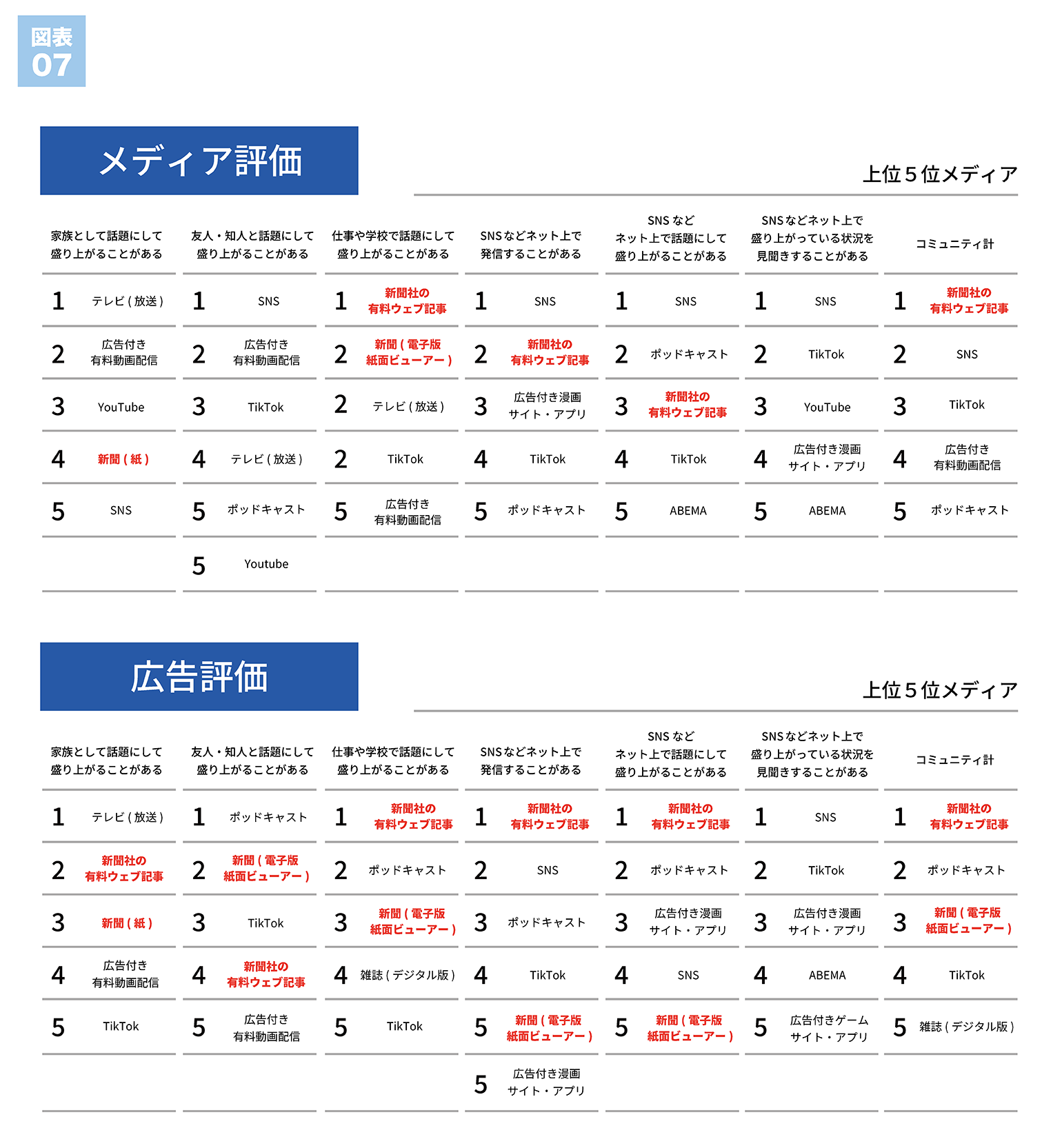
According to the survey results, regarding the role of newspapers as community media, “paid web articles from newspaper publishers” received particularly high ratings for items that lead to information sharing and lively conversation within the community—such as “I sometimes share this on social media or online.”
In particular, for the item “It sometimes sparks lively discussions at work or school,” “newspaper publishers’ paid web articles” ranked first among all media types for both media and advertising. The evaluation of the advertisements was especially outstanding, with the results showing a significant lead over second place and beyond. This suggests that advertisements published in “newspaper publishers’ paid web articles” are not merely read but also generate conversations and discussions among readers, potentially leading to word-of-mouth and information sharing.
From Awareness to Loyalty: The Funnel-Based Effects of Newspaper Advertising
Furthermore, this survey analyzed “how newspaper ads contribute to consumer behavior.”
Specifically, respondents were asked, “When purchasing or using a product or service, in what situations do you find advertisements in each medium to be helpful, reliable, or influential?” The results showed that “newspapers (print)” received a high rating second only to “television (broadcast)” in the category of “serving as a source of initial awareness,” indicating that they possess strong appeal during the “awareness” phase of the purchase funnel (*3).
*3 = A model that illustrates the step-by-step process from when a person first becomes aware of a product until they make a purchase.
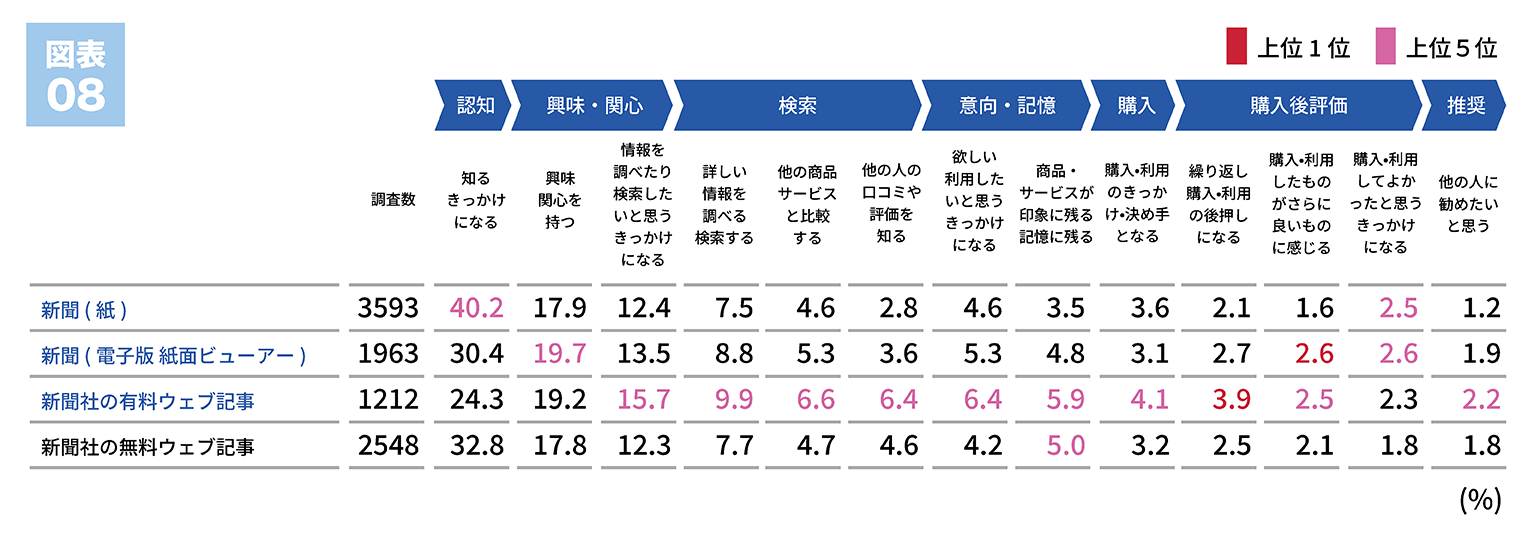
On the other hand, “newspaper publishers’ paid web articles” received consistently high ratings across all stages of the funnel, from “interest” to “purchase.” Particularly noteworthy is that they ranked first among all media in the category “encourages repeat purchases and use.” This suggests that they not only encourage one-time purchases but also exert a strong influence in terms of fostering continued use and building loyalty.
Furthermore , “Newspapers (digital edition, print viewer)” ranked first among all media in the category “Makes the purchased or used item feel even better.” This indicates that they enhance post-purchase satisfaction and a sense of fulfillment, thereby contributing to improved evaluations of products and services.
In other words, within the advertising sphere, newspaper media should not be viewed as a single entity—"newspaper advertising"—but rather as distinct components: "print," "paid web articles," and "digital editions," each playing a different role. The ability to leverage these components at every stage of the purchase funnel—from building awareness to fostering interest, promoting continued use, and even enhancing post-purchase loyalty—is a characteristic unique to newspaper media.
Newspapers: From a “Reading Medium” to a “Medium Supporting Content Distribution”
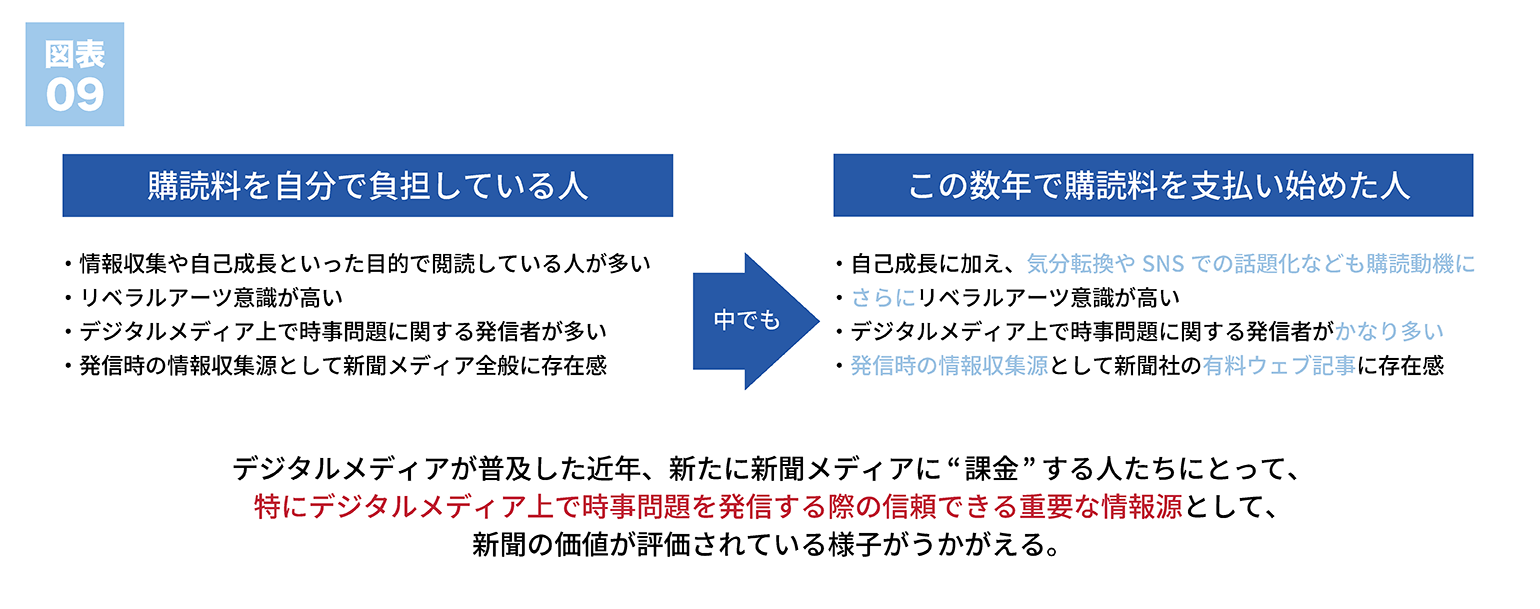
Finally, I would like to touch on the characteristics of newspaper “subscribers.” First, we segmented newspaper subscribers (n=3,960), and among those who pay their own subscription fees (n=1,861), the following characteristics were observed:
・Many read for purposes such as gathering information and personal growth
・They have a strong interest in the liberal arts
・Many are content creators on digital media platforms discussing current affairs
・Newspapers in general play a significant role as a source of information when they share their views
Among these, the behavior of the “group that began subscribing to newspapers in recent years” yielded particularly interesting results in this survey.
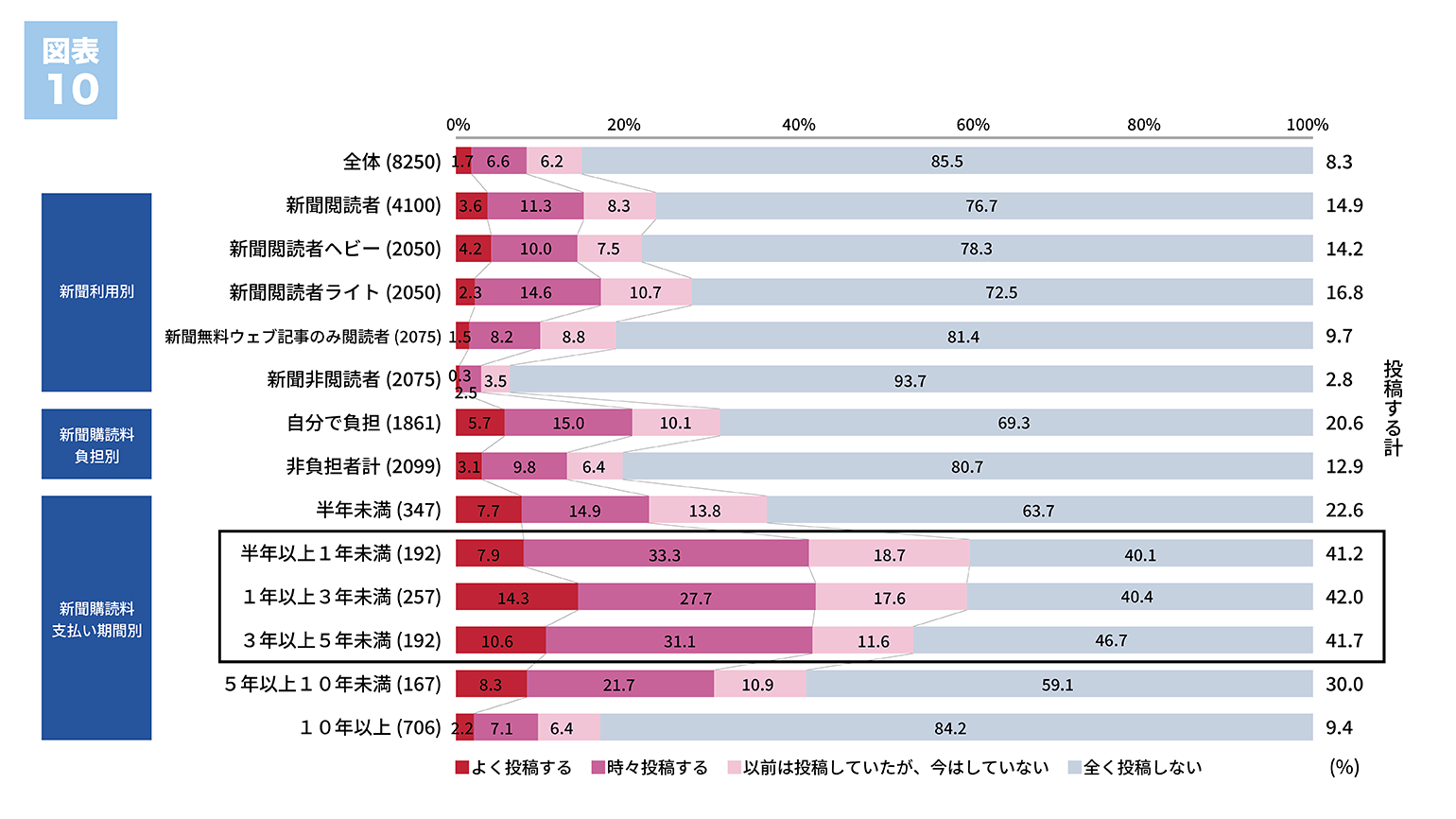
First, we found that approximately 15% of newspaper readers (n=4,100) actively share their own views on current affairs—such as politics, the economy, and social issues—via social media, blogs, and video streaming services. This percentage significantly exceeds the 2.8% observed among those who do not read newspapers (n=2,075).
What is even more noteworthy is that this trend becomes stronger the shorter the period since they began their subscription. Among those who have been subscribing for less than five years, approximately 40% appear to be actively sharing their views on current affairs via digital media.
It was also found that newspapers play a significant role as a source of information when sharing content. When asked, “When sharing information about current affairs on social media, blogs, or video streaming services, which media do you use as a source?” newspaper readers cited “newspapers (print)” as the top source at 41.8%.
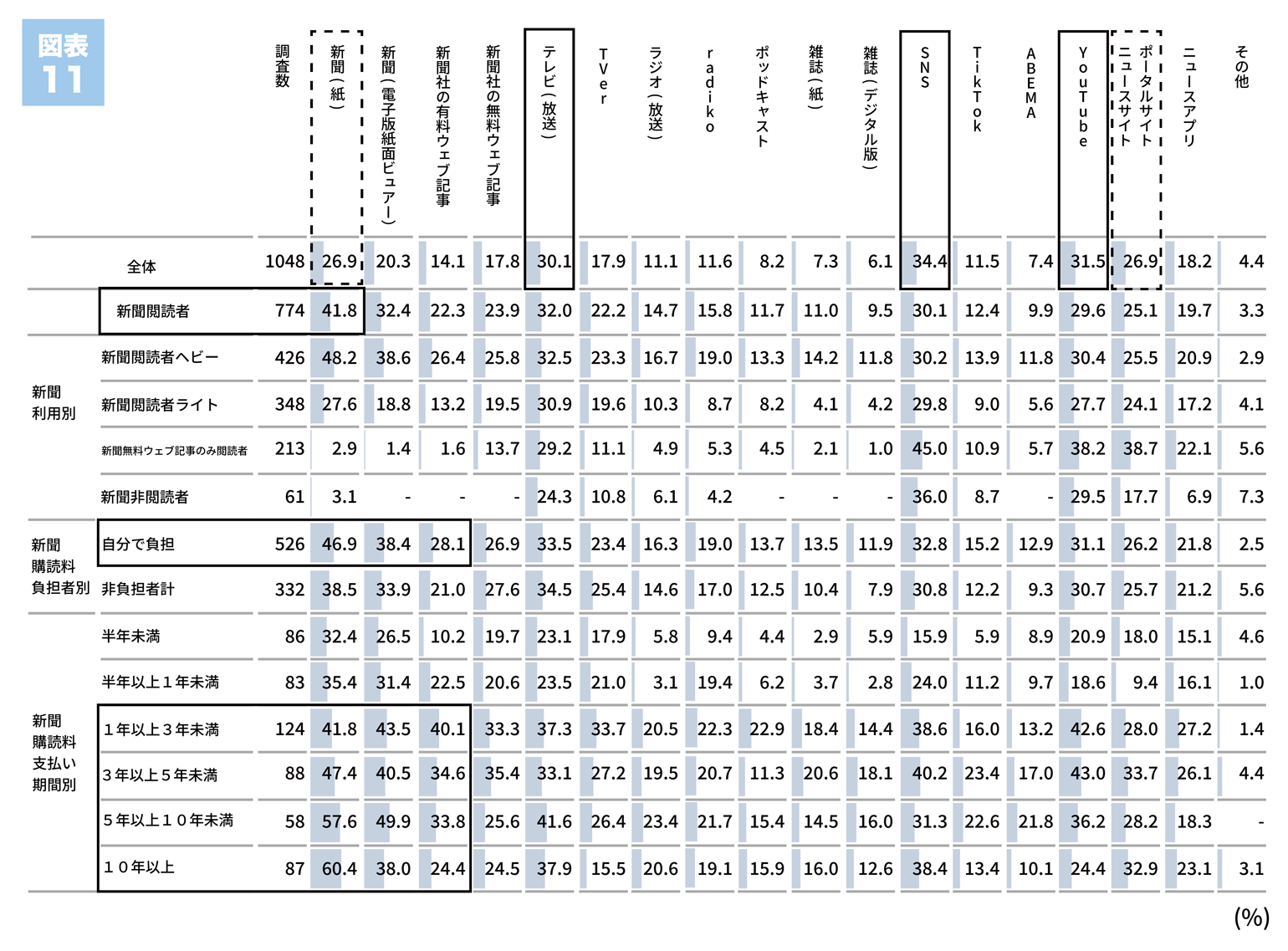
Furthermore, among subscribers, not only “print newspapers” but also “newspapers (digital editions via page viewers)” and “paid web articles from newspaper publishers” showed high usage rates, suggesting that newspaper media in general serve as important sources of information when sharing content, regardless of subscription duration.
In today’s world, where digital media has become widespread , newspapers are no longer merely a medium for receiving information . Beyond that , there are people who take a keen interest in social issues and current events, actively sharing information themselves and spreading it to those around them. It can be said that newspapers, as a trusted source of information for such individuals, also play a role in supporting consumers’ efforts to share information.
Newspaper Advertising: Conveying a Sincere Corporate Stance Along with “Meaning”
What we wish to convey through the results of this survey is that newspapers go beyond being a “long-standing, trusted medium” to become a medium that connects consumers and brands through “meaning.” This is precisely the essence of “ANCHOR,” the concept we advocate.
We believe that the “meaning” referred to here cannot be fully captured by the term “reliability” alone. Given that advertisements are read carefully, newspapers possess the qualities of “moment media” that connect with societal and seasonal changes, and they also function as “community media” that spark conversation and empathy among people.
The importance of companies clearly demonstrating their stance to consumers—including compliance and adherence to corporate governance codes—has grown even more significant in recent years. In such situations, newspapers can serve not merely as a medium for gaining reach, but as a powerful option for building deep understanding and trust with consumers. We believe the results of this survey demonstrate a glimpse of that potential.
In closing, how should we define the value of newspapers, utilize them, and incorporate them into our marketing strategies? I hope this article provides some insights on that matter.
[Survey Overview]
・Purpose: To understand the characteristics and value of newspapers
・Target Area: Nationwide
・Eligibility Criteria: Ages 15–69 *Excludes middle school students
・Sample Size: 8,250
・Survey Method: Online survey
・Survey Period: January 16, 2026 (Fri) – January 21, 2026 (Wed)
・Survey Contractor: Video Research Ltd.
・Survey Implementation and Analysis: Dentsu Inc., Media Services / Newspaper Division
Was this article helpful?
Share this article


Newsletter registration is here
We select and publish important news every day
For inquiries about this article
Author

Yuichi Koyasu
Dentsu Inc.
Media Services / Newspaper Division, Solutions Strategy Department
Senior Producer