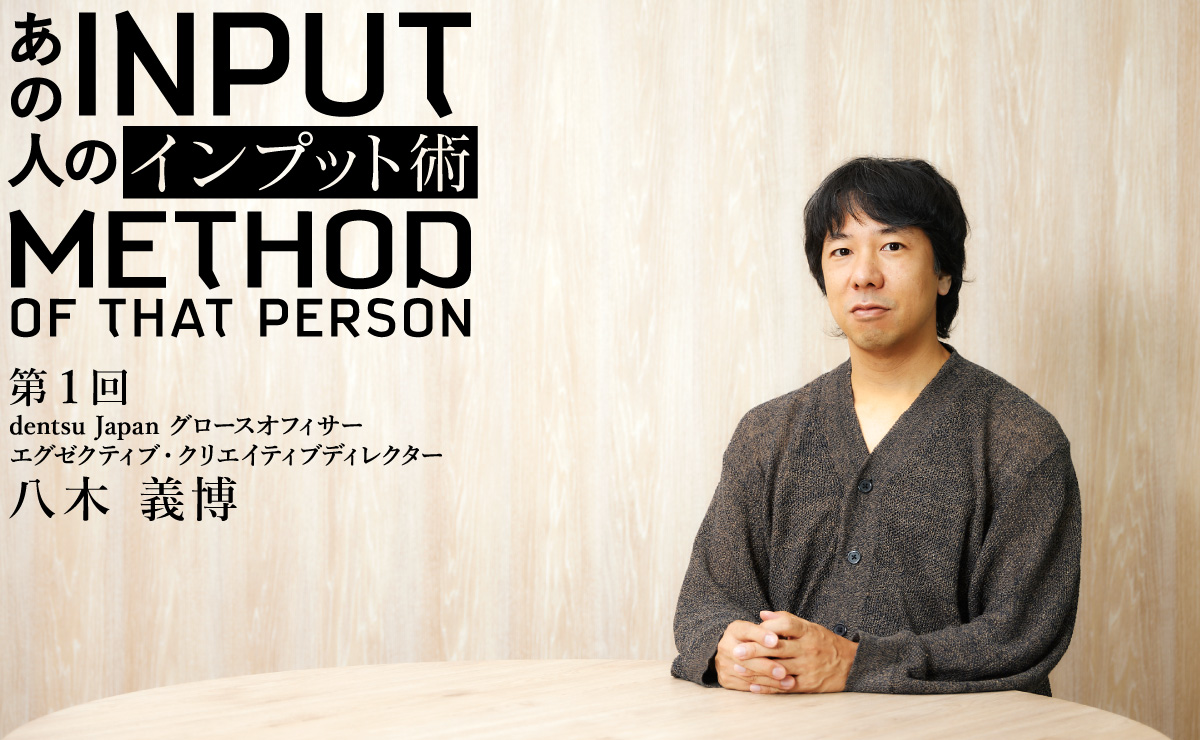
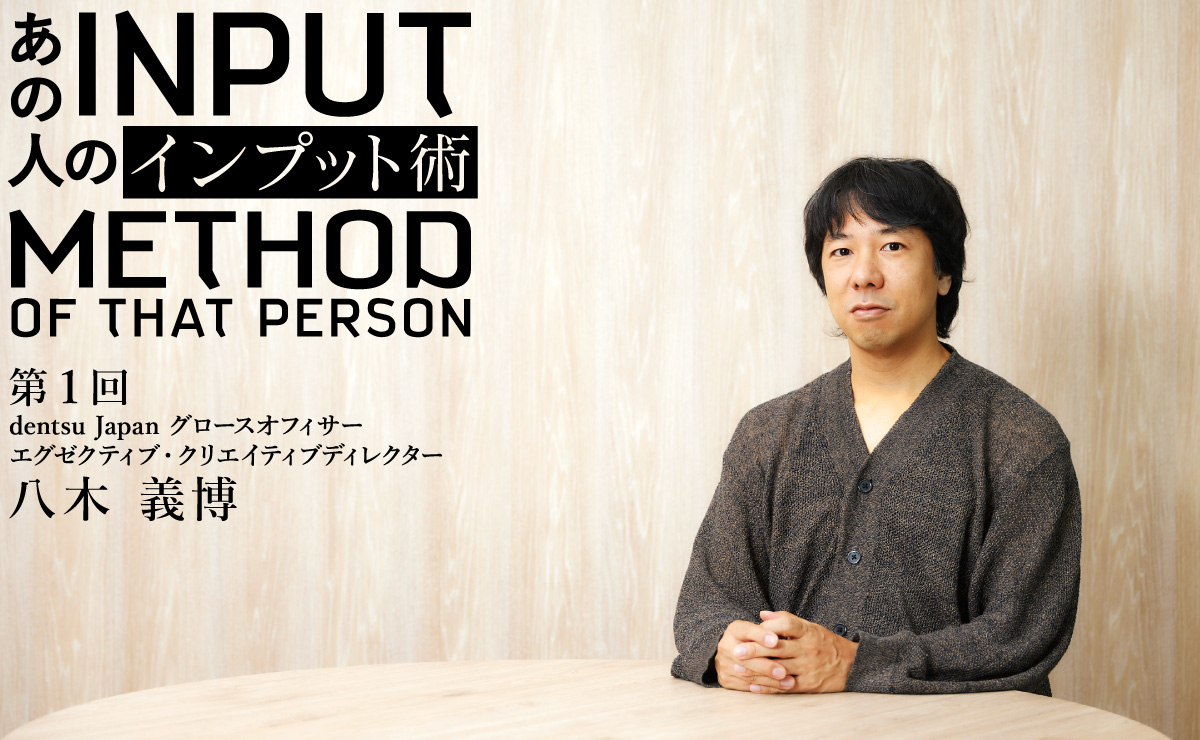
How do people at the forefront of their fields absorb information and inspiration on a daily basis, and how do they apply it to their work and creative thinking? In the series “How They Take in Information,” we introduce the input methods of people excelling in various fields, along with the thinking behind them.
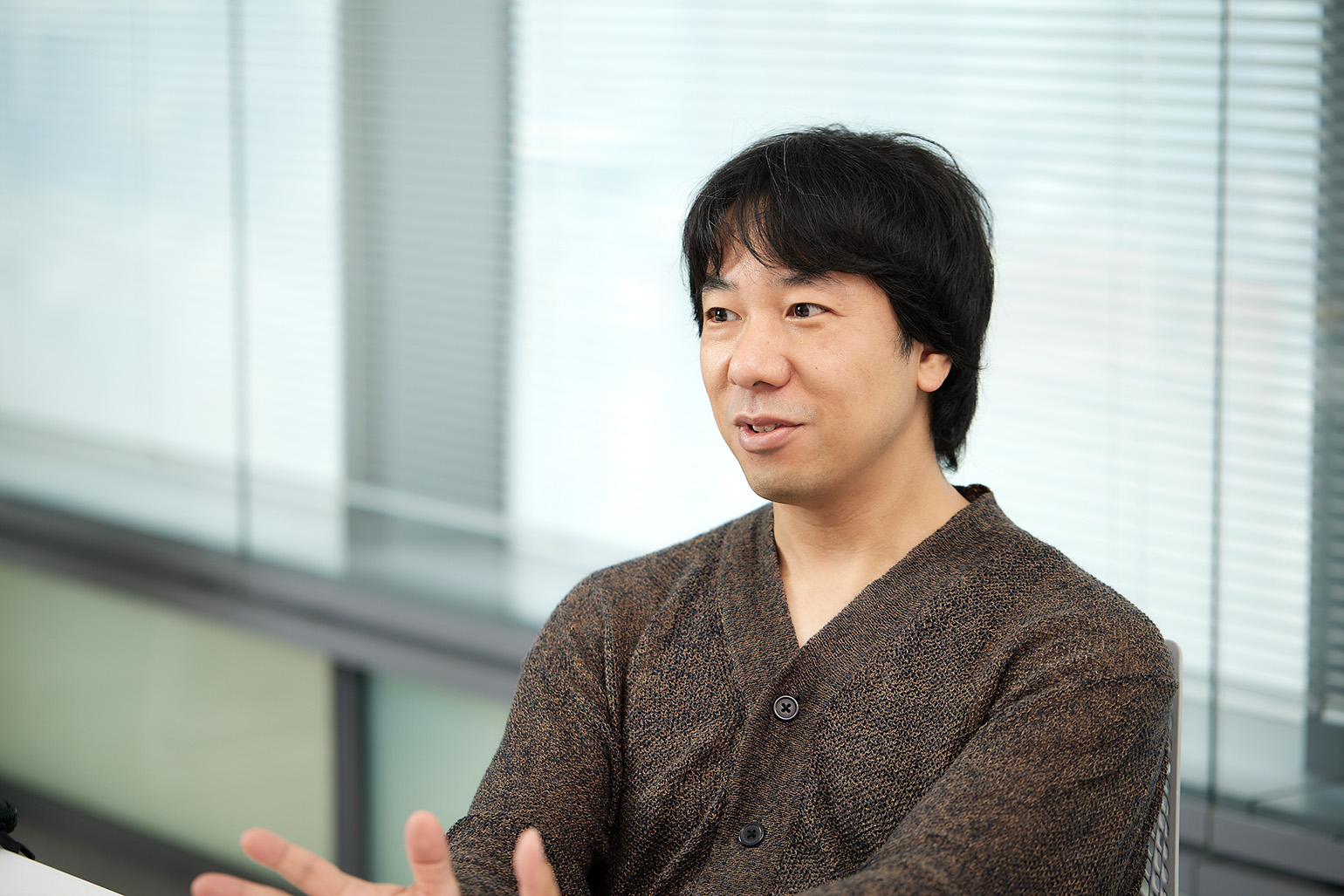
Featured in the first installment is Yoshihiro Yagi, Growth Officer and Executive Creative Director at Dentsu Japan. He has handled a wide range of creative projects centered on visual communication, from corporate and product branding to advertising campaigns. He has won numerous awards both domestically and internationally, including the Cannes Lions Grand Prix, One Show Best in Design, and the D&AD Black Pencil, and will serve as jury president for the Art Direction category at the 2026 D&AD Awards.
As someone who constantly keeps an eye on creative work from around the world, I imagined Mr. Yagi must regularly consume a vast amount of books, movies, and artworks. However, his response was unexpected. How does Mr. Yagi perceive his daily life, and how does he connect it to his work and ideas? We asked him for tips on how to slightly shift our perspective on everyday life.
Discovering the Essence of a Brand in the Ordinary Moments of Daily Life
—How do you usually gather inspiration?
Yagi: Actually, I don’t really “do anything specifically to gather inspiration.” I used to go to the movies a lot, but these days I can’t really find the time—I’m busy spending time with my kids and doing housework.
However, when something catches my attention in daily life, I look into it deeply. For example, I’ve recently become quite obsessed with “laundry.” I wanted to use a detergent with the best possible ingredients for my children’s clothes and garments that come into direct contact with their skin, so I was searching for one when I came across a particular laundry detergent. I looked up its website, bought a book, and even attended a seminar that happened to be held nearby with my wife. I was asking so many questions that my wife told me I had “the look of someone chasing after an idol” (laughs).
──So you didn’t just buy the detergent—you read books and even attended a seminar.
Yagi: As you learn more about laundry, you realize that things you’d always taken for granted were actually wrong. For example, you’d think scented detergents are meant to make your clothes smell nice, right? However, if the detergent’s scent lingers strongly on your clothes, it could mean that traces of the detergent itself are still there—which isn’t necessarily a good thing. So why add fragrance? The answer I heard at the seminar was, “To make the time spent doing laundry more enjoyable.”
The purpose isn’t to leave a scent on the clothes, but to enrich the experience of doing laundry as a household chore. I thought this was a concept that also applies to branding. Detergents have the function of removing stains. However, they can do more than just fulfill that function—they can also transform the time spent on housework itself into something enjoyable. This means we shouldn’t view the value a product provides solely in terms of its functionality.
──So, you drew a connection between laundry and how we perceive brand value.
Yagi: That’s right. What I found even more interesting was that there’s a correct order to the laundry process. When you put clothes into water with dissolved detergent, the dirt lifts from the fibers.Many people think the “washing” step is the most important, but apparently, the spin cycle is crucial for actually separating the loosened dirt from the clothes. After that, you rinse, spin again, reshape the clothes, and hang them to dry. If you change this order, you won’t get the results you expect. Branding and marketing are the same—it’s not just the content of the initiatives that matters, but also what you do and in what order.
If you launch an advertising campaign before improving your product, consumers will feel that “nothing has really changed.” First, improve the customer experience, let them try it out, and only then—once the value has been conveyed—should you implement the next initiative. I sometimes use the laundry process as an analogy when discussing branding with clients.
“Analogy” Thinking: Connecting Different Things
—Do you take everyday events and apply them directly to your work?
Yagi: I think I’m constantly drawing analogies, asking myself, “Can’t this be likened to something else?” One day, my child showed me a gear mechanism they’d made in a programming class. It was a system where the power of small gears is combined to move something larger. The moment I saw it, I thought it might be useful for the brand identity of an overseas publishing company I was working on at the time. Even in a small country, while the power of each individual may be small, when everyone connects, they can move the world. If you view the gears in that light, they become a motif that expresses the company’s essence.
To my child, it was just a gear they’d learned about in class. But the moment I connected it to the work I was doing, it became raw material for an idea.
—So unrelated events end up connecting in your mind, Mr. Yagi.
Yagi: By the way, here’s another story. A while back, my mother called from my parents’ house to say, “The plumbing in the studio bathroom burst.” My parents’ house had been converted into my father’s photography studio, but even if she told me—who was in Tokyo—there was nothing I could do except have a contractor fix it. After hanging up, I recalled a design I was working on at the time and came up with a visual concept using pipes as a motif. A simple phone call about a problem had turned into a design idea.
At first glance, everyday events seem unrelated to work. But when you have a theme you’re constantly thinking about, there are moments when an unexpected encounter connects to it.
──Does the work itself serve as input?
Yagi: Yes, for me, all work is a source of inspiration. If it’s a whiskey project, I visit the distillery; if it’s a beer project, I go see the brewery. Even if they tell me, “You don’t really need to come,” I make a point of going whenever possible. I want to understand how it’s made and what the people working there are thinking.
Take whisky blending, for example. I used to think it was simply a matter of freely mixing different flavors to create a delicious taste. In reality, blending is the work of combining base spirits—which vary subtly by barrel and vintage—to bring them closer to the single flavor defined by the brand. It’s about reproducing the exact same taste this year as last year, and ten years from now. That’s why we combine different elements. There’s a type of blending that isn’t about creating new flavors, but about preserving what remains constant. To me, that was a truly crazy and creative act.
You rarely hear stories like this unless you go out into the field. By understanding not only a product’s features and market data but also the philosophy behind them, you begin to see what lies at the core of the work.
Ideas Begin by Breaking Free from “Pattern Recognition”
—Is there anything you consciously do to transform the information you gather into your own ideas?
Yagi: I believe the foundation of design is “observation.” It means setting aside preconceptions and seeing what’s right in front of you exactly as it is.
Art college entrance exams always include a drawing test. In drawing, you can’t sketch something unless you observe the subject closely. How far apart are the eyes and nose? How is the light falling? How can I convey a sense of transparency? You observe what’s actually there, rather than relying on the mental pattern in your head of “this is what a human face looks like.”
In our daily lives, we unconsciously engage in “pattern recognition,” thinking, “This is what this is.” Even when opening a door, we don’t stop to think each time about which way to turn the handle or whether to push or pull. But if you set aside that pattern for a moment and ask, “How does this actually work?” you’ll start to see things that everyone else overlooks.
The same goes for doing laundry. By not assuming that “removing stains is the ‘washing’ step” and instead examining each step individually, you can realize the true purpose of the spin cycle.
I believe that setting aside preconceptions in this way is what serves as my source of inspiration.
Good design means offering something new
—Does that kind of “perspective” also inform your approach to design, Mr. Yagi?
Yagi: Yes, I think so. I believe it leads to making new proposals regarding what already exists.
The word “design” often conjures the impression of tidying up appearances or creating beautiful forms. However, I believe its true essence lies in re-examining the current state and redesigning it. It involves having one’s own unique perspective—thinking, “It used to be this way, but wouldn’t it be better if it were like this?” Regardless of whether it’s right or wrong, I believe good design is something where you can sense intention and a proposal.
When I worked on the packaging for contact lenses, rather than referencing the typical presentation found in contact lens sections, I researched what the founder was trying to achieve. From that, I came to see the brand not merely as a product that corrects vision, but as one that seeks to offer recovery and relief to people who have lost their sight. Viewed that way, there’s no need to make the design look like that of competing products.
Rather than just refining what’s within the scope of the request, I believe the role of design is to identify the brand’s inherent value and propose, “Isn’t this how it should be?”
──When turning insights and perspectives gained from daily life into concrete proposals, do you also utilize AI?
Yagi: I use AI quite a bit. It’s especially helpful when organizing my thoughts or putting them into words.
On the other hand, I’m careful not to put everything into words. If I feed something to AI that I can’t put into words, it will neatly articulate it for me. But the moment it’s put into words, something complex can become simplistic or run-of-the-mill. Sometimes showing the design as-is conveys the message better, and sometimes there’s value in what can’t be put into words. It’s important for humans to be able to choose whether “this should be put into words, or is it better left unsaid.”
──In the age of AI, what constitutes input and ideas unique to humans?
Yagi: Even when looking at the same thing, what people take away from it varies from person to person. Some people might look at a gear and think about a publisher’s identity, while others might imagine a different kind of work. Sometimes, nothing comes to mind at all. I believe it’s those differences that give rise to originality.
Websites, videos, and training programs contain a wealth of information to learn. If everyone takes the same course, they’ll all gain the same information. But that alone won’t make you original.
What matters is what you notice in your daily life, how you process what you’ve learned, and how you apply it to different contexts. Connecting it to your own experiences and work in this way is what leads to ways of thinking that differ from those of AI, isn’t it?
What matters isn’t so much what you see, but how you see it
—Could you offer some advice for people who feel too busy to set aside time for input?
Yagi: I don’t think you need to believe that you can’t gain new insights unless you go to special places or read lots of books.
Of course, visiting new places and engaging with books and movies are important. However, these are merely raw materials. More important than simply accumulating these materials is how you perceive them and how you connect them to your work and interests.
Doing laundry, listening to your child talk, or receiving a phone call from a family member—all of these can be sources of inspiration.
Instead of dismissing what’s right in front of you with a “Well, that’s just how it is,” try asking yourself: “Why is it this way?” “What could it be replaced with?” “What possibilities does it hold?” If you observe your daily life from a slightly different angle, I believe you’ll find that the world is full of seeds for ideas—even without having to go out of your way to carve out time for input amidst your busy schedule.
Pursuing creativity that transcends the boundaries of brand, business, and culture to redefine the value of companies and brands. Has served as jury president for global advertising awards such as the Cannes Lions and D&AD. Appointed as the only Asian director on the Art Directors Club (NY) Board of Directors. Has won numerous domestic and international advertising awards, including multiple Cannes Lions Grand Prix and D&AD Black Pencils (the highest honor), and is also dedicated to nurturing the next generation of creators.

 That Person’s Input Techniques [1/1]