Note: This website was automatically translated, so some terms or nuances may not be completely accurate.
 The future seen from the perspective of young people, just half a step ahead [7/7]
The future of “learning” will shift from “replicating predetermined correct answers” to “flexibly adapting to society.”
Dentsu Inc.’s Youth Research Division (hereinafter referred to as “Dentsu Wakamon”) held a “Tsugikuru” workshop—a program for discovering signs of the future—with current college students. Under the theme “The Future Shape of [X],” the division is developing hypotheses based on the students’ reports ( click here for the article on the “Tsugikuru” program).
The theme of this session is “The Future Shape of ‘Learning’ as Envisioned by Current College Students.” In an era of rapid change, where AI has become an integral part of daily life, we explore the emerging trends in how students perceive and engage with “learning.”
Dentsu Inc. Youth Research Department “Wakamon”
A specialized division within Dentsu Inc. that continuously researches the attitudes, values, and behaviors of young people, covering areas ranging from marketing and business development to organizational and human resources management. Rather than viewing youth solely through the lens of generational theory, we redefine “young people” as “those who act based on new values.” By interpreting these values as “signs of the future,” we support companies and society in charting their next course.
They Won’t Take Action Unless They’re Convinced: Young People’s Learning Styles
Until now, the mainstream approach to “learning” has been based on school education—characterized by “learning driven by a strong sense of duty” or “a style that views studying through sheer determination, even when the purpose is unclear, as a virtue.”
What are the current attitudes and motivations of today’s students toward “learning”? To understand the current situation, we conducted a survey of college students nationwide using “CircleApp,” a communication app dedicated to university clubs, and identified the following interesting trends.
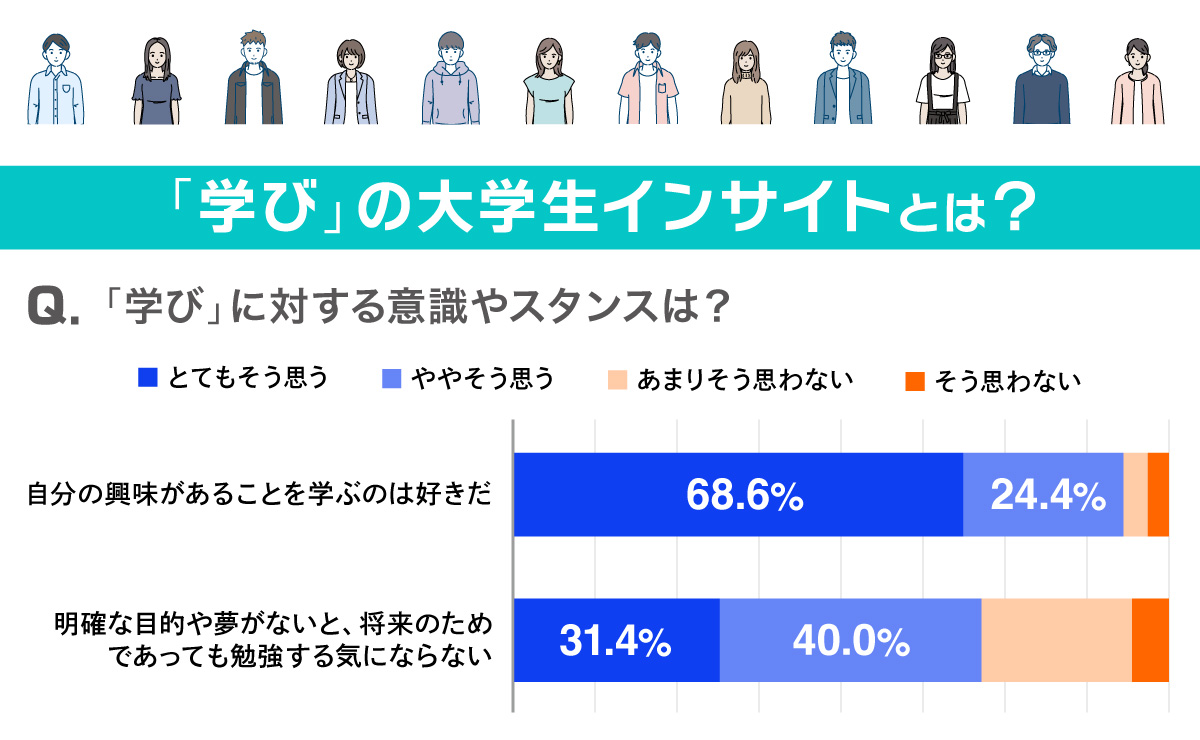
First, it’s worth noting that 93.0% of respondents expressed proactive curiosity, stating, “I like learning about things that interest me.” Young people do not, by any means, have an aversion to “learning” itself. Rather, they are very positive about learning that stems from their own “likes” and “interests.”
On the other hand, regarding the statement, “Without a clear goal or dream, I don’t feel motivated to study, even if it’s for my future,” 31.4% responded “I strongly agree,” which was a relatively high score among the survey items. The idea of “Just do it because it’ll be useful someday” doesn’t resonate well with young people; perhaps the reality for today’s youth is that they only truly get motivated once they personally understand and accept the reason behind their learning—that is, “Why am I learning this?”
Furthermore, 92.6% agreed with the statement, “I want to update my knowledge and way of thinking as needed to keep pace with changes in the world.” As many as 72.8% also said they learn “how to behave to avoid making mistakes in society” from social media. Rather than memorizing predetermined “correct answers,” they are flexibly adapting themselves while reading the ever-changing atmosphere of society. This kind of “learning for life” may be spreading throughout the daily lives of young people.
Young people are striving to adapt to societal changes while valuing what they “like” and what gives them a “sense of satisfaction.” This mindset is also reflected in the “gap” between what they are currently learning and what they want to learn in the future.
The top response for “what they are currently studying on their own” is “studying to avoid failing immediate ‘courses’ or lowering their ‘GPA (college grade point average)’” (57.6%).
However, when they turn their attention to “what they want to learn in the future,” their focus seems to shift abruptly toward “preparing to survive.” Not only are standard skills like “English” and “business etiquette” popular, but “critical thinking and problem-solving skills,” “mental health care,” and “financial literacy” are also surging in popularity. They may be earnestly seeking the skills needed to “survive by thinking for themselves, without falling ill or struggling financially” in a society where rapid change is the norm.
Incidentally, regarding “AI,” which has rapidly gained popularity in recent years, the scores were completely even: 28.4% for “currently” and 28.4% for “in the future.” This suggests a stance of calmly engaging with AI as “infrastructure that makes daily life convenient—something taken for granted”—rather than fearing it excessively or becoming overly dependent on it.
These young people prioritize their own sense of conviction and strive to navigate a rapidly changing society wisely. At the same time, we also saw real-life struggles—such as being caught up in their busy daily lives and searching for ways to rediscover their “pure curiosity” and “sense of self.” Balancing the need to fit in with those around them and the importance of cherishing their own unique “passions”—how do they reconcile these two seemingly contradictory goals in their daily lives?
There, we found a flexible approach unique to them—one that differs from the “prescribed learning” of the past. In the following sections, I’d like to explore the future of “learning” by unraveling these signs of what’s to come through the students’ reports.
From “Prescribed Learning” to “Wisdom for Living”
University students are breaking free from textbooks and predetermined schedules, transforming every moment of their daily lives into opportunities for learning.
For example, student reports show that learning icons like “Korashō” and “Duolingo’s Owl” are incorporating memes and social media culture, evoking a sense of “nostalgia” and “familiarity” as they begin to blend into daily life, transcending the boundaries of traditional learning.
Furthermore, another report notes that by witnessing social media backlashes on a daily basis, young people are regulating their actions and speech out of a fear of “being exposed.” College students are constantly and promptly picking up on the “social climate” and “public reaction” of the present moment; rather than clinging to yesterday’s “correct answers,” they continue to flexibly adjust their mindset and behavior in response to the atmosphere around them.
This constant cycle of minor adjustments is their daily reality and represents a new form of learning that allows them to stay in step with an ever-changing society.
“The Existence of AI” and “Returning to Basics”
It is impossible to keep up with the dizzying changes in society 24 hours a day on one’s own. That is why “AI” is a constant presence in their daily lives. They first run their thoughts through AI and, based on the “average correct answer” it returns, proactively gauge how society is likely to perceive them. AI serves as a reliable buffer, preventing them from straying from the path of society.
However, their relationship with AI goes beyond that. Precisely because AI provides the “average correct answer” via the shortest route, young people are beginning to feel drawn to “deliberate detours”—sacrificing efficiency—because they believe, “Life has no meaning if it’s nothing but correct answers.”
As noted in the report below, rather than efficiently reaching their goals, they are focusing on discovering their own interests through the tangible experience of “hesitation” and “trial and error” along the way—even if these are perceived as inefficient.
In other words, college students are trying to rediscover the pure sense of play—doing things simply because they find them interesting—or deliberately taking the extra time to understand concepts from the ground up, while also focusing on learning experiences that offer a tangible sense of discovery. Precisely because we live in an era where everything is optimized, they are carefully exploring their own interests—the very things that are often overlooked. This return to basics is their new way of learning—one that AI will never be able to take over.
What Is Required of “Learning” Going Forward
These young people are constantly rewriting their own assumptions and, at times, deliberately taking the long way around to grope their way toward “being themselves.” It is precisely within this seemingly tedious process that their true “passions” and “authentic selves” are hidden. That is why what will be required of companies, educational institutions, and families in the future is not to cram them full of “correct answers.”
Rather, they must work together to create the “breathing room” where young people can feel safe to wander, experiment, and discover their own unique “passions” and “sense of self” through trial and error. Learning environments of the future may need to flexibly evolve from “places that teach correct answers” to “places that foster a sense of self.”
<Survey Overview>
Research Organization: Dentsu Inc. Youth Research Department
Survey Participants: 500 undergraduate and graduate students nationwide
Survey Period: July 2026
*Percentage figures are rounded to the second decimal place; therefore, the total may not always add up to 100%.
Was this article helpful?
Share this article


Newsletter registration is here
We select and publish important news every day
For inquiries about this article
Back Numbers
Author

Raikai Kamunten
Dentsu Macromill Insight, Inc.
Marketing Business Division, Decision Research Department 2, Research & Consulting Group 4
Researcher/Planner