Note: This website was automatically translated, so some terms or nuances may not be completely accurate.
 The future seen from the perspective of young people, just half a step ahead [5/7]
Will AI become the “mediator of human relationships” in the era of consideration?
Dentsu Inc.’s Youth Research Division “Wakamon” (hereinafter referred to as Dentsu Wakamon) is conducting “Tsugikuru,” a program to discover signs of the future, in collaboration with current university students. Based on reports submitted by students under the theme “The Shape of the Next [Something],” the division is developing hypotheses ( click here for the article on the “Tsugikuru” program).
The theme of this report is “The Shape of the ‘AI Life’ to Come,” as envisioned by current university students. As AI is increasingly integrated into society across various fields, we explore how students’ attitudes toward AI are evolving.
Dentsu Inc. Youth Research Division "Wakamon"
A specialized internal organization at Dentsu Inc. that continuously researches the attitudes, values, and behaviors of young people, covering marketing, business development, and organizational and human resources domains. Rather than viewing young people solely through the lens of generational theory, we redefine them as “people who act based on new values.” By interpreting these values as “signs of the future,” we support companies and society in charting their next course.
About 40% of Students Use Generative AI for "Counseling and Questions"
What is the current state of students’ use of generative AI? To understand the current situation, we conducted a survey in March 2026 using “CircleApp,” a communication app dedicated to university clubs, and received the following responses.
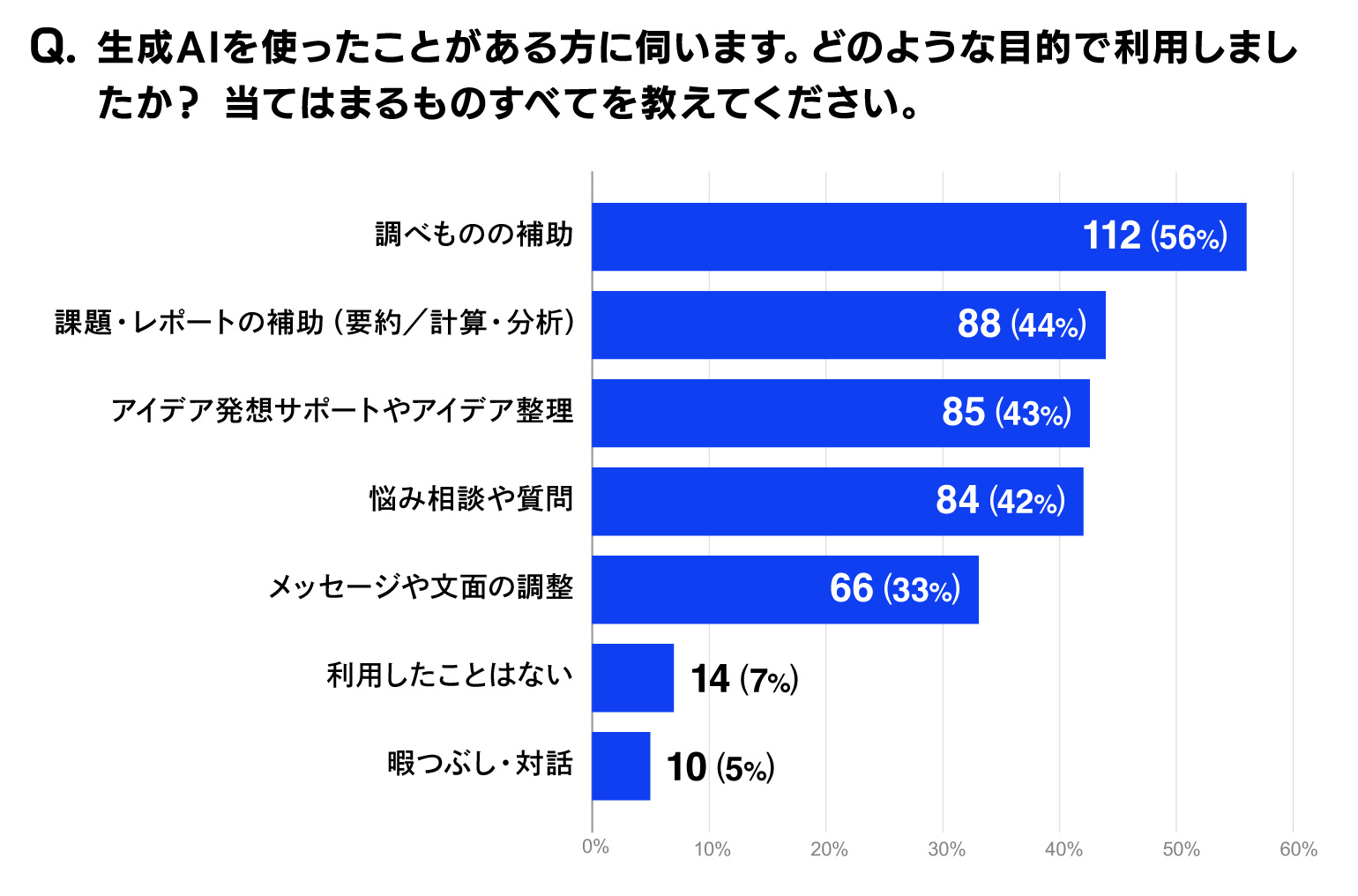
A notable finding was that 42% cited “seeking advice or asking questions,” while 5% cited “killing time or chatting.” The fact that generative AI is used as a “conversation partner”—a usage not seen with other digital tools—at a rate comparable to other categories may be attributed to the values young people hold regarding communication.
As mentioned in the Dentsu Inc. Wakamon article, young people, for whom “spaces where emotions are visualized, disseminated, and reinterpreted”—such as social media and LINE—are a constant part of daily life, expend daily energy on “choosing their words” and “fine-tuning their distance” to avoid hurting others or having their own emotions tainted by a single word or moment of poor timing.
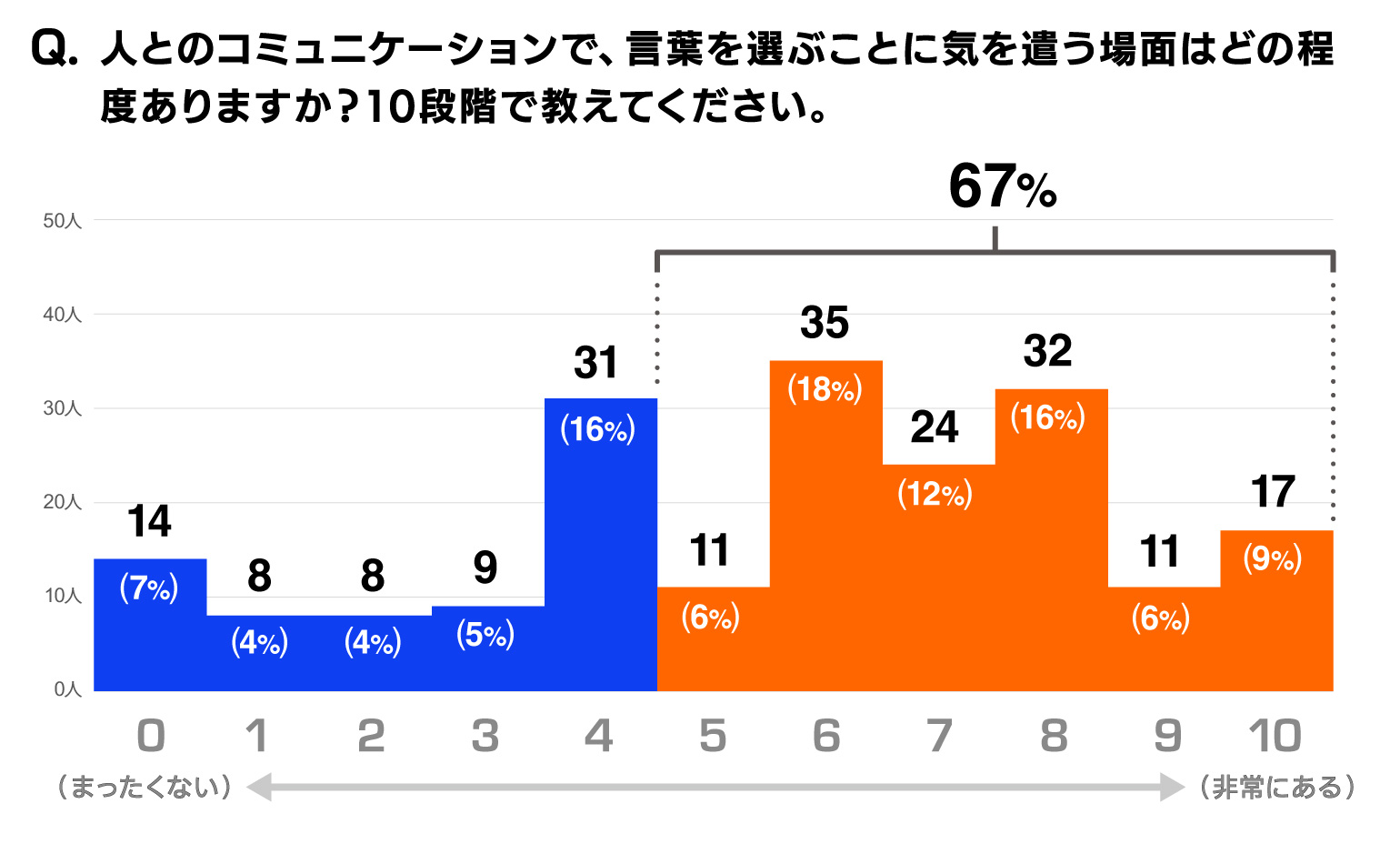
The aforementioned "CircleApp" survey also revealed that approximately 70% of respondents reported being "moderately" or "very" mindful of their word choice in communication situations, highlighting how they pay close attention to even subtle phrasing in everyday interactions.
It appears that today’s young people have internalized the practice of selecting “the right words” while respecting others’ backgrounds and values as a natural part of conversation.
On the other hand, as revealed in the aforementioned article, there is a strong yearning among young people for “relationships where they can connect honestly.”
"I want to connect deeply, but I don’t want to get hurt."
For young people grappling with this dilemma, what form will the “AI life” of the future take?
Three Types of Relationships with AI
After organizing the reports and surveys submitted by students, we found that they do not limit their relationship with AI to a single type but rather use it in various ways depending on the situation and purpose. Broadly speaking, these can be categorized into the following three types:
① Conversation Partner: Someone You Can Talk to Casually About Anything, Anytime
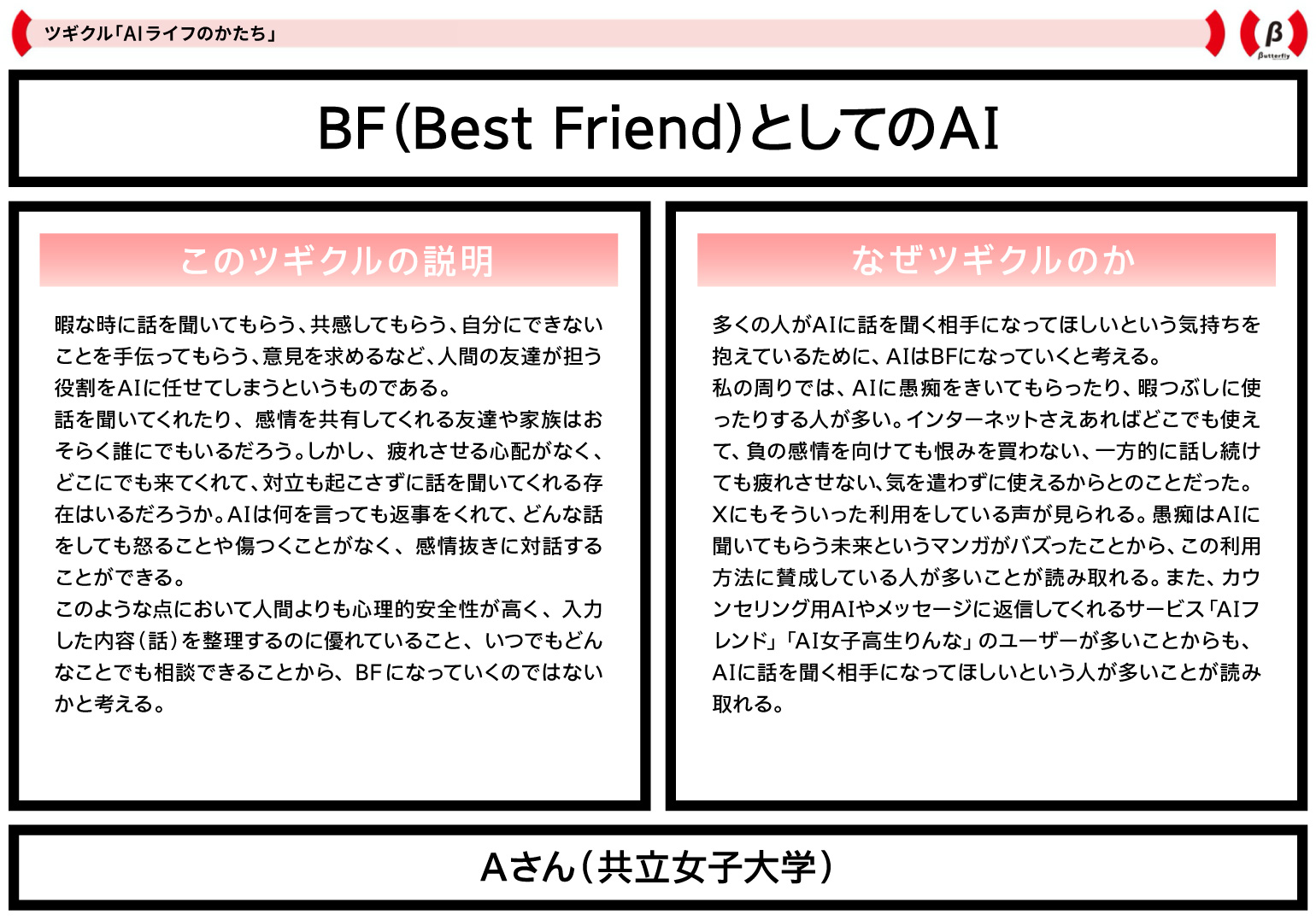
Although this is a form already in use today, the most common scenario described in the reports involved treating AI as a close friend—someone with whom one can freely share emotions, engage in casual conversation, or vent frustrations—a relationship that carries little psychological burden.
Compared to interpersonal relationships that require a great deal of consideration, this approach aligns well with the values of young people, as it allows them to speak at their own pace without fear of rejection.
② Extension Tool: An external function that assists and accelerates thought and action
This refers to using AI to streamline tasks, organize key points, or verify information—essentially as a tool for improving work efficiency or aiding decision-making. While this ranked high in the “CircleApp” survey and is already widely established, it was not frequently mentioned in the report; however, it is expected to remain a foundational use case moving forward.
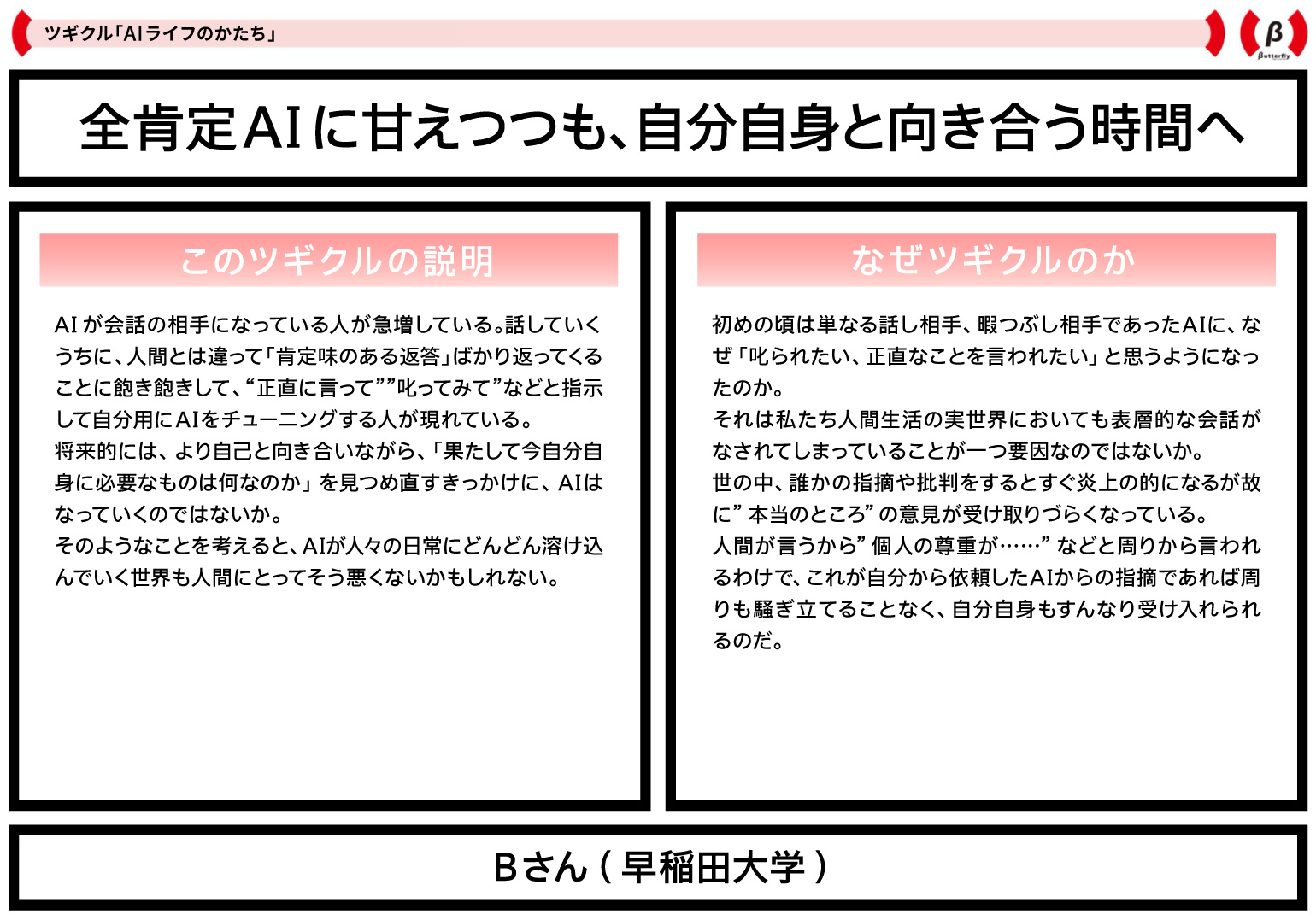
Within the report, we also observed more advanced uses of AI as a tool for self-growth and self-understanding—such as “asking AI first to avoid embarrassment” or “tuning AI to reflect on oneself”—rather than merely as a tool for improving work efficiency as mentioned earlier.
③ Mediator: An Advisor Who Steps “Between” People
A notable feature of the report was the emergence of cases where AI is used as a mediator in human relationships.
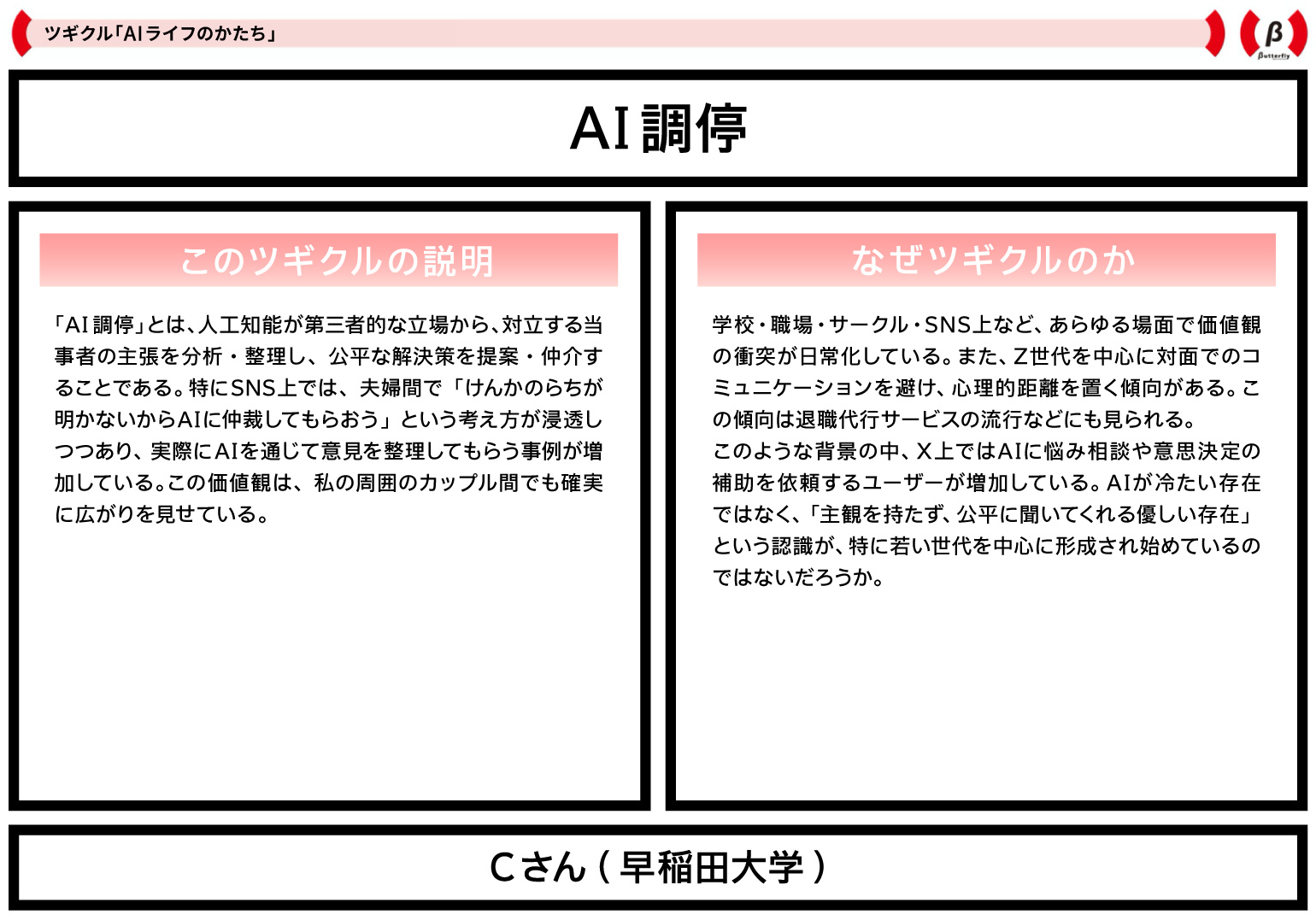
In these cases, the AI acts as a third-party observer to
・Organizing both parties’ arguments
・Proposing fair solutions
—essentially taking on the role of mediating interpersonal relationships.
This differed in nature from other relationships in that AI was positioned not merely as a confidant or a tool for improving operational efficiency, but as a mediator designed to reduce friction in communication.
Why does this usage seem novel? To begin with, the role of AI acting as a third party has long been depicted as a fundamental position for AI in many works of science fiction. Many of you can likely think of several works featuring an AI that observes human society from the outside and makes neutral judgments.
On the other hand, looking at current usage and student reports, this third-party role was not sought from the outset. Instead, it first established itself as a familiar confidant or a tool to assist with tasks, and the third-party aspect naturally emerges when the need arises.
In other words, I believe the novelty and appeal of this phenomenon lies in this reversal: while in science fiction, AI is “initially” portrayed as a third party, in reality, this role “emerges later” within the context of daily life.
For young people grappling with the dilemma of “wanting deep connections but not wanting to get hurt,” having AI act as an intermediary may be readily accepted as one option for mitigating friction and conflict between humans.
In other words, for young people, AI serves not only as a confidant with whom they can speak their minds without worrying about offending others, but also as an advisor who mediates the friction arising from human interactions from a third-party perspective.
Integrating AI’s Third-Party Perspective into Corporate Infrastructure
I believe this third-party approach will eventually extend beyond interpersonal interactions. In situations prone to friction, such as organizational management and customer service, AI could play a neutral mediating role, potentially improving the quality of consensus-building.
By not limiting AI’s role but positioning it as a facilitator that manages the “space” within communication, the very nature of business decisions and customer interactions may change.
Student Co-creation Network “βutterfly”
A new form of industry-academia collaboration project involving young people and companies. By combining the unconventional perspectives of young people with the planning and knowledge of Dentsu Inc., we are expanding collaboration across various fields, including new service development, product development, organizational development, and advertising expression development. Through “βutterfly,” current university students and Dentsu Inc. members are implementing the “Signs of the Future Discovery Program ‘Tsugikuru.’”Each month, we set themes such as “The Future Shape of ‘Health’” and “The Future Shape of ‘Family.’” Based on reports submitted by university students, we hold discussions and construct future hypotheses for each theme.
Was this article helpful?
Share this article


Newsletter registration is here
We select and publish important news every day
For inquiries about this article
Back Numbers
Author

Shiho Yamaguchi
Dentsu Inc.
第8マーケティング局
マーケティングコンサルタント