Note: This website was automatically translated, so some terms or nuances may not be completely accurate.
 Signs of Food Trends in 2026 Revealed by Our Survey [1/1]
The Accelerating “0.5-Meal Market” and Its Future
Dentsu Inc.’s “Food Lifestyle Lab” (hereinafter referred to as the Food Lab) tracks trends in Japanese dietary habits and considers the future of eating. This series will explore emerging trends in food based on survey data from the Food Lab and other sources.
Since around 2020, the Food Lab has focused on a style of eating that breaks free from the traditional habit of “eating three full meals a day,” instead adapting to minor hunger pangs and the rhythm of daily life. It has coined the term “0.5-meal” to describe “small snacks or drinks consumed without dedicating sufficient time or effort to a proper meal” and has been tracking this trend.
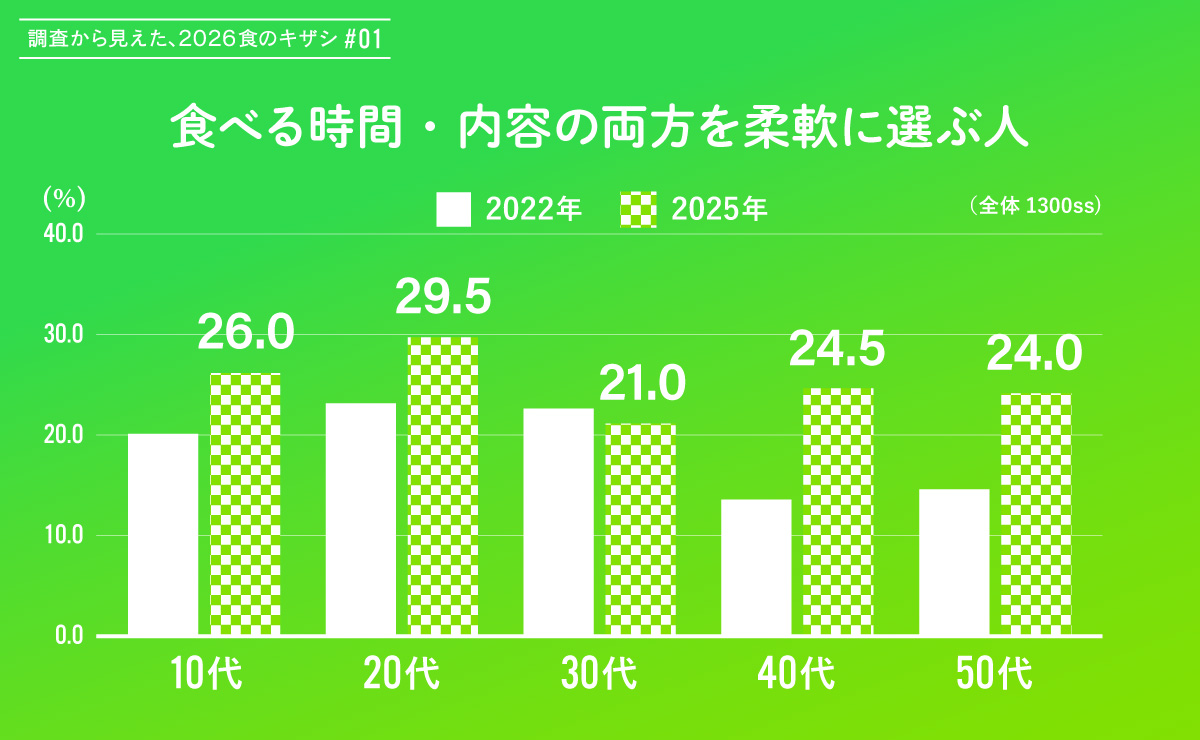
An article on “0.5 meals” published in Dentsu-ho in 2023 generated a significant response. At that time, a trend was particularly evident among women in their 20s: while they were still mindful of the distinctions between breakfast, lunch, dinner, and snacks, they tended to choose when and what to eat based on their own lifestyles. However, “0.5 meals” is now becoming a behavior that is no longer limited to specific generations or demographics.
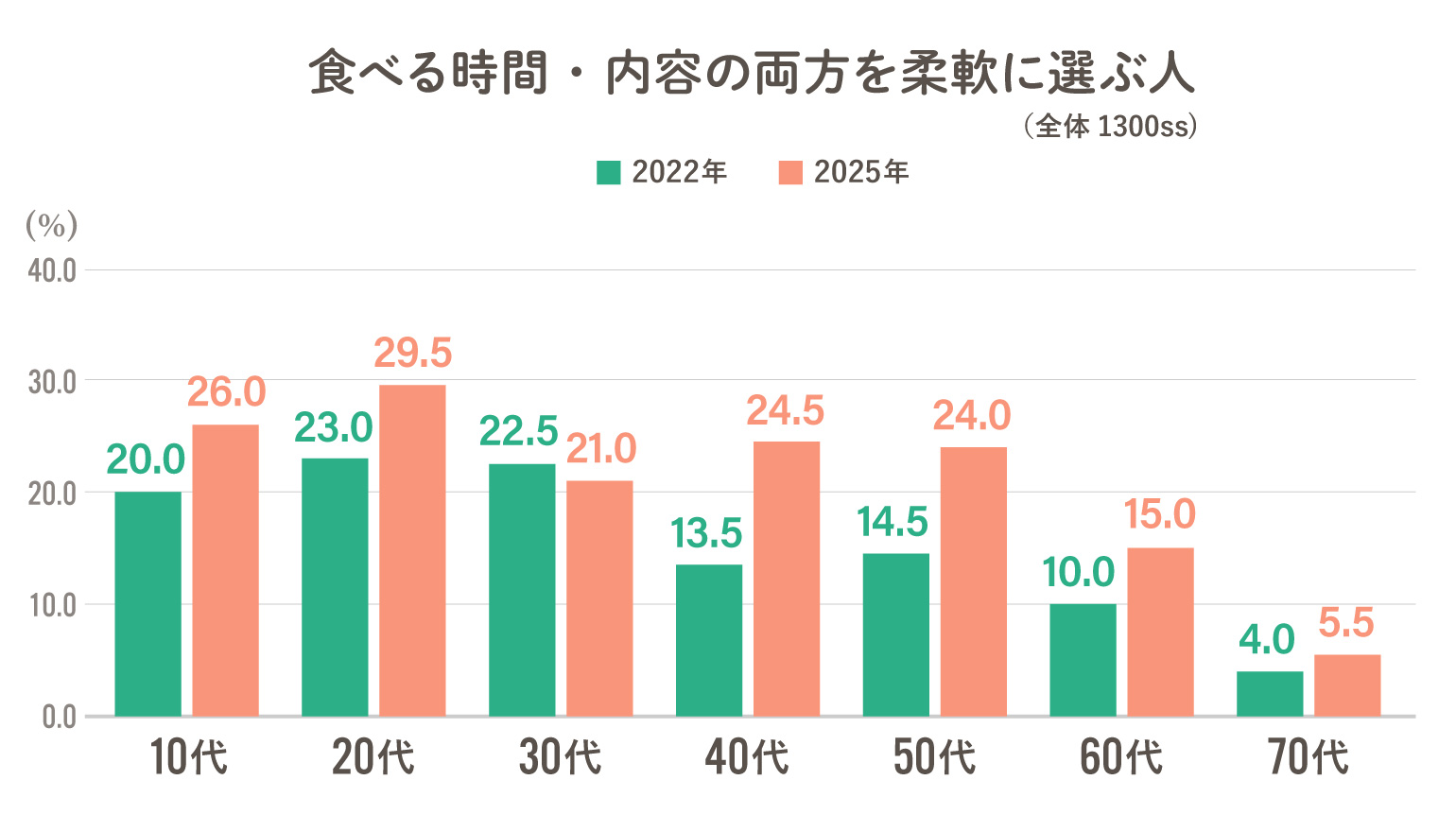
As consumers’ use of time diversifies—spanning work, housework, childcare, hobbies, and social relationships—the practice of adjusting meal portions, timing, and satisfaction levels to suit individual needs is becoming widespread in daily life across all generations. That said, what is happening now is not merely an “expansion of the snacking market.” Consumers are beginning to redefine their eating habits to fit their lifestyles.
<Table of Contents>
▼What Modern People Seek Is “Unobtrusive Eating”
▼Snacks Are Beginning to Take on the “Feel of a Meal”
▼What People Are Seeking Is “Balance” and “Experience”
▼“Half-Meals” Offer Even More Freedom—A New Perspective Required for Products and Services
▼Consumers Are Beginning to “Reimagine Their Eating Habits”
What Modern People Seek Is “Food That Doesn’t Get in the Way”
What today’s consumers seek from food isn’t necessarily just “taking the time to eat a proper meal.” Even if it doesn’t provide the same sense of fullness as a full meal, they prioritize meals that don’t disrupt the flow of work or travel, and that don’t hinder afternoon activities or upcoming plans due to that post-meal heaviness. They want meals that can be incorporated into their lives—including hobbies and time with others—without disrupting the overall rhythm of their daily lives. The demand for this kind of “unobtrusive eating” is on the rise.
When we examine this need more closely, the following four elements emerge:
・Doesn’t take up time = Can be eaten quickly and efficiently
・Not too heavy in portion size = Does not place a physical burden on the body or stomach
・Maintaining mental clarity = Not hindering thought or concentration, allowing you to move on to the next activity
・Yet, it should feel like a good choice for your body = It’s not just about satisfying hunger, but also provides a sense of taking care of yourself, even if only a little
How can we balance the “lightness” needed to maintain daily performance with “self-care” for our bodies? This is the essential perspective for understanding the current “0.5-meal” trend.
Snacks Have Begun to Take on the “Feel of a Meal”
Against a backdrop of time constraints, busy schedules, and the psychological tendency to find “thinking about it a hassle,” there is a growing trend of skipping or simplifying meals. However, what consumers are seeking goes beyond simply skipping meals or simplifying them. Alongside the rational need to “get it over with quickly” and “keep portions small,” there is also a demand for the satisfaction of a proper meal and the assurance that it is a choice that is good for their bodies.
According to a survey by Shoku Lab, the score indicating “resistance to substituting meals with snacks, dietary supplements, or beverages” has been declining year by year. On the other hand, “feelings of guilt when eating greasy or sweet foods” are on the rise.
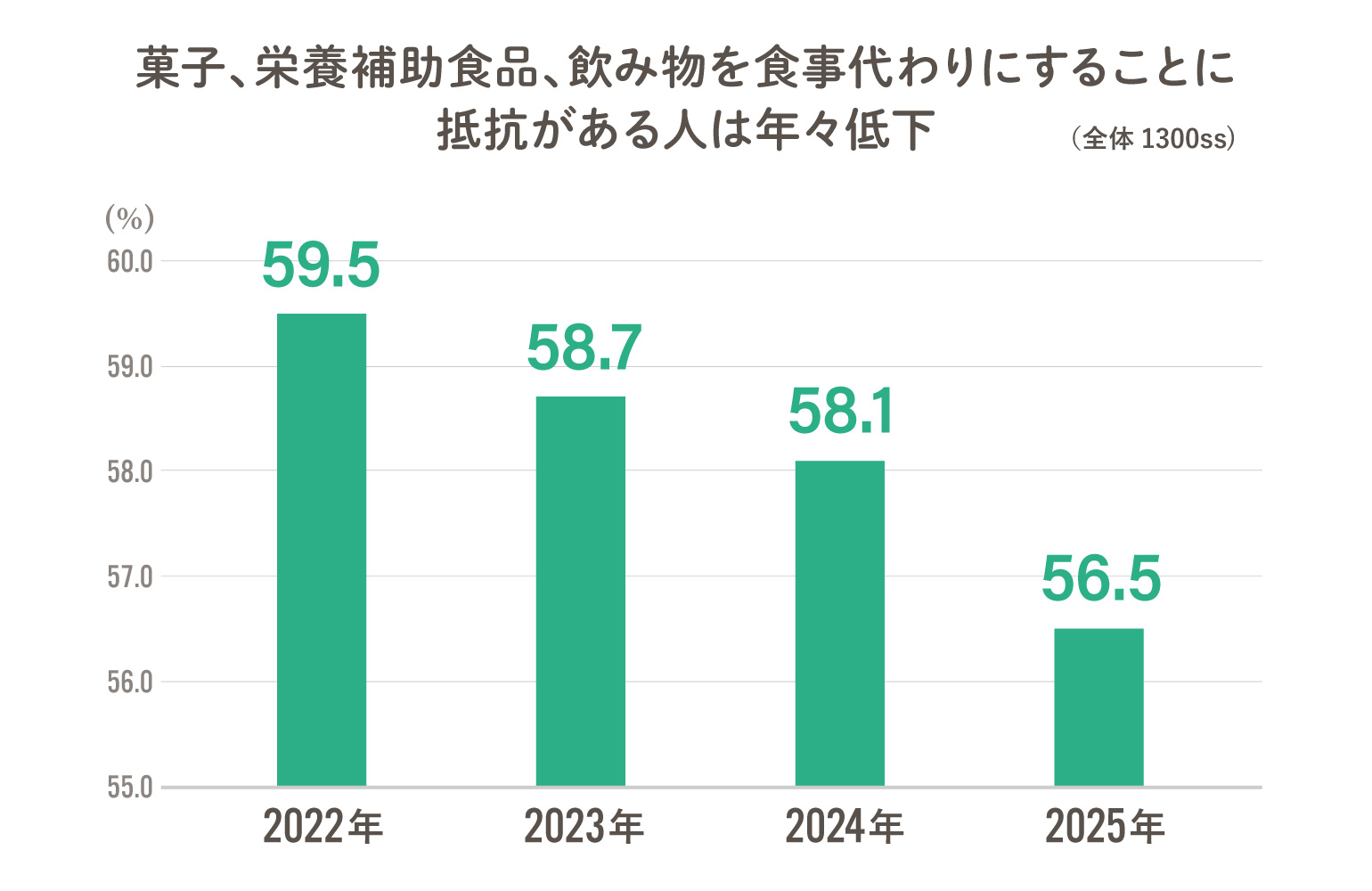
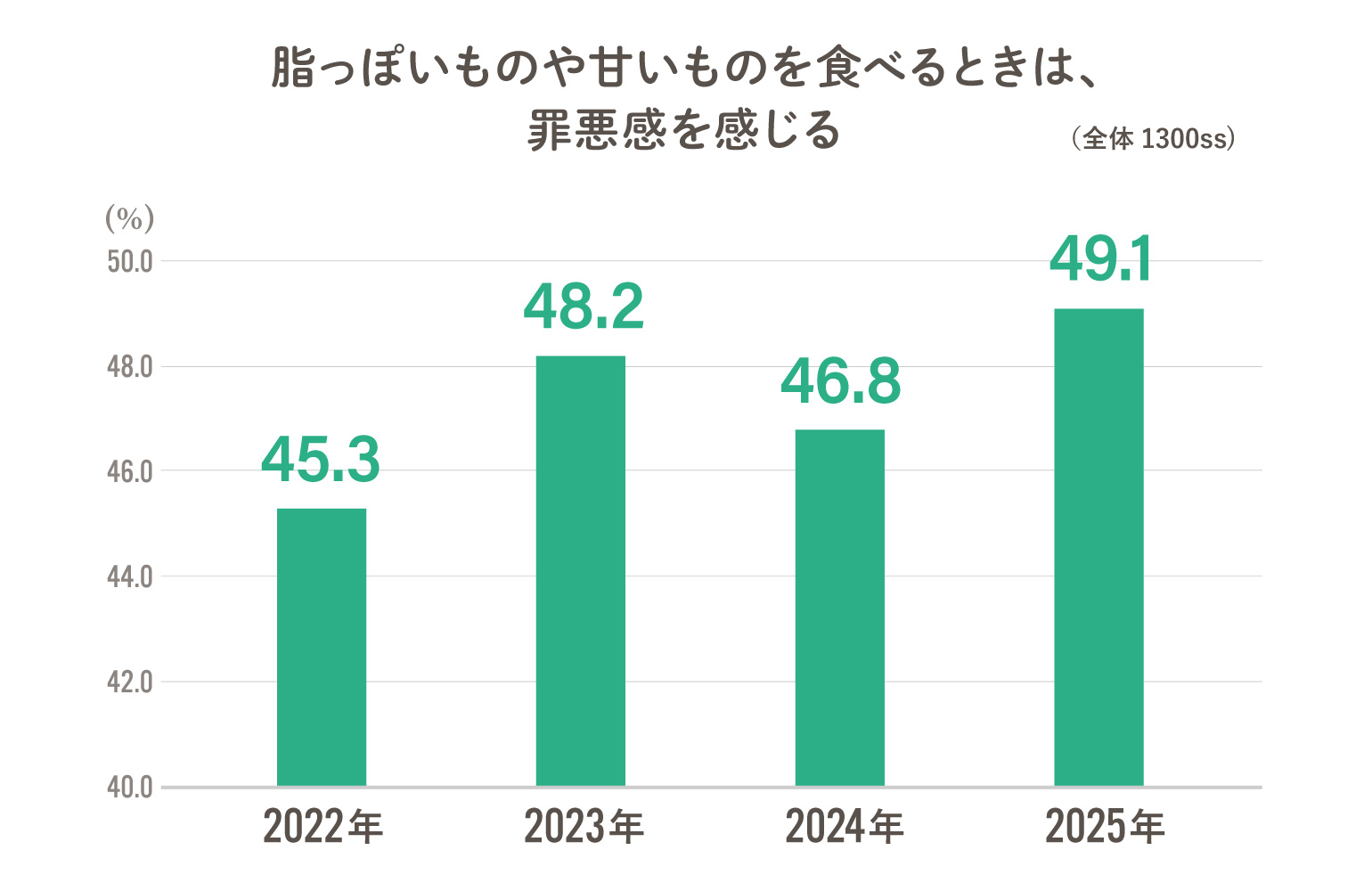
Although resistance to substituting meals with convenient snacks or light meals is declining, people still want to avoid the physical burden and guilt associated with such choices. This contradictory mindset is becoming increasingly entrenched. In response to this conflict, “meal-flavored snacks” and “snacks designed to provide the satisfaction of a full meal” have emerged.
For example, we’ve seen the emergence of rice cracker snacks that taste like fried rice, soup-flavored pastries, and, in the fast-food sector, hot snacks that are easy to eat and not overly filling.
Products that, while technically snacks, can create the “feeling of having eaten a meal” allow consumers to enjoy convenience while reducing psychological stress and guilt. By 2026, such products began appearing on the market in rapid succession, and the trend of accepting them not merely as indulgent treats but as “meal replacements” or “bridge meals” until the next meal accelerated dramatically.Consumers, while harboring conflicting emotions, are finding choices they can personally accept and are driving the expansion of the “0.5-meal market.”
What They Seek Is “Balance” and “Experience”
At first glance, modern eating habits may seem to reflect a waning interest in food and a trend toward simplified meals. However, research from the Food Lab reveals that consumers are not abandoning food altogether; rather, they are adapting the roles they expect food to fulfill depending on whether it is a weekday or a weekend.
Weekday Meals
The “Seeking Gentleness in Meals” score tends to be higher on weekdays than on weekends. This suggests a desire for “foods that are gentle on the body, mellow, and reassuring” and “dishes designed to be easy to eat.”
Weekend Meals
The “Seeking Enjoyment in Meals” score is higher than on weekdays, with a particularly noticeable difference of +3.2 points for breakfast and +3.6 points for lunch. On weekends, it appears people are seeking “fun and stimulation,” such as “I want a meal that lifts my spirits” or “I want a meal that satisfies my mind by engaging all five senses.”
The Shoku Lab survey revealed differences in the emotional needs associated with meals on weekdays versus weekends. On weekdays, there is a tendency to seek “gentleness”—meals that place no strain on the body or mind—to ensure that work and daily life run smoothly. On the other hand, on weekends, there is a tendency to seek stimulation that satisfies the five senses and experiences that lift one’s spirits.
For consumers, eating is not simply “the act of putting food in one’s mouth to satisfy hunger.” It is viewed as an overall experience—including the meal itself—that encompasses how one spends that time and what kind of mood one achieves.
The same can be said for “0.5 meals.” While a “0.5 meal” is the act of eating a lighter meal, it does not mean completely giving up the enjoyment or satisfaction of eating. Rather, it is becoming established as an option for consumers to adjust the amount they eat, the timing of their meals, and their level of satisfaction based on their current physical condition, schedule, and level of hunger. As “0.5 meals” become more widespread in daily life, the values sought in food and services will continue to evolve.
“0.5 Meals” Offer Greater Freedom—A New Perspective for Products and Services
Snacks, which were once eaten simply to satisfy a slight hunger, have evolved into “supplementary meals” that bridge the gaps between main meals, establishing the “0.5-meal” style. Going forward, “0.5-meals” are expected to move even further toward “self-customization based on the situation.”
The very concept of how to allocate one’s total daily food intake is becoming more flexible. Moving away from the traditional fixed notion of “one full meal × 3 times a day,” consumers will likely emerge who distribute their intake—such as “0.5 meals × 6 times a day”—to match their own activity rhythms and physical condition. Along with these changes in eating behavior, we may gain new insights into “strategies” and “product design” within the food, distribution, and marketing sectors.
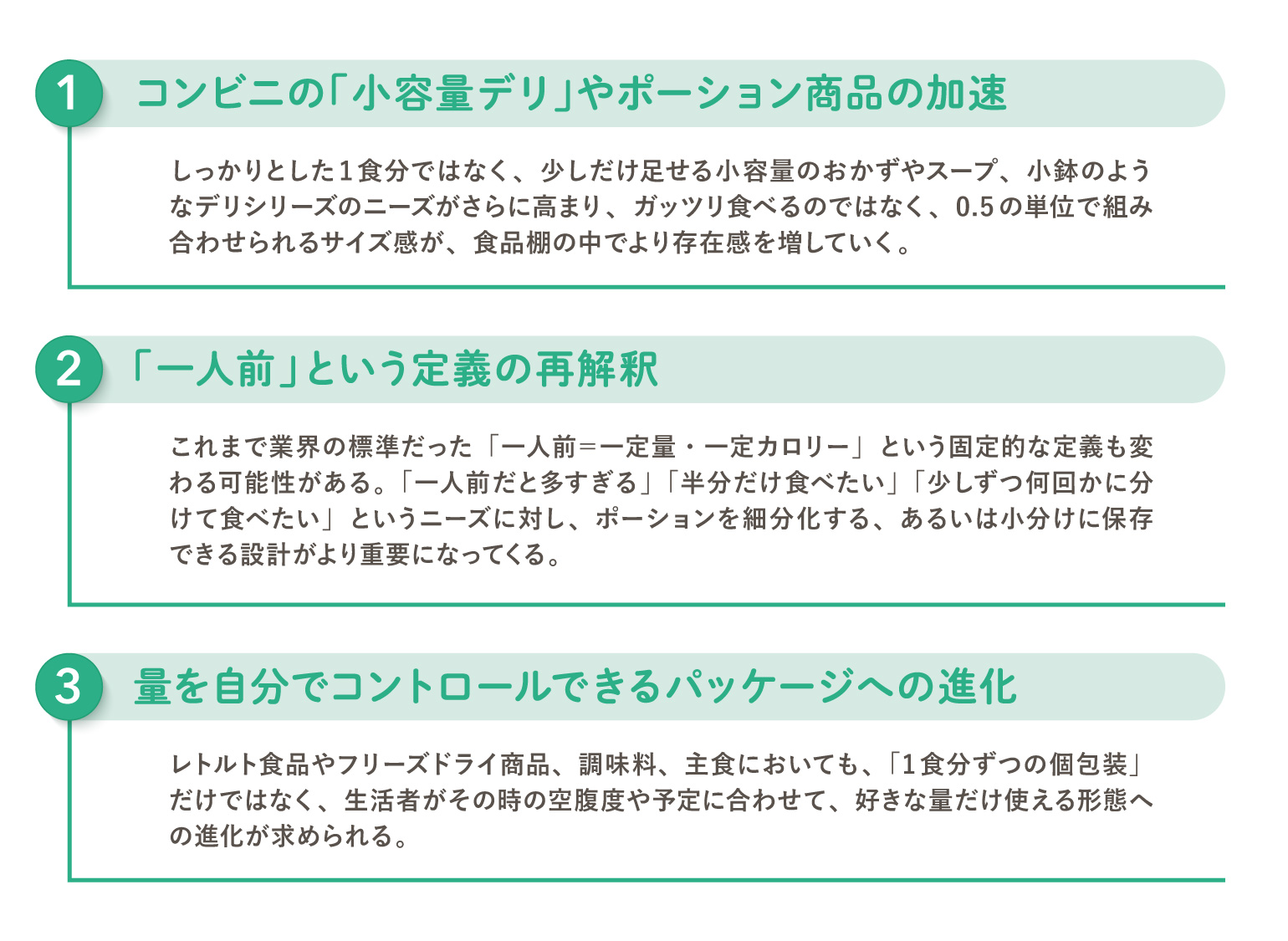
Rather than having companies dictate meal timing and portion sizes, the key question is how to design the flexibility that allows consumers to adjust these factors themselves. This will undoubtedly become a crucial perspective for future product development and store layout design.
Consumers are beginning to “redefine” their eating habits
“Half a meal” is not so much a haphazard approach to eating as it is a new way of thinking—one that allows people to flexibly design a dining style that feels comfortable for them, tailored to their current lifestyle, without being bound by corporate classifications or the rigid rule of “three meals a day.”
It means discarding old preconceptions and wisely reconfiguring one’s eating habits to fit one’s lifestyle. It’s not about affirming the act of not eating, but rather affirming the act of eating in a way that suits you, even if only slightly. It’s about not striving too hard for the “perfect meal,” but rather having options that are just right for who you are right now. We believe that capturing this flexible shift—as consumers “re-edit” their eating habits—will be crucial for the future of the food business.
[2025 Consumer Survey on Eating Habits: Survey Overview]
・Purpose: To understand consumers’ attitudes, actual practices, satisfaction levels, and trends regarding dietary habits in Japan
・Target Area: Nationwide
・Eligibility Criteria: Ages 15–79
・Sample Size: 1,300
・Survey Method: Online survey
・Survey Period: September 2–4, 2025
・Survey Organization: Dentsu Macromill Insight, Inc.
Was this article helpful?
Share this article


Newsletter registration is here
We select and publish important news every day
For inquiries about this article
Author
Yuki Obayashi
Dentsu Inc.
Marketing Division 4
Communication Planner / Director of the Food Lifestyle Lab