Note: This website was automatically translated, so some terms or nuances may not be completely accurate.
 So, how exactly do you put service design into practice? [1/4]
Practical Service Design: An Overview from a Field Perspective
Every day, somewhere in the world, new services are being born.
But why is it that even when talented businesspeople and brilliant engineers gather and hold countless long meetings, the service often ends up deserted once it's finally launched?
On the other hand, in an era where anyone can easily provide services simply by riding on a platform, new services that surprise the world or even change it are sometimes created by loose teams that aren't even formal corporations, or even by a single high school student.
Where does this difference come from?
Resolving this question is precisely the purpose of this series.
We live in an era where a presentation by a guy in a T-shirt and jeans can completely transform the rules of a game or the ecosystem of services running on smartphones overnight. The turnover of services used in users' daily lives is incredibly rapid, and the number of staple services that continue to be used by many people can be counted on one hand.
In an era where ten weeks feel like a decade, it's no longer wise for companies to pursue only "functional realization." They must shift their perspective, reframing their business around the "values" customers seek.
Furthermore, as exemplified by the launch of iTunes for the iPod, the experience doesn't end with the purchase of a product. What support is available afterward, and what benefits come from using it alongside other services, are increasingly important to users.
In line with this shift toward a user perspective, companies are also moving their focus away from how to sell their products as standalone items and toward what context and value they provide within the overall service ecosystem.
This is where service design comes into focus. It's an approach that uses design thinking techniques like visualization and prototyping to unlock competitiveness and innovation in business, aiming to design the value a company delivers.
The fundamental flow of service design is broken down into four major phases:
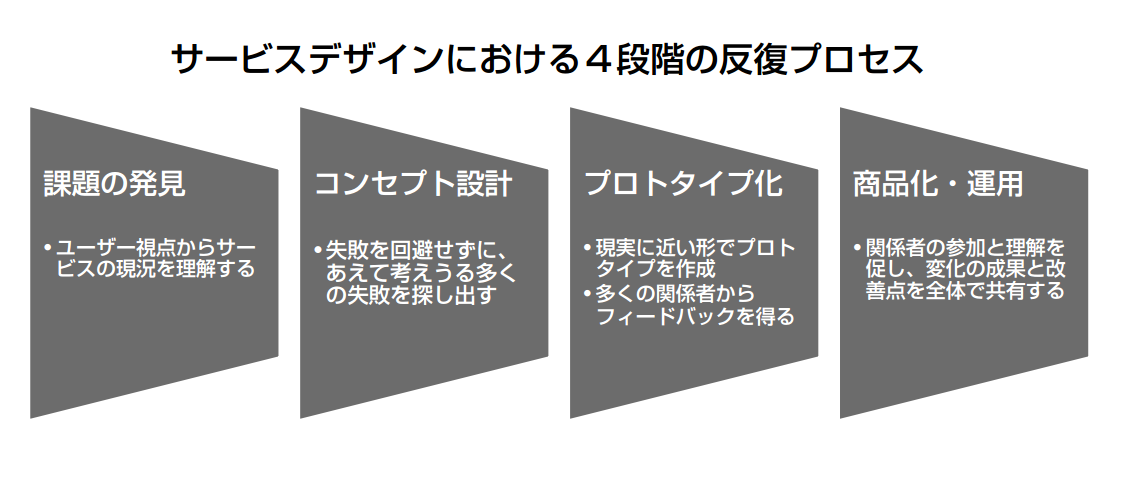
This process is broken down into four major phases. The mission of the service development team is to iterate through these processes, thereby increasing the likelihood that the service will grow within the market.
In this series, we will explore practical techniques applicable in real service development settings across each phase of service design. Over the next five installments, we aim to present these concepts with as many real-world examples as possible.
Why You Should Stop "Wai-Gaya Meetings"
If talented people gather and spend long hours in meetings yet the service's problems remain unsolved, it's better to conclude that the discussion isn't lacking—the problem being discussed is fundamentally wrong.
At the conceptual stage, how users will perceive any service is purely speculative.
For example, before the iPhone existed, almost no one said things like, "I want a touchscreen mobile phone with an MP3 player." Even if you interview users about what products or services they'd like to see, when it comes to products or services that don't yet exist in the world, users themselves often can't articulate the need.
Therefore, to holistically design a service—from its initial development to how it communicates with the market—it's insufficient to rely solely on quantitative surveys to explore the demographics and needs of assumed users, as was traditionally done.
To truly discover problems, a user-centered approach is crucial. This involves first clearly defining who the end users are, then building relationships with them where they willingly share insights—including seemingly unrelated information—and finding a common language with them.
The following methods are effective for achieving user-centered service design.

If you want to increase the likelihood of service success, it might be wiser to spend your time listening to diverse users and creating as many prototypes as possible, rather than devoting time to vague, closed-door meetings with the same members.
However, it is crucial not to misunderstand this: using "user-centered" as an excuse to ignore the client company's intentions or to downplay meetings with them is not acceptable.
Rather, since we are collaborating on service development, we should view the client company as one of the most important stakeholders in the process. We must thoroughly explain the prototypes and service concepts we create not only to the client's marketing and business development sections but also to people in diverse departments involved in service implementation, actively gathering their feedback.
Why Advertising Agencies Should Engage in Service Design
It has long been difficult to generate added value simply by "broadly communicating" as the two characters "advertising" suggest. For companies aiming to maximize profits by offering multiple products and services, merely refining the effectiveness of mass promotions for specific products only provides localized business support. To use an analogy, if a client company wants to create delicious New Year's cuisine (osechi ryori), offering a solution that only relentlessly improves the quality of the chestnut paste (kuri kinton) is clearly insufficient.
In my personal view, a company's service design process and its mass advertising promotions should be closely integrated, ideally executed by the same entity. If any factors hinder this collaboration, they must be eliminated immediately.
After all, proactively investing in people's needs and developing messages that can stimulate those needs is the core business of advertising agencies.
With the rise of SNS enabling end-users to interactively exchange vast amounts of information, and the acceleration of IoT (Internet of Things) causing objects themselves to dissolve into the sea of information, message development is no longer necessarily confined to mass-market methods. For advertising agencies, developing solutions in the service design domain will become increasingly important going forward.
Starting next time, we will introduce frameworks we actually implement in the field. First, we will touch on "problem discovery," the starting point of service design.
Was this article helpful?
Share this article


Newsletter registration is here
We select and publish important news every day
For inquiries about this article
Author

Yamato Watanabe
Dentsu Inc.
Dentsu Inc. Innovation Initiative