Note: This website was automatically translated, so some terms or nuances may not be completely accurate.
 So, how exactly do you put service design into practice? [3/4]
Peer-to-peer money transfers, college girl blogs... What on earth is happening?
Previously, we explained the shift in thinking toward an experience-value-focused approach that prioritizes the service usage environment and the relationship with users.
This time, we analyze examples from a service design perspective that have grown by leveraging high experiential value on smartphones, while inheriting universally applicable core functions. The key takeaway from the cases we present is the importance of considering the user's situation when experiencing the service and focusing on their emotional value.
Rather than starting from surface-level functions and working backward to design, we hope this approach—measuring ideas against the yardstick of user experience value and emotional value—will serve as a reference for service idea development.
Needless to say, a major trend surrounding services since the 2010s has been the increasing smartphone penetration rate. As smartphone usage grows, tool applications that augment individual capabilities have proliferated, leading to market maturation. Within this flow, services and functions previously provided by established corporations are increasingly being replaced by providers offering "services adapted to the smartphone environment."
Banks in the Smartphone Era? Peer-to-Peer Money Transfer Apps Expanding in the US
Recently, IT innovation originating from startups has been gaining momentum in the financial sector both domestically and internationally. These emerging financial-IT services, known as FinTech, are rapidly increasing their share of top venture capital investments in the US, both in terms of the number of deals and investment amounts.
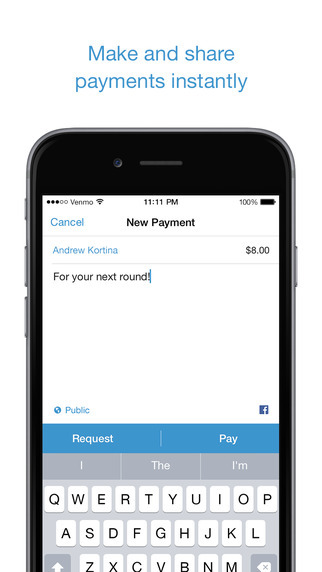
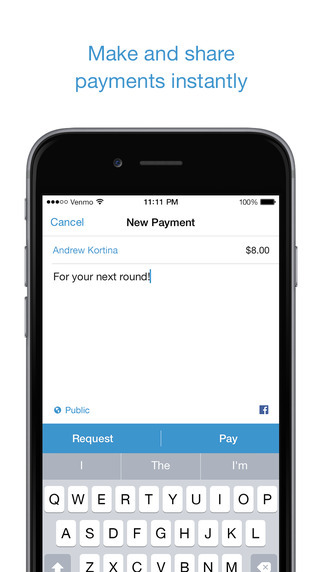
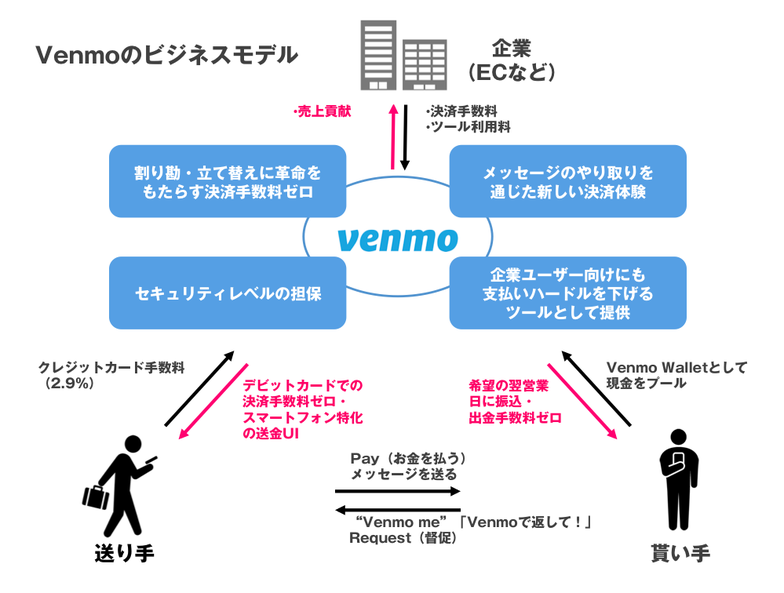
Amid this trend, are you aware that a peer-to-peer payment app called Venmo is rapidly spreading across the United States? Venmo is a smartphone app that allows users to easily send money to each other with no fees. When requesting payment, users can smartly follow up with a single button press.
For instance, Venmo shines in situations everyone has experienced: when a group goes out for a meal or drinks, one person pays upfront and everyone splits the bill later. It's said that among young Americans, it's now commonplace to see the person who covered the bill simply say "Venmo me!" to the others, prompting everyone to pull out their phones, open the Venmo app, and send the payment. Even if someone doesn't have Venmo yet, they can start using it immediately without going through a cumbersome registration process. Coupled with the powerful incentive of zero transaction fees, this naturally drives the service to go viral. It's a prime example of a service design that incorporates its own growth engine.
Indeed, Venmo, launched in March 2012, has seen phenomenal growth. While user numbers remain undisclosed, its mobile payment volume in the US for Q2 2014 reached $468 million, a staggering 347% increase compared to the same period the previous year.
Venmo has achieved such rapid adoption by effectively adapting to the environment of widespread smartphone use and skillfully redefining the value proposition offered by banks and wallets.
The giant bulletin board that failed to adapt to the smartphone shift
Conversely, an example of a service that failed to successfully adapt to the service environment created by smartphone proliferation is "2channel." Once a massive bulletin board, it was where opinions on nearly everything—from companies and products to individuals—were posted daily. Many users found a thrill in browsing the countless anonymous, scathing replies and became immersed in a world where witty comments were revered as "god-tier."
However, factors like the inherent culture of disliking and avoiding posts from mobile devices (which were considered hard to read) and the long-term restriction on posting from iPhones—which became dominant in Japan's smartphone market—significantly diminished the experiential value of posting on the board. This likely led to a decline in content quality. As even users who only read threads left, the service's decline accelerated.
While the rise of summary sites in the 2010s facilitated thread archiving, examining the dates of articles labeled "famous threads" or "famous copy-pastes" reveals that, aside from current events, many date from before 2010. This clearly indicates 2channel's delayed adaptation as a smartphone service.
Illustrations in the smartphone era: Originality > Quality
An example of text content that partially captures the experiential value 2channel once offered—such as the fun of anonymity and sharp-tongued comments—in a form suited to the current service environment is the blog "Idle College Girls Trying Stupid Things."
While the highly interactive aspects of 2channel's nature have been functionally differentiated into services like Twitter, most users are fundamentally ROMs (Read Only Members, users who read others' posts without writing themselves). Therefore, in terms of functionality, the original features provided by blogs suffice. Illustrations are highly valued as a driver to further spread this type of readable content. Illustrations make content easier to convey and more likely to be shared on personal social media. However, since most users read content on smartphones, the quality threshold for illustrations tends to be lower compared to viewing on wide PC screens. What's valued instead of quality is uniqueness. Amidst the rise of viral media and an environment where text-only blogs can be easily plagiarized, the "Idle College Girl Blog" secured its unique originality online. It achieved this by humorously depicting various everyday occurrences through distinctive, surreal illustrations that didn't prioritize technical skill. Last year, it became a major social media sensation and gained a large following.
Was this article helpful?
Share this article


Newsletter registration is here
We select and publish important news every day
For inquiries about this article
Back Numbers
Author

Yamato Watanabe
Dentsu Inc.
Dentsu Inc. Innovation Initiative