Note: This website was automatically translated, so some terms or nuances may not be completely accurate.
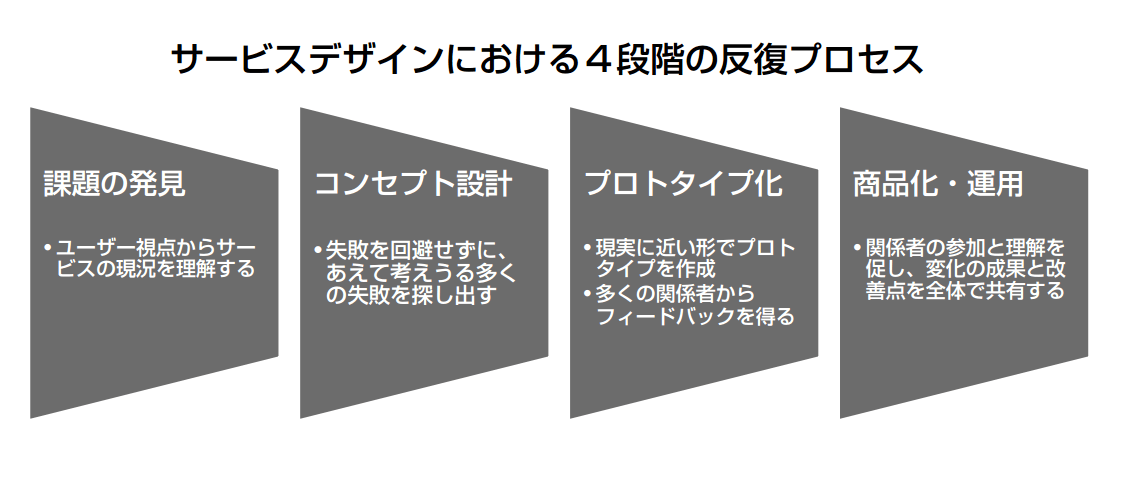
 So, how exactly do you put service design into practice? [2/4]
Three Key Points for Identifying Challenges to Create Something from Nothing
Last time, I wrote about the "overview" of service design. This time, the theme is "problem discovery," which is extremely important for laying the groundwork before service design.
When designing services that don't yet exist in the world, the problems are often unclear. In such cases, quantitative research like simple surveys alone won't yield insights. It's vital to gather developers, target users, and other stakeholders for workshops to accumulate qualitative data, test ideas, and identify problems.
However, the reality is that in many cases, teams face significant challenges implementing such "qualitative research" and are honestly struggling through trial and error.
Personally, through my involvement in various workshops for qualitative research, I've experienced numerous failures and made corresponding improvements—such as not receiving the desired feedback, over-facilitating and introducing bias, or discussions veering off into product design or minor features, causing the conversation itself to become unfocused. From these experiences, three key insights for identifying service challenges have emerged, which I'd like to share.
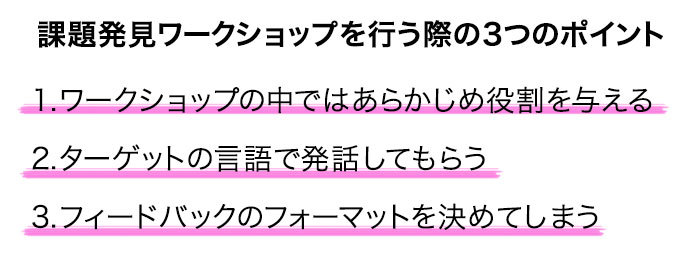
1. Assign roles in advance during workshops
Even in qualitative research workshops, people tend to unconsciously get caught up in their job titles or positions. This can lead to biased comments or discussions being steered by the loudest voices, preventing constructive progress. To prevent this, we pre-assign and rotate roles among participants.
For example, when I previously conducted a workshop with student groups to identify challenges in youth-targeted initiatives for a web service, I had different members serve as facilitators for each group during the early, middle, and late stages. This rotation of discussion leaders aimed to diversify perspectives. This reduced the risk of becoming fixated solely on the problem awareness of vocal students or those coincidentally knowledgeable about peripheral issues. As a result, we gained numerous insights into universal challenges in youth-targeted initiatives, aligning perfectly with the service development team's objectives.
2. Have participants speak in the target language
In service design practice, when structuring experiences related to a service across diverse touchpoints, customer journey maps are often created for organization. This requires fully adopting the service user's perspective to imagine and describe their emotions, which can be quite challenging.
For example, in a qualitative study with a manufacturer, we had the research targets freely use a product mockup while speaking aloud. We then recorded their conversations and had them create their own customer journey maps. By having the targets articulate their interactions with the service and their emotions in their own words, we gained valuable insights. This approach revealed challenges from perspectives the developers hadn't anticipated. Since the product was in a field not yet existing in the market, conventional questionnaire surveys couldn't provide insights. However, eliciting the participants' own verbal expressions became a key hint for discovering issues.
3. Fixing the Feedback Format
Relying solely on the common workshop approach of distributing sticky notes and having group discussions can lead to problems. It often results in lists of vague, non-specific words, or discussions that merely describe phenomena without laddering up to the core desire value. This can negatively impact the accuracy of subsequent analysis.
To prevent this, while still having users articulate the core aspects of the problem, using a pre-prepared format (e.g., aiming to fill in the X and Y in "This is a service that solves the X problem by Y") prevents scattered outputs. This enables obtaining consistent, comparable feedback.

Scene from a problem discovery workshop
Furthermore, during workshops with clients to identify service challenges, feedback can sometimes be startling for those in advertising sales or planning roles. For instance, in the web service example mentioned earlier under point 1, a medium perceived as having long information dwell times was found, through diary-style research (*), to be merely a vehicle for short-term information consumption among younger demographics. This revealed the need to rethink the medium's characteristics. However, even when such discoveries occur, it's crucial to maintain perspective—recognizing that risks were mitigated before the service launched—and to have the courage to open Pandora's box. This mindset is indispensable, especially when developing services that incorporate new technologies or concepts.
*Diary-style survey: A research method where participants record their time usage over a set period, similar to a schedule, noting how they spent their time, which information media they engaged with, and which apps they used.
New concepts that change societal or industry norms usually appear in the form of an ugly duckling.
For instance, just a few years ago, when "Social Networks" represented by Facebook and Twitter were at the peak of the hype curve, some tech-savvy individuals enthusiastically proclaimed them "the next-generation marketing tools." However, success stories were still scarce, and for many, they were perceived as a novelty concept lacking concrete facts.
Now, however, there's no need to redefine what "social" means. Ignoring Facebook or Twitter in marketing is almost unthinkable, and most corporate initiatives involving consumer touchpoints incorporate some form of social element.
Similarly, I believe that in time, the term "service design"—currently used as a buzzword—will lose its special resonance, and service design thinking will become ubiquitous.
Was this article helpful?
Share this article


Newsletter registration is here
We select and publish important news every day
For inquiries about this article
Back Numbers
Author

Yamato Watanabe
Dentsu Inc.
Dentsu Inc. Innovation Initiative