Note: This website was automatically translated, so some terms or nuances may not be completely accurate.
 How to Find That One Phrase [9/10]
We don't follow the predicted route.
"Mito Kōmon" is a period drama with a solid format: each episode features villains appearing at a travel destination, someone in distress, the Kōmon-sama punishing the villains, and the inro (seal case) appearing around the 45-minute mark.
Once, a director condensed an episode into two hours, splitting it into a two-week miniseries. This led to a flood of complaints from elderly viewers. The reason? "I don't know if I'll still be alive next week, so stop with the 'to be continued'!" That's how much the consistent content and timing of each episode became a strangely compelling draw for viewers.
If you stick to the same timing for the inro reveal this consistently, you'll get that "I've been waiting for this!" reaction.
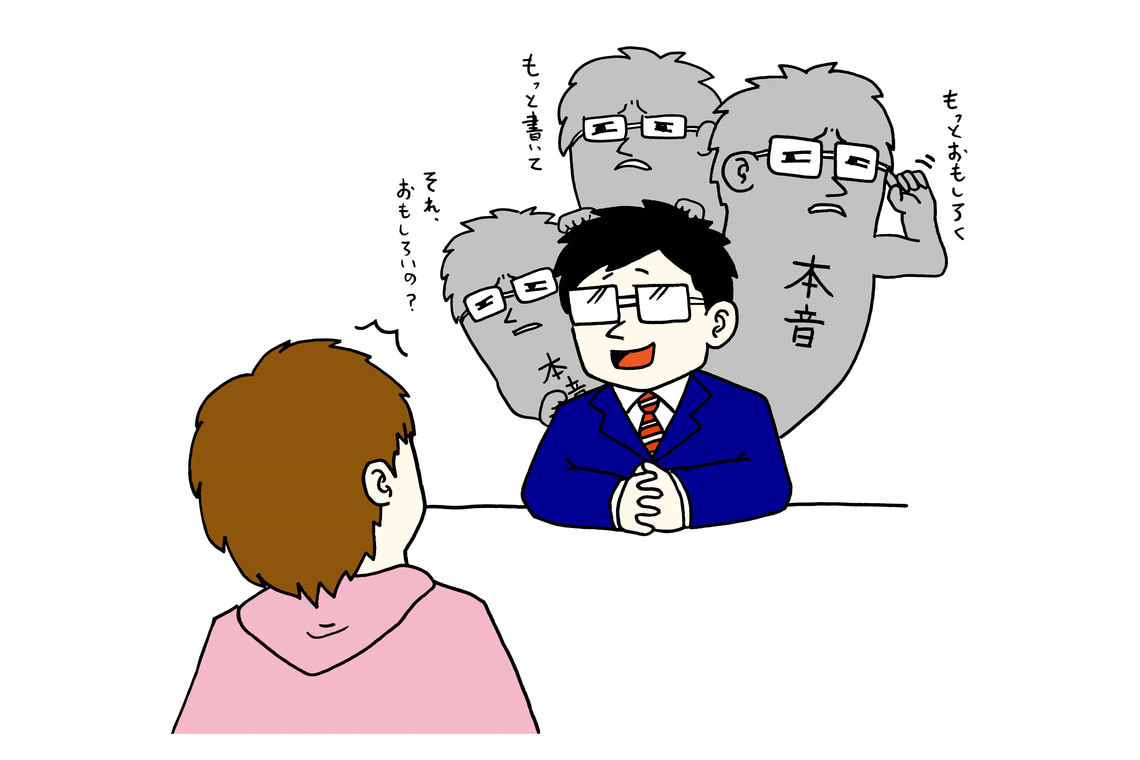
On the other hand, in advertising, where communication must be even shorter, people absolutely won't pay attention to a punchline that makes them think, "Ah, so that's how it ended." Avoiding "predictable developments" is the first thing you should check when planning a campaign.
For instance, no one would read a story titled "Two Lovers Married Safely Without Any Incidents" all the way through. Amidst all the interesting stories out there, people simply won't pay attention to such a mundane tale.
But what if that's the kind of story requested? How would copywriters or CM planners approach it?
They might start with the most interesting part (like opening with the couple suddenly fighting and breaking up), or take it to extremes (like facing opposition from both sets of parents and losing their jobs). They'd experiment and refine the story through trial and error. This allows them to deviate from the audience's expected path.
Once that's done, they focus on the details.
For a breakup scene, ideas flow: do they break up after a fight, drift apart, or part ways through letters? The story evolves into something complex and compelling.
I once watched a documentary film called 'The Secret of El Bulli: The World's Most Difficult Restaurant to Get Reservations At'.
El Bulli is a restaurant located in a picturesque cove overlooking Cala Montjoi in Catalonia, Spain. Led by Ferran Adrià, hailed as the world's greatest chef, it had a mere 45 seats yet received 2 million reservation requests annually—said to be harder to get into than winning the lottery. It operated only from April to October, with Adrià and his chefs dedicating the remaining six months to developing and researching new menus.
The cuisine itself consists entirely of dishes you've never seen before. Known as "molecular gastronomy," it specializes in unique cooking techniques, such as using liquid nitrogen to freeze ingredients instantly.
Dishes like the "Mojito Caipirinha" – a stick resembling burdock root that oozed rum when bitten into – the "Vanishing Ravioli" – oblate sheets (used in Japan to wrap powdered medicine) arranged ravioli-style – and the "Mint-Flavored Lake of Ice" – eaten by chipping away at an ice bowl with a spoon – were more like artworks than food, truly astonishing.
At that moment, I deeply felt that the world of cooking and the world of copywriting are the same.
The bottom line is, you have to defy people's expectations. You have to start by surprising them; otherwise, they won't even turn their heads. That's why you must constantly keep surprising them.
El Bulli never started from the assumption that "this is what cooking is all about." They pursued new cuisine through a rigorous cycle: opening the restaurant for six months, then spending the remaining six months completely rethinking the menu.
That process of "rethinking and examining from every angle" might be the foundation for defying expectations.
Chef Adrià reportedly closed his Michelin three-star restaurant, stating he had "lost sight of his own cuisine," and instead founded a culinary research institute. Innovation seems like a word made just for him.
Illustration: Shinpei Takashima (Dentsu Inc., Creative Planning Division 4)
Was this article helpful?
Share this article


Newsletter registration is here
We select and publish important news every day
For inquiries about this article
Back Numbers

Author
Yosuke Watanabe
Dentsu Inc.
4th CR Planning Bureau (on assignment to Dentsu Inc. Isobar)