
Note: This website was automatically translated, so some terms or nuances may not be completely accurate.
 The schemer plots three times [10/13]
The standard of "I would move"

Satoshi Umeda
All projects are born from the ideas of the planner and their team. What I consider crucial is having the standard: "Would I take action if I were a consumer?"
What I want to explain here is the responsibility of those who create projects.
In reality, when a project or idea is adopted and implemented, numerous people across the organization become involved. The larger the scale, the greater the costs and risks the company bears. I believe it is essential to judge for yourself whether the project you are proposing has reached a quality level that justifies taking on that risk. It absolutely cannot be based on self-serving reasons like "I like it" or "I want to do it."
I even believe this standard for the planner should be treated as equally important as objective measures like survey data.
Planners are also consumers
For the "I would do it myself" standard to function, it ultimately depends on whether you yourself are living well as a consumer. In that sense, I believe future planners must not only be consumed by work but must also live perfectly ordinary lives.
It's not about work-life balance, but rather that while there may be switches for work mode, home mode, play mode, etc., within the individual, all these modes are seamlessly connected.
For example, while I create advertisements professionally, I'm also a consumer influenced by ads who buys products. Commuting, I ride trains and see hanging ads and door stickers.
When I get off at the station, I glance at station posters and large street-side displays, sometimes getting inspired. At the convenience store, I reach for my usual products, and during breaks, I sip canned coffee while scrolling on my smartphone.
These experiences and feelings as a consumer unconsciously feed back into my planning, naturally incorporating the spirit of the times.
This, in turn, cultivates the planner's perspective. Needless to say, doing this consciously makes it even more effective.
"Would I be moved? Would it grab me? And would I buy the product?"
Cultivating these personal standards is what elevates the quality of your work.
"Internal brainstorming" enhances planning precision
We'll also introduce a concrete method for applying the zeitgeist you've absorbed to your planning.
That method is the "solo brainstorming session."
Plans and ideas are fundamentally created alone, and both quantity and quality depend on how much time you can spend thinking by yourself. However, when thinking alone, your thoughts inevitably stall or fail to break through.
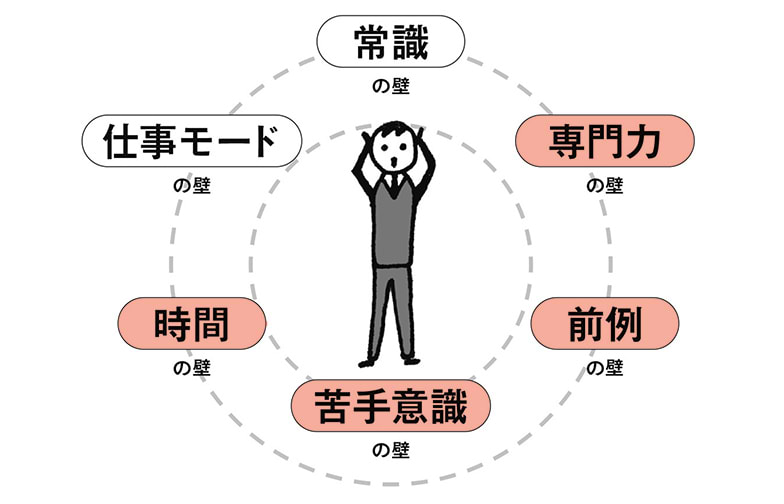
You might also find yourself stuck behind the invisible walls that block your schemes ( Part 1 & Part 2 ).
That's where the Solo Brainstorming Session comes in. It's a method where you consistently handle everything from ideation to discussion, feedback, and refinement all by yourself. Here's an overview:
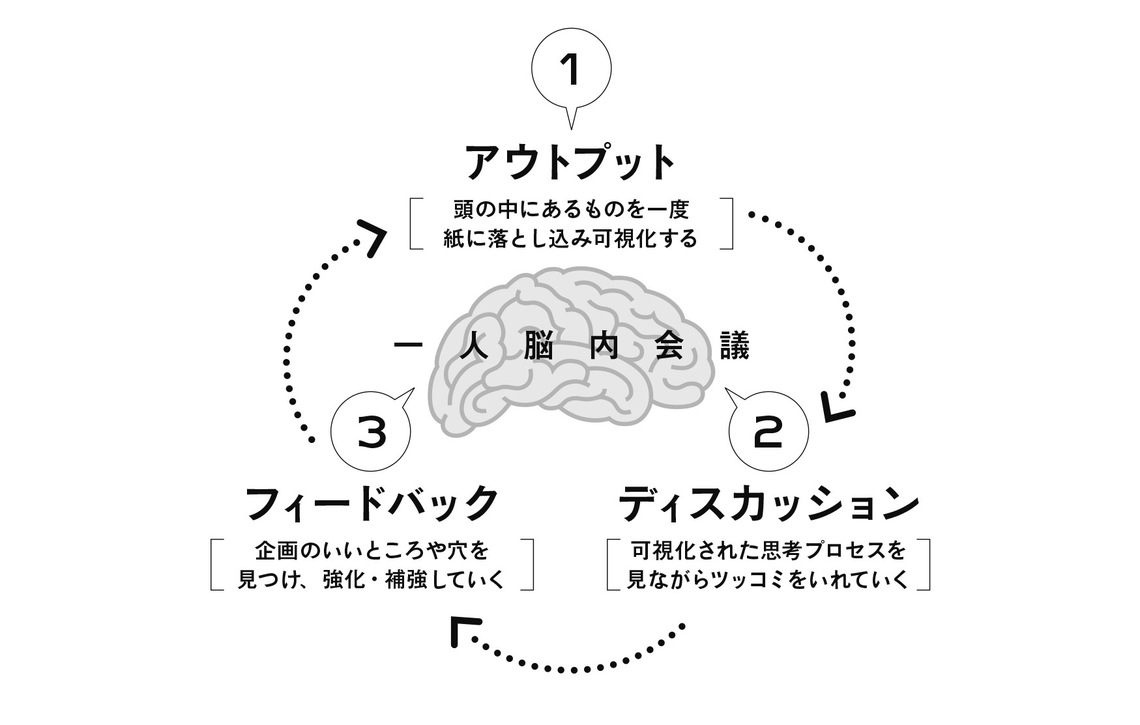
① Output
Think, expand ideas, and translate them into plans. Visualize everything in your mind.
② Discussion
Review the thought process laid out on the table and challenge it from various perspectives.
③ Feedback
Recognize the strengths and weaknesses of the plan, deepen your thinking further. Improve the precision of the plan.
The most crucial step is ② Discussion. To hold this discussion, virtual attendees are needed.
In my case, I invite my department seniors and juniors, respected colleagues from other departments, clients, as well as my everyday self going about daily life, family, and close friends to attend. Of course, since they are virtual, location and time are flexible.
First, I explain the plan to all participants using materials. Out loud, of course. This helps organize my thoughts and reveals immature parts or gaps in my explanation.
Then, each participant writes their opinions on sticky notes and posts them.
This allows you to gain an overview of the perspectives of colleagues, clients, and end-users.
Of course, a plan that satisfies everyone is impossible. Where to focus on improving next is something you should decide for yourself.
But one thing is certain: holding a solo brainstorming session dramatically increases others' understanding of your plan, your own level of satisfaction, and its alignment with the times.
Then, a delicate plan forms a thick trunk, growing strong enough to withstand even harsh criticism without flinching.
This wall-punching-like activity is extremely effective for taking ideas that were just "Ah, I see!" and adding "No way!" or "Wow!" to create "Oh, that's how it is!"
Book now on sale! Details here

Was this article helpful?
Share this article


Newsletter registration is here
We select and publish important news every day
For inquiries about this article
Back Numbers
Author