Note: This website was automatically translated, so some terms or nuances may not be completely accurate.
 PR Transforms Communication: Insights from the Latest Trends in the U.S. [1/2]
Elise Mitchell × Kazutake Hiramatsu (Part 1): Key Terms for Understanding the Latest Trends in the American PR Industry

Elise Mitchell
Mitchell Communications Group

Kazutake Hiramatsu
Dentsu Inc.
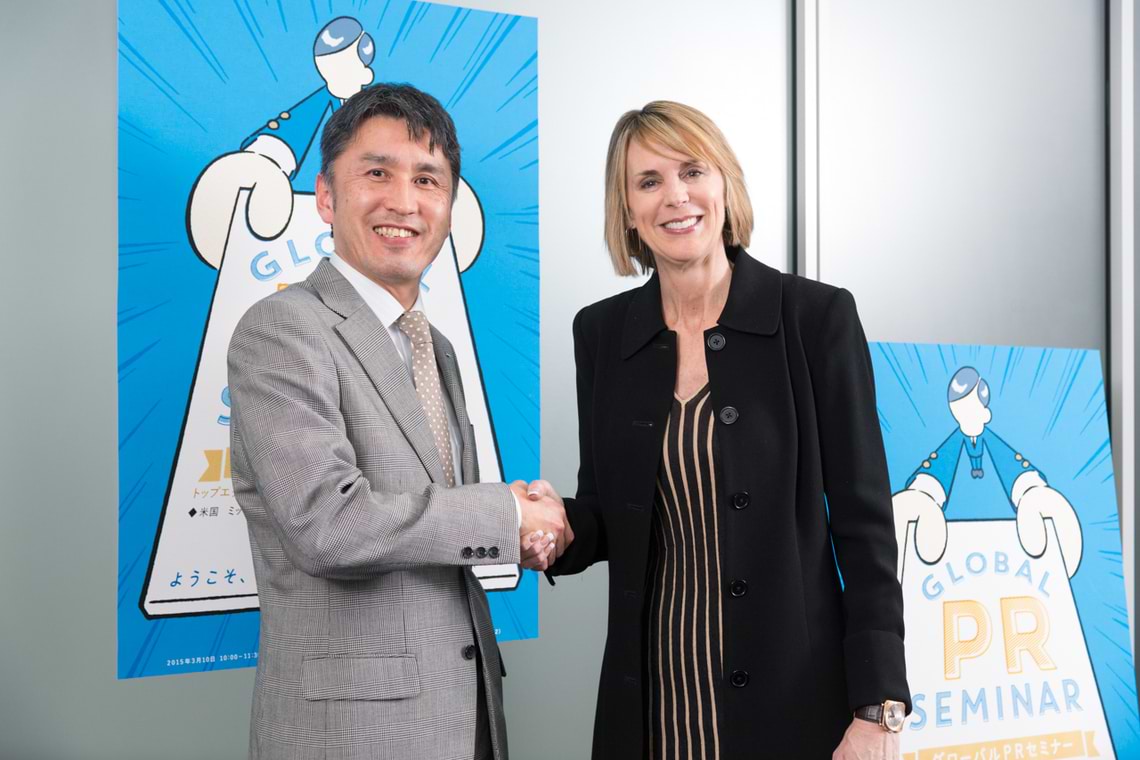
The dramatic evolution of digital media, including social media, has completely changed consumer awareness and behavior. A new era has arrived for PR strategies that connect companies and brands with consumers. Kazutake Hiramatsu, Director of Dentsu Inc. iPR, invited Elise Mitchell, CEO of Mitchell Communications Group, a leader in the American PR industry, to exchange opinions on the latest PR trends in the United States. This interview will be presented in two parts.

Insight and Story: The Keys to Global PR
Hiramatsu: It's been three years since Dentsu Inc. established its iPR division. I've been with this division for two and a half years, and I'm amazed at how quickly things change. After six months, what we thought was cutting edge is already outdated. This means that the services we provide must always be cutting-edge solutions. To achieve this, we need to constantly arm ourselves with the latest marketing methods. Mitchell Communications Group and the iPR Division collaborate on a daily basis, and recently the number of projects has increased dramatically. Against this backdrop, I would like to ask you about current PR trends in the United States.
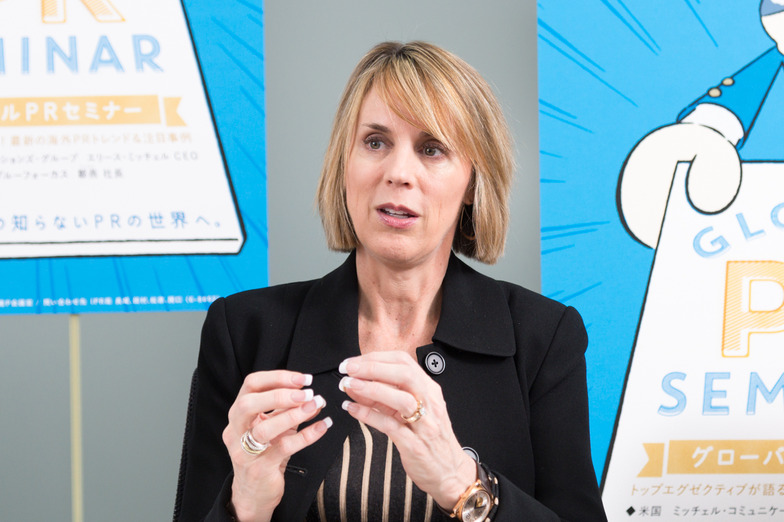
Mitchell: First, there's the word "insight." It's becoming very important to accurately understand consumer psychology: what consumers want from brands and how they feel about them. Recently, various analytical methods and tools for exploring consumer insights have emerged, allowing us to obtain information that was previously unimaginable. In addition to market and consumer data, data on competitors can also be easily obtained by registering online. We can use this information to determine our strategy toward consumers.
Of course, simply acquiring data isn't enough. Based on that data, we must delve deeply into the issues. We need to ask ourselves "So what?" and "Now what?" So what? What is truly important for our brand? Now what? What should we do next, and how? What could be a creative idea for our brand? We must thoroughly consider these points.
Another key trend is content storytelling. Clients are highly interested in what today's consumers are genuinely interested in and find truly compelling. While this information is essential for building content strategies, storytelling becomes a crucial element when communicating based on it. However, this isn't about fabricated stories; it's about stories that reflect real life, the authentic reality of the world. We take pride in leading the PR industry because we've consistently delivered compelling storytelling. What's needed now isn't fabrication, but authentic, trustworthy stories grounded in real life.
Identifying Influencers
Hiramatsu: Are there any other important keywords when building a content story?
Mitchell: Influencers who have an impact on other consumers are also key. Do you need celebrities posting on YouTube, or bloggers who are fashion leaders? Our strength lies in our expertise in selecting such influencers.
Closely related to content strategy, we need to recognize the evolution and growth of "digital" and "social communication" as important trends. Clients are also increasingly willing to increase their budgets for this purpose. Digital encompasses various themes, such as web development and digital asset management. Campaigns are frequently conducted through social media, and platform building is also thriving. As PR professionals, we strongly feel the need to further deepen our knowledge of digital communication and raise our skills to the next level.
Hiramatsu: Listening to Mitchell, I get the impression that you are quite ahead of Japan. In Japan, it is rare to conduct in-depth consumer insight research for PR purposes, and it is common to simply use advertising research. Regarding content, I feel that the methodology for how to disseminate it is still in its infancy.
Historically, Japan has not had the same diversity as the United States, both in terms of ethnicity and language and culture. I feel that Japan's unique homogeneity may be one reason why insight has not been emphasized much until now. Another reason is the strong influence of mass media. Newspapers with circulations of 8 million or 10 million copies are published, and many people watch television for 6 to 7 hours a day. Advertising is developed based on the influence of these mass media. Clients have also allocated a very large portion of their marketing budgets to advertising. In contrast, PR and communications have often been viewed through a very narrow lens, focused primarily on how to get coverage in mass media. Of course, they have now expanded into digital and social media, but the reality is that media exposure remains the primary goal.

Hyperlocal for each region
Hiramatsu: Could you tell us about the "hyperlocal" approach advocated by Mitchell Communications?
Mitchell: We have worked in about 5,000 different markets in the United States alone. What we have learned there is the ironclad marketing principle that "one size does not fit all." Even if you analyze consumer sentiment and develop a strategy for a particular brand, that strategy will not necessarily cover the entire United States. Unlike Japan, which is uniform, as you mentioned earlier, the United States is a very diverse country. Ethnicities vary, and so do customs, perspectives, and attitudes. That's why we often use the term "regionality" – brands must understand this. To effectively convey their message to consumers, they need to adjust their approach, recognizing that in this part of this state, they must communicate in this specific way.
Brand strategy cannot succeed without understanding this "regionality." Even the way a message is conveyed requires state-by-state adjustments. That is what we mean by "hyperlocal."
Secure talent for "brand journalism"
Hiramatsu: In terms of PR trends in the US, "brand journalism" has been gaining attention recently. Please tell us what Mitchell Communications is doing in this area.
Mitchell: First, let's talk about the definition. Brand journalism is similar to content marketing, but it's a concept that didn't exist until recently. Journalism was a concept used exclusively in the news media. Brands, on the other hand, aimed to deliver messages for branding purposes. The two became integrated because companies wanted to deliver their brand messages while also reaching many people through news formats to gain consumer sympathy. By communicating facts about industry trends and different types of products and services in the same category, the aspect of journalism becomes stronger. This also becomes a factor in gaining consumer support.
Hiramatsu: It seems that personnel well-versed in journalism will also be necessary.
Mitchell: You're absolutely right. We also hire people with journalism backgrounds, such as former newspaper reporters and TV reporters. They are experts at finding news stories and telling them as stories. At the same time, they also play a role in checking that the company's sales pitch isn't too strong or that the message isn't too commercial. If consumers sense that something is overly promotional, they will be put off. Needless to say, this is a major negative factor for the brand. After all, it is important to tell stories that are relevant to consumers' lives and interests. I like cameras, and if a manufacturer talks about photography and cameras in general, such as better shooting techniques, it will increase my sympathy for that manufacturer and motivate me to buy a new lens.

Hiramatsu: Are there other initiatives Mitchell Communications is undertaking amid the new trends in the PR industry?
Mitchell: One of our topics this year is establishing new offices in Chicago and New York to prepare for various developments in PR. One aspect of this is securing talent in diverse fields such as insights, digital, social media, and content. Enhancing creativity is also an important theme. Last year, I was selected as a judge for the Cannes PR Lions, which gave me a deeper understanding of how appropriate creativity can have a huge impact on PR campaigns. Based on that experience, I want to further enhance our creative capabilities.
Another point is increasing investment in tools. Among the various tools available for monitoring and tracking how our clients' products and services perform, we intend to identify the most suitable tools for us and invest in them proactively. We are now entering an exciting era where content and technology intersect, and I hope we can leverage this to create synergies between content and technology.
Was this article helpful?
Share this article


Newsletter registration is here
We select and publish important news every day
For inquiries about this article
Author
Elise Mitchell
Mitchell Communications Group
CEO
Kazutake Hiramatsu
Dentsu Inc.
Public Relations Bureau