Note: This website was automatically translated, so some terms or nuances may not be completely accurate.
 DMC Lab Selection: A Book for Thinking Ahead [35/88]
Learning Work Skills from JoJo! 'Hirohiko Araki's Manga Techniques'
JoJo's Bizarre Adventure.
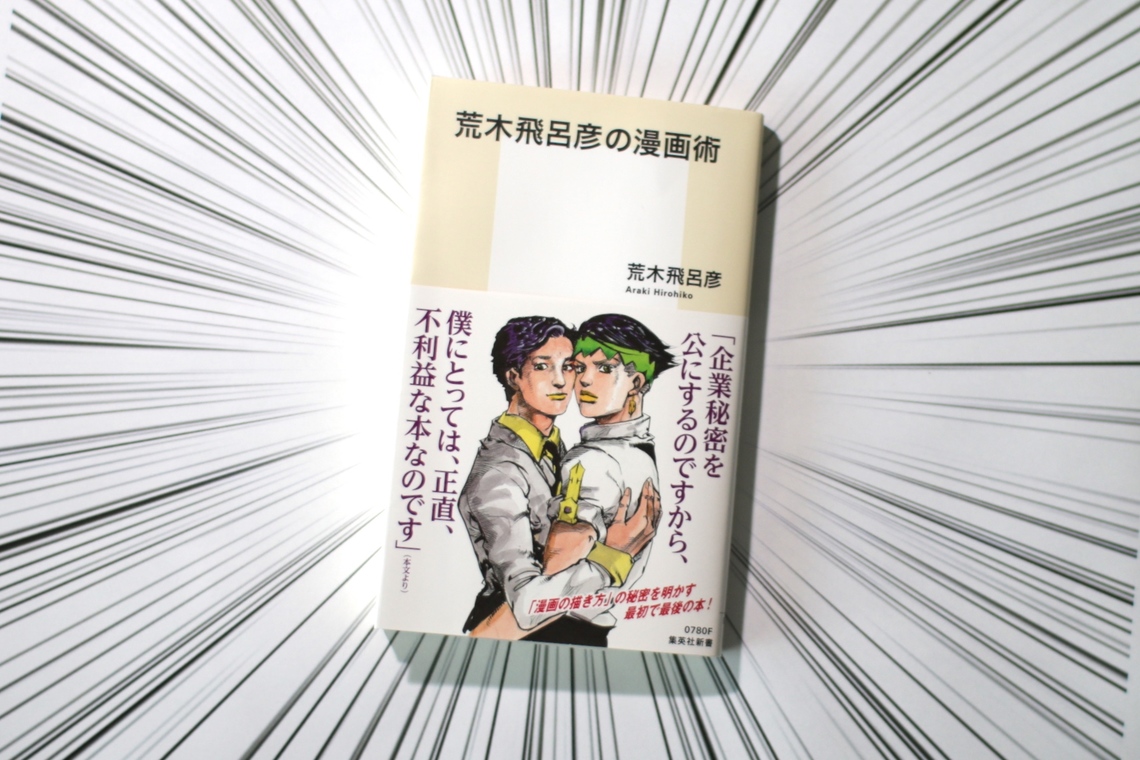
The author of this massively successful manga, Hirohiko Araki, reveals for the first time his previously untold manga techniques... Just this promotional tagline alone makes you want to read it immediately. Introducing "Hirohiko Araki's Manga Techniques" (Shueisha Shinsho).
I say this because I suspect many people might dismiss it just based on the title "Techniques of Manga." What a waste. You can almost hear Jotaro's voice saying, "Oh, come on..." Because this book is packed with hints that will be useful for businesspeople thinking about the next era.
"Techniques for drawing manga? I don't draw manga, and I have no plans to start."
"It's probably just for creators and the like."
"Draw like this and it'll be a hit? There's no such thing as an easy way to succeed."
If you're thinking like that, are you skipping this book without even reading it?
More than a book about manga, it's a book about how to live.
And it's a book of wisdom that teaches you the right way to see things.
That description fits it perfectly, actually.
Manga is the ultimate "comprehensive art form."
It might sound like I'm hyping it up from the start, but of course, the core is about manga techniques. Take a look at the table of contents...
Introduction
Chapter 1: How to Draw an Introduction
Chapter 2: The Four Essential Foundational Structures of Manga You Must Master
Chapter 3: How to Create Characters
Chapter 4: How to Create a Story
Chapter 5: The Artwork Expresses Everything
Chapter 6: What is Manga's "Worldview"?
Chapter 7: All Elements Connect to the "Theme"
Practical Section 1: The Process of Creating Manga
Practical Section 2: How to Draw a Short Story
Conclusion
You might think, "This is totally aimed at manga artists, lol." But the author consistently strives to see through to the essence of things. In this book, he generously shares discoveries cultivated over many years.
What is manga?
What makes something interesting?
Where does that fun come from?
It's astonishing how this attitude of confronting such fundamentals is effortlessly encapsulated in the author's famous statement: "Manga is the ultimate comprehensive art form."
The Four Fundamental Structures Hidden Within Manga That Generate Interestingness
So how does the author create manga?
Of course, an entire book is dedicated to this, covering topics like how to draw the first page, a detailed character profile questionnaire spanning about 60 items, story expression techniques derived from analyzing Hemingway, and the pitfalls of the "minus-plus-zero" story structure... The list goes on, but the fundamental four-part structure, which can be considered the foundational premise, is an absolute must-check.
When actually drawing manga, what you should always keep in mind is the framework I call the "Four Fundamental Structures of Manga."
Listed in order of importance:
① "Character"
② "Story"
③ "Worldview"
④ "Theme"
(omitted)
In other words, what readers see is the artwork, but behind it, "Characters," "Story," "Worldview," and "Theme" each exist interconnected. This structure could be called the workings of a single world, or even a universe. (P.47-48)
Creators who consistently produce outstanding work have their own unique methodologies. Personally, I believe this and have been jotting down various artists' approaches in my notebook. However, it's rare to find someone like Hirohiko Araki who even ranks them.
I was deeply moved by this. To rank the fundamental four-part structure he discovered by thoroughly contemplating the essence of manga—the so-called "royal road" that transcends eras and remains beloved—is just... seriously? How far did he push his thinking...?
That's why I called this a "book about how to live" at the start – I was shaken by the author's attitude. It's not just about honing technique or applying clever tricks. It's about relentlessly pursuing the essence of what's truly good...
"They do what we can't do with such ease! That's what makes us shiver! That's what we admire!" I've always wanted to say that, so I'll say it here.
Ideas never run dry, never wither, never strain
Ideas...
A word we encounter countless times daily in meetings, presentations, and document creation. The book also discusses how to generate such ideas.
I think ideas don't run out so much as our own interest does. Good ideas are deeply connected to our own lives and experiences. If we lose interest, they cease to be born. (P.229)
That's precisely why we must constantly maintain interest in something and respond honestly to events around us. Don't limit yourself to specific fields of interest, and don't ignore things that seem unrelated. It sounds simple but is difficult. Yet, I believe it's the essence.
This resonated deeply with me, as I often find myself trying too hard to force ideas in my daily pursuit of them. It makes me deeply appreciate that JoJo will forever be the true path, because it's drawn by Hirohiko Araki, who never strays from the essence.
Once you learn the "Golden Path" leading to the royal road, your goal becomes what lies beyond it.
The methodology discussed in this book is, in essence, the "Golden Path" leading to timeless, universally beloved classic manga. Why reveal such trade secrets?
Let me state clearly here: the "Golden Path" is not a manual on "how to draw manga."
(Omitted)
Simply practicing what I wrote as the "Golden Path" will yield no development.
Use this 'Manga Technique' as a foundation to create new manga, more powerful manga, or even manga that's completely different or utterly opposite—ignoring this book entirely is fine too. I wrote this book hoping you would create such works. (P.280)
The words written at the end are ultimately a message for aspiring manga artists. But isn't the attitude of aiming for the royal road, devising the "Golden Path," and progressing beyond where you are now something universally required in any business?
Personally, I work in advertising—a field completely different from manga.
But I deeply respect this attitude.
Mr. Hirohiko Araki has been drawing manga for 40 years. And he lives each day with this level of intensity. Believing I might one day reach such a state, this is a book I find myself wanting to revisit time and again.
Was this article helpful?
Share this article


Newsletter registration is here
We select and publish important news every day
For inquiries about this article
Back Numbers

Author
Takuya Fujita
Dentsu Inc.
Creative Planning Division 3