
Note: This website was automatically translated, so some terms or nuances may not be completely accurate.
Advancing Strategic Corporate Character Utilization

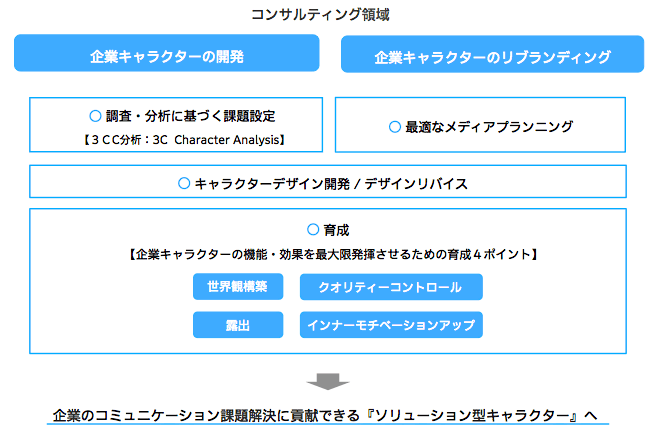
The newly established 'Dentsu Inc. Character Consulting' aims to provide solutions by leveraging communication methods accumulated over many years regarding corporate characters.
Against the backdrop of rising demand for corporate characters, we spoke with Tatsuya Yamamoto of the Marketing Design Center about the strengths of this organization in meeting that demand, along with several corporate character communication case studies, to uncover the strategy behind the adorable designs.
──You've been involved in developing and rebranding corporate characters. What led to establishing this organization?
Above all, client demand has truly surged recently. We increasingly receive inquiries like: "We want to use our corporate character more effectively, but how can we logically measure its impact—including ROI—beyond subjective evaluations like 'cute' or 'fun'? What foundational data is needed?"
Then there's the methodology. How should we systematize and communicate? In this era where characters continue to proliferate, I feel it's becoming increasingly important to view corporate characters as part of a communication strategy, especially for differentiating them from one another. Of course, corporate characters have long been actively used as a means of corporate communication, but the reality is they've often been managed based on individual tacit knowledge, without systematic organizational frameworks.
──What do you consider most important when conducting character communication?
The strength of an independently developed corporate character lies in its ability to enable the client to communicate freely, from mass media to the point of sale. Since it can serve as a consistent symbol for the company, its products, and services, I believe it is particularly well-suited to today's era of increasingly complex and diverse media.
However, while existing content characters like celebrities or anime characters already have built-in affection and trust from consumers, newly created corporate characters start from scratch. To build their power from the ground up, it's necessary to strategically consider corporate communication methods over the medium to long term, encompassing everything from defining objectives to design development, nurturing, and media planning. In fact, looking behind the scenes of hugely popular "yuru-chara" (casual mascots), you'll find they aren't all truly laid-back. They're often strategically conceived to a cunning degree.
While being cute or serving as a decorative element in ads and packaging certainly has value, when a company uses a character for communication, strategic thinking is everything.
From this perspective, a major strength of the newly launched 'Dentsu Character Consulting' is that it brings together strategy planners, brand consultants, creators, and even licensing specialists who have acquired expertise in character communication, enabling us to provide one-stop solutions.
──What should be carefully considered in the process of "cultivating" a corporate character?
First, a character at the design development stage is merely a mark. I often use the example of restroom pictograms: while everyone recognizes them, they generally don't evoke emotional connection. Typically, marks are just identifiers; their function disappears when they're no longer visible.
To form a medium-to-long-term relationship, a bond, with consumers, the character needs to be personified—to become someone people can empathize with and grow attached to.
This is where adding the "added value" of a "worldview" to the character becomes essential. Infuse the design with human warmth, and build a community around this personified "he" or "she." As the worldview and story expand, consumers become more immersed—essentially turning them into fans. This is a crucial element.
Furthermore, corporate characters are inevitably linked to the products they promote and the company's image, so quality control is essential. Establish rules and manage their implementation. Without strict adherence, the character's identity cannot be established. While Japanese consumers are highly receptive to characters, they also have discerning eyes. They are keenly aware of any shortcuts taken in character design. Without rigorous control, it's impossible to cultivate consumer empathy.

──Recently, characters on social media have been gaining attention. How should exposure strategies be developed?
Earlier, I mentioned that media planning requires strategy. Regarding "exposure," television advertising remains the most effective and immediate method. Commercials significantly boost recognition and the perceived connection between the company and the character. However, this doesn't mean we should just keep using TV. We share with the client how much exposure leads to what level of awareness. Based on that, we develop an exposure strategy that not only focuses on paid media like mass media but also examines the characteristics and usage of the client's owned media, such as SNS.
──Indeed, the character for the Ponta common point service, which you handled, is a prime example of how leveraging owned media steadily increased recognition and favorability, ultimately connecting to the company's solutions. I look forward to hearing more specifics about this case next time.
Was this article helpful?
Share this article


