Note: This website was automatically translated, so some terms or nuances may not be completely accurate.
 HIROSAKI MOVING PROJECT [1/2]
The castle moves. The city moves. ~Turning Hirosaki Castle's restoration into a tourism resource. The mayor speaks on Hirosaki City's challenge~
Noriyuki Kasai
Masato Tanaka
Dentsu Tech Inc.
In Hirosaki City, Aomori Prefecture, restoration work is underway on the stone walls of the inner bailey of Hirosaki Castle, the city's symbol. Restoration projects on tourist attractions often mean the "temporary disappearance" of the site, leading to a sharp decline in visitors. However, Hirosaki City has implemented a strategy to turn the restoration project itself into a tourist attraction. What does this entail? What insights does it offer for regional revitalization? We visited Hirosaki Mayor Noriyuki Kasai, who is spearheading the project.
A city where 400 years of history, tradition, and culture thrive, harmonizing Japanese and Western, old and new.
Hirosaki: A city radiating diverse charms
Overlooking Mount Iwaki, Hirosaki City serves as the gateway to the Shirakami-Sanchi World Natural Heritage Site. Its symbol, Hirosaki Castle, was planned for construction by Tsugaru Tamenobu, the first lord of the Hirosaki domain, and completed by the second lord, Nobuhira, in 1611. During the feudal era, numerous temples and shrines were built. Western-style architecture emerged in the Meiji and Taisho periods. Furthermore, many works by Showa Modern architect Kunio Maekawa remain.
Meanwhile, it is the "Apple Kingdom," boasting Japan's highest apple production, and displays beautiful scenery throughout the seasons, including cherry blossoms in spring. A major event occurred in this city of Hirosaki, bringing significant change: the repair of the main keep stone walls of Hirosaki Castle.
Hirosaki Castle, the city's symbol and a major tourist attraction, would "disappear."
Turning this negative into a positive through events
The problem was occurring in the stone walls of Hirosaki Castle. Due to earthquakes and aging deterioration, bulges had become pronounced, and it was discovered there was a risk of collapse. To repair them, the keep would have to be moved. However, Hirosaki Castle is the city's representative tourist spot. Hirosaki Park, where the castle stands, is especially famous for its cherry blossoms, and the view of Hirosaki Castle, its stone walls, and the cherry blossoms from Shimonoe Bridge is a prime photo spot. It was a major draw for tourists. Moving the keep—meaning its disappearance from that scene—would mean the loss of a tourism resource. The impact on attracting visitors was obvious.
"I thought this was a serious crisis. But changing my perspective, I realized the process of moving the keep and repairing the stone walls was something only visible now. I wondered if we could showcase the public works project itself—the Hirosaki Castle Honmaru Stone Wall Repair Project—and turn it into a tourist attraction," said Mayor Kasai.
Losing a tourist attraction is negative. But if we could showcase the stone wall repair project itself and turn it into a tourist attraction, we could turn it into a positive. Based on that idea, numerous events would be developed.
Among these, the experiential event "Hikiyama Week," held at Hirosaki Park's Honmaru from September 20th to 27th, drew significant attention.
The method used to move Hirosaki Castle's keep was called "Hikiyaya." This involved placing the keep on rails and moving it. Hikiyaya Week transformed part of this process into a citizen-participation event, where ropes were attached to the keep and it was pulled by human power. However, the keep weighs approximately 400 tons. There were concerns about whether it could actually be moved. First, a proof-of-concept test was conducted by the organizers. It was found that even with 200 people, or even 100 people, it could be moved. "We concluded it was feasible."
Then came the first day of the event. About 100 general participants pulled on four ropes extending from the castle tower's base. Slowly, the tower began to move. Cheers erupted from the gathered crowd of participants, citizens, and tourists.
Each pull moved it 15 centimeters. Over the event period, 35 pulling sessions were held, resulting in a total movement of 5.3 meters. The event drew approximately 3,900 participants during the Hikiya Week and recorded around 30,000 visitors, making it a major event.
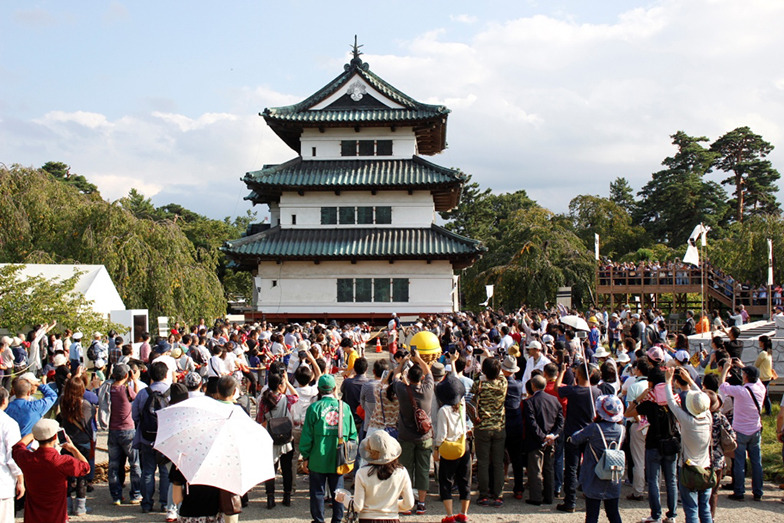
"We received thunderous applause from the citizens. Even after it ended, people approached us saying, 'It was just incredible!' The huge response made me very happy," said Mayor Kasai.
Hikiyasai Week captured the hearts of Hirosaki citizens as a major, visible event. Its reputation spread not only throughout the city and Aomori Prefecture, but nationwide, boosting the confidence of Hirosaki's residents.
"We were able to clearly show many people what Hirosaki City is trying to do and where it is heading. What I truly felt through this event is that by showing our efforts, citizens evaluate the administration positively. They also realized their city is attracting attention nationwide, fostering pride in being citizens." — Mayor Kasai
Mayor Kasai states that the synergy born from the shared vision of the administration and citizens is the major achievement of this event.
The stone wall repair project created a rare, new tourist attraction for a limited time.
Currently, local governments are tackling regional revitalization through various approaches. The project unfolding in Hirosaki City now serves as a model case for "experiential regional revitalization." How does Mayor Kasai perceive this aspect?
"For regional revitalization, in terms of tourism, I believe it's essential to increase the number of visitors and the exchange population. In doing so, we must compete using what already exists there. There must be tourism resources that can be strategically leveraged. We must fully utilize them. By refining and showcasing existing resources, we can generate buzz and transform them into sustainable tourism assets. In that sense, I find great significance in how Hirosaki City used this approach to present dramatic stories to the nation and the world. This initiative could become a shared milestone for regions facing similar challenges."
Furthermore, a key factor behind the success of Hirosaki City's initiative was its ability to engage the entire city and its citizens. Flags featuring the character for "motion" and Hirosaki Castle were displayed throughout the city, uniting the entire community.
"Without the support of our citizens and the city's collective enthusiasm, this likely wouldn't have succeeded. If this success instills confidence in both our citizens and the administration, it can become sustainable. We plan to continue launching various events to generate buzz." ──Mayor Kasai
Including the "Hikiya Week" event, the Hirosaki Castle keep was moved a total of 77.62 meters and now sits at a location separated from its original stone foundation. It will not return to its original position for six years.
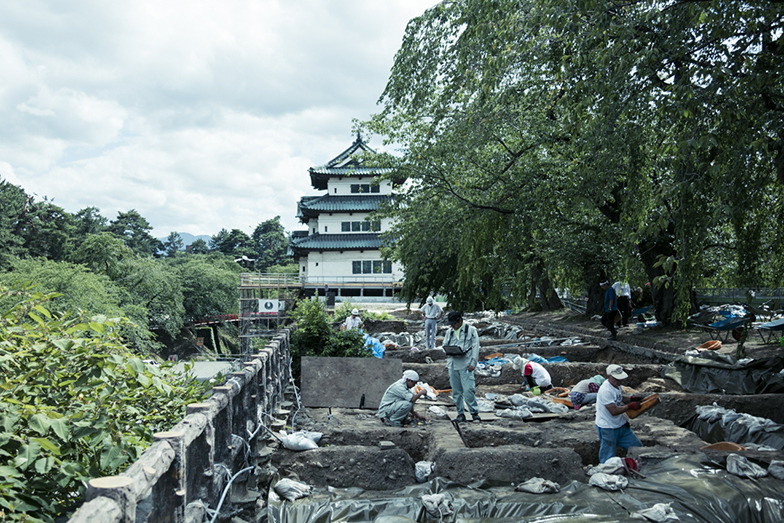
"The previous landscape has indeed been lost. But looking on the bright side, a new landscape has been born. We will build an observation deck where visitors can view the keep framed by Mount Iwaki and enjoy the cherry blossoms together. This is a new tourist spot made possible precisely because of the Hirosaki Castle Honmaru Stone Wall Repair Project. Moreover, it's a limited-time view until the keep returns to its original location." ── Mayor Kasai
Mayor Kasai describes Hirosaki, with its many charms, as "a city where Japanese and Western, old and new blend together in perfect harmony." He attributes this to the character of Hirosaki's people.
"Efuri-koki" means showing off. "Joppari" means stubbornness, refusing to be outdone by anyone. And "motuke" means being a cheerful optimist. These traits have sustained Hirosaki's 400-year history, traditions, and culture. Because of "efuri-koki," we actively embraced Western-style architecture. And because of "joppari," we've preserved both the old and the new. ──Mayor Kasai
Furthermore, during the Snow Lantern Festival from February 11th to 14th next year, a multi-projection event will be held on the stone walls of Hirosaki Castle. Visual works will be projected onto the stone walls, which extend over 140 meters in total length, while lighting effects will be displayed throughout the inner moat area. This is also expected to be a major attraction.
[After the Interview]
The administration and citizens are united, and the entire city is moving forward toward the future.
Masato Tanaka, Dentsu Inc. Tech Project Development Office
Hirosaki City is implementing the "HIROSAKI MOVING PROJECT," initiated by the major relocation of the castle keep due to repairs on the Honmaru stone walls of Hirosaki Castle. This project aims to move not just the castle, but the people and the entire city of Hirosaki. The citizen-participation "Yikiya Week" generated significant buzz. Various events are planned for the future.
As Mayor Kasai mentioned, this project could not be realized without the support of the citizens above all else. In that sense, the project is progressing while capturing significant public attention. This initiative is drawing widespread attention as a model case for "experiential regional revitalization." Being able to contribute to such a project is a valuable experience for me personally. It could serve as a reference point for many considering regional revitalization.
Was this article helpful?
Share this article


Newsletter registration is here
We select and publish important news every day
For inquiries about this article
Author
Noriyuki Kasai
Mayor of Hirosaki
Masato Tanaka
Dentsu Tech Inc.
Production Unit Second Production Room
Articles by this person
Transforming the restoration of Hirosaki Castle's stone walls into a tourist attraction. ~Public-view construction. How to make the work itself compelling. Hirosaki City's challenge~