Note: This website was automatically translated, so some terms or nuances may not be completely accurate.
 HIROSAKI MOVING PROJECT [2/2]
Transforming the restoration of Hirosaki Castle's stone walls into a tourist attraction. ~Public-view construction. How to make the work itself compelling. Hirosaki City's challenge~
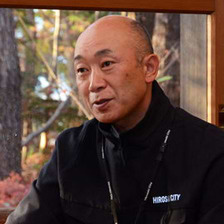
Kami Masaaki

Masato Tanaka
Dentsu Tech Inc.
The Hirosaki Castle Honmaru Stone Wall Repair Project underway in Hirosaki City. Most repair work is not open to the public.
However, Hirosaki City chose an open-access approach. They opened the construction itself to the public, effectively utilizing it as a tourist resource. We asked Mr. Masaaki Jin, Senior Manager of the Hirosaki Castle Maintenance and Utilization Promotion Office and the Smart City Promotion Office within the Hirosaki City Parks and Green Spaces Division, who is driving this unique project, about the benefits of open-access construction and future developments.
[Video] HIROSAKI MOVING PROJECT Time-Lapse ~Tenshu Installation~
Implementing "Visually Engaging" Open Construction. First, Recreating the Construction Scene from 100 Years Ago
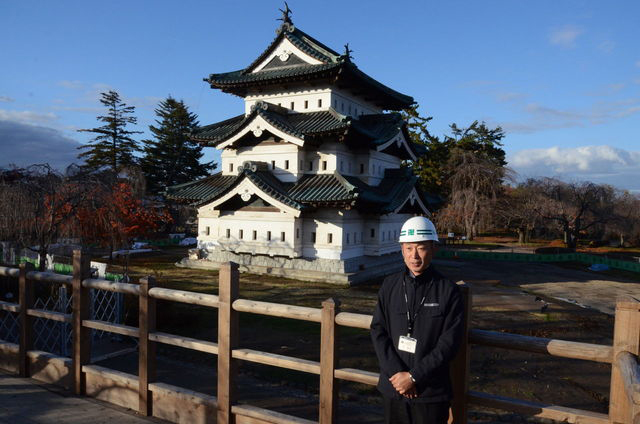
Hirosaki Castle, the symbol of Hirosaki City, Aomori Prefecture. It is one of only 12 castle towers remaining nationwide from the feudal era and the only one in Eastern Japan. Within the castle grounds, the main tower, three turrets, and five castle gates remain, all designated as Important Cultural Properties. Mr. Kami of the Hirosaki Castle Maintenance and Utilization Promotion Office describes its appeal: "You can see it as if you've covered every castle in the country."
Currently underway at Hirosaki Park, home to Hirosaki Castle, is the Hirosaki Castle Honmaru Stone Wall Repair Project. The castle keep is being moved using a technique called "hikiya" to allow for the repair of the stone walls. The project began after signs of bulging in parts of the stone walls and a tilt in the keep were detected. Continuous monitoring initiated after the 1983 Japan Sea Central Earthquake revealed that leaving the walls untreated could lead to their collapse, potentially engulfing the keep during future seismic activity. The repair project commenced in fiscal year 2015, and the completion of the stone wall repairs is scheduled for fiscal year 2023, marking a monumental undertaking.
However, Hirosaki Castle is a vital tourist resource for Hirosaki City. It is particularly renowned during cherry blossom season as an ideal photo spot where the blossoms, castle, and stone walls blend into one. Relocating the castle would mean losing this tourist attraction. It was clear this would be a significant setback for attracting visitors. Therefore, Hirosaki City proposed an "open-access construction project." The idea was to turn the construction process itself into a tourist attraction.
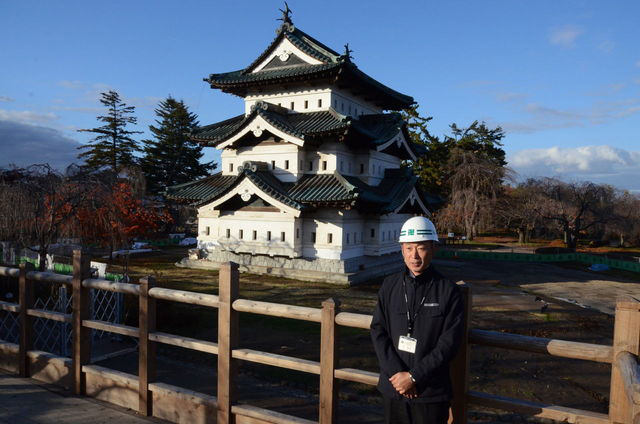
"Simply watching the construction wouldn't be appealing. Our goal was to create scenes people would want to photograph," said Mr. Kami.
To begin repairing the stone walls, scaffolding must first be erected. The typical form involves exposed steel frames. This lacks appeal. Construction work was done about 100 years ago, and looking at photos from that time, they built scaffolding using logs. That's why we decided to recreate that scene.
We combined logs with single-pipe scaffolding and bound them with rough rope. We wrapped thick steel beams in hemp cloth. From a distance, the entire structure appears to be built of wood. Furthermore, we went all out by hanging a banner displaying the Tsugaru clan's family crest. We created a scene that feels like a time slip back 100 years.
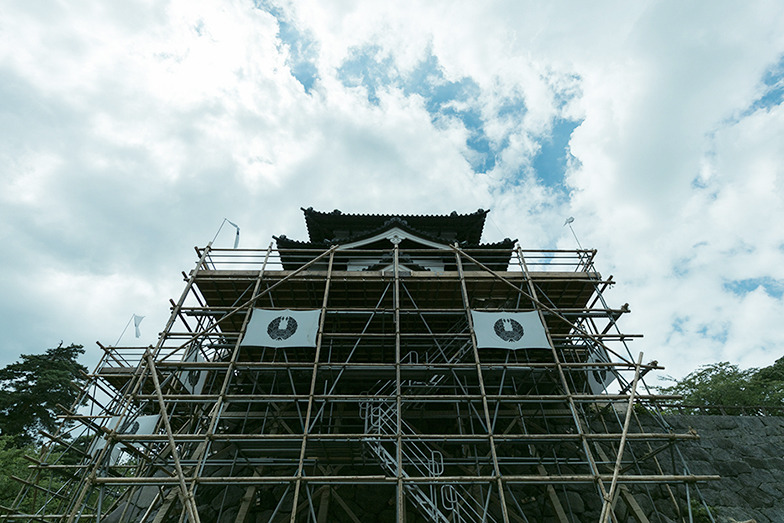
"Regular visitors would say things like, 'That spot changed, didn't it?'" — Mr. Jin
The initial scaffolding setup, as the first step in the open-construction project, also succeeded in capturing the interest of Hirosaki citizens.
Because Hirosaki Castle is so beloved by its citizens, we wanted to move it in its original state.
And with the power of the citizens themselves.
To repair the stone walls, it was necessary to move the keep. Several methods exist for this: completely dismantling the keep and reassembling it elsewhere, or inserting steel beams into the keep and lifting it with jacks for relocation.
"We thought moving it intact would cause the least stress to the castle. Since Hirosaki Castle is a beloved symbol for the citizens, it would be painful to see it dismantled or impaled. The keep isn't damaged either," said Mr. Jin.
The chosen method was to separate the keep from its stone foundation and lift it from below. This involved laying rails beneath the keep for movement, a technique called "Hikiyaya." The separation from the stone foundation, known as "Jikiri," was completed on August 16th.
"Honestly, I was anxious. We were lifting a keep sitting atop stone walls that could potentially collapse. We reinforced the base, laid wide steel plates, and installed jacks. We applied hydraulic pressure to lift it, but we didn't know if the stone walls could withstand the keep's weight of about 400 tons." — Mr. Kami
It was a one-shot gamble, but we managed to clear this first hurdle. However, the hardships continued. We had to move the keep, now on rails, from the stone walls to the rails atop the latticework. The problem arose when moving the keep placed its load on both the stone walls and the latticework. The ground reaction forces differed between the stone wall foundation and the latticework section.
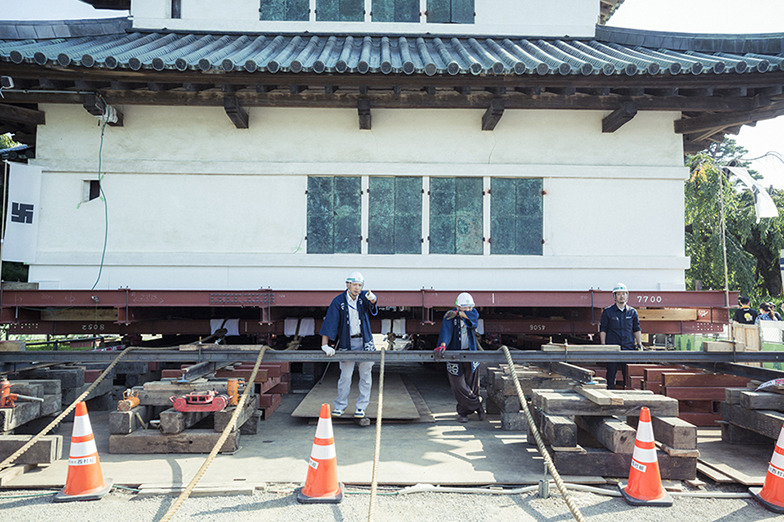
"It was extremely unstable, and the rails would warp. This was the most nerve-wracking part of the entire operation." — Mr. Kami
This operation took place over three days starting September 3rd. With extreme caution, they managed to move it just 30 centimeters per minute. Over the three days, they successfully moved it about 20 meters.
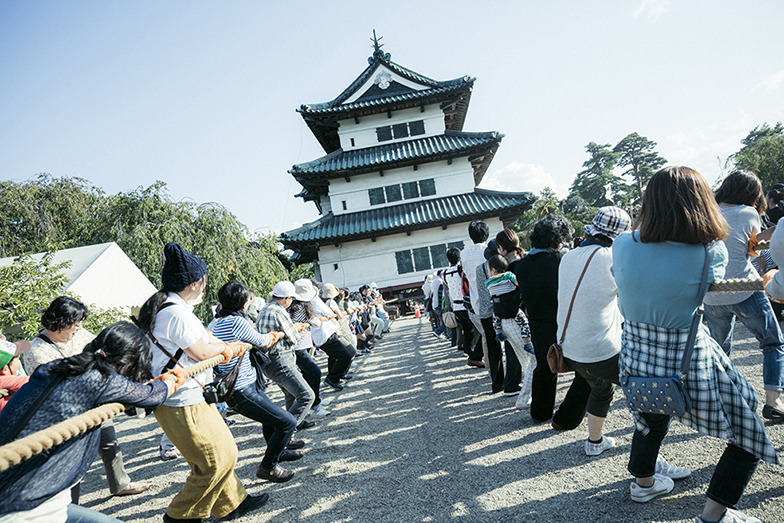
Then came the Hikiyaya Experience Event, Hikiyaya Week, held at Hirosaki Castle's Honmaru from September 20th to 27th. About 100 people pulled on four ropes extending from the keep's base, moving the keep by human power. The ropes were borrowed from a local junior high school, specifically the ones used for tug-of-war at their sports festival. This too shows the city's wholehearted cooperation.
Approximately 3,900 citizens and other participants took part in the event. The keep was moved a total of 5.3 meters over 35 pulling sessions, each moving it 15 centimeters. Around 30,000 citizens and tourists watched the proceedings. This event transcended the realm of a public construction project, becoming a major talking point as an "experiential" event.
Even before the castle tower's move, a temporary open stage was set up, and this too was designed with care.
"We had envisioned using simple steel pipes like those found on construction sites," said Mr. Jin, "but the contractor wanted to install something that harmonized with Hirosaki Park. They crafted the entire structure from cedar wood."
It was precisely because the administration, citizens, and everyone involved in the construction shared a common vision that this project achieved such success.
Dismantling the stone walls and faithfully reconstructing them. Hirosaki City's challenge continues.
Moving forward, various events will unfold, but the major construction tasks will be dismantling the stone wall and then reconstructing it. During this time, the cause of the bulging will also be investigated. The planned repair area covers approximately 1,100 square meters. About 3,000 stones are used. Each one must be numbered, its position recorded, and then returned to its exact original spot.
"It's like taking a completed 3,000-piece puzzle apart and faithfully recreating it. However, some stones are cracked. We'll replace them with new stones, but we must find similar ones. That accounts for about 30%, roughly 900 stones. Finding these will likely be quite a challenge," said Mr. Jin.
Even if identical stones are found, their shape may need adjusting in some cases. That's how thorough they are. Demolition of the stone walls is scheduled to begin in autumn 2016. Rebuilding them exactly as they were and returning the keep to its original location will take until 2021. The entire stone wall repair project will be completed two years later, in 2023. The process will be publicly accessible throughout. For Hirosaki citizens, observing the subtle changes in the castle's surroundings has become a source of enjoyment. For tourists, it offers a chance to witness a scene they will never see again.
"Being involved in the first house-moving in 100 years and the stone wall repairs is a joy, but I also feel the weight of the responsibility. I want this project to be passed down to future generations. That's why it's an open-to-the-public project; I hope many people will come see it. If this project leaves an impression on each person and they pass it on to their children and grandchildren, then it will truly be a project that endures for generations." ── Mr. Jin
[After the Interview]
This unique concept of open-to-the-public construction points to a new direction for regional revitalization.
Masato Tanaka, Dentsu Inc. Tech Project Development Office
Mr. Kami, who oversees the construction, was taught by a contractor involved in the building relocation: "Relocating a building isn't just about moving the structure. For a castle, it means moving the feelings of the people who lived in that era; for a private home, it means moving the memories of those who lived there." Those words struck a chord with me too. The castle tower moves. "Moving" means revitalization, and it also creates opportunities for new memories to be made.
Right now, in Hirosaki City, such a movement is happening, centered around the administration and involving citizens and the contractors involved. I myself am learning a great deal through this project. I hope that not only tourists, but also those involved in regional revitalization, will experience the progress of this new type of project: open-to-the-public construction.
Was this article helpful?
Share this article


Newsletter registration is here
We select and publish important news every day
For inquiries about this article
Author
Kami Masaaki
Hirosaki City Parks and Green Spaces Division Hirosaki Castle Development and Utilization Promotion Office Smart City Promotion Office
Chief Editor
Masato Tanaka
Dentsu Tech Inc.
Production Unit Second Production Room
Articles by this person
Transforming the restoration of Hirosaki Castle's stone walls into a tourist attraction. ~Public-view construction. How to make the work itself compelling. Hirosaki City's challenge~