Note: This website was automatically translated, so some terms or nuances may not be completely accurate.
 Active Learning: What About This? Report [16/33]
In British schools, they learn about money with apples.
The " Active Learning: What About This? " Research Institute launched at DENTSU SOKEN INC. We will propose ideas about active learning from various angles. In this column, we will introduce methods, concepts, and individuals that could be useful for making learning more active.
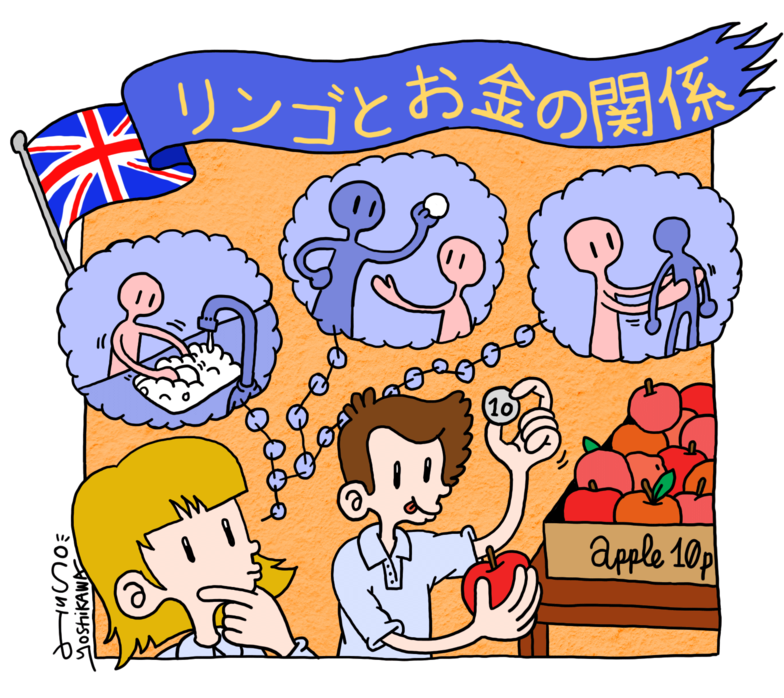
When I transferred to a school in England in third grade, I encountered the concept of "earning my own money." It happened during the longer break between morning and lunchtime.
Apples were being sold on the playground, and many children bought them and ate them with relish. Seeing this, I wanted an apple too. But then I realized I didn't have any money. Wait, do British elementary school students bring money to school? This wasn't something I'd seen in Russia. It's normal for lower elementary students not to carry money. Puzzled, I immediately asked a classmate nearby why they had money. To my surprise, they said they "earned" it.
"Huh!? What do you mean?" I pressed further. "I washed dishes and got paid by my parents," they explained. "Of course, maybe not everyone does it, but that's how we do it at our house." I see. This was quite a shock. You could get paid for washing dishes at home.
Thinking about it, in my own environment, the idea or system of doing something and receiving money from my parents in exchange simply didn't exist. Doing the dishes was seen as "helping out," not "work." Money wasn't involved there. I had run errands before and understood the existence and use of money. But while my parents might buy things for me, I hadn't yet experienced spending my own money on things I wanted.
But my classmates in England and America were given opportunities to earn money from their parents in exchange for helping with chores or looking after younger siblings. Since the English primary school only sold apples, and they were very cheap, I can't help but think this might be an educational method. Seeing that, a child would surely think, "I want an apple!"
So then they'd think about how to get an apple. They could ask their parents for pocket money, beg for the apple money, or earn it by doing chores like looking after younger siblings, washing dishes, cleaning, taking out the trash, or cooking. There must be other ways too.
Furthermore, if they decide to earn money, they'll need to consider how much to charge—like setting the price of one apple equal to the pay for washing one set of dishes. This gives children their first experience of receiving compensation in exchange for doing something.
They also learn how much they can earn for doing something. They discover the value of the apple they want to eat. For many children, this becomes their first opportunity to think about money.
Many Japanese households have an "allowance" system, but the value of money earned versus given is surely different. Children in Russia, where the allowance system is absent, learn the value of money through errands, but managing their own money comes much later in life.
How and when to teach children about money varies around the world. It's fascinating to consider how these different first encounters with money might shape children's future relationship with the business world.
Was this article helpful?
Share this article


Newsletter registration is here
We select and publish important news every day
For inquiries about this article
Back Numbers

Author

Kirillova Nadezhda
Dentsu Inc.
第7マーケティング局
Creative Director