Note: This website was automatically translated, so some terms or nuances may not be completely accurate.
 The Era of AI Writing Novels [2/2]
Can AI Enjoy Novels?
Hitoshi Matsubara
Hokkaido University of Science and Technology
Naoki Matayoshi
Keichi Yoshizaki
Dentsu Inc.
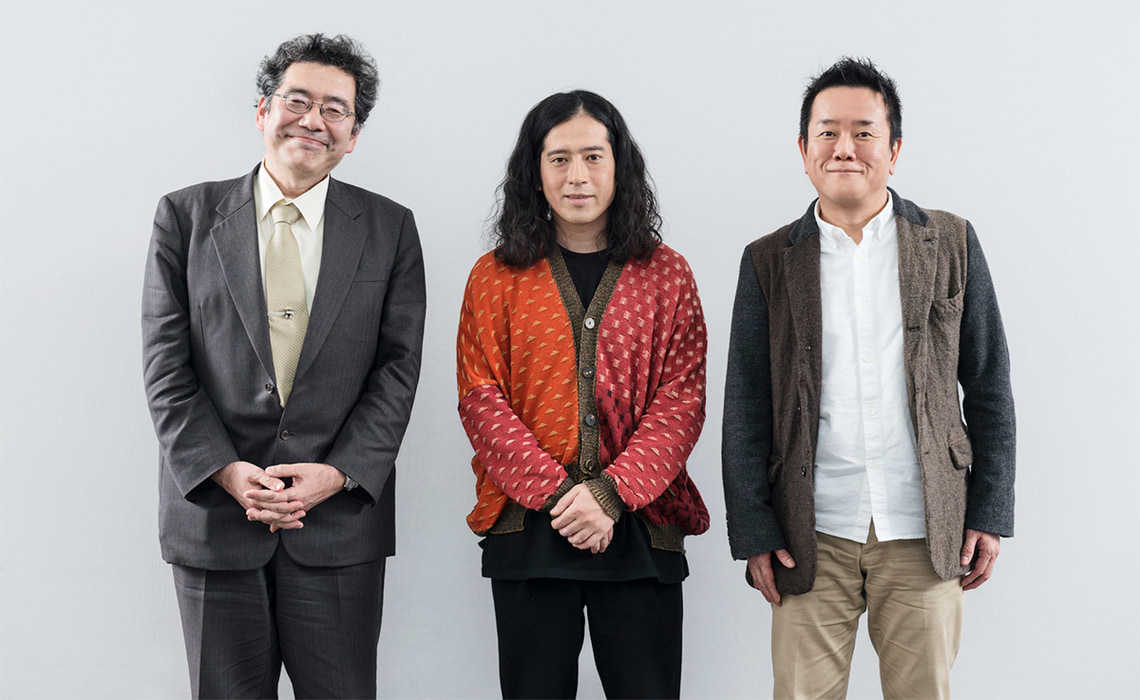
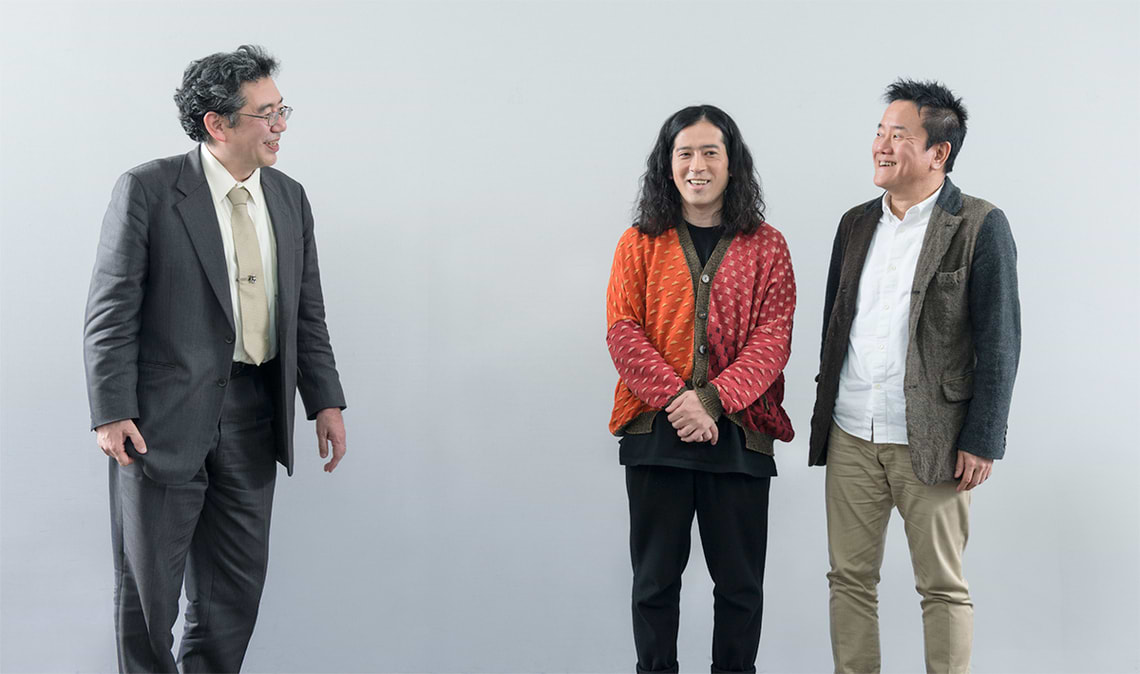
As artificial intelligence (AI) garners significant attention, an AI-generated novel was submitted to the recently announced Nikkei Hoshi Shinichi Literary Prize. How far has AI evolved in the realm of literature? What will 'creative writing' look like in an era where AI writes novels? This is the second part of a roundtable discussion featuring Professor Hitoshi Matsubara of Future University Hakodate, who leads the project; Naoki Matayoshi, an Akutagawa Prize-winning author and comedian; and Keiichi Yoshizaki of Dentsu Inc.
AI's defining feature is its randomness. Could it enhance human creativity?
Yoshizaki: AI creative research is advancing in other fields too. For example, in music, they play computer-generated compositions alongside Bach's works and ask people which is Bach's piece. The results sometimes show that more people identify the computer-generated piece as "Bach's music."
Matsubara: Research on poetry is also advancing. They input many words from famous past poems and let the computer combine them. Then, about one in a thousand times, something makes you go "Wow!" Music and poetry have fewer options than novels, so even random selections can work well. You could even call it "avant-garde" and it wouldn't be unevaluable.
Matayoshi: Even if a computer randomly selects words to create haiku or poetry, few might be proper works. But seemingly awkward pieces could still spark inspiration for writers. Like, "Ah, if I clash these words and polish them, it could become a piece." Fundamentally, randomly bringing in completely unrelated words to spark ideas is something humans struggle with. We lack the courage to introduce unrelated elements. We tend to assign meaning to things.
Matsubara: As you say, Matayoshi-san, I think one ideal form for AI is to work in a way that enhances or complements human creativity.
Yoshizaki: What kind of image do you have, Mr. Matayoshi, about AI assisting in that way? Like, if AI offered choices while you're writing, that would be helpful?
Matayoshi: It would definitely be helpful if it offered choices. But I think writers and comedians have their own unique ways of generating ideas. Like reading newspapers, or opening a dictionary to find words that catch their attention. That's essentially searching for hints for ideas. Writers often go for walks for the same reason – they hear sounds, feel the seasons, get tired, experience changes. Their reactions to those changes spark various ideas.
Yoshizaki: Opening a dictionary and having a computer randomly select words are somewhat similar, but the difference is whether the writer's physical experience is involved.
Matsubara: That's probably where the writer's physicality, or characteristic, reflects in the work. Even when ideas come from some change, the writer's style and sense of unity are maintained. On the other hand, AI, for better or worse, brings truly random things. That's what leads to the "discrepancy" I mentioned earlier.
Yoshizaki: Humans have physicality, AI has randomness. That seems like a clear difference between the two. Yet, Mr. Matayoshi, you don't seem to have any aversion to AI, which excels at randomness, entering the world of novels?
Matayoshi: I absolutely love reading books. If an incredibly interesting story came out and I heard it was an AI novel, I'd definitely read it. I'd be interested. To take it to the extreme, imagine it being super interesting up until the last 50 pages or so, and then it's like, "Wait, this is exactly the same as a Natsume Sōseki work." Even a novel with that kind of discrepancy could be interesting, right? Of course, that would be a problem (laughs). Either way, I'd like to read an AI novel.
Can AI Enjoy Novels? AI Steps Into Uncharted Territory
Yoshizaki: When I hear about brainstorming ideas, I feel it ultimately leads back to the fundamental question: "Why do people write novels?" Mr. Matayoshi, why did you decide to write novels?
Matayoshi: I didn't understand that part at first either... When the publisher asked me, "Would you like to write a novel?" I actually asked them, "Please tell me why I should write one" (laughs). There are so many wonderful writers out there. Then they explained that I've had experiences different from other writers, and that from my position as a comedian, "there are things only I can write." They kept saying it, so I gradually started to think, "Maybe they're right" (laughs).
Yoshizaki: When did you first feel the desire to be on the writing side, to be on the expressing side?
Matayoshi: Since I was a kid. Whether it was puns or whatever, whenever I thought of something, I wanted to say it in front of people, see their reactions. That's what led me to become a comedian, but creative work like writing novels is the same. I think I would have done something like this even if I'd had a different job. So, actually writing a novel, the time spent writing was fun. But after it's written, you get either huge praise or harsh criticism, and that's tough (laughs). I never expected to get this much attention...
Matsubara: From that perspective, AI still doesn't understand its own work. It doesn't have the motivation to write or grasp what makes it interesting. The fact that novels have punchlines at the end is because humans gave it that framework through programming. The AI itself isn't conscious of delivering a punchline. The ideal would be for the AI to choose the most enjoyable option from various possibilities even when considering the middle developments. For the AI itself to select the plot it finds most fun and interesting, and for that choice to align with external evaluations.
Yoshizaki: In that sense, whether an AI can read a novel and find it interesting is a major factor.
Matsubara: That's right. In our project, among hundreds of possible plot patterns, the AI selects which one is most "Hoshi-like." We're actually researching this too. For example, while reading Hoshi's works, we define a function for "Hoshi-ness." Then, the AI creates its own works and scores them itself, choosing the ones that feel more like Hoshi. We aim to realize this in the future.
Yoshizaki: Achieving that would be a major step forward.
Matsubara: Then there's whether people will actually call the resulting work "a good novel." Defining "a good novel" is difficult; unlike shogi or go, there's no clear answer like "winning." Until now, AI has been developed for things where we can judge quality, but this marks stepping into the realm of things where we can't judge quality.
A sense of a new creative style emerging. Could writers and AI collaborate in the future?
Yoshizaki: What direction do you think AI novel research will take going forward?
Matsubara: For our current project, the immediate goal is to create AI-generated short-short stories with minimal human involvement. The ideal outcome would be for such a work to win the Nikkei Hoshi Shinichi Award. Even if we don't reach that level, we want to create works we consider of a certain standard. Beyond that, while the tone sometimes shifts even in short stories, we're unsure whether to eliminate or utilize that trait, but we aim to challenge ourselves with novellas and full-length novels. We've also received work data from the family of Sakyo Komatsu. We aim to analyze and create works from it in a similar way to what we're doing with Mr. Hoshi. Moreover, regarding Mr. Komatsu's unfinished work, 'The Void Corridor,' he specifically said, "Please have AI complete it in the future." That's an extremely difficult and long-term challenge, but it shows another possible form for AI-generated novels.
Matayoshi: That would be incredible if it worked. There are many unfinished works, like Kenji Miyazawa's "Night on the Galactic Railroad" or Soseki Natsume's "Light and Darkness."
Yoshizaki: It might give rise to a new type of creator—someone skilled at collaborating with AI. In a way, smartphones are already an extension of our bodies, supplementing our memory and such.
Matsubara: So in terms of supporting novelists' creative work, it's already quite functional at this point.
Matayoshi: I thought the idea of AI writing novels was incredibly interesting. Among novelists, a new style might emerge where collaborating with AI boosts efficiency. I'm looking forward to seeing how this develops.
▶︎Creative Approach of the "Whimsical Artificial Intelligence Project & Writer, You Know"
The late Shinichi Hoshi would combine several unrelated words or keywords to craft his ultra-short stories. The project challenged this technique using AI, experimenting through trial and error. Professor Matsubara describes it as "similar to rakugo's three-topic stories." Currently, over 1,000 Hoshino works have been cataloged in a database. By inputting the protagonist's name, setting, and plot development, the AI combines various elements to generate prose and output it as a novel. Humans provide the major narrative structure (such as the initial situation explanation or the punchline at the end), and the AI creates the story within that framework.
The submitted works from this round are published on the project website ( www.fun.ac.jp/~kimagure_ai/ ).
Was this article helpful?
Share this article


Newsletter registration is here
We select and publish important news every day
For inquiries about this article
Author
Hitoshi Matsubara
Hokkaido University of Science and Technology
Professor
Naoki Matayoshi
Comedian / Writer
Keichi Yoshizaki
Dentsu Inc.
Content Business Design Center
Executive Officer