
Note: This website was automatically translated, so some terms or nuances may not be completely accurate.
 To achieve results through digital utilization [16/18]
Developed from scratch: nxdb. Also utilized for BI to visualize vast amounts of data.
*Nextedge Dentsu Inc. became "Dentsu Digital Inc." on July 1, 2016.

──Please tell us about nxdb, the foundation supporting the automation mechanisms introduced earlier.
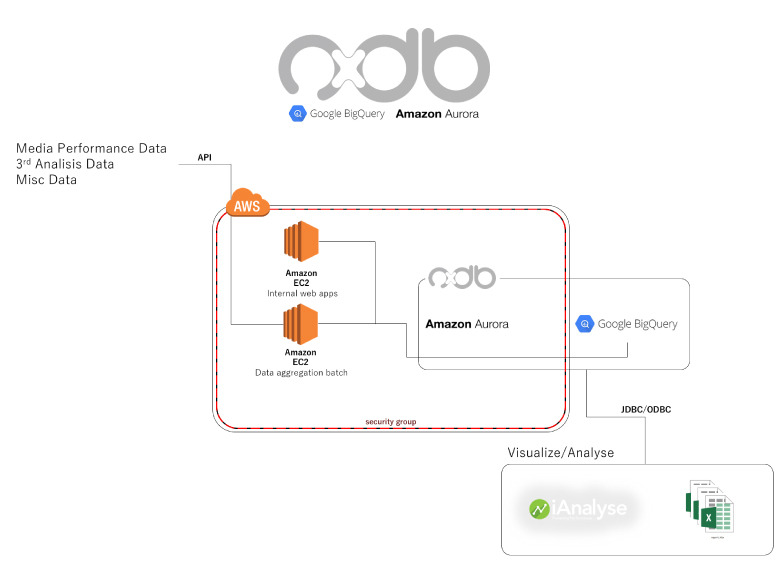
Izumi: nxdb is a database server. It consists of two main data streams: client media delivery performance data and access analytics data for programmatic advertising, plus internal operational management data.
Media delivery performance data and access analytics data are collected via separate batch servers. These servers use APIs provided by each delivery platform to centrally accumulate data into nxdb. By normalizing data from different delivery platforms into nxdb's data format, we enable integrated analysis across various media. The data is modeled in a highly reusable format, allowing flexible output in an easily analyzable form.
To illustrate with a very simple example: for search-linked and display-type advertising, Google AdWords and Yahoo! Promotion Ads are representative distribution platforms. When distributing ads, campaigns are designed for each platform. These campaigns consist of ad groups, and within each ad group, keywords and ads are registered, forming a hierarchical structure.
By retrieving data from each platform via API and accumulating ad delivery performance in nxdb, we can perform integrated analysis across these two platforms. This allows us to retrieve data and generate reports tailored to the required granularity, time period, and other conditions. For instance, we have a mechanism to retrieve data for all report types provided via API, such as creative-level, ad placement-level, and segment-level reports.
──Was nxdb built from scratch?
Izumi: Yes. While existing solutions offering similar systems on a monthly subscription basis exist, we decided to build our own because none met our needs down to the smallest detail.
Typically, you'd log into each delivery platform's management screen when needed, specify the report type and period from the interface, and generate the report. Manual work inevitably leads to errors, and the more types and conditions involved, the longer report generation takes. nxdb cuts the time and effort spent on these tasks, allowing you to start data analysis immediately. Access to all report types also enables an exploratory approach to uncover detailed facts.
Reduced annual man-hours by 310
──Mr. Hirose, what are your impressions of using nxdb?
Hirose: We must always report ad delivery performance and results to clients. For us on the ground, automating report generation has significantly improved efficiency.
Since all data is available at the smallest granularity, we can freely pivot as needed, making analysis much easier. Compared to before implementation, the man-hours spent on reporting have been drastically reduced, and operational errors due to human mistakes have disappeared. Eliminating these simple tasks has freed up time for more in-depth analysis.
The ability to proactively propose development-oriented solutions to client challenges, as explained previously, stems from automating routine tasks. This frees up resources to take on new initiatives. Data accuracy has improved, significantly reducing the risk of errors and enhancing the credibility of the data.
──In terms of reducing man-hours, how much of an effect did it have?
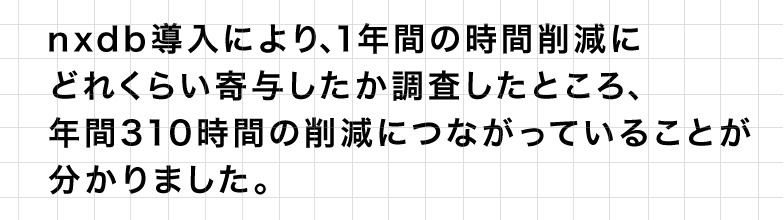
Izumi: We investigated how much nxdb contributed to annual time savings and found it resulted in a reduction of 310 hours per year.

Replacing with BigQuery enables analysis of large-scale data
──What other effects are there?
Izumi: As mentioned, nxdb can retrieve data from all report types for Google AdWords and Yahoo! Promotion Ads. Conversely, this means we handle massive volumes of data. The world of programmatic advertising evolves rapidly, with new platforms emerging daily and various targeting methods and segments continuously expanding. Concurrently, data volumes are growing exponentially.
Initially, we built the system using MySQL, a traditional open-source relational database (RDB). However, we sometimes encountered cases where MySQL couldn't deliver sufficient performance speed for processing large volumes of data. Therefore, we adopted Google's BigQuery, which can handle massive data volumes, and migrated some data to it. While MySQL is an RDB, BigQuery is a columnar database. These two have different orientations, so they have their respective strengths and weaknesses. BigQuery is well-suited for processing massive amounts of data at high speed. Currently, we operate a hybrid configuration, using each system appropriately for its specific purpose.
Also provided as a client-facing BI tool
──Are there other uses for nxdb?
Hirose: Clients mentioned that Google Analytics was too complex and difficult to understand, requesting formatted reports. So, we leverage nxdb data to provide a BI tool for each client account. By accessing the BI dashboard, clients can view their own data instantly. They can see how much advertising is spent on each media channel and instantly visualize graphs showing sales and profit figures.


Izumi: We've also made the BI dashboard accessible internally. Any employee can now holistically review sales, gross profit, sales composition ratios, and more across various granularity levels—from company-wide (top-line) to service areas down to individual projects (bottom-level granularity)—all on the dashboard.
Before implementing nxdb, accounting staff manually compiled data from Excel reports. This process took about three days for aggregation and a full week to produce reports. Now, we can view data in near real-time and utilize it for management decision-making.
System development is underway with an eye toward automated advertising account creation.
──What are your future goals?
Hirose: While report automation and keyword generation automation are already implemented, we're currently developing a system that can automatically create client advertising accounts from scratch. This system will set keywords for each page based on the client's site structure, enabling effective ad campaign management.

Izumi: To elaborate further, we extract the site structure from the structured data markup used in the website's breadcrumb list and generate ad delivery sets for campaigns. The ideal is for website content and ad groups to correspond and be automatically generated.
For example, someone searching for "Okinawa hotels" should ideally be taken directly to a site where they can book Okinawa hotels. We'll automate the process of registering the corresponding ad group, ad, and highly relevant targeting keyword ideas for the Okinawa hotel listing page extracted from the site structure.
While this shares similarities with SEO strategies, once operational, this system enables the automatic generation of ad sets that directly display the information users need—in a format evaluated as correct by the ad delivery platform. Our goal is to enable automatic ad account construction based on the concepts demanded by the ad delivery platform.
Was this article helpful?
Share this article


Newsletter registration is here
We select and publish important news every day
For inquiries about this article
Back Numbers


Author

Shota Izumi
Dentsu Digital Inc.
Technology Solutions Department


Kazunori Hirose
Dentsu Digital Inc.