
Note: This website was automatically translated, so some terms or nuances may not be completely accurate.
 9.America in Years 11 to 15: Leadership in an Age Without Charts [2/7]
What is the "true north" seen in Starbucks founder and Michelle Obama?

Kimié Morishita
Hello, everyone! In this series, I'll share experiences learned from international leaders I've met or newly discovered over the past year through theMcCain Institute'sNext Generation Leaders (NGL) Program. Together, we'll explore "Future Global Leadership."
Part 1: What is Global Leadership?
What motivated the founders of Starbucks to start their company?
Have you ever been disappointed by leaders around you?
Or conversely, have you ever felt let down as a leader yourself?
"What they say and what they do are worlds apart," "Tough on others but easy on themselves," or even "They only look up, don't they?" While we'd all like to avoid stifling relationships and endless lectures, I think deep down, we all want leaders to show us overwhelmingly righteous words and actions that make us feel our hearts are being cleansed.
Yes, don't we all want to feel intense respect for someone?

It would be great if I could become that kind of leader myself.
So, how do we get there? "Keep doing what you believe is right, even if you make mistakes."
Today, I'd like to share a story about that.
This is an episode about Howard Schultz, one of Starbucks' de facto founders and considered its modern-day founder.
Mr. Schultz didn't just want to create a café where everyone could feel comfortable; he was deeply influenced by his childhood environment, which shaped the Starbucks we know today.
It began when he was seven years old. His father, a truck driver, was forced to quit his job after a minor injury, losing their health insurance. Amidst their struggling life, his parents' conversations at the dinner table were dominated by arguments about "how much money they needed and who to borrow it from." Schultz would even answer the collection calls. Surrounded by Brooklyn residents working relentlessly just to survive, Schultz says this experience is "something I will never forget."
Later, through several opportunities, he entered the coffee business. His motivation for acquiring the then-small Starbucks was "because my father wanted to work but never got the chance; I wanted to create a company that values its employees." Despite his father's lack of formal education, he worked diligently. Why did he drift through thirty different jobs, living a life of constant complaint? "Wasn't it because he wasn't given opportunities to feel proud of himself?" Schultz reflected for the first time after his father passed away.
From the start, Starbucks provided health insurance to employees working at least 20 hours per week, even if not full-time, and who met certain qualifications. This fostered absolute trust among employees and grew the company into a global enterprise with over 24,000 stores in 73 countries today. Even today, they call employees "partners" and provide benefits like stock options – perks his own father never had. The values Schultz himself cultivated continue to underpin the entire Starbucks organization*1.
The 62 million "me's" Michelle Obama wants to reach out to
Another example is First Lady Michelle Obama. Recently appearing on a popular CBS program, her joyful karaoke session in a car resonated widely, with the official YouTube video garnering over 33 million views in just one week.

Why is Michelle doing this? Because she wants to give the 62 million girls worldwide who aren't in school the chance to learn. But this is absolutely not about "the First Lady extending a helping hand to the underprivileged." This is the story Michelle shared at a speech venue under ultra-tight security.
Growing up as a Black woman in South Chicago, the adults around her repeatedly told her not "you can do this," but "you can't do this, and you can't do that."
Whenever she sees girls who have given up on life because of their circumstances and believe they can't do anything, she still thinks, "That's me when I was little." What she wants to tell them is, "Let's prove that it's a lie that you can't do anything. I worked hard, and it was really, really hard, but I did it, so you can too."
Michelle launched a project called "Let Girls Learn," and to spread awareness and raise funds, she teamed up with Missy Elliott and others to release a song called "This Is For My Girls." Watching her sing, clap her hands, and happily introduce the song on a TV program, you can see the girl Michelle was, who loved singing, dancing, and Stevie Wonder.
She does what she believes in, in her own way, not because someone else told her to. That's probably why so many people relate to her.
What is the "True North" required of leaders today?
Then came 2015.
The first assignment from the McCain Institute was to read the book True North.*2
What? "True North"?
The book states, "What leaders need is to move toward their own 'True North'." True North is the direction indicated by each individual's most important values, the moral compass built through life.

I think Mr. Schultz and Mrs. Michelle, whom I mentioned earlier, are two people who truly move toward their "True North." The program also said this:
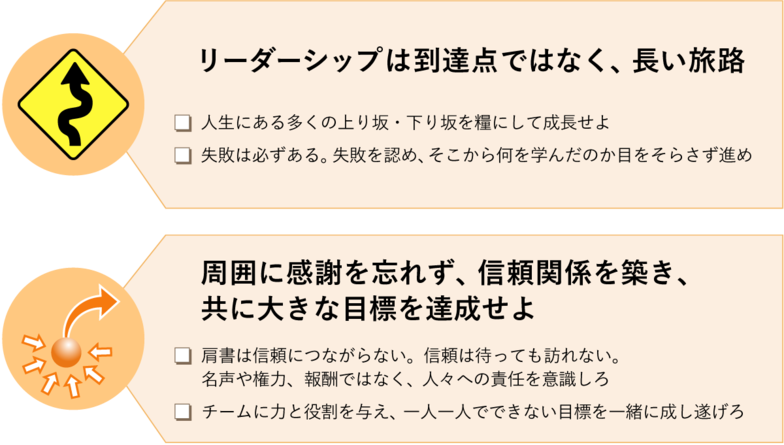
I see... But isn't this "true north" concept closer to the Japanese way of thinking than the American one?
We'll explore that next time! Alongside the evolving image of American leadership, we'll share an episode about Konosuke Matsushita that deeply impacted the young leaders from emerging nations participating in the program.
*1 From the latest data in the McCain Institute materials and the reference*2 "True North"
*2 "True North: Discover Your Authentic Leadership" by Bill George and Peter Sims. Published by Jossey-Bass in March 2007. A leadership theory book authored primarily by Bill George, Senior Fellow teaching leadership at Harvard Business School, documenting lessons and discoveries gained from interviewing 125 leaders who excelled both in their achievements and as individuals.
Was this article helpful?
Share this article


Newsletter registration is here
We select and publish important news every day
For inquiries about this article
Author