
Note: This website was automatically translated, so some terms or nuances may not be completely accurate.
 9.America in Years 11 to 15: Leadership in an Age Without Charts [3/7]
The Impact Konosuke Matsushita Had on Emerging Market Leaders

Kimié Morishita
Last time, we introduced the concept of "True North" – what is now required of leaders – using episodes involving Howard Schultz of Starbucks and former First Lady Michelle Obama. This time, we begin from the perspective that the concept of "True North" may have been practiced in Japan since ancient times.
The Impact Konosuke Matsushita Made in Washington
Setting aside the part about "following your own values," the "True North" concepts of "cherishing those around you and society," "working together," and "taking the long view" are actually things we've been told since childhood, right? "Kindness benefits others," "benefit all three parties" (benefit the seller, benefit the buyer, benefit society), "employees are family," "peaches and chestnuts take three years, persimmons take eight."
In theMcCain Institute'sNext Generation Leaders (NGL) Program I participate in during my time in the U.S., each member gave a presentation on "leaders who changed the world by following their own values." I introduced Konosuke Matsushita, founder of Panasonic. I first showed leaders from emerging nations like Congo and Pakistan photos depicting Japan's poverty around 1900 (when Matsushita was born) – where Japan ranked below Sri Lanka and nearly equal to Cuba in purchasing power parity (PPP), an economic indicator of living standards published by certain institutions – and images from the post-war period.
I explained how Matsushita dropped out of elementary school at age 9 to support his impoverished family, discovered the potential of electricity while working as an apprentice, and resolved to "make all materials as inexhaustible as tap water" – aiming to eradicate poverty from the world through commerce, believing this was the "mission of an industrialist." Despite losing his parents, all seven siblings, and later his eldest son in his youth, he cherished those around him—employees, distributors, and agents—building his global enterprise from a workshop smaller than 4.5 tatami mats. Deeply aware of the importance of education and nurturing people, he founded the Matsushita Institute of Government and Management, cultivating numerous leaders.
And the image of Japan in 2015, having achieved such development.
After a brief 10-minute presentation, the Decision Theater venue in Washington fell silent. Amidst the complete stillness, where all who had been asking various questions of other members had fallen quiet, the only sound heard uniformly was "...Konosuke, that's incredible..."
What first astonished these young leaders from emerging nations, unfamiliar with Japan, was the poverty of Japan at that time, where many children began working before the age of ten. And then, amidst adversity, it was the figure of Mr. Matsushita, who embodied the "true north" more than anyone else, who helped improve the lives of so many people through his unique ethics and relentless effort. "We had nothing. Our country was destroyed by war, and our children couldn't even go to school. Catching up to the privileged West seemed like a dream, but Japan, which we thought was an advanced nation from the start, actually did it..." "Having lost so many family members, how could he avoid despair and still think about the happiness of those around him? I want to hear Konosuke's story." Unfortunately, that's impossible, but there were also opinions like this: "Hearing Konosuke's story makes you realize that the purpose of a company isn't just to pursue profit, but to make society better."
Later, during an interview at the major PR firm Burson-Marsteller, Phirun, a teacher from Cambodia and one of the program members, responded: "Japan was very poor, but through education and leaders of high moral character, it became a respected developed nation. I want to work hard to raise children and make Cambodia a great country like Japan. If even one person doesn't give up and takes action, the day will come when we can change society."
It's a bit late to realize this, but I truly believe Japanese companies and leaders played an enormous role in making today's convenient society possible around the world. Since coming here, I've felt that Japan can do an infinite amount for many countries where people still can't enjoy convenient lives – not just for itself.
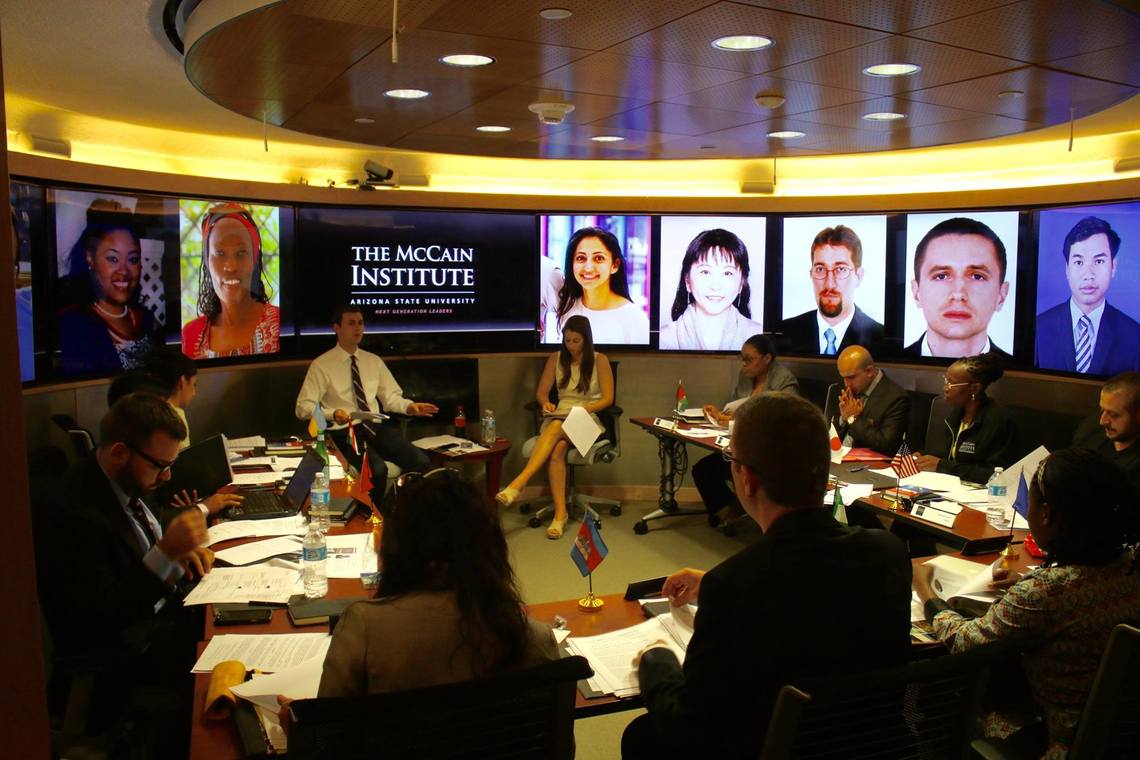
Decision Theater: As shown in the photo, it can function as a standard multi-screen display. For example, it can project a hypothetical scenario or figures onto the rightmost screen while simultaneously displaying the ripple effects unfolding in real-time across the subsequent screens. This allows leaders gathered together to simulate the impact of decisions and select the optimal scenario on the spot. (Provided by the McCain Institute)
The traditional role of a leader is "maximizing value."
Have expectations for leaders changed significantly?
This was the first question I felt upon arriving in America.
So, compared to when, and how did I feel things had changed?
It was the summer of 2001. America 15 years ago, just before 9/11. It was a time when the IT bubble was rapidly expanding and then bursting. I was attending business school near Chicago. Even then, leadership was a traditional subject. In a small class, the then-unknown President Obama (at the time, an Illinois State Senator – yes, the husband) taught us, calling himself a "community organizer," and he was within arm's reach.
Back then, leadership was defined as "the ability and qualities to move a team most efficiently and effectively toward achieving goals and delivering results." Ultimately, it could also be described as "the ability and qualities to maximize organizational or corporate (shareholder) value." What we were relentlessly taught, with overwhelming frequency, volume, and persistence, was the image of a rational leader who prioritized efficiency, effectiveness, speed, and short-term results under a clear vision.

And now. The sincere image of American leaders
The "true north" taught in the program bore no resemblance to the image of the unshakable leaders of the past. Initially, I viewed it skeptically, thinking, "Do people really believe that?" However, I had no choice but to abandon that doubt when confronted by the overwhelming presence and sincerity of the leaders themselves. In Washington, D.C., I met with Senator John McCain, Kurt Volker (former U.S. Ambassador to NATO and diplomat), and Admiral Dennis Blair (3rd Director of National Intelligence).
Can you imagine how these individuals engaged with us?
One person spoke earnestly, holding a handwritten, ink-stained memo, saying, "I noticed this was missing while I was showering this morning, so I added it..." Another person greeted us by name, asking questions based on our profiles (without notes, of course), saying, "I'm happy to share my lessons, but today I learned this. I want to apply this." Yet another person responded to our questions with long, long silences before searching for the best answer.
They say "Trust is paramount, but hard to build," yet nothing speaks louder than someone in a high position practicing their teachings with such unmatched intensity and utter sincerity. Above all, they engaged so deeply with this tiny group of complete strangers. We were utterly defeated (though it wasn't a contest!).

Keep doing what you believe is right, even if you make mistakes.
But what happens when a seriously delusional person puts this into practice? Hmm, it's serious... Everyone around them would be under immense stress every day. Yet, haven't the people who changed the world been, to varying degrees, delusional? Will they remain deluded to the end? Or are those around them mistaken? Or will the times change...? This experience made me think that those around them need to take the long view, too – what is that person's true north, and what will it lead to? While finding ways to vent that stress somewhere (Shinbashi, the holy ground for Dentsu Inc. employees, comes highly recommended. It's a shame I haven't been able to go lately).
On the other hand, I believe people who want to achieve something must constantly ask themselves "Is this truly right?" and then, with resolve and a sense of responsibility, persist in their convictions. Japan still feels like a place that strongly pressures conformity, and pushing through opposition might be tough in that environment. However, if you constantly compromise, avoid friction, and just go along with others, you risk losing trust over time. You might end up failing to accomplish what only you can do. I feel that the strength to stand firm in the direction you believe is right and to rally those around you will be increasingly demanded going forward (and I'm telling this to myself!).
And so, after three weeks in Washington, we each departed for our respective workplaces.
Next time, I'll share about the leaders in New York as we approach the 15th anniversary of 9/11!
Was this article helpful?
Share this article


Newsletter registration is here
We select and publish important news every day
For inquiries about this article
Back Numbers


Author