
Note: This website was automatically translated, so some terms or nuances may not be completely accurate.
 The ability to put things into words is a weapon. [5/5]
Even non-linear ideas are born from "organization."

Satoshi Umeda
ISBN: 978-4-532-32075-1
In the previous column, I outlined two methods for enhancing the resolution of your inner voice. The first was installing a "Thinking Cycle." The second was using the "T-shaped Thinking Method" as a concrete technique to advance your thoughts.
In this column, I'd like to explore how using the inner words written down through the T-shaped thinking method can advance your thoughts to areas you hadn't previously considered. Yes, even non-linear ideas actually stem from organization.
The foundation is the fragments of "inner words" written down in the previous column. Therefore, reading the previous column first will deepen your understanding.
Observe your inner words from a bird's-eye view.
After expanding your thoughts using the "T-shaped thinking method," the next step is to organize the broadened ideas. It's like sorting scattered materials on your mental desk, grouping similar items together and separating them by direction.
This makes it visibly clear how narrowly you've been thinking. But there's no need to be discouraged here. Because what you're doing at this stage is the process of recognizing your own thinking habits. Once you grasp your "tendency" – your own habit – you can develop "countermeasures" to overcome that wall of habit.
The first step in organizing is extremely simple. Look through the written notes one by one, grouping words that seem to represent a different way of thinking.
At this stage, you won't know how many clusters will ultimately form, and the number of papers assigned to each cluster will vary. This variation stems from your thinking patterns, so don't worry about things like "this group has an unusually high number" or "another group isn't forming." Just calmly continue sorting.
Once all papers are categorized, take the largest bundle—the one representing the dominant thought direction—and reclassify it. Having completed one round of sorting gives you an overview, allowing you to re-categorize with greater objectivity: "This inner thought could go in a different group," or "This might warrant a new group."
Repeating this process of sorting and reviewing about three times should result in groups that are mostly correct. In my case, I often find that one round isn't enough to fully grasp the whole picture, so I make sure to review at least three times.
After completing the first stage, rearrange the thoughts with the horizontal line representing the direction of thought and the vertical line representing the depth of thought.
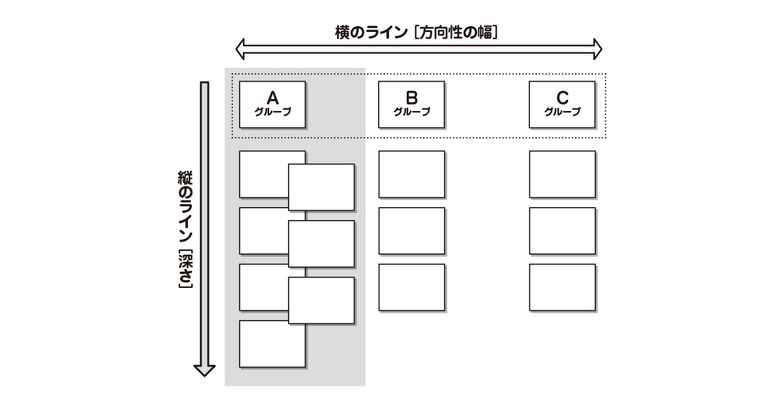
First, place the categorized souls from left to right in order of the number of sheets of paper, leaving space between them. This lays out the inner words born from different perspectives side by side.
Next, take the bundles sorted by direction. Within each, further classify similar ones, arranging them from top to bottom based on how closely they approach your true feelings or how strongly you feel "Yes, that's definitely it."
Arranging the papers this way allows you to grasp the breadth and depth of your thinking. Refining this grid increases the resolution of your inner words.
Once your thoughts are organized to this extent, the areas needing further consideration become clear. Is the breadth of your thinking insufficient horizontally, or is the depth of your thinking lacking vertically? Once you grasp this, what you need to think about next becomes obvious.
By constantly repeating this process while consciously focusing on "broadening" and "deepening," the "resolution," "vocabulary," and "density" of your inner words will increase.
Forcing yourself to consider the exact opposite widens your perspective.
From here, we move into the content of '③ Triggering a Chemical Reaction' as shown in the 'Thinking Cycle'. In my book, "Being Able to Put It Into Words Is a Weapon," I introduce several techniques such as "letting it sit properly," "considering the exact opposite," and "thinking from someone else's perspective." In this column, I want to focus specifically on "considering the exact opposite" and continue the explanation.
When using the "T-shaped thinking method" and consciously focusing on the vertical and horizontal lines, the visualized inner words remain strictly within "the bounds of your own common sense." Therefore, by considering the exact opposite, you can begin to contemplate "things you wouldn't think of within your own common sense," "things you couldn't have thought of," and "things your thoughts couldn't reach."
The common sense you hold is, in most cases, merely the common sense of your own world, often diverging from others' common sense. Nobel laureate Albert Einstein succinctly expressed this truth: "Common sense is nothing more than a collection of prejudices acquired by the age of eighteen."
As this quote suggests, your common sense is merely the common sense of the environment in which you were raised. To others, it is often unconventional—or, to put it another way, it is mostly preconception.
In other words, thinking the opposite leads to "breaking free from your own common sense and preconceptions." It can be seen as a process that forcibly expands your thinking into another world, prompting you to consider things not on the extension of your past self—discontinuous ideas.
So, how exactly does one think in the opposite direction?
You might associate "opposite = negation," but that's only one aspect of the opposite axis. Since there are several types of opposites, let's explore three specific opposite axes.
Opposite as Negation
Negation is the easiest form of opposite to grasp. It's straightforward because you simply need to find "what is not X."
Examples: Can ⇔ Cannot, Want to ⇔ Don't want to, Like ⇔ Indifferent ⇔ Dislike
Strength ⇔ Weakness, Agree ⇔ Disagree, etc.
Meaning-Based Opposites
This form involves progressing your thinking toward a direction with a relative meaning, rather than negation. If negation is seen as an antonym, then the opposite in meaning becomes a contrasting term.
Example: Want to ⇔ Have to, Hope ⇔ Anxiety, True feelings ⇔ Facade
Work ⇔ Play ⇔ Family, Past ⇔ Present ⇔ Future, etc.
The polar opposite in terms of perspective
Finally, this involves broadening your perspective by considering things from someone else's viewpoint. It's also an effective way to use the opposite to break free from self-centered thinking.
Examples: Me ⇔ Other person ⇔ Third party, Subjective ⇔ Objective, Someone I know ⇔ Someone I haven't met yet
Alone ⇔ Large group, Ally ⇔ Enemy, etc.
Mastering these three types of opposites allows you to explore ideas unimaginable from your own perspective.
It is crucial to feed back these newly discovered inner words into yourself during this process. Doing so increases the seeds of outward-directed words, empowering the language you use daily.
In the next column, we'll move into the stage of creating "words directed outward" for concrete communication.
Was this article helpful?
Share this article


Newsletter registration is here
We select and publish important news every day
For inquiries about this article
Back Numbers
Author