
Note: This website was automatically translated, so some terms or nuances may not be completely accurate.
 The ability to put things into words is a weapon. [3/5]
Sharpening the resolution of "inner words."

Satoshi Umeda
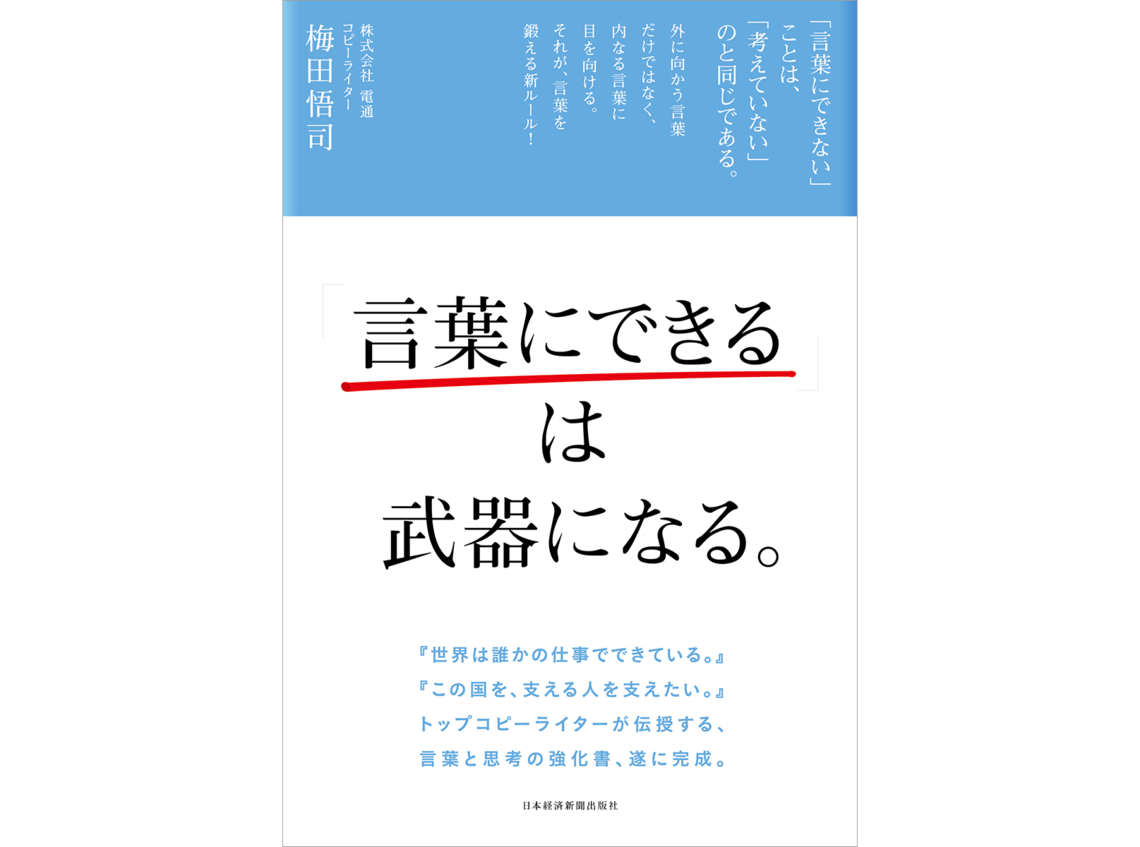
ISBN: 978-4-532-32075-1
Cultivating opinions through "inner speech" and converting them into "outward speech."
When we think or feel about things, we unconsciously utter words in our minds. As I wrote in my previous column, these are our "inner words." Whenever any emotion arises in our minds, it is always accompanied by these inner words.
While inner words form the core of outward words, it's difficult to recognize this relationship without conscious awareness.
"Outward words" are already visible and are the words we use daily, so they are easier to understand. On the other hand, "inner words" never appear on the surface, making them easy to overlook.
However, inner words definitely exist within our minds. Therefore, it is crucial to strongly recognize these inner words as "a single word."
The impressions people have about another's words—whether they feel "heavy or light," "deep or shallow"—stem from how much they have expanded and deepened their own thinking by engaging with their inner words. No matter how much one hones their outward words, they may gain verbal skill, but they cannot attain the weight or depth of words.
Breaking down this structure reveals a two-step process for creating words: ① Cultivating opinions through inner speech, and ② Converting them into outward speech. If you genuinely wish to refine your words, the priority is not to start with outward speech, but to first nurture your inner speech as opinion.

Enhancing the resolution of your inner words.
So, how exactly can you cultivate your thoughts through inner speech?
The most fundamental and crucial step is securing time alone to engage with the inner words that well up from within yourself. It comes down to nothing else than understanding for yourself what inner words arise when an event occurs, how you perceive things, and how your thoughts progress.
When something sad happens, what do you feel?
When something joyful happens, what do you feel?
What do you feel when you look back on the past?
What do you feel when you think about the future?
When facing difficulties, what do you feel?
What do you feel when you achieve success?
What do you feel when a friend is in trouble?
What do you feel when your friends achieve success?
In all these situations, don't dismiss the emotions that well up as vague categories like "happy," "sad," or "joyful." Instead, confront the complex thoughts that surface in your mind. Carefully engage with your own feelings, striving to recognize and grasp each one through words. Through this repetition, your inner language gains breadth and depth. This process is precisely what enhances the resolution of your inner words.
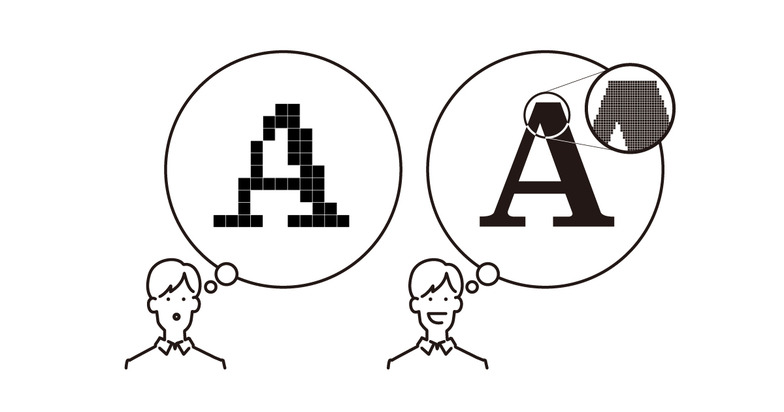
Resolution is a numerical measure of the precision of images or photographs, indicating the fineness of the grid used to represent the image and its density. It's also used to indicate the performance of monitors like those on PCs, smartphones, and tablets, so it might be familiar to some.
Resolution can be illustrated as shown above. The left side represents low resolution, while the right side shows high resolution. Although both display the letter "A," low resolution renders the character jagged and barely recognizable as an "A." Conversely, high resolution makes the shape of the "A" clear and distinct, allowing anyone to unambiguously identify it as an "A."
Now, let's apply this concept of resolution to our inner words.
When the resolution of your inner words is low, your thoughts and feelings are vague. You can't accurately grasp what you're feeling or thinking in the moment. In other words, you can't fully understand the very content you're trying to express through speaking, writing, or typing. Often, when your mind feels foggy, the root cause is actually low resolution in your inner words.
Conversely, the higher the resolution of your inner speech, the clearer your thoughts and desires become. The resolution of your inner speech is also an indicator of how well you understand your own mind.
In recent years, words like "cute" or "crazy"—which convey many emotions by omitting details—have become widely used. While these words are truly convenient, overusing them out of convenience can dull the sensitivity of your heartstrings, so caution is needed.
Moving forward, I encourage you to make it a habit to go beyond simply using "cute" or "awesome." Instead, use your inner words as a guide to delve into the root of your emotions and enhance the resolution of your inner words. As a result, the words you express outwardly will naturally become stronger.
In the next column, I will introduce several concrete methods for enhancing the resolution of your inner words. The stage of refining the words themselves comes later. What you should always keep in mind is the flow: nurture your opinions with "inner words" and then convert them into "words directed outward."
Was this article helpful?
Share this article


Newsletter registration is here
We select and publish important news every day
For inquiries about this article
Back Numbers
Author