
Note: This website was automatically translated, so some terms or nuances may not be completely accurate.
 The ability to put things into words is a weapon. [2/5]
It is not thinking. It is uttering its "inner words."

Satoshi Umeda
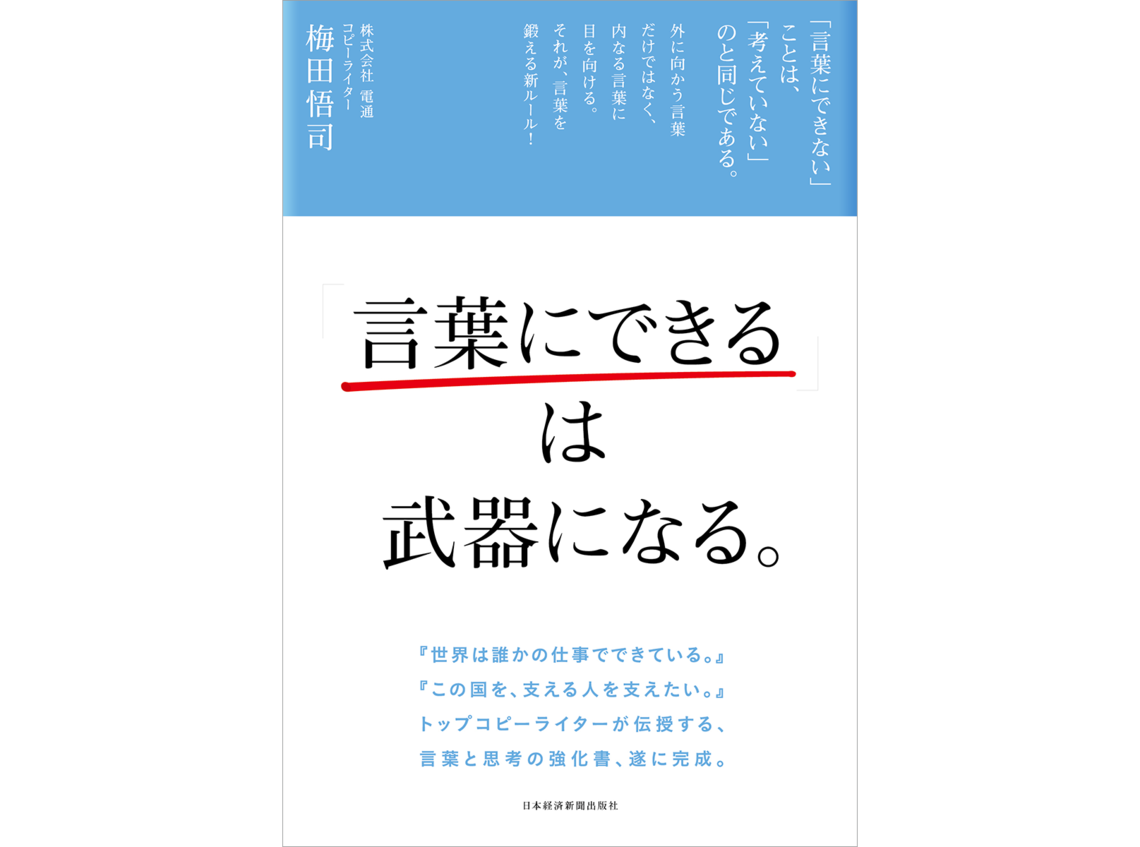
ISBN: 978-4-532-32075-1
There are levels to how things are conveyed.
Though we call them simply "words," many different kinds exist.
Spoken words, written words, heard words. And further, words typed on computers or smartphones.
To convey what you think or feel to others, you need to use words to express your emotions.
While emojis, photos, and stickers are increasingly used to convey feelings these days, the fact remains that to accurately and fully express one's emotions, we must inevitably use words—spoken, written, or typed.
This leads to the problem where, no matter how hard you try to convey something, it actually "didn't get through" or "wasn't fully understood."
If we consider words as tools for communication, it presupposes both a speaker and a listener. The situation where something "gets through" is the result of a joint effort between these two parties: the speaker and the listener, or the writer and the reader.
If we break down the levels of how well something is conveyed into finer details, we can organize them into the following stages:
・Misunderstanding/Misinterpretation
The message hasn't been conveyed at all, or the content has been conveyed incorrectly. A gap in understanding has emerged between the sender and the receiver. In real life, this often surfaces as problems like "I said it, but you didn't hear it" or "I heard it, but you didn't say it."
・Comprehension
The conveyed content has been received accurately and completely. The recipient has grasped what was said without omission or error. However, this does not involve interpretation beyond mere comprehension, and it can easily lead to situations where "the mind understands, but the heart doesn't follow."
・Acceptance
A state where the speaker's words are not only intellectually grasped but also deeply resonate. Compared to mere understanding, this involves internalizing the message as personally relevant. Listeners often experience accompanying emotions like "I see" or "That makes sense."
・Empathy/Resonance
A state where, after understanding what was seen or heard, one's heart is moved and personal interpretation is added. One feels "That's exactly right" about the other person's opinions or emotions, adding their own thoughts, or feeling motivated to take action like offering to help by asking if there's anything they can do.
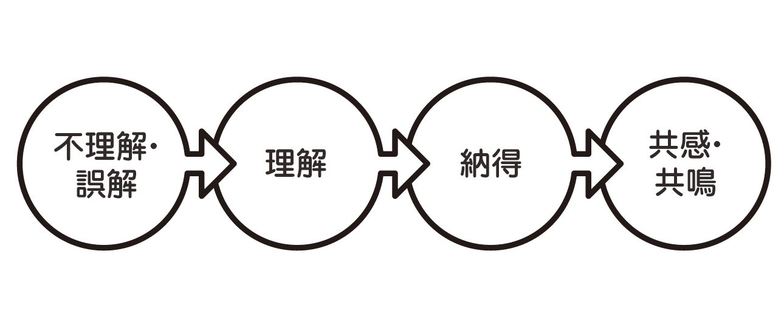
Looking at it this way, while reaching understanding is a passing grade, it becomes clear that conviction and empathy/resonance are the true essence of communication.
Now, I want you to recall something.
When meaning was unclear or you felt nothing in response to someone's words—that is, when communication stopped at misunderstanding, misinterpretation, or mere comprehension, failing to reach conviction, empathy, or resonance—how did you evaluate that person?
Most likely, it wasn't an evaluation of their actual word choice—like "their wording is poor" or "they should express themselves better"—but rather a judgment of their character: "their thoughts aren't organized," "their ideas are shallow," or "they haven't thought deeply."
In other words, humans unconsciously evaluate the very essence of a person's character through the weight or lightness, depth or shallowness inherent in their words—and are themselves evaluated in turn.
Are you aware of the existence of your "inner words"?
Are there concrete ways to give words weight and depth?
The key theme I want to explore is the existence of "inner words." More specifically, it's the weight of words gained by giving breadth and depth to the "inner words" born within our own minds.
Yes, what's truly necessary to create words that resonate in the listener's heart isn't polishing the "words directed outward" that we actually write, speak, or type.
"Inner words" are distinct from the words used in daily communication. They are the words that unconsciously surface as emotions in your mind, or the words you use to deepen your thoughts through self-dialogue. It's no exaggeration to say that every emotion and thought that arises in your mind is brought about by these "inner words."
For example, when coffee is unexpectedly hot, alongside your physical reaction, your brain says "Hot!"
When you see a cat in your neighborhood and want to take a picture, you say "Cute" or "Let's take a picture."
Even when reading this passage and feeling convinced, you're saying "Indeed." When feeling doubt or disagreeing with an opinion, you're saying "Is that so?"
In this way, even without concrete actions like speaking, writing, or typing words, you are still using language in your mind.
Becoming aware of this fact and directing your attention to it contributes to enriching the thinking that is the source of all actions. This is because accurately grasping "what you are thinking right now" and "what inner words are being born in your mind" creates the seeds for "words directed outward," naturally refining those outward-directed words. As a result, your words gain weight and depth, enabling you to use words that feel convincing.

Comparing "words directed outward" with "inner words," the latter—converting opinions into words—seems easier to imagine and more effective. But if you have no opinion within yourself, if there are no thoughts to put into words, what exactly are you supposed to say? You can only blurt out whatever comes to mind instantly or respond reactively to the other person's words.
The result is often a one-sided label like "This person isn't thinking at all," born from misunderstanding or miscommunication. To avoid falling into this trap, it's crucial to cultivate a source within yourself that continuously generates opinions and thoughts. And it's important to recognize that the stage of verbalizing those opinions and thoughts comes only after this.
In the next column, I will explain how to cultivate your own opinions by focusing your awareness on your "inner words."
Was this article helpful?
Share this article


Newsletter registration is here
We select and publish important news every day
For inquiries about this article
Back Numbers
Author