Note: This website was automatically translated, so some terms or nuances may not be completely accurate.
 F2 is the "Frustration-Filled" generation where frustration and irritation are at their peak?! [1/4]
The F2 generation is connected by their worries!
Hello everyone reading Web Dentsu Inc. News. My name is Reiko Murata from Video Research Ltd. I lead the 'f2 Lab' team researching the F2 demographic.
As you may know, F2 refers to women aged 35 to 49 (*1). The F2 demographic currently numbers approximately 13.4 million people. With Japan's total population at around 127 million, F2 accounts for just over 10% of the total.
Today's F2 generation consists of the "baby boom junior generation" (children of the baby boomers) and the "employment ice age generation" (those who entered the workforce after the bubble economy burst). They are a large cohort of women following the demographic wave of the baby boomers. Generally, this is the period of family formation—marriage, childbirth, and child-rearing—when their responsibilities increase.
As F2 women, they exert significant influence across other age groups, serving as the "family hub": as wives to their husbands, mothers to their children, and daughters or daughters-in-law to their parents. Their multiple roles grant them exceptionally strong influence over other generations.
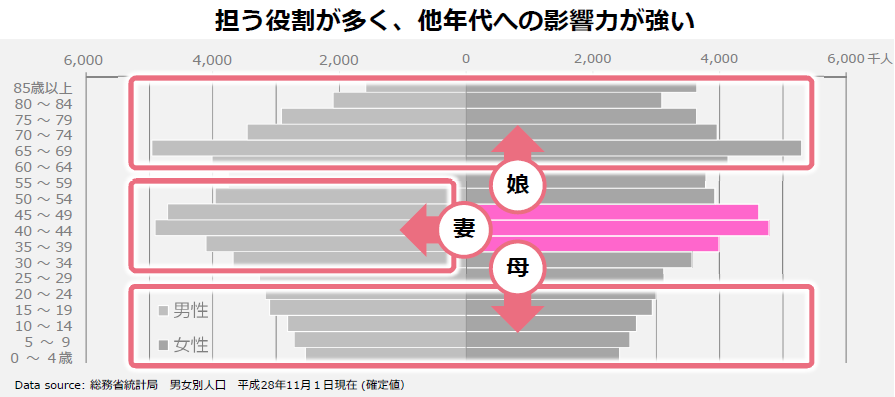
Let's examine the actual data on consumption.
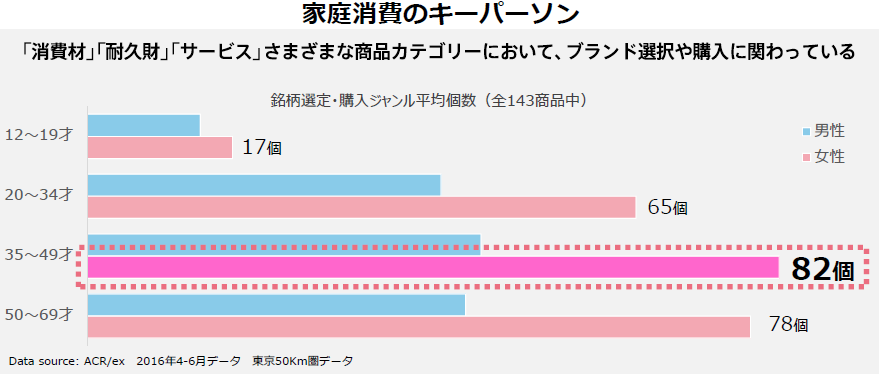
Analysis of our ACR/ex survey(*2) also shows that F2 is most involved in brand selection and purchasing, particularly for consumer goods. As a key target for corporate marketing challenges, F2 is undoubtedly the "key decision-maker for household consumption."
The lifestyle of F2 is undergoing significant change
As many of you may already sense, within this short span of 10 to 15 years, life course choices have dramatically shifted, with an increasing number of F2s opting for diverse lifestyles.
Traditionally, F2 could be broadly defined as housewives with children roughly in elementary to junior high school. However, amid trends toward later marriage and childbirth, today's F2 segment is diversifying (becoming more dispersed). This is reflected in children's varying ages and diverse work arrangements, including part-time, temporary, and full-time positions.
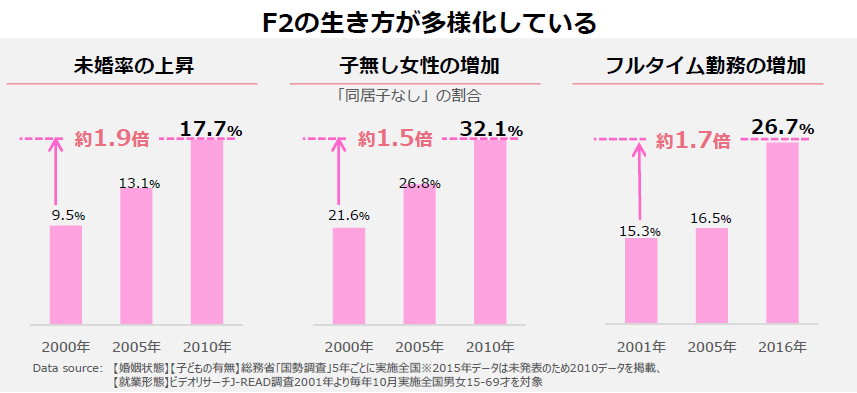
I imagine many companies are conducting marketing based on segmentation by life course, such as the following.
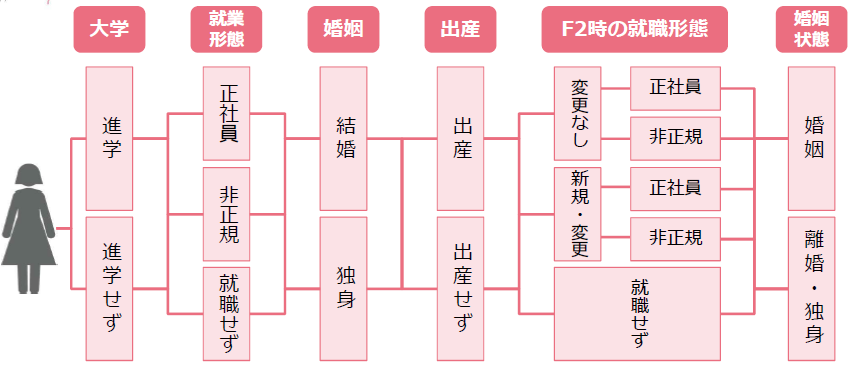
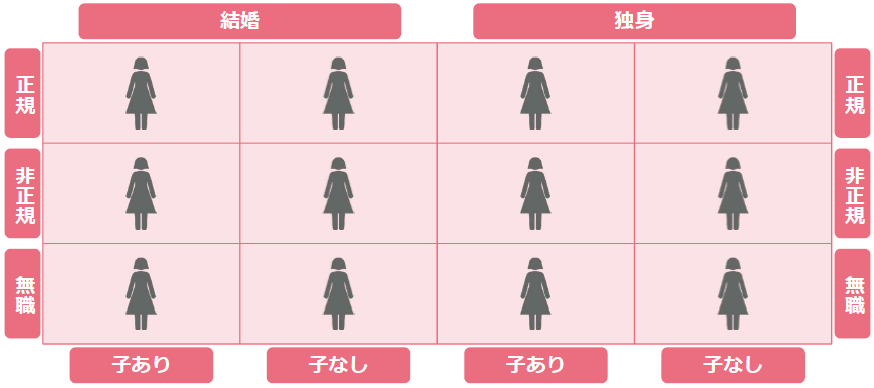
On the other hand, F2 sees segmentation re-differentiating—marriage/non-marriage, full-time/part-time employment, having children/not having children—and the more precisely one tries to capture it, the smaller each segment becomes, conversely blurring the overall picture. Corporate marketing managers may well feel this difficulty.
The common thread that unites them is "the abundance of worries."
Since beginning research at f2 Lab about a year and a half ago, we've conducted quantitative analysis using our company's ACR/ex consumer database to understand F2 values and behaviors, and we've also gathered direct feedback from over 100 F2 individuals. In doing so, we've gathered insights on a wide range of topics, including their life histories, ideal lifestyles, and daily concerns.
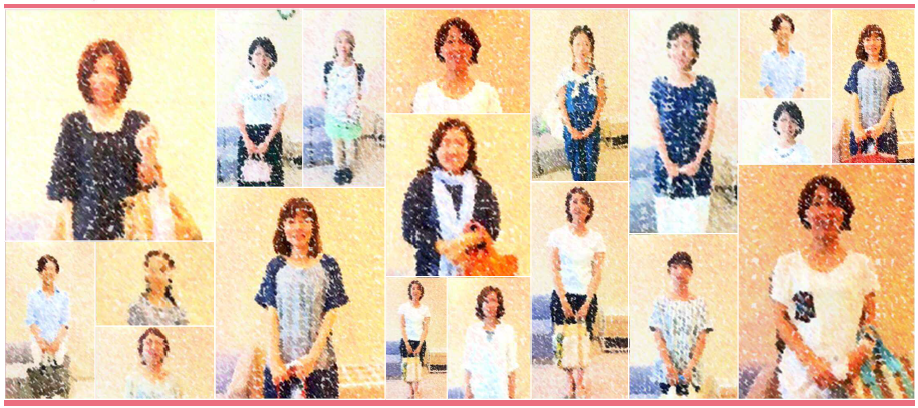
And as we listened to their voices, we noticed a common thread: the sheer number of worries they carry. While each individual concern might seem insignificant, we found that these worries and conflicts accumulate, creating a lingering sense of unease in their hearts.
During group interviews, it was common to see participants who initially struggled to build rapport (*3) suddenly connect, exclaiming "I get it! I totally get it!" in mutual understanding.
"We, F2, are connected by our worries!"
We concluded that this shared, worry-filled daily life was a common ground that could serve as an angle to understand them. Next time, we'll delve into this "worry-filled daily life," the common thread that defines this F2 group. Thank you for reading this far!
<End>
*1) In our media targeting classifications, including our viewership ratings surveys, the age groups are segmented as follows: 20–34 years old as Tier 1, 35–49 years old as Tier 2, and 50 years old and above as Tier 3. The "F" in F2 stands for Female; for reference, "M" denotes Male.
*2) Analysis Overview
Survey Source: ACR/ex
Survey Method: Persuading respondents through visits, electronic survey forms via tablet devices
Analyzed Population: 4,800 samples of men and women aged 12 to 69 residing within a 50km radius of Tokyo
Survey Period: April–June 2016
*3) In psychological terms, a state of harmony and mutual understanding.
Was this article helpful?
Share this article


Newsletter registration is here
We select and publish important news every day
For inquiries about this article
Author

Reiko Murata
Video Research Ltd.
Human Research Institute
f2 Lab Leader