Note: This website was automatically translated, so some terms or nuances may not be completely accurate.
 F2 is the "Frustration-Filled" generation where frustration and irritation are at their peak?! [2/4]
What is the "frustratingly vague" daily life of F2?
Approximately 90% of F2 feel a sense of unease
In our previous column, we noted the commonality among F2 women of having numerous worries. While each concern may seem small individually, these worries and conflicts accumulate and intertwine, building up in their minds like a layer of dust to create a sense of "moyamoya" (muddled feelings).
Our independent survey revealed that approximately 90% of F2 women experience this foggy feeling, irritation, or stress in their daily lives. When combining those who feel this way "always" and "often," the frequency reaches about 60%.
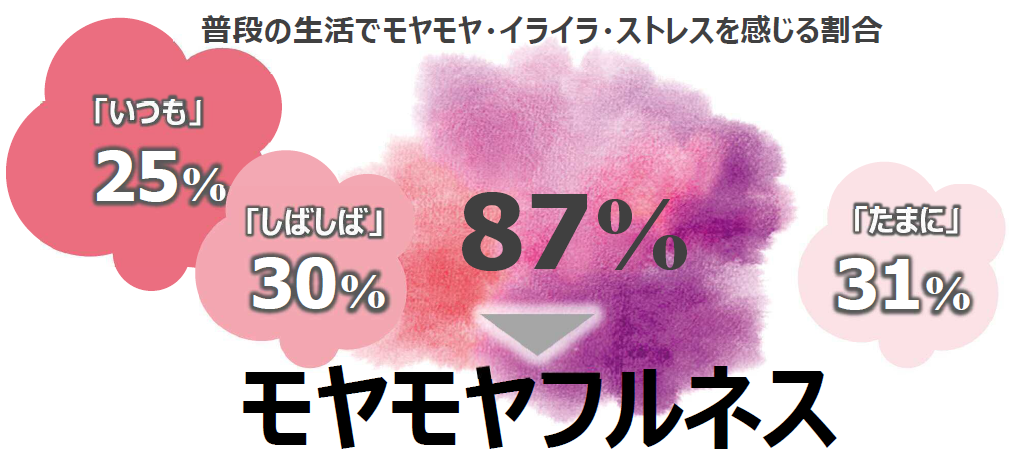
The cause lies in the complex accumulation of various worries, a state we named "Moyamoya Fullness." Furthermore, we observed that this "Moyamoya Fullness" in daily life influences F2's consumption behavior, presenting business opportunities from a corporate perspective.
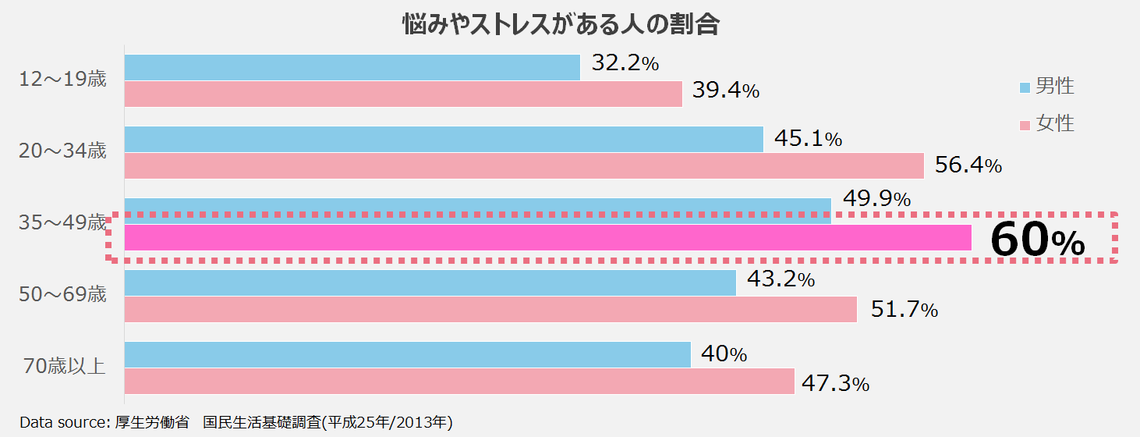
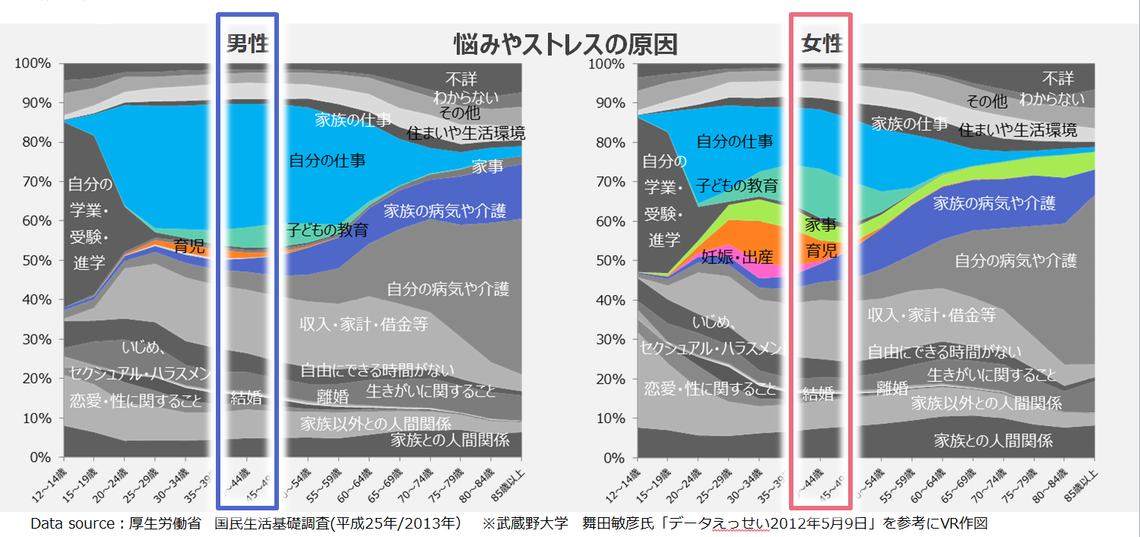
Many may wonder: Is this "Moyamoya Fullness" unique to F2? Certainly, no one is entirely free of worries. However, according to a Ministry of Health, Labour and Welfare survey (2013 National Life Survey), F2 has the highest proportion of people reporting worries and stress compared to men and other age groups.
The causes of these worries are also unique to F2. Comparing the causes of worry between men and women, for example, men of the same age group, namely M2, place a high weight on "their own work." However, for F2, in addition to "their own work," "housework," "childcare," "children's education," and other small but numerous responsibilities pile up.
As mentioned in the previous column, the sheer number of roles F2 women juggle is significant. This likely contributes to the greater quantity and complexity of their worries compared to men and other age groups.
The Real Deal with That Fuzzy Feeling
So what kind of "frustrations" do F2s carry? Below are representative examples of the "frustrations" we've heard from them.
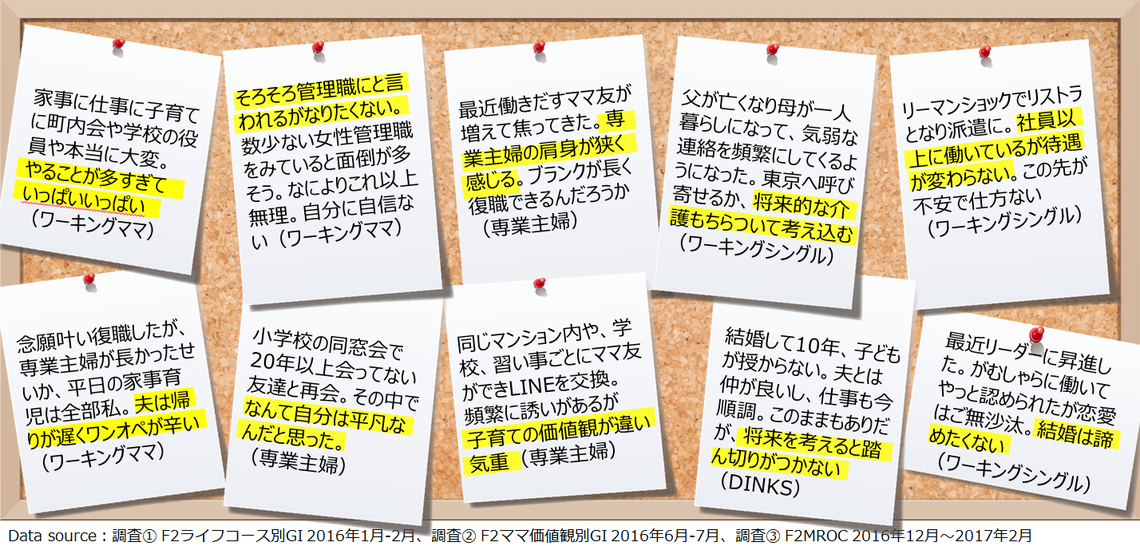
For example, stay-at-home moms tend to be relied upon for things like PTA or neighborhood association duties. A common sentiment expressed was that despite dedicating themselves to school and community, they feel somewhat marginalized by recent trends, and others seem dazzlingly successful by comparison.
It was also striking how many self-introductions in the interviews included self-deprecating phrases like "just a full-time homemaker" or "a carefree homemaker."
For women in dual-income households, many feel hesitant to bring up household chores division due to feelings of inferiority stemming from lower income or fewer working hours compared to their husbands. Additionally, those returning to work after childcare leave or re-entering the workforce after being a full-time homemaker often shared that their family's expectations hadn't changed, leaving them still primarily responsible for household chores and childcare.
Working singles, on the other hand, often feel greater anxiety about their own future compared to married individuals. They also tend to be more reliant on their parents and siblings.
What are the 4 major frustrations of F2?
Organizing these many frustrations reveals four major patterns.
① Confusion stemming from having multiple "faces"
② Confusion from wavering self-affirmation due to diverse choices
③ Confusion stemming from financial insecurity
④ Confusion stemming from physical discomfort
① This unease stems from having multiple "faces"—such as mother, wife, daughter, and working professional—yet receiving little understanding or recognition for these roles.
While dissatisfaction with the lack of recognition from others certainly exists, what was felt more strongly was that the person themselves also vaguely held an ideal image of "how things should be," including societal norms. When they couldn't fulfill these roles well, they felt guilt and blamed themselves, leading to this sense of unease.
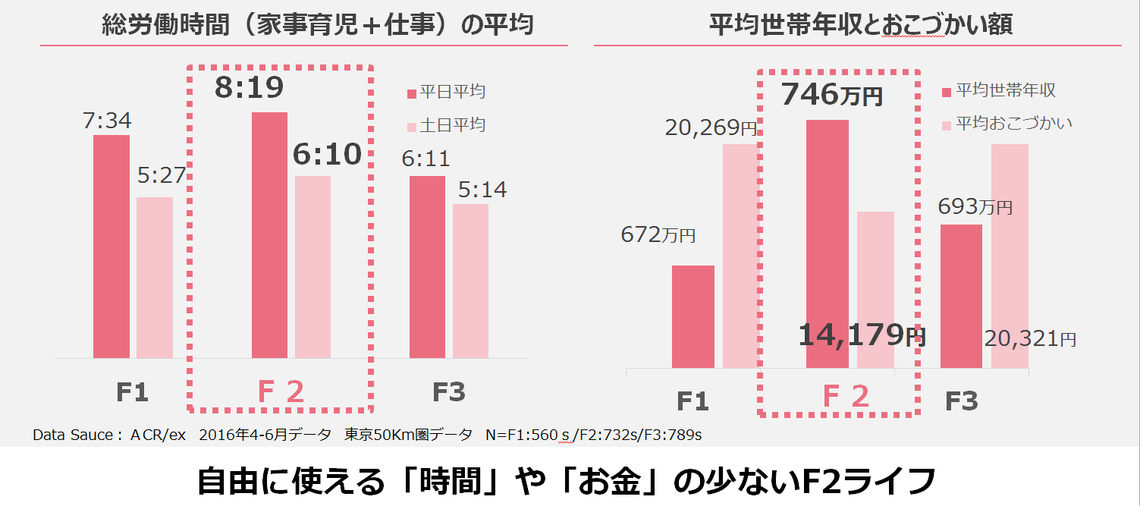
Furthermore, transitioning from F1 to F2 significantly increases total working hours—combining housework, childcare, and paid work—on both weekdays and weekends. Even though household income may rise, personal spending money drastically decreases. F2 life clearly involves little free time or money, many constraints and sacrifices, and consistently putting oneself last.
② is low self-esteem. With more lifestyle choices available these days, we often hear about "shaky self-esteem" – losing confidence, wondering if this really is the right way to live, or feeling down when comparing oneself to others.
In the past, friendships naturally drifted apart when opportunities to meet in person decreased. Now, however, social media makes it easier to see different lifestyles and ways of living, which seems to be contributing to this trend.
Furthermore, precisely because life paths have diversified, it can be surprisingly difficult to find someone nearby who shares similar struggles.
③ is the prevalence of worries stemming from economic insecurity, which cannot necessarily be resolved by one's own efforts alone. The current F2 generation is largely comprised of those from the so-called "employment ice age" generation. The university graduate employment rate for those turning 40 now was a record low of 55%.
Due to the social climate at the time, women faced particularly tough job markets. Many who couldn't secure their desired positions ended up as temporary workers, feeling anxious about their future prospects—a concern amplified for those who are single.
④ is the overlapping physical and mental discomfort. F2 coincides with a period of significant bodily changes. Medically, female hormones begin to decline around age 35, and drop sharply after age 40.
According to OB/GYN specialists, this coincides with later childbearing ages and increased career demands for working women. This overlap with bodily changes makes the impact on daily life more pronounced than in the past. Our interviews also revealed numerous voices expressing difficulty keeping up with these physical changes, feeling misunderstood by others, and finding it hard to talk about these issues.
Thus, F2 life is truly filled with a hazy fullness, or "moyafuru" for short. Precisely because of this, we've come to understand that F2s are learning to navigate this hazy fullness skillfully or take action to overcome it, ensuring they aren't crushed by it.
Next time, we'll focus on these coping strategies. We'll explore potential business opportunities emerging from the behaviors associated with this Moya-Furu lifestyle.
Was this article helpful?
Share this article


Newsletter registration is here
We select and publish important news every day
For inquiries about this article

Author

Reiko Murata
Video Research Ltd.
Human Research Institute
f2 Lab Leader