Note: This website was automatically translated, so some terms or nuances may not be completely accurate.
 Planning for a Better Life [5/11]
How to Raise Your Wellness Deviation Score? ~Money, Popularity, and Self-Esteem~
In the first installment of this column, we explained that wellness refers to "a state of radiant health in both mind and body" and signifies "living better." But can we really measure "how much wellness" someone has? Precisely because it's a concept above health, it shouldn't be measured solely by the "worry symptoms" introduced in the third installment. Therefore, Team Wellness decided to create five indicators—adding "happiness level," "coolness level"*1, "satisfaction level," and "stress level" to "health level"—to gauge wellness. This time, I'd like to discuss that.
Before diving into the specific results, what state do you imagine when you hear "a radiant state of physical and mental health"? In a survey two years ago, we asked about "your ideal state of health" by adding wellness-related elements to Maslow's Hierarchy of Needs, which theorizes human desires in a five-tiered hierarchy.
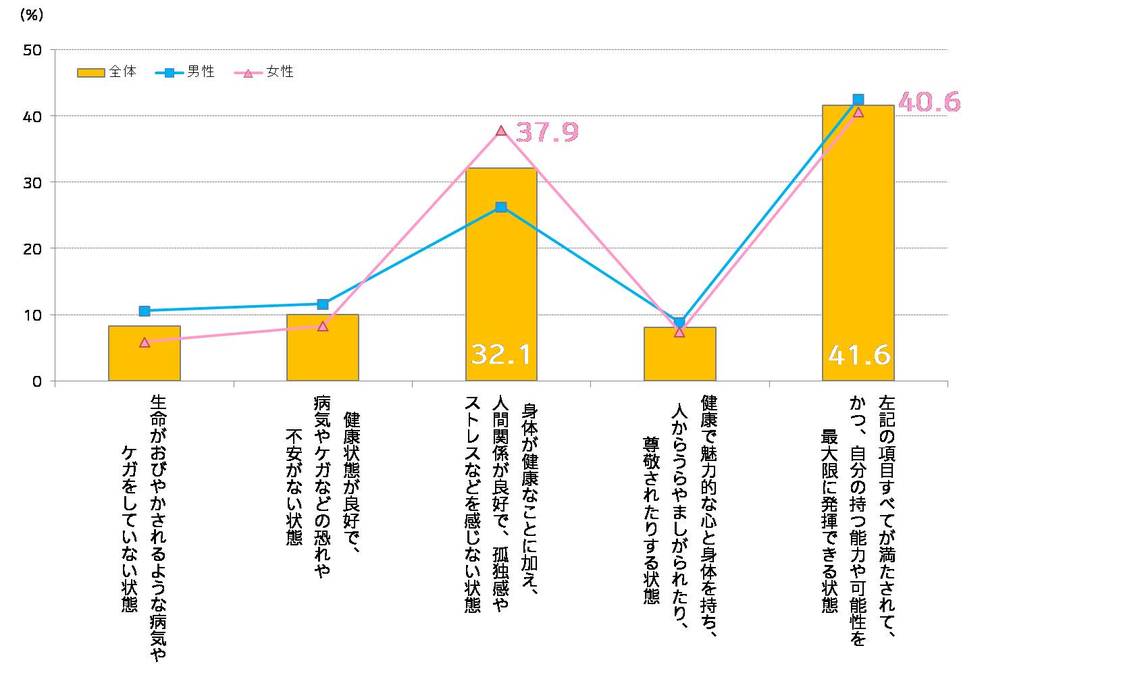
According to that survey, the most common response was the highest level of health among the options. Since the choices were arranged in ascending order of health, this was the natural choice. However, another item achieved a score very close to this top choice. That was "a state where, in addition to physical health, one has good relationships and feels no loneliness or stress." This means that roughly one in three people desire "good interpersonal relationships" more than being able to perform at their peak or having an enviable physique, or consider this sufficient. Whether viewed as a focus on realistic expectations or prioritizing relationships, this feels very much in line with contemporary values.
I digressed a bit, but let's get back to the topic of the five wellness indicators.
To jump straight to the conclusion: we found that "wellness levels generally improve with age for both men and women."
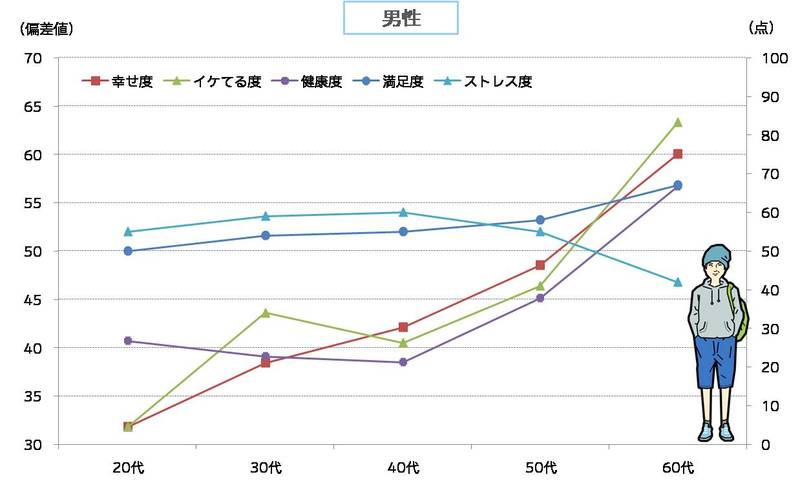
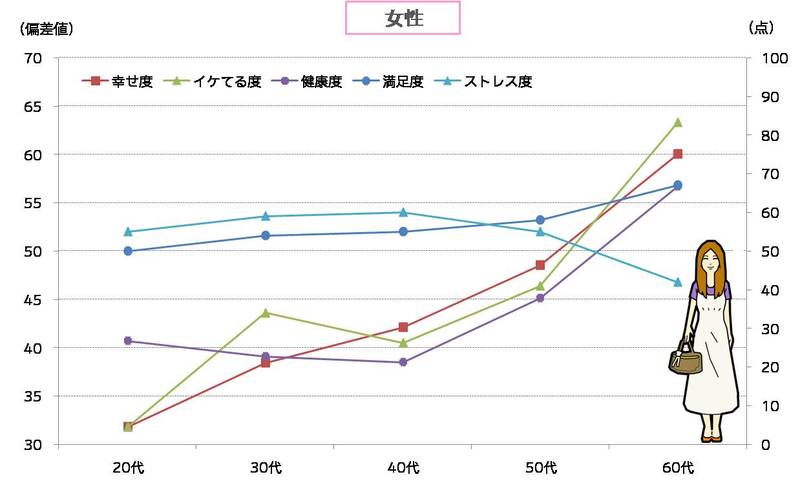
Health, Coolness, and Happiness are shown on the left axis as deviation scores, while Satisfaction and Stress are shown on the right axis as raw scores.
Why "generally"? Because the "40s" age group didn't fit this pattern. Their perceived health and coolness scores were lower than those in their 30s, their stress levels were the highest, and for women, their happiness scores also declined. While generational characteristics vary, analysis of qualitative research and magazine data suggests that after the 20s—marked by pure struggles with dreams—and the 30s—driven by relentless pursuit—the 40s seem to be a time to pause and reflect on oneself. It might be an age where, upon closely examining one's state, people feel the gap between their ideal and reality, or the decline brought by age, sometimes leading to discouragement.
Creating these metrics also made the following points visual:
・"Health," "feeling cool," and "happiness" are linked.
・ Being satisfied doesn't necessarily mean you're happy. And being happy doesn't necessarily mean you're satisfied.
Once we understand how well consumers are doing wellness-wise, the next question is: What would it take to make them do even better? This can be seen as an unmet need, offering hints for product development and promotional activities. Can you guess?
The overwhelming number one factor is "money." It completely dominates the top spot for men and women from their 20s to 50s. However, its ranking drops among those in their 60s, where "daily fulfillment" and similar factors become more valuable than money. Furthermore, summarizing the elements of the top items ranked second and below reveals that to live better, people feel they need things like "self-esteem (confidence, etc.)," "popularity/romance," and "peace/healing." Incidentally, looking at men and women separately, men seem to lack "sense of accomplishment," while women lack "smiles," compared to their ideals. 
What do you think? How would you rate your wellness score? What would help you shine brighter? This post got a bit lengthy, so we'll skip the small tidbits this time. Thank you for reading this long article.
※1 "Cool Factor" = Overall assessment of appearance, financial status, social standing, popularity among peers, etc.
Was this article helpful?
Share this article


Newsletter registration is here
We select and publish important news every day
For inquiries about this article
Back Numbers

Author

Michiko Obata
Dentsu Inc.
PR Solutions Division, Business Development Department
Integrated Marketing Strategist, PR Planner