
Note: This website was automatically translated, so some terms or nuances may not be completely accurate.
 Advertising Legal Pitfalls Explained in 3 Minutes [1/9]
Advertising orientation information is confidential!
Hello. I'm Masanori Hasegawa from Dentsu Inc. Legal Management Bureau.
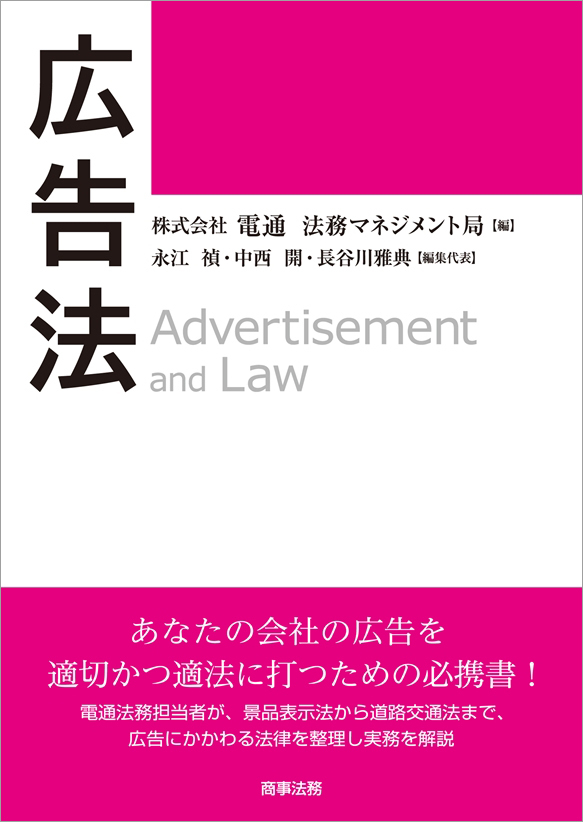
In 2017, a group of volunteers from the Legal Management Bureau published a book titled "Advertising Law" with Shōji Homu. "Advertising Law" comprehensively explains the legal regulations related to advertising from both practical and theoretical perspectives.
Advertising should be implemented to raise awareness of products, brands, and the company itself, fostering a positive image. However, there are cases where advertising damages that image, and the most egregious example is advertising that violates laws and regulations.
To prevent such counterproductive outcomes, this series will focus on particularly practical points from 'Advertising Law' and explain them in a Q&A format.
This time, we'll look at the planning stage of advertising, focusing specifically on points to note during planning and presentations.
Q. I work at an advertising agency. Our client is holding a competitive presentation for a new product launch campaign, and we've been invited to participate.
I'll be attending the orientation soon. What should I be mindful of? When an advertiser requests proposals for an advertising campaign from agencies, there is often an opportunity beforehand to share information about the product or service targeted by the campaign, along with an overview of the campaign itself. This is called an orientation.
During the orientation, highly confidential information, including new product details, may be shared.
A. Please ensure strict information management to prevent leakage of received information. If information leaks due to carelessness, you may face claims for damages from the advertiser, who disclosed the information.
Additionally, you may disclose received information to partner companies when outsourcing part of the presentation-related work to them. If a non-disclosure agreement (NDA) exists with the advertiser, you must handle it according to the contract (e.g., obtain the advertiser's consent). Furthermore, when disclosing information, you should also enter into a confidentiality agreement with the partner company. In the unlikely event of an information leak, immediately consult with the relevant specialized department within your company.[Basic Knowledge]
Explanation of Non-Disclosure Agreements.
1.Definition of Confidential Information
In confidentiality agreements, confidential information is often defined as "information disclosed in tangible form, such as documents, charts, or other related materials clearly marked as confidential." Information meeting this definition qualifies as confidential. Therefore, if the disclosing party provides information in a manner matching this definition, the receiving party can be held liable under the confidentiality agreement if they leak that information.
2.In Case of Violation
If information is disclosed in violation of the confidentiality agreement, the disclosing party is obligated to compensate the disclosing party for any damages incurred as a result. Additionally, the disclosing party may be obligated to take necessary measures to minimize damages arising from the disclosure.
(Note) This content is from a legal perspective. In actual business transactions, various additional measures may be necessary.
Was this article helpful?
Share this article


Newsletter registration is here
We select and publish important news every day
For inquiries about this article
Author

Masanori Hasegawa
Dentsu Inc.
Legal Management Bureau

