
Note: This website was automatically translated, so some terms or nuances may not be completely accurate.
 Advertising Legal Pitfalls Explained in 3 Minutes [2/9]
Whose ad is it?
In this series, we'll focus on particularly practical points from the book Advertising Law and explain them in a Q&A format.
This time, we address the question "Who owns the finished advertisement?" specifically examining who holds the copyright to the advertisement.
Q. Who owns the finished advertisement?
Does ownership differ depending on the type of advertisement, such as newspaper ads, magazine ads, TV commercials, internet ads, billboards, or hanging advertisements? Must advertisers re-commission the advertising agency or production company that created the ad if they want to reprint posters or replace hanging TV ad banners?
The question "Who owns the ad?" has various answers depending on perspective. However, when determining whether the finished ad can be freely used, it is necessary to consider the attribution of copyright.
A. For "video advertisements" like TV commercials and some internet ads, copyright generally belongs to the advertiser.
For advertisements other than "video advertisements," such as graphic ads or audio-only ads, copyright generally belongs to the creator of the advertisement. This is often an advertising agency, a production company, or a joint creation by both. In such cases, copyright belongs to both companies.
[Basic Knowledge]
An explanation of copyright.
1.What is Copyright?
① "Creative expressions of ideas or emotions" constitute copyrighted works
② The "person who created the work" is the author.
③ "The exclusive right of the author to use the work" is copyright.
④ "Copyright" generally* belongs to the author
*Exceptions are listed in point 3.
2.What is copyright? (The following is not an exhaustive list)
① The right to prevent unauthorized reproduction (copying) of one's own work
② The right to prevent others from modifying one's work without permission
③ The right to prevent the use of modified versions
Therefore, reprinting (reproducing) posters requires permission from the copyright holder. Advertisements are generally created by advertising agencies or production companies commissioned by advertisers. Consequently, unless otherwise agreed upon between the parties, the copyright for the advertisement generally belongs to the advertising agency or production company (or both) that created it. However, "video advertisements" are an exception.
3.Copyright Ownership of "Video Advertisements"
① "Video advertisements" are cinematographic works
② Copyright for "cinematographic works" belongs to the film producer
③ In "video advertisements," the film producer is generally the advertiser
However, it is common for advertisements to utilize materials where third parties hold rights (such as talent or existing works by third parties). Additionally, photographs may be commissioned from freelance photographers, or illustrations created by freelance illustrators, for use as materials. In such cases, the copyright for these photographs or illustrations belongs to the photographer or illustrator (though it may be transferred by agreement between the parties).
When using advertising, one is subject to the restrictions of these material usage agreements. Therefore, even if copyright belongs to the creator, it is often not possible to use the advertising completely freely. Consequently, even for modifications in video advertising like TV commercials, consultation with the advertising agency or production company that created the ad is necessary.
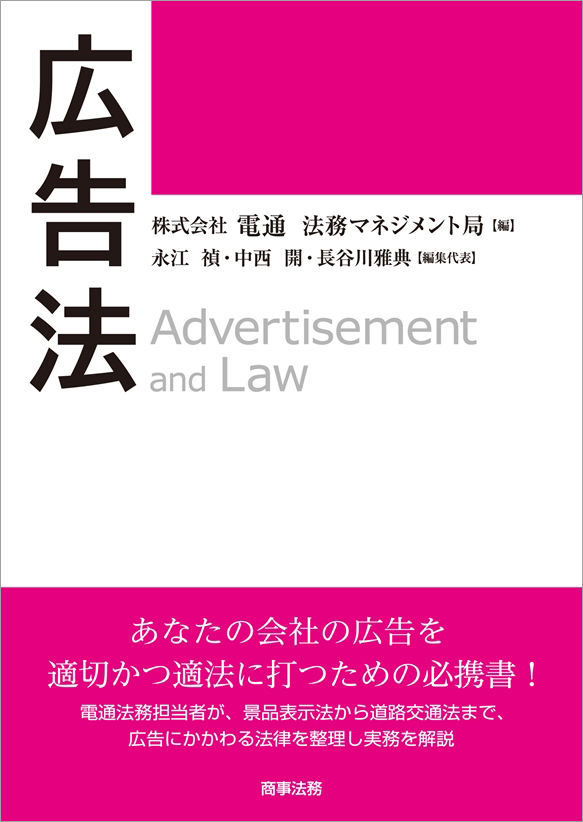
For more details, please refer to the book 'Advertising Law', which comprehensively explains the legal regulations related to advertising from both practical and theoretical perspectives.
Was this article helpful?
Share this article


Newsletter registration is here
We select and publish important news every day
For inquiries about this article

Author

Masanori Hasegawa
Dentsu Inc.
Legal Management Bureau

