
Note: This website was automatically translated, so some terms or nuances may not be completely accurate.
 Advertising Legal Pitfalls Explained in 3 Minutes [3/9]
Exercise caution when handling sample images in advertising planning and presentations!
In this series, we'll focus on particularly practical points from the book Advertising Law and explain them in a Q&A format.
This time, we address the handling of sample images in advertising planning and presentations.
Q. When planning or presenting advertisements, we sometimes use existing works—such as visuals or music—as sample images to share the intended final look. What should we be mindful of? Examples of sample image use include: - Using existing photos or videos as sample visuals in presentations to explain, "We'll create graphic ads with this kind of image." - Discussing internally within the planning team, "How about composing an original song with this kind of feel?"
A. If the final product is strongly influenced by the sample image, it may constitute copyright infringement (such as unauthorized reproduction or modification). This could lead to cease-and-desist orders or claims for damages under copyright law.
Therefore, handling sample images requires extreme caution in advertising business practice.
Even when sample images are used solely for sharing concepts, there may be uncertainty about whether the final advertising production will be recognized as an independent creative work distinct from the sample image.
In such cases, ensure the work undergoes review by specialized departments within the company.
[Basic Knowledge]
A brief explanation of copyright.
1.What is Copyright?
① "Creative expressions of ideas or emotions" constitute copyrighted works
② The "person who created the work" is the author.
③ "The exclusive right of the author to use the work" is copyright.
2.What rights does copyright confer? (The following are not exhaustive)
① The right to prevent others from reproducing (copying) one's work without permission
② The right to prevent others from modifying one's work without permission
③ The right to prevent others from using modified versions
Therefore, using someone else's creative expression of ideas or emotions (i.e., a work) in advertising without permission (unauthorized reproduction) or using it after making minor changes (unauthorized modification) can potentially constitute copyright infringement.
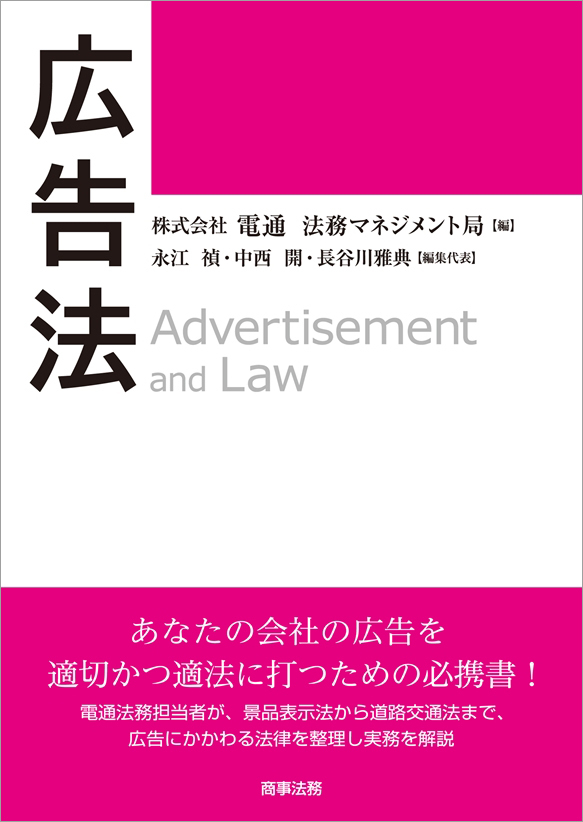
For more details, please refer to 'Advertising Law', which comprehensively explains the legal regulations related to advertising from both practical and theoretical perspectives.
Was this article helpful?
Share this article


Newsletter registration is here
We select and publish important news every day
For inquiries about this article
Back Numbers

Author

Masanori Hasegawa
Dentsu Inc.
Legal Management Bureau

