Note: This website was automatically translated, so some terms or nuances may not be completely accurate.
 The Future of Communication: Insights from AI Chatbots [2/7]
I tried making a talking ad while giving directions.
Car navigation systems (hereafter "car navi") are now indispensable in automobiles. In recent years, apps have emerged that allow smartphones to function directly as car navigation systems. These apps offer the latest map information and high functionality, leading to their gradual spread.
Some of these smartphone car navigation apps feature voice input capabilities, allowing drivers to operate them hands-free while driving. Specifically, functions like specifying destinations or switching map views can be controlled simply by giving voice commands.
While the input/output method differs (text vs. voice), these voice dialogue functions can also be considered a type of "chatbot."
Following our previous character chatbot, this time we introduce the process of creating a new advertising prototype that leverages voice interaction.
A Rough Explanation of "Talking Ads"
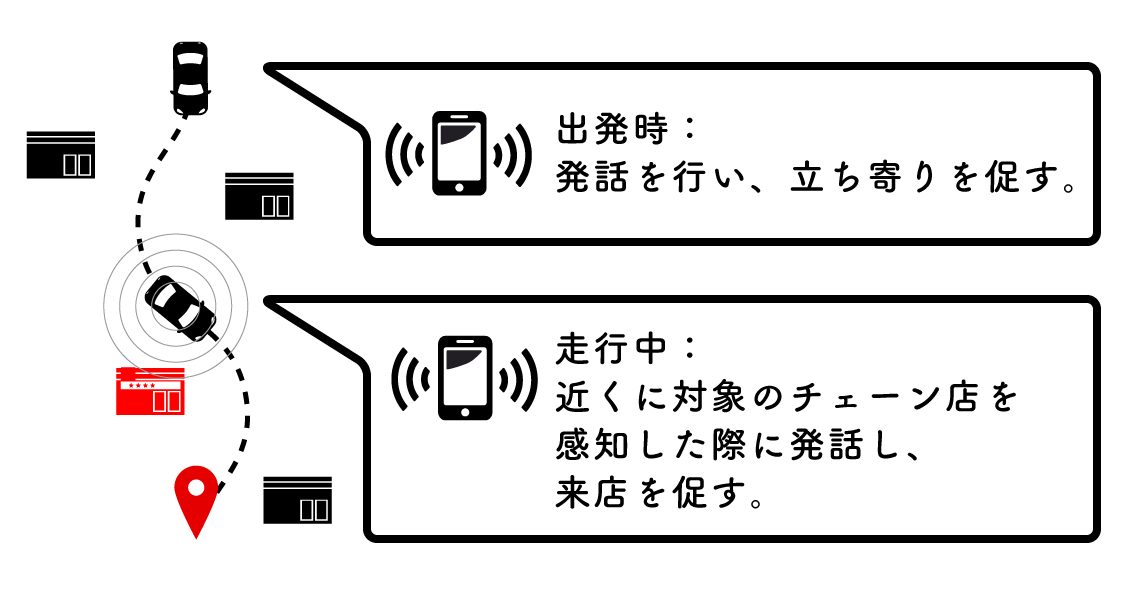
This trial was conducted in collaboration with a car navigation app provider. When drivers using the app approach partner stores along their route to a destination, the system delivers voice ads with special offers based on external data, aiming to attract them to the store (this trial partnered with a supermarket chain).
This audio ad incorporates a prototype of an interactive system currently under development by Dentsu Inc. The app asks the driver via voice whether they want to change the route to the nearest store. Upon the driver's verbal confirmation, the navigation begins.
The external data includes the date, weather and temperature information for that day, the time of day, and the driver's own attributes. Utilizing this data enables, for example, suggesting hot pot dishes on days that are significantly colder than the previous day and promoting ingredients for them, or introducing time-saving recipes to housewives on weekday afternoons. This achieves effective product promotion aligned with the listener's timely needs.
The service flow is as shown in the diagram below.
Four-Stage Production Process
We produced these audio ads through the following four-step process (①–④). We'll introduce each step along with some behind-the-scenes stories.
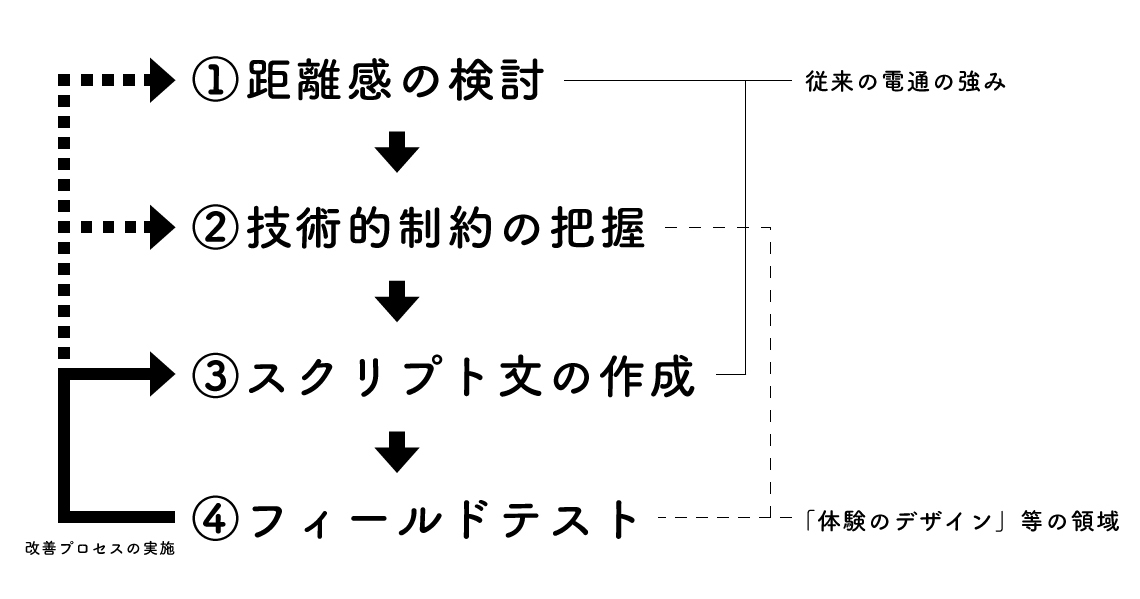
① Considering the Distance... Aiming for a "Radio-Like" Distance
Our first consideration was finding the right communication distance that fits into the context of daily life and connects appropriately with drivers.
Even if the information is a timely bargain, the recipient is driving. A one-sided ad that distracts from driving will likely be ignored or cause the user to leave the service.
As copywriter Takashi Nakahata aptly noted, "Advertising inherently starts from a negative stage where its purpose is fully exposed." Fundamentally, ads tend to be disliked. This remains true even with technological advances, making our challenge how to create communication that earns listeners' attention.
Our solution was to create a "radio-like" distance. Not overly assertive, not distracting from driving. On that basis, we aimed to provide small daily topics while engaging in conversational context that promoted the product, ideally leading to store visits. We developed dialogue scripts aligned with this approach.
Incidentally, Twitter is often noted for resembling radio interactions (*). My past experience writing copy for corporate Twitter accounts and Twitter campaigns—incorporating timely topics—proved valuable when crafting these scripts.
※Both share characteristics like "real-time, continuous information flow" and "occasional interactivity."
② Understanding Technical Constraints... Service Design Considering the Driving Environment
It might be surprising, but voice input while driving presents technical hurdles. Inside a car, the distance between the smartphone and the driver is significant. Crucially, driving noise—like engine sounds or radio audio—creates substantial background noise. Additionally, vibrations during motion significantly impact the system, making it difficult for the machine to focus solely on the necessary speech.
The longer the driver's utterance, the greater the impact of noise and vibration, increasing the likelihood of misinterpreting the input. Therefore, this system employs a conversational format where the driver responds with simple yes/no choices (accommodating variations in phrasing). Furthermore, a function to stop ads is included if the driver says "Stop" or "Turn it off."
Furthermore, as a fundamental principle, causing an accident due to speech would defeat the entire purpose. Therefore, we included precautions as prerequisites: disabling speech during particularly critical driving scenarios like turning right or left, and requiring the use of polite phrases like "May I have a moment?" before initiating speech.
③ Script Creation... Balancing Distance and Constraints
Within these technical constraints, we write script lines to provide topics with the "radio-like" distance mentioned earlier, using a format where conversation progresses with "Yes/No" responses.
We considered two approaches for the script:
【A】Speech that provides topics like "Today is [Event] Day" based on date data
【B】Speech that provides topics based on external data such as temperature or driver attributes
For example, here's an example for "February 3rd" using approach 【A】:
Today, February 3rd, is Setsubun.
Actually, Setsubun is determined by the sun's movement, so in 2025, it will be one day earlier on February 2nd.
So, how are your Setsubun preparations coming along?
〇〇 Mart has beans for bean-throwing and Ehomaki rolls ready for you.
Why not stop by your nearest 〇〇 Mart ☓☓ store?
Please answer "Yes" or "No".
If "Yes" →
We have set 〇〇 Mart ☓☓ Store as your destination. Voice guidance will begin. If "No " →
Understood. Drive safely.
Also, examples of "days when the minimum temperature falls below the previous day's low" based on approach [B] are as follows.
Cold days continue, don't they? To prevent colds, it's important to avoid weakening your immunity. Protein, in particular, is essential for strengthening immunity.
At 〇〇 Mart, we provide safe and reliable seasonal fish like salmon, tuna, and yellowtail. Sashimi and hot pot dishes are recommended. Why not stop by your nearest 〇〇 Mart ☓☓ Store?
Please answer with "Yes" or "No." (same below)
④ Field Testing... Verifying all elements and implementing the PDCA cycle
After reviewing the script text, we conduct actual field tests on the road. Under conditions identical to those experienced by general drivers using the app, we verify various elements such as the timing, frequency, length, and reading speed of voice prompts.
Testing revealed unforeseen issues: unexpected delays in speech timing, excessive (or insufficient) frequency, overly long text, and other challenges not anticipated beforehand.
To address these issues, we analyzed recordings and logs to pinpoint causes each time and made corrections. We then retested on the road, improving through the PDCA cycle.
Following this process, we conducted a field trial. From late January to late March, we invited app users to participate in the trial. Over the period, approximately 5,000 users who granted permission to use the service made over 30,000 speech utterances. Drivers who heard the script were about 2.3 times more likely to stop at the target chain's stores compared to those who did not.
Further Potential of "Talking Ads"
As this was our first trial, the focus was on establishing the foundational mechanisms. However, potential future developments could include the following three directions:
1. Precise Recommendations Through Integration with External Data
This trial used attributes registered in the app and date/temperature data for speech-based recommendations. Linking to external data held by client companies could enable more precise recommendations.
For example, linking to purchase data could suggest recipes utilizing leftover vegetables bought the previous day or prompt replenishment when toilet paper is running low.
2. Increased Convenience and Platformization Through Multi-Client Implementation
While this trial only provided information from one supermarket chain, expanding to multiple clients would allow for more savings information to be offered, significantly increasing convenience for drivers.
As convenience increases, user numbers will grow, making it an attractive platform for clients. In this case, as the platform provider, it will be necessary to coordinate the timing of messages to be acceptable to all clients and establish rules for handling duplicate messages.
3. Optimization for Each User Through Continued Use
Although we collected user usage logs this time, the short trial period meant they had little impact on recommendation content. Improvement is possible here.
For example, we could switch to more intimate scripts for users who consistently engage in daily conversations, or adjust speaking times to days and hours when users are more likely to respond.
Dentsu Inc.'s existing strengths + something extra are needed
The greatest advantage of voice-input chatbots is reducing the effort of "input," making them easier to integrate into the context of daily life.
However, factors like the content of the utterance, the timing, or discrepancies with the expected response can cause discomfort for users, potentially pulling the interaction out of the natural context of their lives. Furthermore, in the case of advertising, which is already inherently disliked, even greater caution is required.
Beyond the car navigation app example, similar communication design principles will be essential for smart speakers like Amazon Echo, Google Home, Apple HomePod, and LINE's Clova WAVE, which are expected to see increased adoption.
This is where Dentsu Inc.'s accumulated expertise in copywriting and communication design can be leveraged.
Beyond that, we believe it is essential to effectively integrate insights from seemingly unrelated fields, such as 'experience design,' with Dentsu Inc.'s existing expertise.
Was this article helpful?
Share this article


Newsletter registration is here
We select and publish important news every day
For inquiries about this article
Author

Kishimoto Kazuya
Dentsu Inc.
Dentsu Lab Tokyo
Creative Technologist / Communication Designer
After working in cross-media marketing analysis and planning, I transferred to the Creative Bureau. Through surveys, planning, and prototyping, I explored "wrong" ways to use technology. In recent years, I've focused primarily on projects involving generative AI and sound/music.