Note: This website was automatically translated, so some terms or nuances may not be completely accurate.
 Japan Brand Survey 2018: Suggestions for "Business Targeting Inbound Visitors" [6/8]
What Japanese products would you like to buy? And why?
The number of international tourists visiting Japan has been increasing year by year, reaching a record high in 2017.
Furthermore, 2019 saw the Rugby World Cup, 2020 hosted the Tokyo Olympics and Paralympics, and 2021 welcomed the World Masters Games Kansai, marking the "Golden Sports Years."
These major sporting events are expected to further increase the number of foreign visitors to Japan and stimulate more active initiatives by government, local authorities, and companies. Amidst this, how is Japan perceived globally?
In which countries and regions is the intention to visit Japan growing, and for what reasons? Furthermore, how is "Made in Japan" currently perceived? Dentsu Inc.'s "Team Cool Japan" conducted the "Japan Brand Survey 2018" in 20 countries and regions worldwide from January to February 2018.
This series introduces survey findings that will be key points for future businesses targeting visitors to Japan. Part 6 focuses on "The Image of Japanese Products," analyzing what kinds of Japanese products people overseas are seeking.
Q: What is the image of Made in Japan (Japanese products)?
A: They hold a high-quality image centered on functionality, such as "high-tech," "reliable," and "high performance."
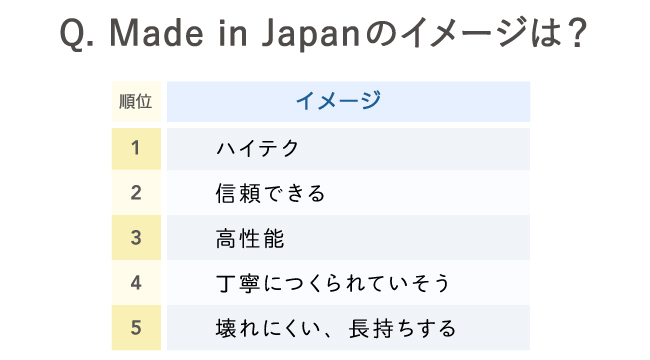
Images related to functionality and quality, such as "high-tech" and "reliable," ranked highly. Compared to neighboring countries like South Korea and China, Japanese products receive particularly high evaluations in these areas.
While Japanese characters and culture are gaining recognition, especially in Asia, the image of "Made in Japan" remains strongly associated with mechanical products like home appliances, cars, and AV equipment.
Q: What do you prioritize when purchasing items?
A "Good quality" ranked nearly top across all categories.
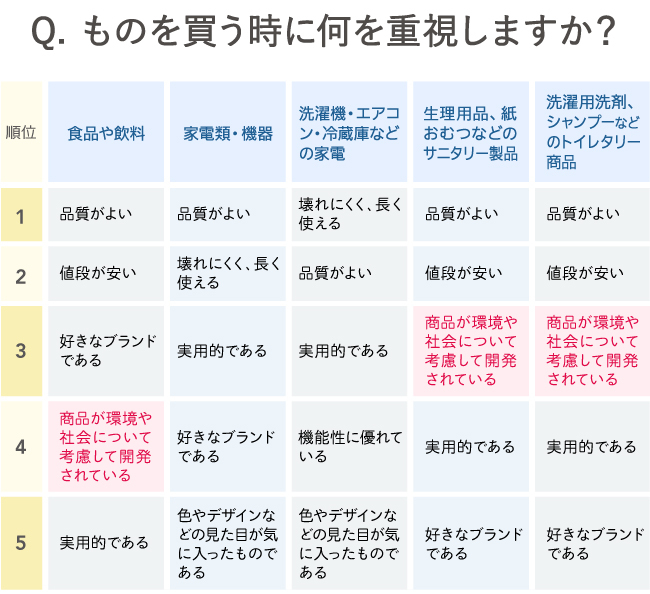
For home appliances, "durable," "practical," and "color/design" ranked highly. For food and daily necessities, "affordable price" and "consideration for the environment and society" ranked highly.
"Good quality," which also scored highly in the image of Made in Japan products, ranks high across all categories. This suggests the strength of Japanese products can be leveraged.
Meanwhile, for sanitary and toiletries products, the issue perspective "developed with environmental and social considerations" ranked in the top 3 after price, and also ranked 4th for food and beverages. Beyond just CSR (Corporate Social Responsibility) perspectives, consideration for the environment and society is becoming necessary as a marketing strategy and for corporate and municipal initiatives.
Overview of the Japan Brand Survey 2018
● Purpose: To understand overseas consumers' perceptions and actual behavior regarding the overall "Japan Brand" encompassing Japanese food, tourism, and Japanese products, thereby supporting corporate marketing activities.
●Target Areas: 20 countries and regions
China (Group A = Beijing, Shanghai, Guangzhou; Group B = Shenzhen, Tianjin, Chongqing, Suzhou, Wuhan, Chengdu, Hangzhou, Dalian, Xi'an, Qingdao), Hong Kong, Taiwan, South Korea, India, Singapore, Thailand, Indonesia, Malaysia, Vietnam, Philippines, Australia, USA (Northeast, Midwest, South, West), Canada, Brazil, UK, France, Germany, Italy, Russia
※East Asia (China, Hong Kong, Taiwan, South Korea)
※ASEAN (Singapore, Thailand, Indonesia, Malaysia, Vietnam, Philippines)
●Survey Method: Internet survey
●Respondent criteria: Men and women aged 20-59 in the middle-income bracket and above
※Definition of "middle-income": Conditions set per country based on national average income (OECD statistics, etc.) and social class classification (SEC)
●Sample size: China: 300 each for A and B groups, total 600; USA: 600; Other regions: 300 each, total 6,600
●Survey Period: January 12 to February 16, 2018
Dentsu Inc. Team Cool Japan
A cross-functional project team established by Dentsu Inc. to promote 'Cool Japan-related initiatives'—expanding products and services leveraging Japanese culture and strengths into overseas markets. It brings together client company representatives handling overseas expansion, media and content specialists, overseas subsidiary network managers, producers, and planners to undertake efforts promoting Japan's appeal globally.
Was this article helpful?
Share this article


Newsletter registration is here
We select and publish important news every day
For inquiries about this article
Back Numbers
Author
Tomoko Matsumoto
Dentsu Inc.
Third Integrated Solutions Bureau
Planner