
Note: This website was automatically translated, so some terms or nuances may not be completely accurate.
 Business Solutions for an Ultra-Aged Society [1/4]
How should we approach business solutions for the challenges of a super-aged society?
Tetsu Saito
The "Super-Aged Society" as a New Business Opportunity
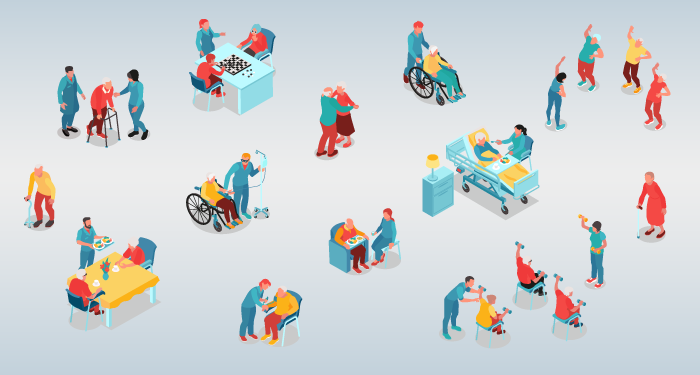
As many of you likely already know, Japan is the most rapidly aging country in the world. As of 2018, Japan's aging rate (the percentage of the population aged 65 and over) stood at 28.1%. Nearly one-third of the population is elderly. This aging trend will accelerate further. By 2060, nearly 40% of the population is projected to be elderly, with the most significant increase occurring among the late elderly (aged 75 and over).
Generally, as people enter the late elderly stage, many begin to experience impairments or discomfort in various physical functions. The proportion reporting symptoms such as poor eyesight, hearing difficulties, and back or knee pain increases. The rate of serious conditions caused by hypertension, diabetes, and other diseases also rises. Furthermore, the likelihood of requiring nursing care due to declining physical and cognitive functions increases, as does the risk of encountering unforeseen accidents like falls, choking, and traffic accidents.
The growing number of elderly inevitably leads to social challenges stemming from aging. This column argues that we should tackle these social challenges as a business opportunity.
The Significance and Rationale for Addressing Aging Society Issues as "Business"
Until now, the primary entities tackling these elderly challenges have been government agencies, local authorities, medical corporations, social welfare organizations, and NPOs. Funding for these activities has primarily come from taxes and social insurance premiums, such as social security benefits. However, as Japan's population declines and transitions into a mature economic growth phase, relying solely on these funding sources will reach its limits. Rather, what is now required in Japan is to boldly challenge these issues, viewing them as business opportunities.
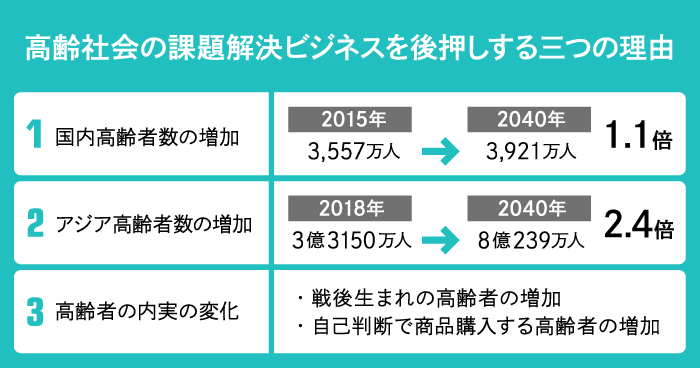
Three main reasons underpin this business opportunity. First is the absolute increase in the elderly population. Currently at 35.57 million (2018), this number will rise by 3.6 million to 39.21 million by 2040. It is the only sector growing within a shrinking population. While not all elderly face significant challenges, viewing this as a potential market for addressing challenges is certainly valid.
Second is the fact that aging is progressing similarly not only in Japan but worldwide. This trend is particularly pronounced in developed nations and across Asia. Asia's elderly population, currently 331.5 million (2015), is projected to increase 2.4-fold to 802.39 million by 2040 (UN estimates).
If the Japanese market, which is leading in aging, can create new business models and products to solve elderly challenges, it holds significant potential to connect to the global market. The seeds of such businesses are already beginning to sprout. I plan to introduce specific examples in the third installment of this series.
The third reason is the changing nature of the elderly population itself. While the number of seniors is increasing, their composition differs from today's. Those entering old age in the future are the post-war generation, including the baby boomers. They grew up alongside Japan's high economic growth from the time they became aware of their surroundings. Unlike those born before the war, who tended to value thrift and frugality as virtues, the post-war generation knows the joy of consumption.
Until now, many products and services for the elderly were often chosen not by the seniors themselves, but rather purchased for them by their sons or daughters. From now on, however, the seniors' own discernment will be key. If products and services can be developed that meet their demanding standards, the possibilities will expand significantly.
The scope of responses to aging society challenges varies greatly
While I began by framing the challenges of an aging society in broad terms, the actual scale and scope of these challenges vary considerably. Developing services and products from a "preventive" perspective—supporting minor difficulties in daily life and preparing for future deterioration—is one solution. Building community support systems to assist individuals when maintaining healthy daily or social lives becomes difficult also falls within this category of "community-based solutions."
Of course, approaches like preventing traffic accidents, rescuing elderly victims during disasters, and supporting the daily lives of seniors with dementia are also key themes in addressing the challenges of an aging society.
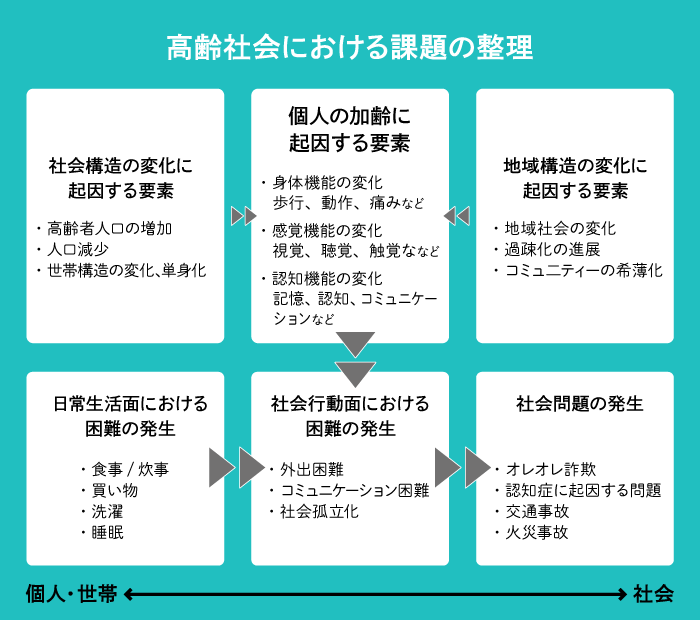
Social issue themes can broadly be divided into three layers: individual, community, and society. ① An increasing number of individuals face difficulties in daily life due to aging (physical function, sensory function, cognitive function). ② Changes in their surrounding environment (increased single-person households, population decline, depopulation, etc.) compound these difficulties, leading the community itself to face various challenges (shopping refugees, community disappearance). Furthermore, at the national level, social issues stemming from aging are proliferating (increased traffic accidents involving seniors, more missing persons due to dementia). Social challenges thus arise at each of these levels: individual, community, and society.
Of course, there are numerous other challenges requiring solutions. First, let's consider which of these challenges we should tackle as our theme. It could be an issue you've personally encountered, or articles featured in newspapers and news reports can also help cultivate an awareness of these challenges.
That concludes our first session on the overall landscape of problem-solving businesses in a super-aged society. Next time, we'll discuss how to identify challenges as business themes and connect them to business development.
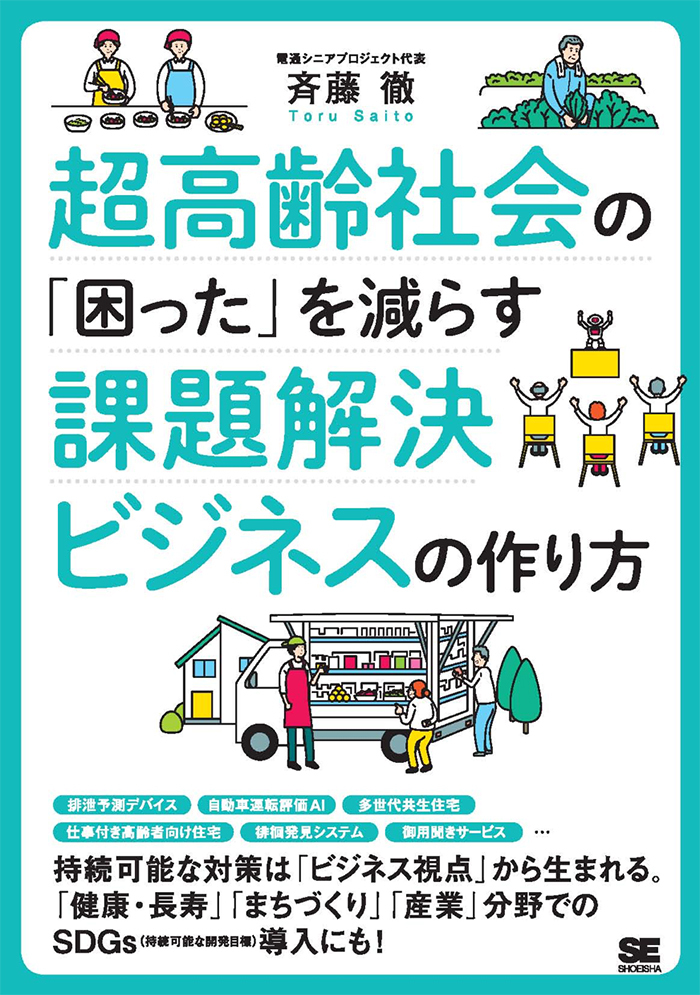
I would be delighted if you could also take a look at the book, "How to Create Problem-Solving Businesses to Reduce the 'Troubles' of a Super-Aged Society. "
Was this article helpful?
Share this article


Newsletter registration is here
We select and publish important news every day
For inquiries about this article
Author