
Note: This website was automatically translated, so some terms or nuances may not be completely accurate.
 Business Solutions for an Ultra-Aged Society [2/4]
How can we discover and develop the seeds of businesses that solve the challenges of a super-aged society?
Tetsu Saito
In the first installment of the "Business Solutions for an Ultra-Aged Society" series, we discussed the overall landscape of an ultra-aged society and the significance of tackling it as a business. This time, we introduce how to turn this into a business.
How to Discover Seeds for Problem-Solving Businesses
While numerous social challenges exist in a super-aged society, the first step is deciding which theme to target and pursue for business development. A key point in theme selection is choosing a theme as close as possible to your own industry, business model, or area of interest – something that might seem obvious.
In my book, Creating Problem-Solving Businesses to Reduce the "Troubles" of a Super-Aged Society, I interviewed over 20 venture companies. What they consistently cited as the starting point for their business ideas were the daily challenges they or their parents faced, or customer issues encountered while running their businesses. It's fair to say that these were real-life problems they personally encountered, not theoretical abstractions, which made their commitment to solving these problems genuine. In that sense, the first place to explore is likely your own industry and business model.
That said, cases where technological seeds drive problem-solving efforts are certainly possible. However, when proceeding with technology-seed-driven approaches, it becomes crucial to thoroughly understand the target market, as we will discuss later.
Approach to Problem-Solving Business Methods
Once the problem theme is defined, the next step is to consider specific methods for solving it. The fact that a problem is apparent means it has not yet been solved. There may also be cases where the solution is clear, but some obstacle prevents its implementation. These obstacles can stem from systemic issues, financial or human resource constraints, or technological challenges. By breaking down the nature of these obstacles, we can find a starting point for solving the problem.
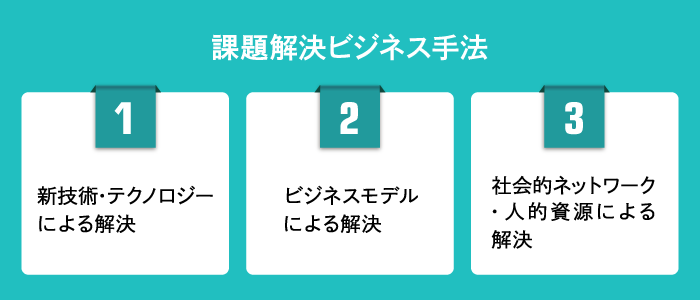
Several approaches can be considered for solution methods.
One approach is leveraging technology and innovation. Solutions may be found by utilizing rapidly advancing technologies like IoT/sensors, AI, and robotics.
Traditional problem-solving methods have largely relied on manual labor (e.g., finding missing dementia patients through training dementia supporters or forming agreements with local convenience stores and post offices). However, this inevitably involves constraints, such as building cooperative frameworks within the community. This approach aims to efficiently solve problems by effectively utilizing technology. While this type of solution requires technical expertise and involves disadvantages like costly and time-consuming prototyping, it opens up significant potential for overseas business expansion.
The second approach involves developing new business models. For instance, many services in the caregiving industry still follow models established before the introduction of long-term care insurance in 2000. I feel there remains considerable room for developing new services in this field.
The final approach involves solving problems by reconfiguring local community networks. Social issues in an aging society primarily arise within households and local communities. However, alongside aging, these communities are also experiencing population decline, pushing mutual aid systems to the brink of collapse. Attempts to rebuild these fading mutual aid systems as part of business operations represent a meaningful theme, particularly from the perspective of revitalizing social capital.
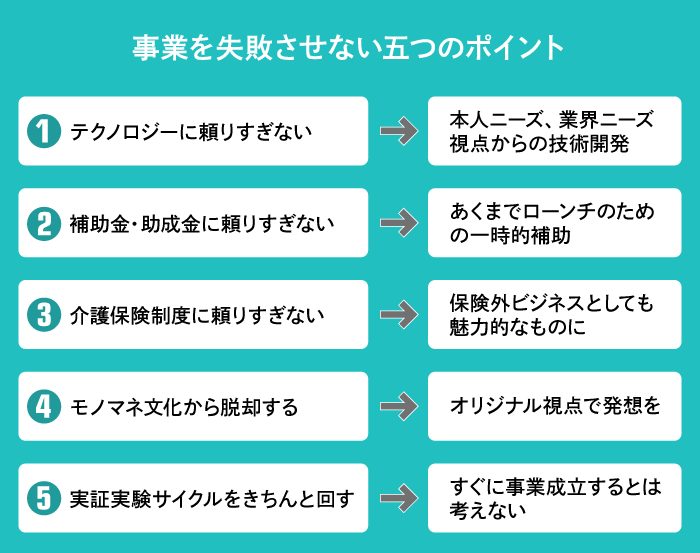
Key Points to Avoid Failure in Problem-Solving Business
Looking back at the history of the senior market, there are numerous examples where attempts to tackle challenges did not succeed. It is crucial to learn from these past failures while maintaining a mindset of continuing to challenge.
The most common reason for failure is development proceeding without sufficient consideration for user acceptance. Several "monitoring services" exemplify this. Many companies have attempted services that use sensors or communication technology to monitor distant parents, yet few have succeeded. This is because while children want to monitor their parents, the parents themselves often feel they don't want to be monitored. Proceeding with business based on a one-sided misconception like "seniors are..." without understanding this mindset is dangerous.
Other key points include breaking free from subsidy-dependent business models, reducing overreliance on the long-term care insurance system, moving beyond imitation culture, and properly executing proof-of-concept cycles.
Considering Business Models
If the solution doesn't operate within economic mechanisms, it falls under volunteering or social contribution, not "business." Therefore, the question becomes how to offer products or services that gain customer support and generate profit in the market. The first consideration here is: "Is the price something the beneficiary can afford to pay?"
The reality is that the elderly are not as affluent as younger people generally assume. Pricing is critically important. For instance, if targeting individual households proves difficult, targeting business needs should be considered as an alternative option.
Furthermore, the most crucial point to emphasize is whether the service or product brings joy to the elderly themselves, their families, or other stakeholders.
It's not just about solving a problem; it's about the solution bringing joy, happiness, or pleasure to the person themselves or someone else. That's where people find value and become willing to pay. Product and service development that doesn't lose sight of this is what's needed.
Was this article helpful?
Share this article


Newsletter registration is here
We select and publish important news every day
For inquiries about this article
Back Numbers

Author